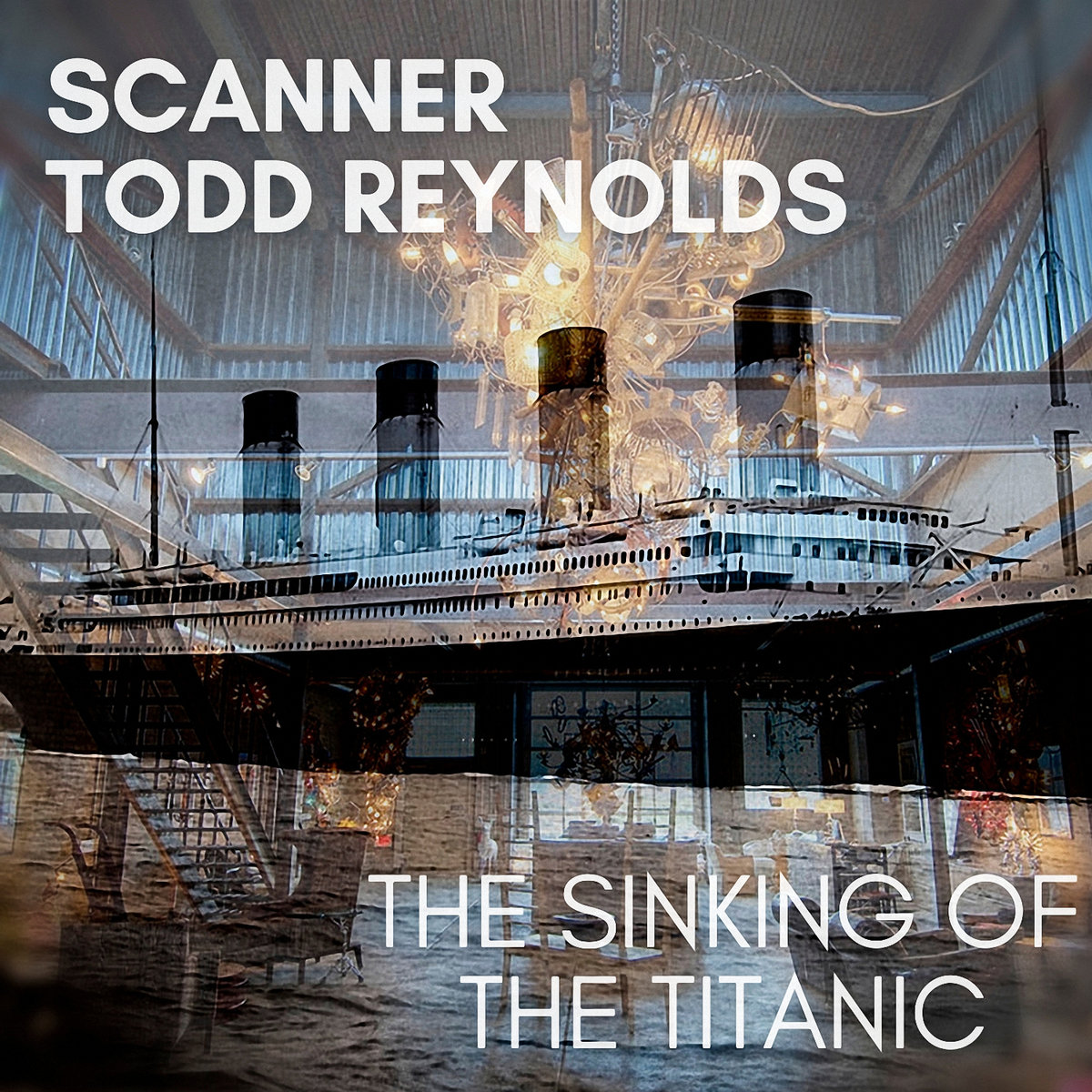
Robin Rimbaud, aka Scanner, writes on his Bandcamp site:
Back in February 2007, I was invited to perform with my friend Todd Reynolds for the opening of the new season for Peregrine Arts in Philadelphia. It was a low key event, as I was about to present my museum performance/installation work, The Order of Things, at the Wagner Free Institute of Science in the same city in the following days.
Bahdeebahdu is an eclectic establishment in Philadelphia, PA that offers a unique blend of art, design, and creativity. It was an extraordinary space, filled with sculptures constructed almost entirely from everyday objects that the owner Warren Muller collected on regular pilgrimages to flea markets, junk stores and so on.
Todd and I set up in this remarkable space and performed an intimate interpretation of the classic work from British composer Gavin Bryars, The Sinking of the Titanic.
For years Todd has been violinist of choice for contemporary artists such as Steve Reich, Meredith Monk, and Bang on a Can, and he’s also a founder of the string quartet known as Ethel. He’s also collaborated with artists like Yo-Yo Ma, Todd Rundgren, Joe Jackson, Mark Mothersbaugh, and even Bruce Springsteen!
It has been remixed and remastered for this 2025 release. Purchase options are below:
James McVinnie (organ), BBC Symphony Orchestra / Thomas Adès
Sibelius The Swan of Tuonela Op.22/2 (1893, rev. 1897 & 1900) Gabriella Smith Breathing Forests (2021) [UK Premiere] Adès Five Spells from The Tempest (2022) [Proms premiere] Sibelius The Tempest – Suite No. 1, Op. 109 No. 2 (1925-6, arr. 1929)
Royal Albert Hall, London Tuesday 2 September 2025
Reviewed by Richard Whitehouse Photos (c) BBC / Andy Paradise
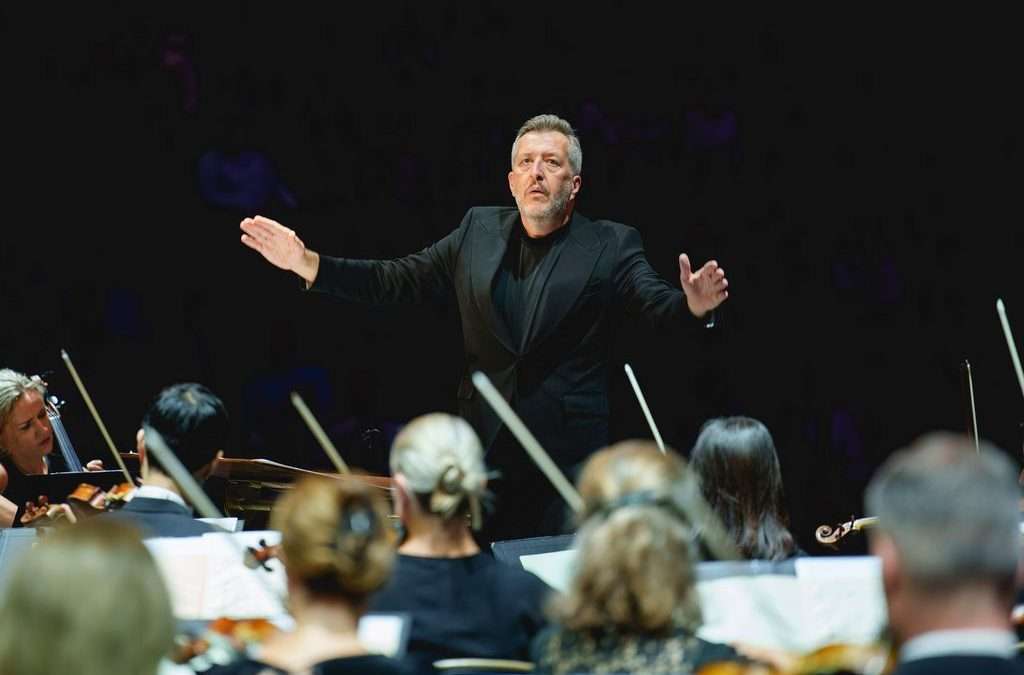
Having worked across the board with orchestras in London (and elsewhere), Thomas Adès tonight conducted the BBC Symphony Orchestra in what, for his ninth Prom as a conductor, was a typically imaginative programme that centred on concepts of nature and the elements.
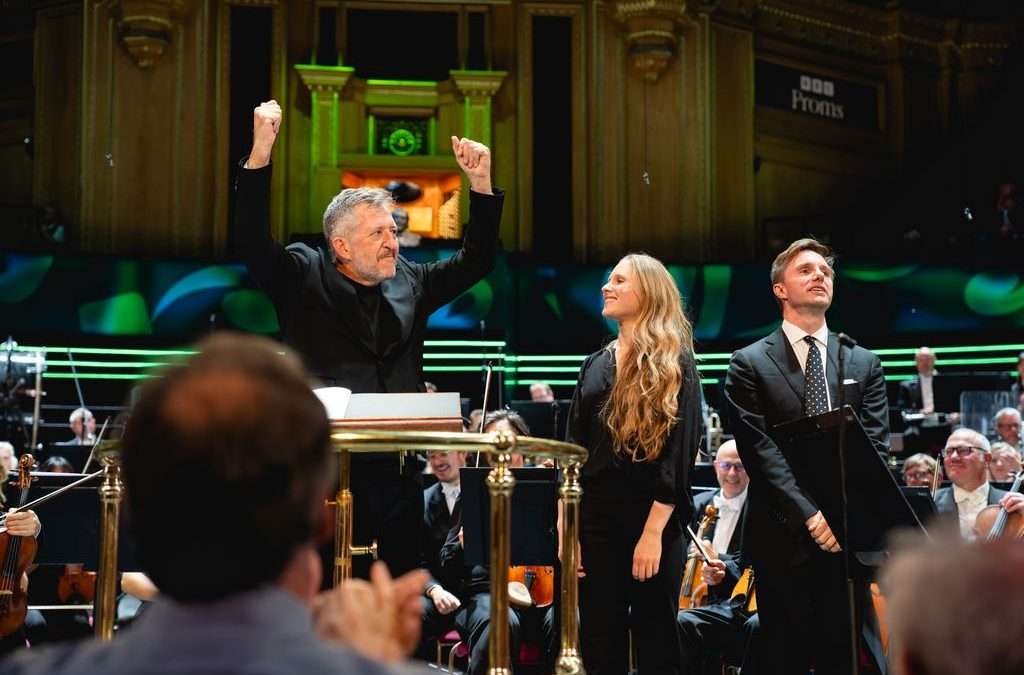
A concept, moreover, whose primary focus was Breathing Forests – an organ concerto by the American composer Gabriella Smith (below). She herself has described this work as ‘‘a reflection on the complex relationship between humans, forests, climate change and fire’’; one that unfolds across three interconnected movements and whose evoking the fast-slow-fast archetype belies its overall ingenuity. The opening Grow picks up on Ligeti’s ‘op-art’ pieces of the late 1960s as it pulsates gently if insistently into life, then the central Breathe draws from the interplay of soloist and orchestra a variety of methodically evolving textures; given emotional impetus in the final Burn as it builds to a climax which spatially engulfs the whole ambience, though its continuation towards a clinching apotheosis sounded just a little gratuitous in this context.
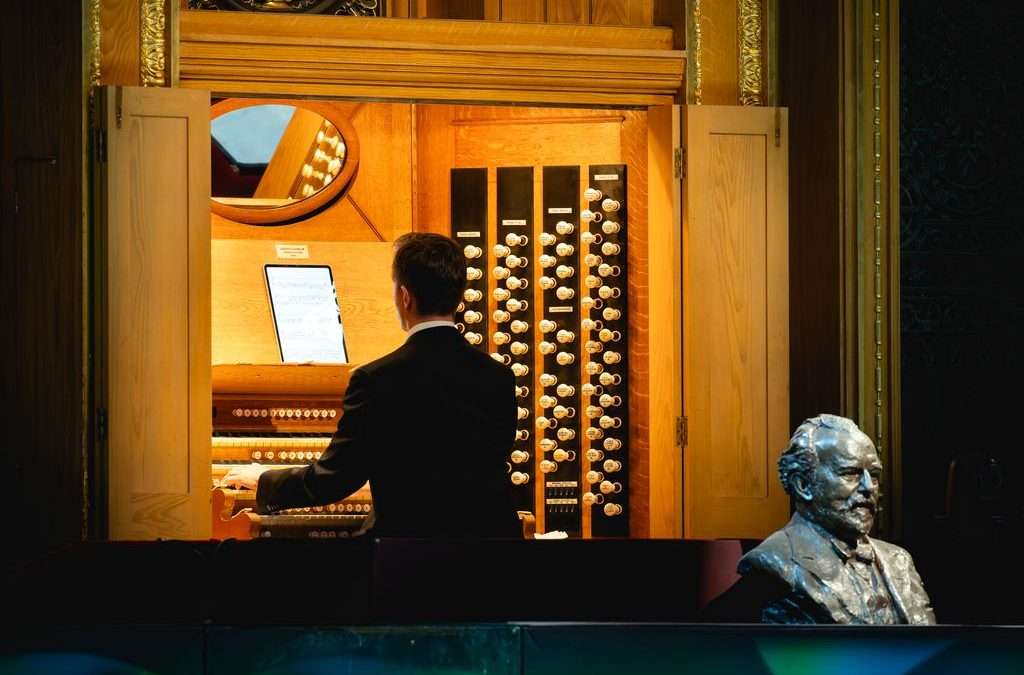
What was never in doubt was the sheer dexterity of James McVinnie (below) in conveying the power and poetry of the solo part, to which the BBCSO’s contribution was scarcely less visceral. As musical representation of the natural world in time of crisis, this piece more than left its mark.
Adès as composer was featured after the interval with Five Spells from ‘The Tempest’, a suite drawn retrospectively from his eponymous opera. This ranges widely over the parent work – beginning, not unreasonably, with its Overture such as depicts the play’s opening storm in guardedly elemental terms. From there it heads into Ariel and Prospero, akin to a scherzo where the contrasting characters of the two protagonists are vividly played off against each other. A more nuanced juxtaposition is evident from Ferdinand and Miranda, its inherently amorous nature conveyed with due reticence, then The Feast affords a culmination of sorts with its stealthy interplay of character-imbued motifs. The end comes, naturally enough, in Prospero’s Farewell – Caliban with the music evanescing in the most equivocal of terms.
The programme was framed with music by Sibelius – opening with The Sawn of Tuonela as emphasized the music’s hieratic poise and fatalistic aura, as did those eloquent contributions from cor anglais and cello. Maybe Adès will one day tackle the whole Lemminkäinen Suite?
The First Suite from Sibelius’s compendious score for The Tempest opens with the searing evocation The Oak Tree which was a little underwhelming here, though there was nothing amiss in the characterful Humoreske or in Caliban’s Song with its telling bizarrerie. The Harvesters is a reminder of Sibelius’s innate gift for light music at all stages in his career, as also the animated Canon and insinuating Scene; to which the plangent Intrada/Berceuse then the ominous Interlude/Ariel’s Song provide startling contrasts. The truncated Prelude follows on seamlessly through to its decidedly abrupt end. Right through this sequence, the BBCSO was always attuned expressively and, while a sense of the music as teetering on the edge of some greater catastrophe was minimal, there was no denying Adès’s insight overall.
On September 12th, Sony Classical releases Fortissima, the new double album by cellist Raphaela Gromes with the Deutsches Symphonie-Orchester Berlin (DSO), conducted by Anna Rakitina and featuring Julian Riem on piano:
The album is a compelling collection of numerous world premiere recordings featuring works by neglected women composers. Their remarkable life stories can also be discovered in the book by Raphaela Gromes and Susanne Wosnitzka, published simultaneously in German by Random House. Fortissima is an inspiring musical document celebrating strong women figures who pursued their dreams under adverse conditions and refused to be held back by prescribed societal roles.
“Fortissima is about role models, for everyone, but especially for young women,” states Raphaela Gromes. “The stories of these artists are about personal integrity, the longing for freedom, and irrepressible creativity. It’s not just about outstanding music, but deeply inspiring personalities.”
Raphaela Gromes has been researching the music of women composers for more than five years. Her successful 2023 album ‘Femmes’ was already a result of this work. “In my education and career, I hardly ever came into contact with the music of female composers, and yet there is so much extraordinary music to discover,” explains Raphaela Gromes. “I want to help make these works more widely known and hope they will one day become part of the standard repertoire.”
The first half of the double album is dedicated to compositions for cello and piano by Henriëtte Bosmans, Victoria Yagling, Emilie Mayer, Mélanie Bonis, and Luise Adolpha Le Beau, complemented by an arrangement of All I Ask by Adele. The second half features cello concertos by Maria Herz and Marie Jaëll, a ballade for cello and orchestra by Elisabeth Kuyper, two newly composed orchestral works Femmage I and Femmage II by Rebecca Dale plus an orchestral arrangement of P!NK’s Wild Hearts Can’t be Broken.
Raphaela Gromes was inspired to record Maria Herz’s cello concerto by the composer’s grandson, Albert Herz, who contacted her following a radio programme about her 2023 album ‘Femmes’, which placed women composers firmly in the spotlight. Maria Herz, born in Cologne in 1878 into the Jewish textile dynasty Bing, was forced to flee Nazi Germany and initially lived in England, later in the United States. She left her grandson a large box full of compositions, letters, and pictures, in which the forgotten cello concerto was found. Gromes was instantly captivated upon first browsing the score: the cello leads through an exciting movement with virtuosic solo cadenzas, dense harmonically complex passages, and a jubilant final stretta that evokes the Jewish dance ‘Freylekhs’. Herz began composing after the birth of her four children and, following the death of her husband, sometimes published under a male pseudonym.
The struggle to gain recognition as a female musician and composer was shared by contemporaries Marie Jaëll, born 1846 in Alsace as Marie Trautmann, and Elisabeth Kuyper, born 1877. Although Marie Jaëll was hailed as a musical prodigy and toured across Europe as a child piano virtuoso, a career as a composer largely eluded her. She received private tuition from César Franck and Camille Saint-Saëns and, as personal secretary to Franz Liszt, edited and completed several of his works. Liszt aptly summarised her situation: “A man’s name above her music, and it would be on every piano.” Her virtuosic and moving cello concerto is considered the first such work by a woman and is dedicated to her late husband. Elisabeth Kuyper became the first woman to win the Mendelssohn Scholarship (1905) and was appointed composition lecturer in 1908 in Berlin, another first. Yet a lasting career as a composer and, especially, conductor, was denied her. She subsequently founded several women’s orchestras – in Berlin, London and the USA – all of which eventually failed due to lack of funding. Kuyper died impoverished and forgotten in Ticino. Many of her works are considered lost, including her Ballade for Cello and Orchestra, which Julian Riem reconstructed from a surviving piano score.
Emilie Mayer, born in 1812, and Luise Adolpha Le Beau, born in 1850, were fortunate to gain recognition as composers during their lifetimes. Mayer’s works were performed at the Konzerthaus Berlin, including for King Friedrich III. She had to finance both the performances of her works and their publication herself, which was only possible thanks to an inheritance from her father. The Sonata in A major for Piano and Cello is one of ten surviving cello sonatas. Luise Adolpha Le Beau was supported early on as a pianist by her parents and received lessons from Clara Schumann. She was the first woman to study composition under Josef Rheinberger in Munich and first gained attention for her compositions in 1882 with her Five Pieces for Violoncello Op. 24. The cello sonata Op. 17, recorded by Raphaela Gromes, was even recommended by an all-male jury as a “publishable enrichment.” Henriëtte Bosmans, born in 1895, also received some recognition as a composer in her homeland of the Netherlands, although she was better known as a pianist and, after the war, as a music journalist. Due to her Jewish heritage, she was forced to go into hiding during the Nazi regime and succeeded in rescuing her mother, who had been deported to a concentration camp. Her cello sonata was originally commissioned for the cellist Marix Loevesohn and was composed after the First World War.
Many of the early female composers were initially instrumentalists – a description that particularly applies to Victoria Yagling, a true star cellist. Born in 1946 in the Soviet Union, she studied with Rostropovich and won major competitions. Censorship in the USSR hindered her creative work, and it was only in 1990 that she was able to emigrate to Finland, where she became a highly respected professor. In an era when, in some circles, working as a female musician was equated with prostitution, Mélanie Bonis, born in 1858 in Paris, had to fight even for piano lessons. Exceptionally talented, she was eventually admitted to the Paris Conservatoire at the age of twelve to study with César Franck. Oppressed by her parents and forced into marriage, she suffered from severe depression during the final 15 years of her life. Yet it was during this period that she composed the delicate piece Méditation, which her granddaughter discovered in 2018 in an attic.
Three contemporary works are included on ‘Fortissima’: Femmage I and II were composed especially for Raphaela Gromes by British composer Rebecca Dale (b. 1985). In the reflective, cinematic ‘She walks through History’, Dale places a sweeping melody at the centre to highlight the vocal expressiveness of Raphaela Gromes’ cello playing. In ‘Meditation’, Dale unfolds a harmonically fascinating sound spectrum, with the cello solo rising from its lowest register to extreme heights. The adaptation of Adele’s ‘All I Ask’ pays tribute to one of the greatest soul voices and songwriters of our time, while P!NK’s ‘Wild Hearts Can’t be Broken’ holds special personal significance for Raphaela Gromes. The lyric “My freedom is burning, this broken world keeps turning, I’ll never surrender, there’s nothing but a victory. This is my rally cry.” could also serve as a motto for the women composers featured on the album.
As part of the album’s production, three new sheet music editions were also created: Henriëtte Bosmans’ cello sonata will be published by the renowned Henle Verlag. Marie Jaëll’s cello concerto, now including a newly discovered second movement recorded for the first time on this album, will be published in an edition by Julian Riem at furore Verlag. Elisabeth Kuyper’s Ballade for Cello and Orchestra, whose original score is lost, has been newly orchestrated by Julian Riem and Raphaela Gromes from the surviving piano version and will be published by Boosey & Hawkes.
‘Fortissima’ is released on September 12th by Sony Classical.
TRACKLIST:
CD 1 (feat. Julian Riem, piano)
1. – 4. Henriëtte Bosmans: Cello Sonata in A Minor
5. Victoria Yagling: Larghetto
6. – 9. Emilie Mayer: Cello Sonata in A Major
10. Mélanie Bonis: Méditation
11. – 13. Luise Adolpha Le Beau: Cello Sonata in D Major, op. 17
14. Adele: All I ask
CD 2 (feat. Deutsches Symphonie-Orchester Berlin, conductor: Anna Rakitina)
1. – 4. Marie Jaëll: Cello Concerto in F Major
5. – 11. Maria Herz: Cello Concerto Op. 10
12. Elisabeth Kuyper: Ballad for Cello and Orchestra, op. 11
13. Rebecca Dale: Femmage I – She Walks Through History
14. Rebecca Dale: Femmage II – Meditation for Cello & Orchestra
15. P!NK: “Wild Hearts Can’t Be Broken”
Published post no.2,644 – Thursday 4 September 2025
by Ben Hogwood Picture by Sl-Ziga, used from Wikipedia
Last week we learned of the sad news that Russian composer Rodion Shchedrin had died at the age of 92. You can read a brief obituary of him at the Guardian website.
Shchedrin was a colourful orchestrator, and my occasional encounters with his music were rarely less than entertaining. One that particularly stands out was his Piano Concerto no.4, a broad canvas of dazzling virtuosity and exotic harmonies.
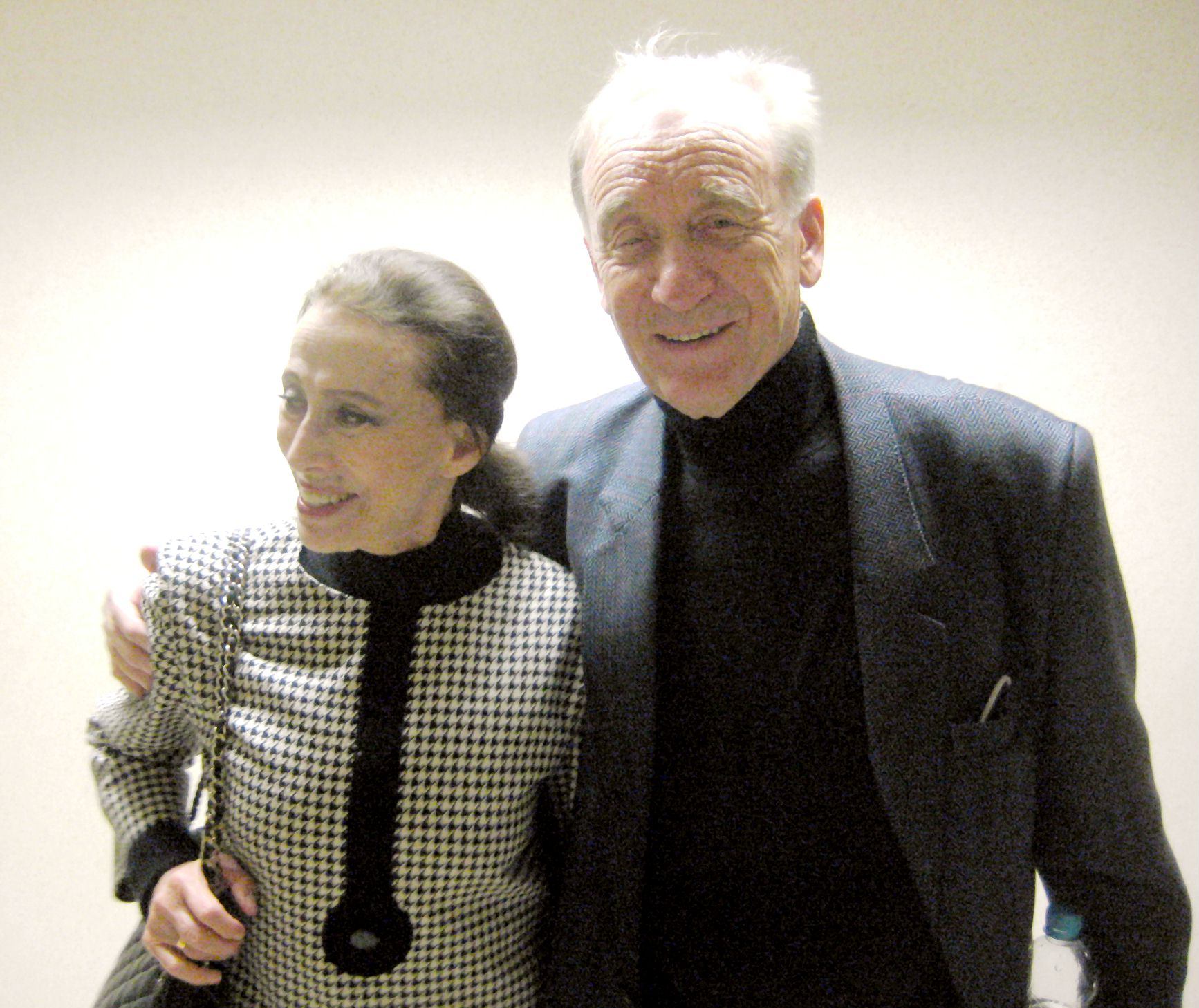
Meanwhile on record the orchestral colour is always evident in his Carmen Suite ballet, an arrangement and enhancement of Bizet’s music with percussion to the fore. His Concertos for Orchestra are also full of original thoughts, while the ballet Anna Karenina – an illuminating score – is a standout work, written for his ballerina wife Maya Plisetskaya (above, with Shchedrin).
The playlist below brings the first Concerto for Orchestra, Naughty Limericks, as an overture to the Piano Concerto no.4 and the Carmen Suite. Added to that is the Anna Karenina ballet in full.
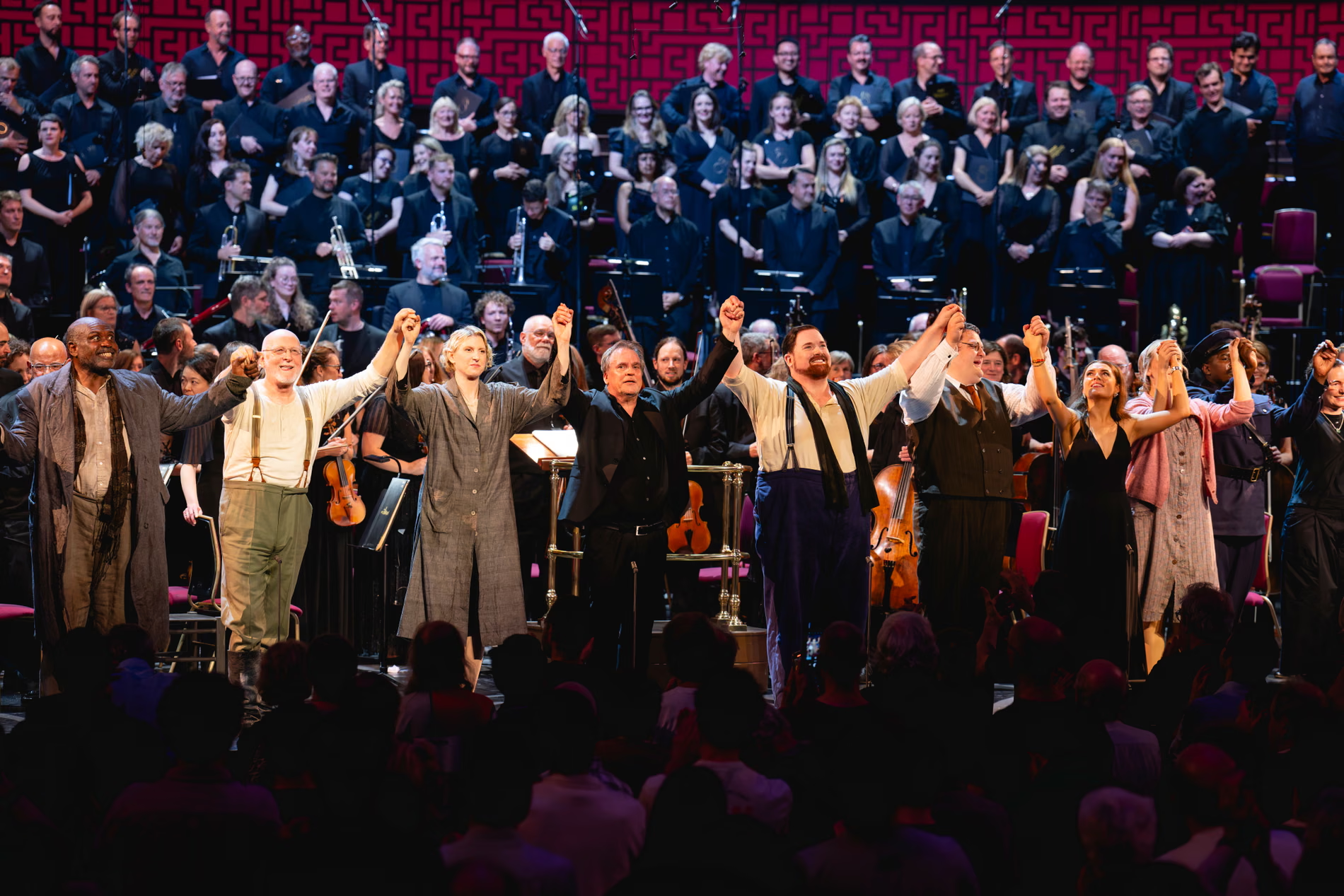
Opera in Four Acts (Nine Scenes) Music by Dmitri Shostakovich Libretto by Alaxander Preys and the composer after the novella by Nikolai Leskov English translation by David Poutney Semi-staged performance, sung in English with English surtitles
Katerina – Amanda Majeski (soprano); Boris/Ghost of Boris – Brindley Sherratt (bass); Zinovy – John Findon (tenor); Mill-hand/Priest – Thomas Mole (baritone); Sergey – Nicky Spence (tenor); Aksinya/Convict – Ava Dodd (soprano); Shabby Peasant – Ronald Samm (tenor); Steward – Alaric Green (baritone); Police Sergeant – Chuma Sijeqa (baritone); Teacher – William Morgan (tenor); Old Convict – Sir Willard White (bass-baritone); Sonyetka – Niamh O’Sullivan (mezzo-soprano)
BBC Singers, Chorus of English National Opera, Brass Section of English National Opera, BBC Philharmonic Orchestra / John Storgårds
Ruth Knight (director)
Royal Albert Hall, London Monday 1 September 2025
Reviewed by Richard Whitehouse Photos (c) BBC / Andy Paradise
In this 50th anniversary year of Shostakovich’s death it made sense for the Proms to schedule Lady Macbeth of Mtsensk, his second and final completed opera, in a performance reminding one of English National Opera’s commitment to this work stretching back almost four decades.
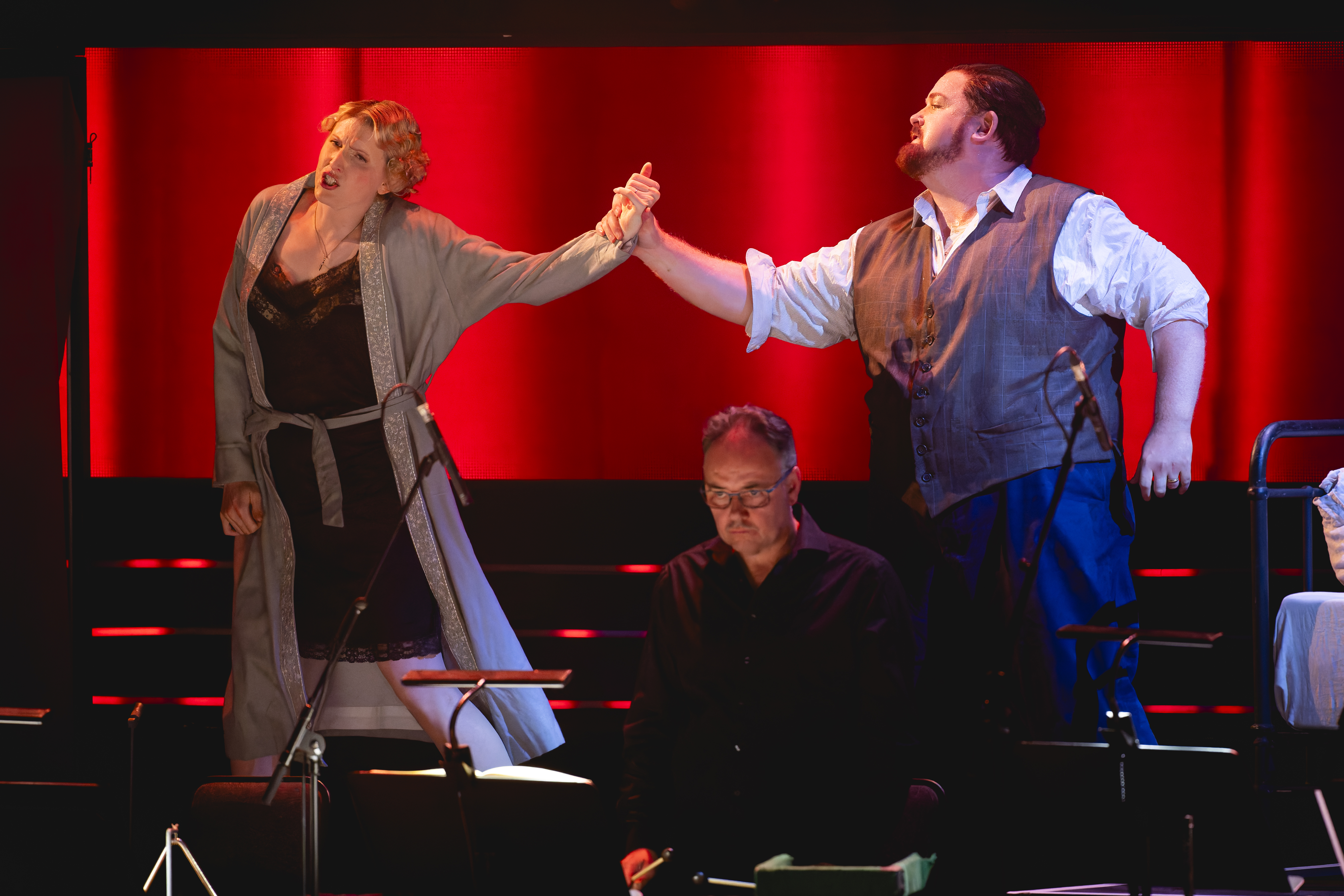
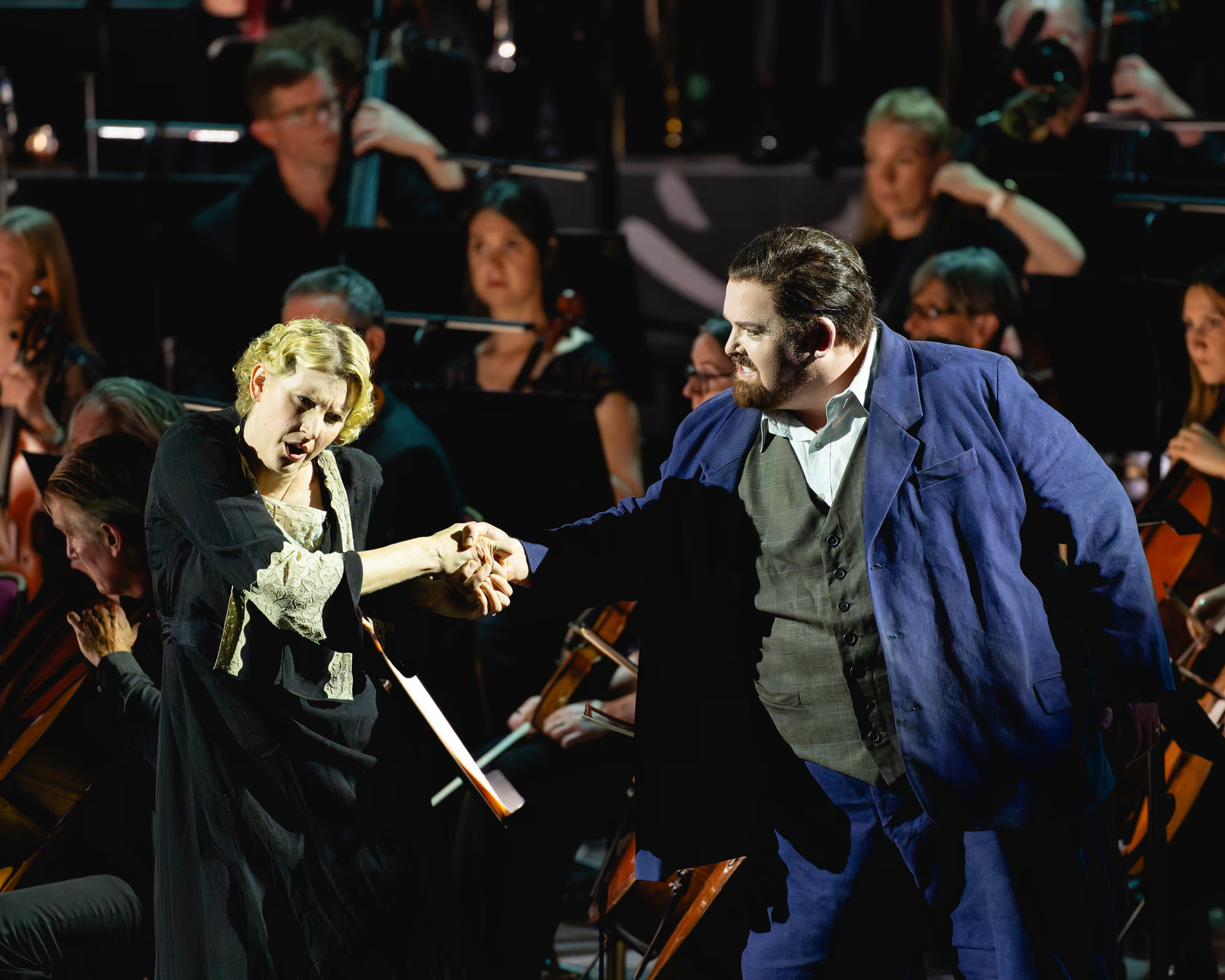
In scenic terms, the semi-staging directed by Ruth Knight was little more than a gloss on what was heard. Its framing device of the heroine in the witness box now seems a tired device that served little purpose, and the emergence of a bed at rear of the platform as a focus for sexual activity had surely passed its sell-by date at the end of the David Poutney era. More effective was the use of lighting to accentuate dramatic highpoints; incidentally reminding one such a procedure had come of age around the time that Shostakovich’s opera first appeared on stage.
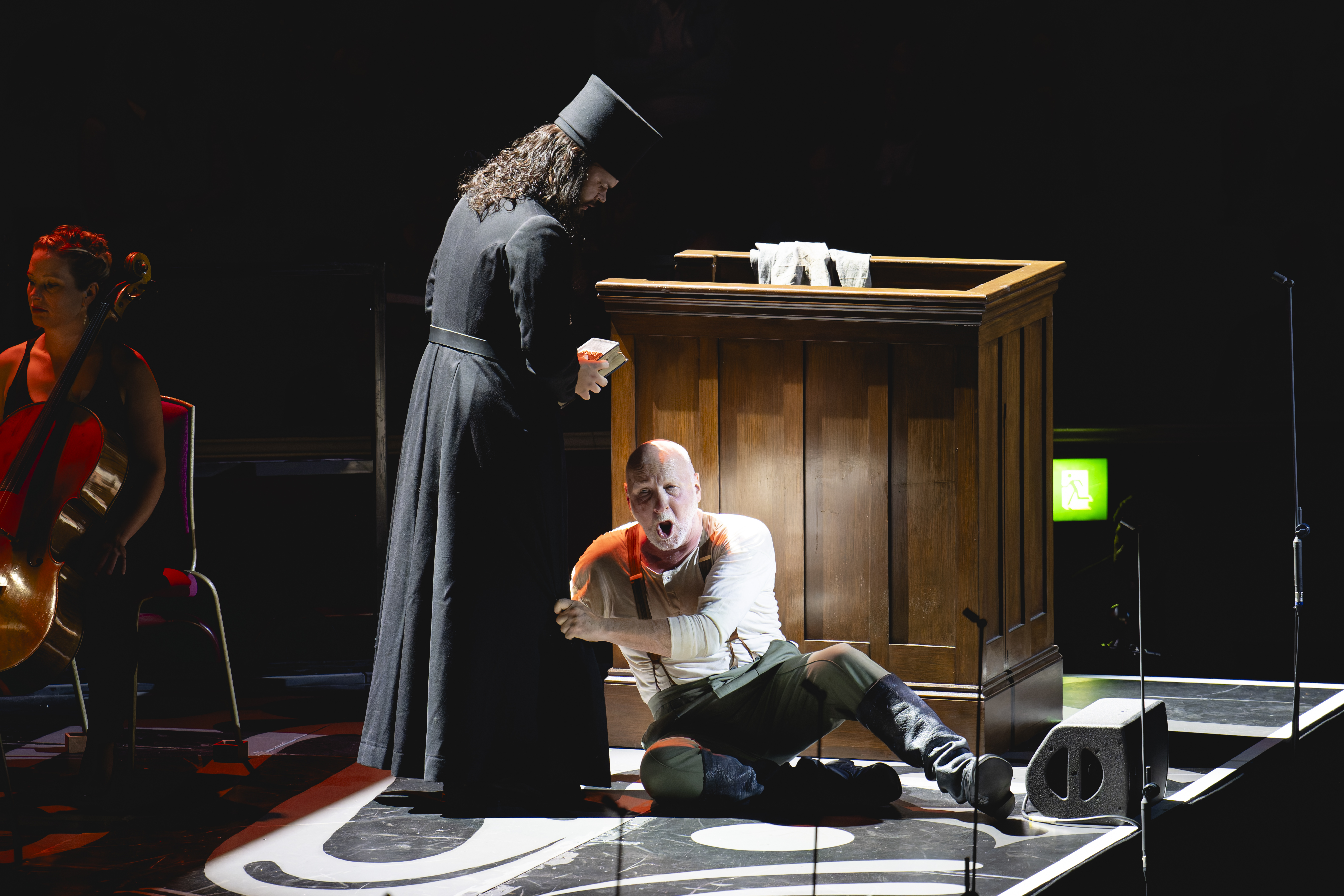
Vocally this was a mixed bag. No-one could accuse Amanda Majeski of lacking presence or, moreover, eloquence in her assumption of the title-role, yet her emotional aloofness made her seem not so much distinct as overly detached from the wretched circumstances all around her. Brindley Sharatt was a shoo-in for Boris, his boorishness yet evincing a cunning intelligence who easily held the stage – not least his latter ‘ghost’ incarnation. Nicky Spence was vocally assured but dramatically two-dimensional as Sergey and, as Zinovy, John Findon resembled more a provincial critic than a merchant, though Thomas Mole made a lively contribution as a dipsomaniac Priest with Chuma Sijeqa uproarious as the Police Sergeant. His cameo as an Old Convict found Sir Willard White in gratifyingly fine voice near the end of his eighth decade.
Smaller roles were generally well taken, not least Ava Dodd’s hapless Aksinya and Niamh O’ Sullivan’s scheming Sonyetka, while the ENO Chorus lacked little in forcefulness or clarity of diction, though this latter might have been felt a drawback given the frequent contrivance of Poutney’s translation – which has not aged well. Otherwise, this was very much the BBC Philharmonic Orchestra and John Storgårds’s show. Having impressed with Shostakovich symphonies over recent seasons, the latter had a sure grasp of this opera’s dramatic unfolding and paced it accordingly. No stranger to this composer’s music, his orchestra was as responsive to the seismic climaxes (suitably abetted by ENO brass) as to passages of mesmeric introspection which, in many respects, prefigure the composer Shostakovich was increasingly to become.
It has often been claimed that, had his fortunes not reversed so dramatically as on that fateful evening of 26th January 1936, Shostakovich would have continued upon his path as an opera composer. Yet there is a nagging sense that, whatever its theatrical potency, Lady Macbeth of Mtsensk is intrinsically no more than the sum of its best parts. Leaving aside the intermittent success of his and Alexander Freys’ remodelling of Nikolai Leskov’s ‘shabby little shocker’, dramatic characterization frequently seems to have been laminated onto its musical context.
If tonight’s performance never entirely banished these thoughts, it certainly gave this opera its head in what was a memorable night for orchestra, conductor and, for the ENO contingent, an impressive bowing-out as it prepares for the next phase of its existence – based in Manchester.



 Arcana.fm