Unknown's avatar

About Arcana

My name is Ben Hogwood, editor of the Arcana music site (arcana.fm)

Listening to Beethoven #124 – Piano Sonata no.19 in G minor Op.49/1


Self-portrait by Caspar David Friedrich (1810)

Piano Sonata no.19 in G minor Op.49/1 for piano (1795-7, Beethoven aged 26)

1 Andante
2 Rondo: Allegro

Dedication unknown
Duration 8′

Listen

Background and Critical Reception

The two short sonatas by Beethoven published as Op.49 in 1805 have become very popular with pianists of a more moderate ability (such as yours truly!). For this we have to thank the composer’s brother Kaspar, who assembled the two works in 1802 and gave them to publishers, though they date from several years earlier.

We have already encountered the second piece from this set, written in G major, and its counterpart shares the same pitch but operates in the minor key. Angela Hewitt, writing for her Hyperion recording, tells how the sonatas ‘were billed by their publisher as Sonate facile, a good marketing ploy, and one that reminds us of Mozart’s C major sonata K545, written in 1788. It is interesting to learn that the same publishing house, less than a month after bringing out Beethoven’s pieces, brought out Mozart’s work for the first time, with the same title’.

Hewitt, who clearly loves this piece, declares it a ‘two-movement work that is perfection in miniature’. ‘It has become almost commonplace to say that early Beethoven sounds like Mozart, but to me this sonata is pure Beethoven from start to finish’.

Thoughts

It is easy to share Hewitt’s enthusiasm for this short but expressive piece. The first movement certainly has a Mozartian simplicity but it is also very serious, a straight-faced counterpart to the exuberance of the Sonata published alongside it. Beethoven speaks with the profound nature of a Baroque overture, as though he were introducing a bigger Suite rather than a short piece.

The second movement casts off the shadows of the first, moving to the major key for a brighter approach – yet it still reverts to the minor key for a brief episode. In the end the outlook is positive, with a gently rocking coda to end the piece in a serene mood.

Recordings used and Spotify links

Emil Gilels (Deutsche Grammophon)
Alfred Brendel (Philips)
András Schiff (ECM)
Angela Hewitt (Hyperion)
Paul Badura-Skoda (Arcana)
Stephen Kovacevich (EMI)
Igor Levit (Sony Classical)
Ronald Brautigam (BIS)

The approaches to this piece are fascinating. Two of the most contrasted viewpoints – both valid – are held by Paul Badura-Skoda, playing the fortepiano, and Emil Gilels. Badura-Skoda is quite fast in the first movement but feels slower in the second, while Gilels’ approach is expansive to say the least in the opening pages, but he makes it work with deep expression. His second movement has a spring in its step, enjoying its relative freedom.

You can hear clips of Hewitt’s recording at the Hyperion website

You can chart the Arcana Beethoven playlist as it grows, with one recommended version of each piece we listen to. Catch up here!

Also written in 1797 Pleyel Flute Concerto in B flat major B106 .

Next up Piano Sonata in C major WoO51

Switched On – Stereolab: Electrically Possessed [Switched On Volume 4] – Warp Records / Duophonic UHF Disks

reviewed by Ben Hogwood

What’s the story?

Stereolab fans tend to be completists, and with good reason. The long running, much-loved band have taken line-up changes and relationships in their stride to be well-known for the consistency of their output. In recent years a housekeeping exercise on the back catalogue has yielded three excellent Switched On volumes, gathering together the band’s extra-curricular tracks, EPs and album-avoiding singles. Volume four of the Switched On collection goes further, a complement to the deluxe album reissues made over the last couple of years. Being a Stereolab fan is an expensive business, but a worthwhile one it seems!

What’s the music like?

As seasoned fans will know, there is something immediately appealing about the Stereolab sound, giving off a comforting warmth. Yet this is never comfortable music, for the spirit of experimentation runs strong, especially in tracks where there are no constraints or boundaries.

Most of the tracks here are instrumental, but they give the listener an opportunity to revel in the sound the band make. Lovely warm keyboards often spill over into Krautrock-inspired riffing, while on occasion there is a lovely cool marimba (Intervals) or the friendly parp of a trombone (Free Witch And No Bra Queen, a track where two simultaneous loops wander out of phase in entertaining fashion). This track also has some deliciously clashing harmonies from the multi-tracked vocals of Laetitia Sadlier.

The vibraphone and trombone-powered groove of Outer Bongolia is rather wonderful, the listener able to bask in the sounds, while Laetitia’s vocalise at the end of Intervals goes nicely with the marimba. I Feel The Air (Of Another Planet) is a beatless wonder with a nice strings / Hammond organ combination, while other highlights include the perky keyboards of Solar Throw-Away (the original version) and the breezy loop powering The Super It. B.U.A is enjoyably far out, while the best riff – among strong competition – goes to Dimension M2, burning a bright light.

Another talent the band has is somehow finding a funky turn for some pretty obscure time signatures. L’exotisme Interieur is the best of these, a track set in 7/4 but still getting the feet tapping.

Does it all work?

Yes. Electrically Possessed may not be an album as such but it is arranged in a satisfying program, so that its 27 tracks never outstay their welcome. The spirit of invention runs through it, and with a consistently high quality threshold it is very rare to get the sense the band are coasting or not fully focussed. In other bands’ outputs the scraps from the cutting room floor should be just that, but in Stereolab’s case the offcuts are well worth hearing and a pleasure to listen to.

Is it recommended?

Very much so – to Stereolab completists but also to relative newcomers to the band. These tracks may not all be fully formed but they are stamped throughout with the familiar identity of breezy funk, experimentation, offbeat rhythms and warm, beguiling sounds. It is a lovely collection to get lost in.

Stream

Buy

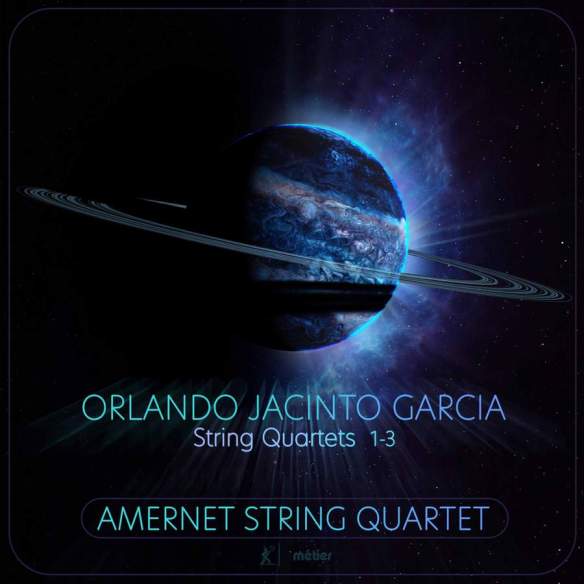
On record – Orlando Jacinto Garcia : String Quartets – Amernet String Quartet (Métier)

Orlando Jacinto Garcia
String Quartet no.1 (1986)
String Quartet no.2 (1998)
String Quartet no.3 (2018)

Amernet String Quartet [Misha Vitenson, Avi Nagin (violins), Michael Klotz (viola), Jason Calloway (cello)]

Métier MSV28613 [65’39”]

Producer Orlando Jacinto Garcia
Engineer Jacob Sudol

Recorded 27 August 2019 at Concert Hall of Wertheim Performing Arts Centre, Miami

Written by Richard Whitehouse

What’s the story?

The highly enterprising Amernet Quartet latest releases comprises the three string quartets by Orlando Jacinto Garcia (b1954), the Cuban-born American composer for whom these works underscore the gradual and incremental changes in idiom across his now substantial output.

What’s the music like?

Although its subtitle Rendering Counterpoint may suggest music which is beholden to such luminaries of post-war complexity as Milton Babbitt, the First Quartet is aesthetically much closer to Morton Feldman (with whom Garcia had undergone an intensive while productive period of study) in its content. Put another way, the very concrete shapes and textures do not so much develop as metamorphose across the course of its almost 26 minutes – with lengthy silences not so much interrupting as motivating the discourse through to an ending the more conclusive for its sparseness. Those daunted by the imposing duration of Feldman’s quartets should find this piece an excellent primer, as well as an engrossing listen on its own terms.

Its subtitle Cuatro might seem straightforward in context, but the Second Quartet predicates the number ‘four’ at conceptual, structural, or expressive levels. Hence four instruments and (continuous) sections, alongside evocations of an eponymous Cuban guitar with four sets of strings, then four composers whose work is alluded to literally yet obliquely. Beyond these, there is the interplay of registers, timbres, textures, and dynamics such as make the resultant piece a varied and involving listen despite (or even because of) its more consonant harmonic sense. Nor is there anything unmotivated about music whose ultimate destination is one of a repose is deeper for its unwavering concentration on the most elemental motifs and gestures.

And so to I Never Saw Another Butterfly, the subtitle of a Third Quartet with inspiration in the art and poetry of children from Terezin (aka Theresienstadt), the transit camp just outside Prague where many artists or composers and their families were interned prior to being sent to concentration camps. Numerous pieces have been written over recent decades in tribute or commemoration, with Garcia’s surely among the most affecting in its absence of extraneous emotion or superfluous rhetoric – opting instead for a contemplative inwardness where solo and ensemble passages are freely alternated, even superimposed over the course of a journey whose 24 minutes proceed eventfully towards a conclusion eloquent in its deft quizzicality.

Does it all work?

Yes, though anyone expecting to encounter radical or seismic changes along the way might be disappointed. More approachable and immediate as Garcia’s idiom has become, there is never any sense of his music courting easy appeal or popular acclaim. Rather, these quartets maintain a steady and methodical course akin to a thawing out or loosening up of emotions audible from the outset. It helps that the Amernet Quartet (who previously recorded quartets by Steven R. Gerber for the Albany label) is so attuned to this music’s understated intensity.

Is it recommended?

Indeed. The sound is well-nigh ideal in its balance and focus, while cellist Jason Calloway’s booklet notes are the more pertinent given his involvement in the actual recording. Garcia’s discography is not yet sizable, but this release should help pave the way to greater coverage.

Listen

Buy

You can discover more about this release at the Divine Arts website, where you can also purchase the recording. For the composer’s website, click here, and for more information on the Amernet String Quartet click target=”_blank”>here

Playlist – The Rustle of Spring

Welcome to The Rustle of Spring.

This is a playlist designed to look at the positive, to anticipate our emergence from what has been an incredibly difficult winter for many.

Although we are not out of it yet nature is doing its best, with green shoots making themselves known, birds and animals starting to flex their muscles, the nights drawing out a bit and the weather – hopefully – improving.

This selection offers a range of responses to spring from classical composers. We have the outright optimism of Schumann’s Spring Symphony, his first, alongside more mysterious responses to the season from Lili Boulanger and John Foulds. Spring doesn’t have to mean orchestral music, either – there are intimate thoughts from the piano works of Grieg, Sinding and Tchaikovsky, while rarely heard choral pieces from Holst and Moeran lend an exotic air.

We finish with two very different portrayals of spring, in the form of one of Johann Strauss II’s best-known waltzes, Voices of Spring, and an all too rarely heard tone poem by Frank Bridge, Enter Spring. There isn’t even room for Vivaldi’s Four Seasons!

I hope you find something to enjoy.

Ben Hogwood

Listening to Beethoven #123 – Piano Sonata no.4 in E flat major Op.7


Emilias Kilde by Caspar David Friedrich (c1797)

Piano Sonata no.4 in E flat major Op.7 for piano (1797, Beethoven aged 26)

1 Allegro molto e con brio
2 Largo con gran espressione
3 Allegro
4 Rondo. Poco allegretto e grazioso

Dedication Countess Babette von Keglevics
Duration 28′

Listen

Background and Critical Reception

‘If any proof was needed to show that early Beethoven is not just imitation Haydn or Mozart’, writes Angela Hewitt, ‘then surely the Piano Sonata in E flat major Op.7 would be the best example.’

This is a work of formidable size, lasting nearly half an hour and second only to the Hammerklavier Sonata in Beethoven’s 32 published piano sonatas. Yet it has a common thread running through it, as Daniel Heartz observes. ‘The whole cycle is remarkable for its unified tone, which is both stylistic and motivic. No sonata of the Op.2 trilogy quite succeeded in achieving this feat.’

Hewitt has a special affection for the piece. ‘The colour change to C major for the Largo…startles us but immediately calls our attention to expect something different and exceptional’, she says of the second movement, finding the third ‘full of humour and charm’. The finale, however, works as ‘one of the last examples of his early style’, and ‘the movement ends in the most unassuming way. Perhaps if it ended loudly, she muses, this piece would be performed more often.’

The sonata is dedicated to Countess Babette von Keglevics, one of Beethoven’s most gifted piano pupils of the time.

Thoughts

Op.7 certainly is a substantial piece, but – as agreed above – a unified one. The flowing interaction between right and left hand of its opening pages set the tone. The piano writing is dense for its time, with lots going on, and in the middle (development) section of the first movement Beethoven travels far harmonically before suddenly deciding to go back to the first theme.

This proves to be a feature of the other movements. The slow movement, beautifully simple in its hymn-like theme, enjoys the sound of C major but suddenly takes a darker turn, where it really feels like Beethoven is using the piano as an orchestra. The left hand (lower strings) has an ominous figure which turns the music colder. Then we return to the safety of C major and all is forgotten.

The third movement is initially graceful, with a little stop-start motion in triple time, but its central section is a complete contrast, a turbulent episode in the minor key. The finale looks to resolve this, beginning in serenity, before it too succumbs to a stormy central section. Finally peace is completely restored, and Beethoven ends in quiet peace.

Recordings used and Spotify links

Emil Gilels (Deutsche Grammophon)
Alfred Brendel (Philips)
András Schiff (ECM)
Angela Hewitt (Hyperion)
Paul Badura-Skoda (Arcana)
Stephen Kovacevich (EMI)
Igor Levit (Sony Classical)

Claudio Arrau captures the full drama and exploration of the first movement development section. It takes a little while for the ear to adjust to Paul Badura-Skoda’s instrument but the sonorous tones suit chords that are close together. His is an intimate account if slightly jumpy on occasion, and he achieves considerable turbulence in the stormy trio of the third movement. It’s lovely to hear the piano itself creaking as he plays it. Emil Gilels is superb in the slow movement but perhaps a bit too grand in the outer two, and so it is Alfred Brendel who finds arguably the best combination of expanse and gracefulness.

The playlist below accommodates all the versions described above except that by Angela Hewitt:

You can hear clips of Hewitt’s recording at the Hyperion website

You can chart the Arcana Beethoven playlist as it grows, with one recommended version of each piece we listen to. Catch up here!

Also written in 1797 James Hewitt Piano Sonata in D major ‘The Battle of Trenton’

Next up Piano Sonata no.19 in G minor Op.49/1