Unknown's avatar

About Arcana

My name is Ben Hogwood, editor of the Arcana music site (arcana.fm)

On record: BBC Symphony Orchestra / Martyn Brabbins – Vaughan Williams: Symphony no.5 & Scenes adapted from Bunyan’s Pilgrim’s Progress

*Emily Portman (singer); *Kitty Whatley (mezzo-soprano); *Marcus Farnsworth (baritone), *BBC Singers; *BBC Symphony Chorus, BBC Symphony Orchestra / Martyn Brabbins

Vaughan Williams
Symphony no.5 in D major (1938-43)
Scenes adapted from Bunyan’s Pilgrim’s Progress (1906)*

Hyperion CDA68325 [66’59”]
English text included
Producer Andrew Keener
Engineer Simon Eadon

Recorded 2 December 2018* & 4-5 November 2019 (Symphony 5), Watford Colosseum, UK

Reviewed by Richard Whitehouse

What’s the story?

Martyn Brabbins’s traversal of Vaughan Williams symphonies continues with the Fifth, long the most widely regarded of this cycle, alongside music written for a dramatized production which effectively launched the composer’s lifelong obsession with John Bunyan’s ‘allegory’.

What’s the music like?

Premiered in June 1943, the Fifth Symphony poses a challenge or even provocation through that inwardness all too easily regarded as escapism. A ‘less is more’ concept which Brabbins clearly appreciates – not least in a Preludio as builds incrementally, with little overt rapture going into the radiant second theme or a development understatedly accruing energy, toward a reprise whose climactic restatement of the second theme is (purposely?) less arresting than a coda in which any tonal ambiguity feels the more real for happening almost out of earshot. Easy to skate over, the Scherzo emerges with not a little malevolence in the deftness of its cross-rhythms – the chorale-like aspect of its trio questioning rather than affirming, then the return of the opening music exuding a sardonic quality left unresolved by the spectral close.

That the Romanza is the emotional heart of this work only increases a need for its contrast of moods to be (subtly) underlined. Brabbins achieves exactly so through an adroit interplay of the melodic and harmonic components whose cumulative yet unforced evolution accords the central phase of the movement an encroaching anxiety barely pacified at its culmination, before being more wholly transcended by a coda that is luminous in its simplicity and poise. Often thought unsatisfactory as a formal design, the final Passacaglia seems of a piece with what went before; its theme stated simply while purposefully before the variations build to a resolute central climax – after which, those conflicting elements of negation and affirmation are sublimated into a postlude which reaches out as though at once entreaty and benediction.

As a coupling, Scenes adapted from Bunyan’s Pilgrim’s Progress could not be more apposite. Written for a staging at Reigate Priory, the 13 short items unfold well as a continual sequence at the outset of an involvement with Bunyan’s novel that resulted in an evening-length drama 45 years on. Highlights are Emily Portman’s disarming take on the ‘Flower-girl’s song’, ‘The angel’s song’ eloquently rendered by Kitty Whately (her contribution an undoubted highpoint of ENO’s uneven 2012 production), Marcus Farnsworth’s fervour in a setting of Psalm 23 as constitutes the Shepherd’s Song, and lusty response from the BBC Symphony Chorus in The arming of Christian (best known as the hymn To be a Pilgrim) then a rapturous Final scene music which also serves as reminder that VW’s Tallis Fantasia was merely four years hence.

Does it all work?

It does. Brabbins’s Fifth may not be the most fervent or powerful but has the work’s measure as a cohesive and integrated entity. The Pilgrim’s Progress ‘Scenes’ makes for a fascinating comparison with subsequent versions in VW’s decades-long quest for a satisfying realization.

Is it recommended?

Indeed. The sound is on a par with previous instalments in its clarity and realism, and Robert Matthew-Walker’s booklet note expertly clears up any uncertainty over the genesis of VW’s Bunyan-related projects. Those remaining symphonies will hopefully not be long in coming.

For further information on this release, visit the Hyperion website, or the BBC Symphony Orchestra. You can also read Arcana’s interview with the conductor here
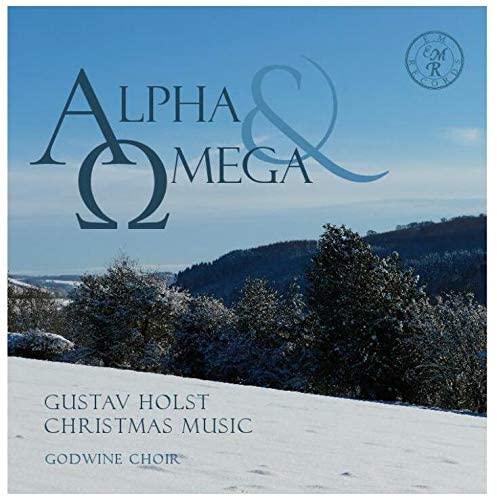
On record – Holst: Christmas Music (Godwine Choir) (EM Records)

Holst
In the Bleak Midwinter H71 (1904)
Four Old English Carols H82 (1907)
Two Carols H91 (1907/16)
Christmas Day H109 (1910)a
Lullay my Liking H129 (1916)
This Have I Done for My True Love H128 (1916)
Of One that is so Fair and Bright H130 (1916)
Bring us in Good Ale H131 (1916)
Three Carols H133 (1916/17)a
A Dream of Christmas H139 (1917)a
Wassail Song H182 (c1931)
Scherzo H192 (1933, arr. Brasier)**
Four Organ Voluntaries HApp8-11 (1890/1, transc. John Wright)*

*John Wright (organ); **Richard Brasier, **Tom Bell (organ duet); Godwine Choir / Alex Davon Wetton, Edward Hughes with a Douglas Tang (organ); b Charlotte Evans (oboe); c Alison Moncrieff-Kelly (cello)

EM Records EMR CD0062 [82’42”]

Producer / Engineer Myles Eastwood

Recorded 13 & 14 July 2019 at St Jude-on-the-Hill, London; **22 August 2019 at Hereford Cathedral

Written by Richard Whitehouse

What’s the story?

EM Records continues its enterprising release schedule with this anthology of seemingly all Holst’s choral music written for or with Christmas in mind, along with first recorded outings of original pieces plus a transcription for organ that in themselves explain this album’s title.

What’s the music like?

As incrementally wide-ranging as might be expected from a composer whose never wore his distinctive personality on his sleeve. Earliest of the choral works is also the most famous – a setting of In the Bleak Midwinter that will be heard the Christian world over these next few weeks (no comment as to a preference between this and Harold Darke’s setting!). Intricately wrought in rhythm and texture, the Four Old English Carols exude a luminously Medieval atmosphere, as also the Two Carols with their modally evocative harmony. Most ambitious among these earlier items, Christmas Day alternates before superimposing its four carols in this heady and engaging medley – of which Holst’s subsequently dismissive view says more about his constantly changing stylistic preoccupations than any intrinsic failing of this work.

Almost all the latter choral pieces date from around the time of Holst’s move to Thaxted and the festival he initiated there. The call-and-response of Lullay my Liking retains its enduring charm, but how surprising I Saw Three Ships has not previously been recorded, its vivacity as appealing as the purposefulness of Personent hodie or gaiety of Masters in this Hall. Holst’s view that Of One that is so Fair and Bright ‘‘should be done simply like a good village choir’’ might give pause for thought, its rhythmic flow as exacting as the cumulative vocal weave of This Have I Done for My True Love or the accelerating part-writing of Bring us in Good Ale. There is an almost impressionistic allure to the little-known A Dream of Christmas, with the Wassail Song a reminder of the ribald element that often surfaces in this composer’s music.

Even Holst’s admirers are likely unfamiliar with his output for solo organ, if only because the four voluntaries in question have gone unheard since the teenage composer tried them out in his Cheltenham schooldays. Modest in scope, the first three are an intriguing parallel to what his contemporary Ives was coming up with across the Atlantic – thus the resolute March, the whimsical Allegretto Pastorale and the capering Postlude. Much more ambitious, the Funeral March is an animated processional whose opulent climaxes and quirky registrations admit of more personal traits. From Alpha to Omega – the Scherzo being the only movement realized of the symphony upon which Holst was working at his death, arranged here for organ duet by Richard Brasier such that its contrapuntal dexterity and fluid evolution are acutely conveyed.

Does it all work?

Absolutely. Holst was a master of many guises; his Christmas output is unfailingly evocative for all its technical demands. It helps that performances by the London-based Godwine Choir are so attentive to this music’s spirit, as are Brasier and Tom Bell in the Scherzo transcription.

Is it recommended?

Very much so. The Hampstead and Hereford venues are ideal acoustics, and the booklet note includes an overview of choral items by Chris Cope – Chairman of the Holst Society, whose extensive recording programme will result in much unfamiliar music being brought to light.

Listen and Buy

You can discover more about this release at the EM Records website, where you can hear clips from the recording and also purchase.

Live review – Henry Goodman, English Symphony Orchestra / Kenneth Woods: The Art of Storytelling – Lubin from Chelm

David Yang (above, music), Alisa Snyder (illustrations) Henry Goodman (narrator), English Symphony Orchestra / Kenneth Woods

Wyastone Concert Hall, Monmouth
Friday 4 December 2020 (online)

Written by Richard Whitehouse

Following on last week’s arresting version of The Ugly Ducking, the English Symphony Orchestra continues its series of pieces for virtual storytelling in the guise of an old English tale here given an inimitably Jewish twist to result in the ‘morality’ fable Lubin from Chelm.

While the tale of Lazy Jack might hardly have seemed other than an English story, it works well when relocated within Ukrainian Jewish environs then decked out with Yiddish turns of phrase and Klezmer stylings. The anti-hero Lubin – put to work only at the prompting of his aging mother, who is incapable of holding on to his wages, but who enchants the daughter of Chelm’s wealthiest family – could be interpreted in various ways; that of fortune smiling on those who least expect it, yet are by no means the least deserving, is the most straightforward.

Henry Goodman certainly makes the most of this barbed whimsy, relating the narrative with audible enjoyment as he assumes the role of Yiddish storyteller with aplomb. He is abetted by David Yang’s direct and characterful score, engagingly conducted by Kenneth Woods (who undertook the expert orchestrations) and illustrated by Alisa Snyder with a true appreciation of what line drawings are capable of conveying in this context. A few linguistic ‘curve-balls’ are thrown in, without detracting from the self-effacing directness of the unfolding narrative.

The ESO musicians (shots of whom alternate with the illustrations) play with their customary skill and sensitivity, and the whole production ought to amuse as well as provoke children and adults alike. As usual with ESO, a range of supporting material enhances the total experience.

You can watch the concert on the English Symphony Orchestra website here

For more information on the English Symphony Orchestra you can visit their website here

For information about Auricolae, visit Kenneth Woods’ website here

Listening to Beethoven #96 – Wind Quintet in E flat major


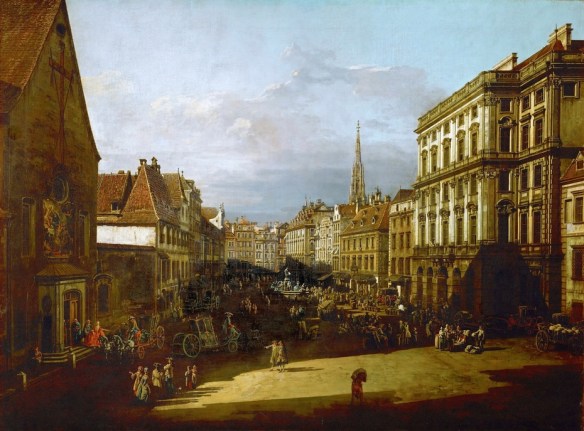
Vienna, Panorama from Palais Kaunitz by Bernardo Bellotto (1759)

Quintet in E flat major Hess 19 for 3 horns, oboe and 2 bassoons (1796, Beethoven aged 25)

1. Allegro
2. Adagio maestoso
3. Minuetto

Dedication unknown
Duration 15′

Listen

Background and Critical Reception

Beethoven’s preoccupation with wind instruments continues with this incomplete quintet, written for the unusual combination of three horns, oboe and bassoon. The unfinished work sits in three movements, the bones of which were seemingly sketched out in 1796 or 1797. The first movement autograph score begins at bar 158, the second movement is complete but only a fragment of the third, a Minuet, remains.

Keith Anderson, writing in the booklet notes for Naxos’ recording of the Quintet, details how the first movement was reconstructed by Leopold Zellner and first played in 1862, while the celebrated Beethoven scholar Willy Hess edited the work for publication. In its surviving form it is top heavy, with a first movement more than double the length of the second and third combined.

Thoughts

We are once again in E flat major, Beethoven’s ‘key of choice’ for wind instruments – and his most-used up until now. The colouring is slightly different here though, the full-bodied horns dominating in a largely mellow texture, until the oboe pokes its head above the parapet. The melodic material is less distinctive than the preceding Sextet but is pleasant all the same.

The slow movement stays in the ‘home’ key and again has lovely sonorities but feels lacking in the craft a finished version from the composer would surely have brought. A perky Minuetto tails off all too soon.

Recording and Spotify link

Jeno Keveházi, János Keveházi, Sándor Berki (horns), Ottó Rácz (oboe), Jozsef Vajda (bassoon)

A nicely balanced account from the Hungarian soloists, recorded by Naxos in Budapest in 1994.

You can chart the Arcana Beethoven playlist as it grows, with one recommended version of each piece we listen to. Catch up here!

Also written in 1796 Boieldieu Duo no.2 in B flat major for harp and piano

Next up Erlkönig

Listening to Beethoven #95 – Sextet in E flat major Op.71


Mehlmarkt in Vienna by Bernardo Bellotto (1758)

Sextet in E flat major Op.71 for 2 clarinet, 2 bassoons and 2 horns (1796, Beethoven aged 25)

1. Adagio – Allegro
2. Adagio
3. Menuetto quasi allegretto
4. Rondo. Allegro

Dedication unknown
Duration 21′

Listen

Background and Critical Reception

Beethoven wrote his Sextet for an established combination of clarinets, bassoons and horns – two of each – in 1796. However it appears not to have been performed until 1805, at a concert for the benefit of his violinist friend Ignaz Schuppanzigh, and another five years elapsed until it was published.

Reviewing the benefit concert, Allgemeine musikalische Zeitung spoke of ‘lively melodies, unconstrained harmonies, and a wealth of new and surprising ideas.’

When handing it over to his publisher, Beethoven is said to have described it as ‘one of my earlier works, written in one night, and one can only say that it is written by an author who has brought out at least some better works’.

The quick composition time explains the fluent writing through four traditional movements, Beethoven thinking in a form that would please Viennese audiences.

Thoughts

The Sextet starts with what feels like a very basic introduction, a slow and simple statement of the notes of the E flat triad. From these less memorable beginnings comes a first movement of charm, rooted in the dance – which the bassoons are intent on reminding us about with a spring in the step of their accompaniment. Burbling clarinets help the inner workings as the piece trips along, the sonority of the ensemble in itself a lovely tonic to the ear. Beethoven gradually develops his material, moving to keys further afield, before reasserting E flat with the jauntier fast theme.

The slow movement is lovely, giving the bassoon an unusual prominence for its songlike first them, echoing the male baritone voice. The Menuetto brings the horns forward, and is more staccato in tone as a result, with a central trio section of lovely colours that is the ideal complement. Finally a Rondo, easy on the ear, makes the most of ensemble teamwork with its busy exchanges.

Recordings used and Spotify links

Academy of St. Martin-in-the-Fields Chamber Ensemble (Philips)
Scottish Chamber Orchestra Winds (Linn)
L’Archibudelli (Sony Classical)
Gerd Seifert, Günter Piesk, Henning Trog, Karl Leister, Manfred Klier, Peter Geisler (Deutsche Grammophon)

Some very fine performances here. The ASMF winds are immaculate, and so too are the Scottish Chamber Orchestra ensemble, who benefit from Linn’s superb recording. L’Archibudelli, playing on period instruments and a slightly lower pitch, have a coarser sound that proves every bit as enjoyable as their modern counterparts. The starry team of soloists from the Berlin Philharmonic on DG are not as consistent with their use of Beethoven’s repeated sections.

The Spotify playlist below collects the recordings used:

You can chart the Arcana Beethoven playlist as it grows, with one recommended version of each piece we listen to. Catch up here!

Also written in 1796 Haydn Trumpet Concerto in E flat major Hob. VIIe/1

Next up Quintet for wind in E flat major H19