
Unknown's avatar

About Arcana

My name is Ben Hogwood, editor of the Arcana music site (arcana.fm)

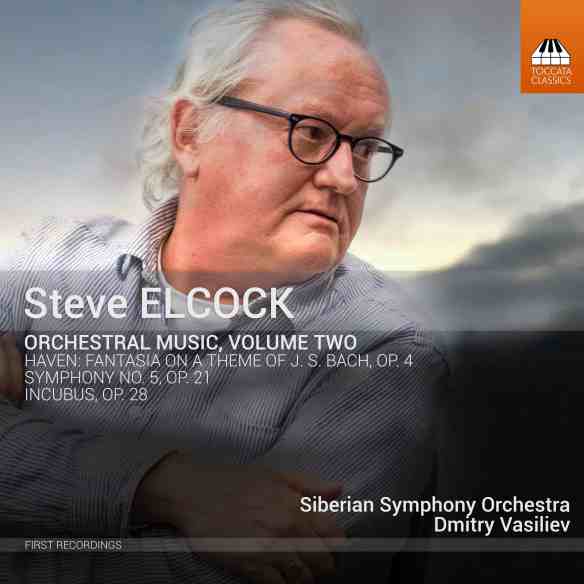
On record: Steve Elcock: Orchestral Music, Volume Two (Toccata)

Steve Elcock
Incubus Op.28 (2017)
Haven: Fantasia on a Theme by J.S. Bach Op.4 (1995, rev. 2011-17)
Symphony no.5 Op.21 (2014)

Siberian Symphony Orchestra / Dmitry Vasiliev

Producer/Engineer Sergei Zhiganov
Recorded 8-12 July 2019, Philharmonic Hall, Omsk

Toccata Classics TOCC0445 [77’20”]

Reviewed by Richard Whitehouse

What’s the story?

Toccata Classics continues its coverage of Steve Elcock (b1957) with this second instalment of orchestral music – dominated by the Fifth Symphony with provocative allusions to its most famous predecessor, together with shorter yet distinctive pieces from either end of his output.

What’s the music like?

Although it marks a return to the four-movement format of his first two such works, the Fifth Symphony is hardly conventional in formal or expressive follow through. As with the almost contemporaneous Fifth by the late Christopher Rouse, the presence of that archetypal ‘No. 5’ feels undeniable – even more so given Elcock’s explicit referencing at the start of each outer movement; a head-on approach hardly less confrontational than that with Beethoven Nine in Tippett’s Third Symphony a half-century ago. In all other respects, Elcock goes entirely his own way: the visceral charge of that beginning quickly subsides into an opening movement whose restive searching seems becalmed emotionally while not tonally, as the music strives increasingly to regain its initial energy before relapsing into a mood of pervasive desolation.

The next two movements unfold without pause as a contrasting duality. As its title suggests, the Ostinato builds explosive impetus over a remorseless rhythmic motto that climactically implodes to leave a musing clarinet melody as expands into the ensuing Canzonetta. Less a slow movement than extended intermezzo, what might have brought a return to the earlier sombreness rather assumes a more compassionate aura that makes possible the final Allegro. Comparable to the first movement in its scale, this unfolds as a sonata design of unflagging dynamism whose twin themes are drawn into a process of continuous development on route to a peroration which, though it could hardly evince the triumph of Beethoven, is never less than affirmative in its bringing the work decisively and, moreover, demonstrably full circle.

A notable achievement, then – less ruggedly distinctive if ultimately more cohesive than the Third Symphony (recorded on TOCC0400), and evidently a statement with which to reckon. It is preceded here by two pieces that further attest to the consistency of Elcock’s underlying vision. Haven: Fantasia on a Theme by J.S. Bach takes the Sarabande from the First Violin Partita as basis for a series less of variations than of paraphrases such as pass from nostalgia, through militaristic brutality, to renewed concord with the theme newly explicit at the close. Derived from a recent string quartet, Incubus is a study in nocturnal imaginings – ostensibly the result of insomnia – which seems predictable only in its marshalling a disparate range of ideas into a taut ‘curtain raiser’ whose outcome is the more telling for being so unexpected.

Does it all work?

It does. Just occasionally taxed in those more demonstrative passages, the Siberian Symphony Orchestra otherwise yields little to the Royal Liverpool Philharmonic as to the conviction of its playing, with Dmitry Vasiliev demonstrating an absolute grasp of Elcock’s combative musical vision.

Is it recommended?

It is. Orchestral sound has commendable heft and perspective, while Francis Pott’s extensive annotations situate all three pieces within an appropriately wide context. Hopefully Elcock’s Fourth Symphony will feature on the next volume in what is an absorbing and valuable series.

Listen

Buy

For further information, audio clips and purchase information visit the Toccata Classics website. For more on Steve Elcock you can visit the composer’s website
Listening to Beethoven #36 – 14 Variations in E flat major Op.44


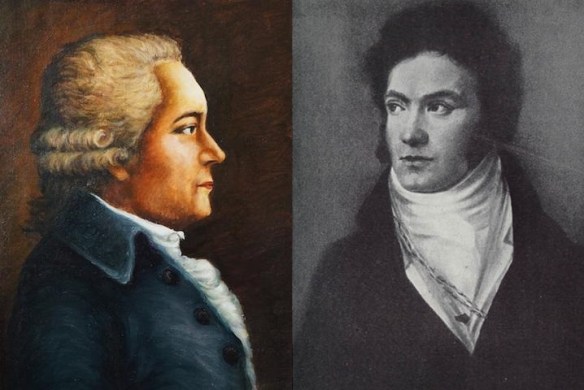
Carl Ditters von Dittersdorf (left) and the young Ludwig van Beethoven

14 Variations in E flat major Op.44 for piano trio (1790-92, Beethoven aged 21)

Dedication not known
Duration 15′

Listen

What’s the theme like?

Very simple – but Dittersdorf‘s theme has comic potential, as you might expect from a humorous stage work. In the right (or wrong!) hands this could be a bit po-faced.

Background and Critical Reception

Beethoven wrote a lot of chamber music for trio in his Bonn years – and a good deal in the key of E flat major too. This piece was not published until 1804, but is thought to have been completed in 1792 before he left for Vienna. Choosing a simple theme from a comic operetta by Dittersdorf, Das rote Käppchen (‘The little red cap’), he wrote 14 variations of varying character.

Writing to accompany the Florestan Trio recording of this piece on Hyperion, Richard Wigmore compliments Dittersdorf, whose ‘comically rudimentary tune is a vision of dry bones, as bare as the famous ‘Eroica’ theme which it faintly resembles.’ He also notes the glint in Beethoven’s eye and his predilection for mischief in several of these variations, most notably the ‘delicately tripping twelfth…’disrupted by an uncouth fortissimo outburst – Beethoven gleefully sticking out his tongue at rococo decorum’.

Thoughts

This set of variations is great fun, and you really get a sense of Beethoven flexing his compositional muscles and trying a few new things. From the first variation there are strong hints that he is going to have some fun with this theme – and so it proves. In the second variation the pianist enjoys the opportunity to flex the rhythms, bringing in the violin for a capricious third variation, before the baton passes to the cello for the benefit of its richer tone.

The ensemble passages have great energy, and for almost the first time we are getting a sense of the terrific forward drive in Beethoven’s music, especially in the propulsive movement of the sixth variation. A slow minor key deviation follows (variation 7), the cello and violin exchanging mournful thoughts, before the distant chugging of the violin and cello support a piano theme given in octaves. Variation 9 is lively and fun, while the syncopations of the tenth feel particularly advanced at this stage in Beethoven’s development.

As we approach the end, the second minor key variation (13) is even slower and more drawn out. This only makes the reappearance of the ‘home’ key all the happier, before a striking passage where the piano takes a sort of cadenza over the bare bones of the strings. Finally we return to the simplicity of the theme’s profile from the start, before a rush to the finish.

The variety and virtuosity of these variations is reminiscent of the earlier Venni Amore variations for piano, in their wide breadth of moods and techniques – and in their entertainment value, too.

Recordings used

Florestan Trio (Susan Tomes (piano), Anthony Marwood (violin), Richard Lester (cello) (Hyperion)
Wilhelm Kempff (piano), Henryk Szeryng (violin), Pierre Fournier (cello) (Deutsche Grammophon)
Daniel Barenboim (piano), Pinchas Zukerman (violin), Jacqueline du Pré (cello) (originally EMI Classics)

The superstar trio of Henryk Szeryng, Pierre Fournier and Wilhelm Kempff take their time with Dittersdorf’s theme in a very deliberate presentation, and Variation 2 finds Kempff in particularly airy mood – but it is really well judged. That said, they are still a good deal quicker than another superstar ensemble, including husband and wife team Daniel Barenboim and Jacqueline du Pré.

The best modern version of the variations comes from the Florestan Trio on Hyperion, which enjoys not just the sparkling pianism of Susan Tomes but also the closely-matched Anthony Marwood and Richard Lester. They all embody the first principles of chamber music by clearly listening to each other and responding in kind. As a result their recording is instinctive and fun.

Spotify links

Wilhelm Kempff (piano), Henryk Szeryng (violin), Pierre Fournier (cello) (Deutsche Grammophon)

https://open.spotify.com/track/2C1FUcjpsjZksRaaHoDfm4?si=QJYPb0DaRzqncTXuYd-itA

Daniel Barenboim, Pinchas Zukerman, Jacqueline du Pré

You can hear a clip from the Florestan trio version on the Hyperion website

Also written in 1792 Haydn Symphony no.73 in D major ‘La Chasse’

Next up An Minna

Listening to Beethoven #35 – An Laura


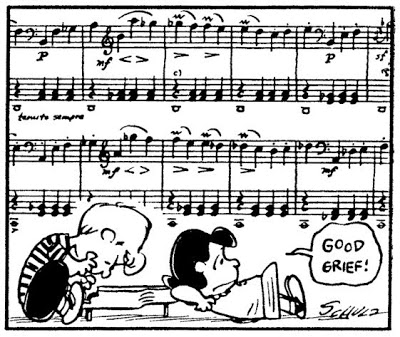
Peanuts comic strip, drawn by Charles M. Schulz (c)PNTS

An Laura WoO 112 for voice and piano (1790-92, Beethoven aged 21)

Dedication not known
Text Friedrich von Matthisson
Duration 3’40”

Listen

Background and Critical Reception

A note on this song from the Beethoven-Haus museum in Bonn tells us that Friedrich Matthisson first published this poem in 1785 in Hamburg, under the title An Serena. In 1787 however the poem appeared unchanged in the first edition of Matthisson’s poems, under the new title An Laura.

Beethoven’s setting followed soon after – maybe as little as three years – and only the first and third verses were written out under the music in the autograph score. This is taken as an indication that the first part was to be repeated for the second verse.

Thoughts

The message from this song is positive to begin with, joyful even – and the soprano line carries nicely above flowing piano accompaniment. Beethoven gets quite chromatic with the melody towards the end of the first two verses, before a change of mood in the central section heightens the drama.

After that brief aside we return to the music of the opening, if not the mood – a scene at the grave casting a shadow over proceedings. It is as though Schubert and Mahler are waiting in the wings at this point.

Recordings used

Pamela Coburn (soprano), Leonard Hokanson (piano) (Capriccio)

Peter Schreier (tenor), Gisela Franke (piano) (Brilliant Classics)

Pamela Coburn brings a relatively rich soprano line to this song. Peter Schreier is a fair bit quicker, pushing the melody along.

Spotify links

Pamela Coburn, Leonard Hokanson

Peter Schreier, Gisela Franke

Also written in 1792 Sterkel 3 Violin Sonatas, StWV 198

Next up 14 Variations in E flat major Op.44

Listening to Beethoven #34 – Punschlied


Peanuts comic strip, drawn by Charles M. Schulz (c)PNTS

Punschlied WoO 110 for voice, choir and piano (1790-92, Beethoven aged 21)

Dedication not known
Text Anonymous
Duration ’50”

Listen

Background and Critical Reception

This is another example of Beethoven setting a ‘Gesellschaftslied’ – a public form of the song, but in this case thought to be for private consumption. It is another drinking song, setting its anonymous text with a similar structure to the previous Trinklied.

A florid piano introduction brings in the singer, who encourages each of his friends to drink the punch as it goes round the room. The choral response is emphatic: ‘Wir trinken alle hocherfreut, so lang uns Punsch die Kumme beut’ (‘We’ll surely stay a merry bunch, as long as our cups stay full of punch!’)

Thoughts

This is a good complement to the Trinklied – and is pretty much the next gulp from the flagon, with high spirits and good cheer! For a second time Beethoven reads his room well, leading the festivities with music of celebration.

Recordings used

Hermann Prey (baritone), Heinrich Schütz-Kreis Berlin, Leonard Hokanson (piano)

Peter Schreier (tenor), Gisela Franke (piano)

Once again Hermann Prey is on fine form, with sprightly piano playing from Leonard Hokanson and a fulsome choir. They eclipse Peter Schreier’s slightly higher version, which lacks a choir and cuts out the piano introduction.

Spotify links

Hermann Prey, Heinrich Schütz-Kreis Berlin, Leonard Hokanson

Peter Schreier, Gisela Franke

Also written in 1792 Méhul Stratonice

Next up An Laura WoO 112

Listening to Beethoven #33 – Trinklied


Peanuts comic strip, drawn by Charles M. Schulz (c)PNTS

Trinklied WoO 109 for voice, choir and piano (1790-92, Beethoven aged 21)

Dedication not known
Text Anonymous
Duration 1’30”

Listen

Background and Critical Reception

In her essay on Beethoven as a song composer for Deutsche Grammophon’s Beethoven: The New Complete Edition, Helga Lühning notes how ‘there was no period during his creative life where he did not explore the field of vocal music and write for the human voice’.

She writes how Lieder was the prime form of expression, but that Beethoven also turned to the ‘Gesellschaftslied’, the public form of the song. A typical example of the form would be for a soloist to sing the verse and a choir to respond with a chorus.

The Trinklied is the first of one of these settings, a drinking song with an anonymous text encouraging ‘Erhebt das Glas mit froher Hand und trinkt euch heitren Mut’ (‘Raise your glass with a glad hand and drink your hearty courage’)

Thoughts

A playful piano introduction trips down the stairs before a lusty bellow from the bass encourages everyone in the room to raise their glasses. Beethoven has the measure of the crowd, with everyone included in the enthusiastic response! Then it’s no doubt straight on to the next song…and drink…

Recordings used

Hermann Prey (baritone), Heinrich Schütz-Kreis Berlin, Leonard Hokanson (piano)

Peter Schreier (tenor), Gisela Franke (piano)

Hermann Prey is in very good voice here, and the choir respond with full bodied tones. Peter Schreier’s tenor version, set a good deal higher in pitch, is a little more chaste, and there is no choir to back him up. That said, his brighter tone rings out clearly.

Spotify links

Hermann Prey, Heinrich Schütz-Kreis Berlin, Leonard Hokanson

Peter Schreier, Gisela Franke

Also written in 1792 Haydn 150 Scottish Songs, Hob.XXXIa:1–150

Next up Punschlied WoO 110