Unknown's avatar

About Arcana

My name is Ben Hogwood, editor of the Arcana music site (arcana.fm)

Listening to Beethoven #20 – Piano Trio in E flat major WoO 38


Piano trio – an image used by the Viennese music publisher Artaria on the title page of several of its publications of the mid-1780s

Piano Trio in E flat major WoO 38 for piano, violin and cello (1790-91, Beethoven aged 19)

Dedication not known
Duration 17′

Listen

Background and Critical Reception

The piano trio was a growing form in the latter part of the 18th century, thanks principally to the work of Haydn and Mozart. Haydn tended towards works which gave the piano most prominence, with violin and particularly cello in a more accompanying role. Mozart was a little more lenient with the stringed instruments, but as we will see it was Beethoven who fully freed up the form.

This early work, however, stays true to the example of its predecessors, a mark in the sand if you will. Richard Wigmore, writing for Hyperion’s fine cycle of the piano trios from the Florestan Trio, sums it up. He describes the E flat work as a work that was ‘doubtless played with members of the Elector’s orchestra. This slender, amiable three-movement work seems almost tentative beside the ambitious Opus 1 trios. But it contains much charming, unassuming music, together with occasional prophetic touches’.

Wigmore delights in the subtle inventions of the third movement in particular, including a ‘quiet sideslip to a surprise key in the coda’…an ‘early example of a Haydnesque gambit which Beethoven would fruitfully exploit in the years to come’.

Thoughts

The piano leads off, setting the scene for a work where the violin and cello play largely second fiddle, so to speak, to the keyboard. It is an attractive theme, and Beethoven develops it in a relatively safe way.

However the second movement, subtitled as a ‘Scherzo’, is also in E flat major – and does not really exhibit the qualities of a scherzo as we might expect, with not a great deal of wit or daring, which Beethoven would later introduce to the form. The trio feels like a much safer composition as a result.

With no slow movement, the third movement is also based in E flat major, by which time we have pretty much had enough of this key, despite the attractive, open writing. There are some more adventurous moments in this movement, a couple of moves towards the minor key and some lower and quite intriguing murmuring in the inner parts that Wigmore highlights – but these are all relative.

Beethoven has got the form of the piano trio under his pen with relative comfort, but the feeling persists there will be many more radical statements to come in this form.

Recordings used

Florestan Trio (Hyperion)

Beaux Arts Trio (Philips)

Wilhelm Kempff (piano), Henryk Szeryng (violin), Pierre Fournier (cello) (Deutsche Grammophon)

ALl three recordings are excellent, though perhaps inevitably the superstar trio of Kempff, Szeryng and Fournier bring impressive gravitas to even the slightest of music in this piece. They also employ a couple of daring held passages, pulling back the reins on the tempo before moving off again. Either of the three performances has much to recommend it – the Beaux Arts are charming and light footed, while the Florestan Trio are affectionate.

Spotify links

Beaux Arts Trio (Philips)

Wilhelm Kempff (piano), Henryk Szeryng (violin), Pierre Fournier (cello) (Deutsche Grammophon)

Also written in 1791 Mozart Piano Concerto no.27 in B flat major K595

Next up Musik zu einem Ritterballet WoO 1

Switched on – Bibio: Sleep On The Wing (Warp Records)

Reviewed by Ben Hogwood

What’s the story?

Bibio has timed this release rather well. Sleep On The Wing is essentially a short album or a long EP, depending on your view – but it is an exploration of life in the wake of a loss, as well as a study of escaping the city to find peace in the countryside. In that sense Bibio – real name Stephen WIlkinson – is uncannily reflecting what many city commuters have found during the Coronavirus lockdown period, that an extended period in the country can shift the patterns of the mind considerably.

Sleep On The Wing is a deepening of Bibio’s folk connections too, using field recordings to bring the pure sounds of the countryside into the music, but also continuing his love of acoustic instruments. It has ten tracks and lasts just under half an hour.

What’s the music like?

Blissful. If you were indeed looking for music to help you escape the city, or as a distraction from the overwhelm brought on by electronic media in recent times, then this is definitely for you.

The music feels like a carefree celebration of the countryside, respectfully done but beautifully voiced. The pastoral language is soft but never too twee, and feels as green and pleasant as the beautiful cover from Joe Giacomet.

There is a slightly woozy feel about Bibio’s vocals, and when applied to the title track they give an appealing and slightly whimsical air. On Oakmoss they complement the rich acoustic guitar lines and ruminative violin,

The instrumentals are rather lovely. The Milky Way Over Ratlinghope spins a picturesque tale with the silvery tone of a viola and treble lines that include brief reveries for flute and wordless vocal. By contrast Awpockes is led by a softly picked guitar, while A Couple Swim follows the ripples of the water with the lazy lapping of its guitar,

The field recordings add to the charm. With what sounds like a thrush singing over running water, Bibio ensures Lightspout Hollow is bursting with life, while Crocus has a murkier profile.

Does it all work?

Yes, beautifully. Bibio’s songs or instrumental threads never outstay their welcome – if anything they could easily be stretched out for at least half their length, for his compressed way of working means time is never wasted.

Is it recommended?

Yes. Sleep On The Wing gets a strong recommendation, adding to the full to bursting Bibio discography a half-hour of pastoral charm. He is a remarkably consistent producer, but even so this is up there with his best work.

Listen

Buy

You can buy Bibio’s new release from the Warp Records website

Switched on – Ellen Allien: AurAA (BPitch Control)

What’s the story?

Ellen Allien is riding the crest of a creative wave. AurAA is her third album in as many years, and finds her descriptive music exploring the notion of unseen energies controlling Earth.

As with much of her solo work Allien uses every instrument at her disposal, including the voice – though there are no songs as such here.

What’s the music like?

Mysterious but also affirmative. Allien’s music draws strongly from primal energy, so although the subject matter may often be unseen, she gets terrific momentum behind her music through full-bodied, four to the floor productions.

AurAA harnesses this energy quickly. After the mysterious introduction of Hello Planet Earth, In Music I Trust strips back to the basics and cranks up the tempo, hitting the dancefloor and not looking back. The pounding bass drum is a familiar companion through the album, used for strong effect on Walking In The Dark, dfgdf and Auraa itself, though the textures often pan back to reveal darkly mysterious backdrops.

Allien’s vocals are strange and otherworldly, entirely in keeping with the album’s subject matter but also complementing the dark colours from which she paints her electronic pictures. Walking In The Dark is quite creepy, its vocals transposed and used as the melody, while . That said, there are flashes of light too – as the album cover implies. Hello Planet Earth appears in its original form later in the album, and shimmers in the darkness, while Traum dances with enormously positive energy, acidic oscillations lighting up the sky.

AurAA’s nine tracks are linked together seamlessly, written in the form of a DJ set – so that the breaks between each function as dancefloor-friendly breakdowns – and the closing track, Human, offers a brooding coda in which to come down.

Does it all work?

Yes. AurAA leaves a powerful and personal impression, and the way Allien uses her vocals only heightens the intensity. As an album with a concept it works really well.

Is it recommended?

Yes – well up to the high standards Ellen Allien has consistently met in her album career to date.

Listen

Buy

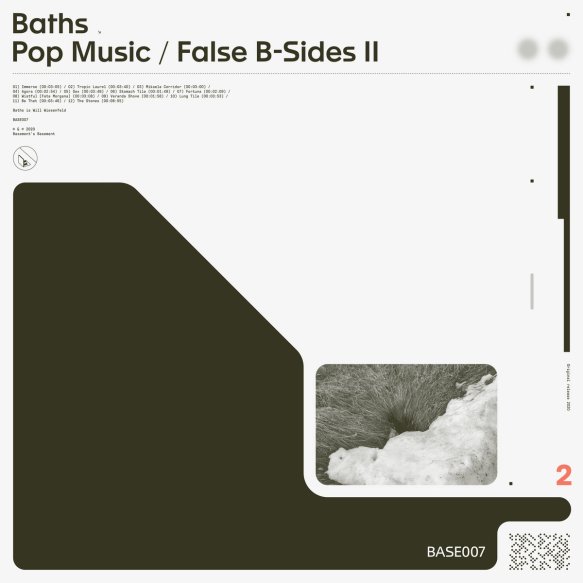
Switched on – Baths – Pop Music / False B-Sides II (Basement’s Basement)

What’s the story?

As its name begins to imply, Pop Music / False B-Sides II is a second chance for those ideas which Will Wiesenfeld has not been able to find a home for. Until now, that is. He has been through this process once before, around the time of release of his first album as Baths, Cerulean, but here he repeats the exercise as the first release on his own new Basement’s Basement label.

The fragments Wiesenfeld has drawn together are from a wider chronological area, but the lyrics – where used – are recent.

What’s the music like?

Soft. That’s not an insult, but Wiesenfeld has a nice set of electronic colours at his disposal, creating tracks that are notable for their dappled shades, their winsome lyrical couplets and some nicely constructed rhythms.

On songs like Mikaela Corridor and Sex, Wiesenfeld sounds like a softer version of Bombay Bicycle Club, especially in the latter’s couplet ‘Is this love or is this focus’. At other times he runs closer to singer / songwriters like James Yuill in his combination of intimate productions and songs that are easy to relate to.

Immerse is a blissful beginning to the album, while Wistful (Fata Morgana) gets a nice combination of busy beats, warm textures and Wiesenfeld’s soothing vocal. Meanwhile Stomach Tile has a dreamy fusion of guitar and piano.

The most meaningful song is The Stones, a substantial piece of work with the added personal reference that Wiesenfeld’s late father loved the line ‘I still trust that men can be lovely, do what you like, but do it to me’. It is softly sung, surrounded by shimmering electronics and calming keyboards. Be That runs it close, with some beautifully layered vocals that typify the warmth of the Baths production experience.

Does it all work?

Yes. Wiesenfeld’s sound world is extremely reassuring, and on headphones the extra musical material in the middle ground brings extra layers to the songs. It is the music of a solitary mind, but looks outwards and upwards. Ultimately Wiesenfeld’s positivity shines through.

Is it recommended?

Yes – although it is not a substantial listening experience, Baths devotees will have no problem in snapping this up. Those looking for blissful late night experiences are also encouraged to follow their instincts.

Listen

Buy

Switched on – Apparat: Soundtracks: Dämonen (It’s Complicated Records)

What’s the story?

This is the third release in a series of soundtrack recordings from Apparat, aka Sascha Ring – who has made a name of himself as an accomplished instrumental music writer. This piece of work dates from 2015, when Apparat wrote and performed the score to a theatre play of Dostoevsky’s Demons, directed by Sebastian Hartmann.

Sascha wrote the sound- track and performed live in Frankfurt with Philipp Thimm and Christoph Hamann as Apparat. He then re-recorded and arranged this release with Thimm in his Berlin studio.

Dämonen is Apparat’s second collaboration with Hartmann – the first, Krieg und Frieden (Leo Tolstoy’s War and Peace), has been released on Mute.

What’s the music like?

Hartmann described Apparat’s working style as ‘no beating about the bush, no fussing about frills – just working together and getting something done – staying inspired.

That approach comes across in the music for Dämonen, setting the scenes with economy and effectiveness, and never resorting to overindulgence. There are some moments where Apparat invokes the spirit of Hans Zimmer, for example in the closing scene Amos where the radiant textures are boosted by intelligent writing for the organ. Habakuk, too, has a swell and shimmer that we would associate with the older composer, but it is never derivative – Apparat’s harmonic language is very clearly his own.

The cello plays a leading role here, taking charge in Hosea and Jona, where it adds a strong melodic profile. By contrast Sacharja is a lovely, intimate scene with plucked strings, drawing the ear with its changing in mood and colour. The piano plays a subtle but important part in Maleachi, setting a slightly ominous pulse.

Does it all work?

It does. Less is definitely more in the writing here, and Apparat uses texture and harmony to get many of his deeper thoughts. The cello elevates the music wherever it appears, while the more brooding numbers such as Hosea do make a strong impact without obvious melodic material to match on to.

Is it recommended?

Yes. Sascha Ring has always written music of great depth under his Apparat alias, and he is perfectly suited to film or theatre – or both. Even if you don’t know the story of Dämonen, the music will tell you a good deal of what you need to know.

Listen

Buy