Havergal Brian Symphonies – No. 2 in E minor (1931); No. 14 in F minor (1960)
Royal Scottish National Symphony Orchestra / Martyn Brabbins
Summary
Dutton continues its traversal of Havergal Brian’s symphonies in the company of the Royal Scottish National and Martyn Brabbins, whose live recording of the Gothic symphony from the 2011 Proms (Hyperion CDA67971/2) confirmed a Brian interpreter of real perception.
What’s the music like?
Brabbins and the RSNO make a persuasive case for the Fourteenth Symphony, unheard since its premiere by Edward Downes in 1969 and here receiving its first recording. In his seminal study of Brian’s symphonies (Kahn & Averill), the late Malcolm MacDonald considered this to be the worst of the whole cycle – but it has arguably greater cohesion than the comparable one-movement works on either side; notably with the brooding introduction that segues into a resolute Allegro then a ‘slow movement’ whose restiveness is typically Brian. The return of the Adagio as a formal pivot brings the most dramatic music, but neither the intermezzo nor Allegro sections that follows sustains momentum on the way to a brutally decisive coda. Less than the sum of its best parts, No. 14 is by no means the low-point as has often been credited.
Brian was never to hear his Second Symphony, its first performance by Leslie Head in 1973 followed in 1979 by a broadcast with Charles Mackerras. An earlier studio recording by Tony Rowe and the Moscow Symphony (Naxos 8.570506) did it scant justice, but Brabbins gets far closer to the heart of a work inspired by Goethe’s play Götz von Berlichingen, and described by Brian as representative of ‘‘MAN in his cosmic loneliness: ambition, loves, battles, death’’.
With its glowering woodwind and stark pizzicato strings over three sets of timpani, the first movement’s Adagio introduction is a striking invention and if the main themes of its Allegro are a little inflexibly drawn, Brabbins ensures their purposeful correlation through an eventful development and on to a coda that collapses into darkness. Even finer is the slow movement whose sequence of developing variations on a plangent cor anglais melody which finds Brian at his most questing harmonically; its dense textures scrupulously rendered here. The scherzo adds eight horns – making a total of 16 – organ and two pianos to a large orchestra, though its surging climactic pages are less memorable than the expectant and resigned music either side. A funereal procession, the finale’s Wagnerian gestures do not impede its powerful unfolding to an eloquent episode for divided cellos, before it builds to a baleful climax and fateful close.
Does it all work?
For the most part, yes. Undeniably among Brian’s lesser symphonies, the Fourteenth can at last be judged on its own terms (the central climax arresting in context), while the Second’s head-on confronting of late-Romantic symphonism at the height of European neo-classicism yields often impressive results; not least in the oblique rhetoric of its Andante (might Brian have heard Henry Wood’s Proms performance of Myaskovsky’s Silentium in 1929?). The status of Brian as one of the last century’s most individual composers is further reinforced.
Is it recommended?
Indeed. As on previous Dutton releases, the sound yields admirable detail within its spacious sound balance, with John Pickard’s notes as extensive as they are informative. A worthwhile coupling of these contrasted yet characteristic works from different periods of Brian’s output.
Scott Morgan (above) is the Vancouver-based producer behind the music of Loscil. Under this moniker his music is often found filed under ‘ambient’, but in reality it has more of a foreground impact through its deep and meaningful content. He talks with Arcana about his experiences of classical music, how it can be found in the fringes and structures of his work, while discussing his methods of composition and personal investment in the music.
Can you remember your first encounters with classical music?
That’s a tough question! I don’t know if I can remember listening to what I understand as classical music, as I wasn’t really from a musical family at all. I’m quite sure my first exposure would have been to some sort of film or movie. I did eventually go to university for music, and it’s funny because even though I took music at high school – saxophone and playing in a rock band – I don’t remember a relationship with classical music until later.
I was studying from modernism and moving on, and of course a lot of that is rooted in classical music. Certain composers like Schoenberg and Stravinsky had their more retro periods; they were doing their experimental stuff and went back to more kind of tonal, traditional classical stuff.
I always look back and kind of regret that my parents never put me in piano. My first exposure to music was through my uncle who gave me an acoustic guitar which I self taught, and then I took saxophone in high school. I eventually gave up on that, but that was the road that led to me being more of a composer and an experimenter with studio stuff, in that I loved to play around with electronics and to muck with things and make sounds. I would pick up an instrument and learn how to play it but never that well, enough to make sounds with it.
In your encounters with classical music, who are the composers you have grown to admire?
I was really drawn to people like Ligeti and Penderecki, people like these 1960s composers who were doing stuff with texture and using the orchestra as a sound palette rather than writing melodies and harmonies and traditional stuff.
Xenakis too, and I really loved all that Webern twelve tone stuff. I was really drawn to this idea that you could play with texture, because texture and timbre – the colour of the sound – had always been present, and good orchestrators know how to manipulate that stuff, but it was never at the forefront, it was always rhythm and melody and harmony that were given all the attention.
When did you realise you had a real aptitude for working with texture in particular?
I wasn’t conscious of it in my teens when I was doing rock band stuff, but when I was first going to school the splinter for me was working with computers and electronics. I had a professor I worked with who was really in to this technique called granular synthesis, and actually Xenakis explored a lot of this stuff too. There are some overlaps with acoustic writing and practice, but granular synthesis is where you take a sound and you cut it up into a bunch of tiny grains or components, and it gives you this control over the sound in terms of multiplying it in density or growing it in time. You have this sculptural control over sound.
The first time I heard it and the first time most people hear this kind of process is so ghostly, and you hear all these voices that come out of the sound. The texture of it is so rich and inviting that it creates this instant kind of sound world, stretching and multiplying the sound. I was really taken by this process, and I think finding the connections from there into what people were doing acoustically was really interesting.
That’s why Ligeti is often a good acoustic counterpart in terms of building up these clouds and textures of sound. That was the genesis for me, and then I went on to muck with other computer, digital signal processing models to build up textures and sounds. That ended up being the root of the Loscil project, which has been about building these textures and working with sound in that sculptural way.
There’s something truly different from what you heard before, that eureka moment of doors opening, where you realise that you can think of it this way now. In my early school days I was having more moments like that with worlds opening up, and different ways of thinking about sound and music.
Your music has a vast sense of space in it. Is that something you are keen to have, or is it a by-product of how you write?
I think it’s a bit of both. When you’re working with electronics, everything is so instant in real time that you can almost be as much of an audience member or listener as you are a composer. I find there is this very zen-like state that I get in to making stuff where I can sit and listen to loops for long periods of time, and really enjoy that space, and in fact feel kind of guilty that I have to really impose myself on it as an editor and as a composer, to present it to people. I’ve done a couple of releases, one of them a digital release a few years ago called Stases.
It was this exploration of these long, drone-like textured arcing shapes that had a longer trajectory to them. They didn’t have really identifiable elements to them – rhythm, melodic components, and yet they have been some of my more popular recordings. People like to put them on and have them as this kind of aural wallpaper, while they’re writing or working on visual arts. I find people put these on as a mental stimulus. I get into these patterns when I’m working that is an altered state, half listening and have creating, and the tools let you do that. I guess a lot of instrumentalists get into a similar state, where you’re zoning out on scales or something.
I find your music very effective during travelling to work on the train.
Train travel is an interesting one. There is something inherent about the rhythm of the train and the movement outside the window and I assume a lot of commuters want to get out of the reality that they’re in when commuting!
What I perhaps wasn’t quite so prepared for at first was the depth of emotion or concentration in your music.
Sometimes there are things you can’t quite explain when you’re creating stuff, and where it comes from it’s hard to put your finger on. I know I am generally a happy person, but things come out when I’m making stuff! There is a way of using the creative process and the creation of music to express that which you can’t express in other ways, and that’s what ends up coming out a lot of the time.
With your new album Monument Builders, was it a coincidence to be releasing it on Remembrance Day, or was that planned?
It’s funny. I didn’t choose that, but I asked the label if it was intentional, and I got a three word reply that was something to the effect of ‘yes of course!’ I believe it was somebody’s intention, but not really mine.
Was it inspired by a particular event or set of events? I know you mentioned a link with the Philip Glass score to Koyaanisqatsi.
I rewatched Koyaanisqatsi, and the version I was watching was quite messed up. It was a VHS tape and the pitch was a little off, and the tracking on the machine, and I thought it was interesting. I saw it first in a Vancouver theatre, which has ironically been destroyed and replaced with condos, which is the Vancouver thing right now.
We’re such a young city, and that is my attraction to it. I used it for the cover of Monument Builders, a 1970s kind of brutalist thing. It is one of only a couple of buildings of that style in Vancouver now, everything else is like flashy glass towers. I found that related to Koyaanisqatsi as something that was very epic and meant to spark you and wake you up emotionally as to what is going on in the world – over consumption, over population.
Over time, as technology progresses, maybe what was once epic is no longer quite as epic, and especially when it was projected on an old format. It’s like you are looking into the past, warning you of the future. A lot of time has gone by now, over 30 years since that movie came out, and there is something interesting to me about that and relating it to architecture.
You look at our city, and my mum thinks that building is so ugly, but there is something beautiful about it too, and there will probably be one of the last things standing. It was a swarm of ideas about that kind of stuff. Some of it is admittedly a little dark but there is a core beauty about it too.
There is a certain brightness to your music too, for instance in the previous album Sea Island where there are bright, deep blues implied.
When I look back at most of my catalogue, I realise so much of it is unintentional when you’re inside it, but when you see it splayed out in front of you a lot of my work accidentally plays with the spectrum between the natural world and the industrial world. There are times when I have moved to one side over the other, but ultimately I think I’m after some sort of balance of what it is to be human, and what it is to be human inside of this natural world we live in. We are a part of it but we’re also outside of it – or we think of ourselves as out of it.
When you are writing with electronic sounds and samples do you feel like you are in charge of an orchestra, in a classical sense?
A little bit. I definitely take some of my musical education in terms of writing for instruments and apply that. You’re often working in tonal ranges or pitch ranges, the bass, the mids and the highs, and you’re always wanting to balance those things, and I definitely think I compartmentalise those things in a similar way. I don’t think of moving a melody among different instruments and things, but there is a slight touch that is definitely taken from acoustic writing.
Some of the Loscil tracks could in theory be played by an orchestra.
Yeah, I’ve actually tried to imagine that at times myself. It is a really interesting question, wondering how I could create this sound not using electronics and only using an orchestra. It would be a really fun challenge but I just need more money!
I think I have always really been a kind of acoustic composer at heart, who just ended up using electronics. I think that’s part of the reason I’m folding in acoustic instruments a lot of the time. On Monument Builders I wrote a lot for the French horn, I thought that would be interesting.
The final track on Monument Builders, Weeds – does that use cut-up vocal sounds?
Yeah, that’s my friend Ashley Pitre. She sang on a couple of tracks on Sea Island, and I had the samples still kicking around. I ended up using some processing on them, and it has some of the granular technique I was talking about, to chop up the voice a little bit.
When I play live I tend to leave that one towards the end, because you can’t do much after it! It has more of a dynamic range that is not as common in my work – most of it gets to a point where it sits at one particular level and will then gradually decay. That track really goes from nothing to everything over the course of seven or eight minutes, and when I do it live the volume gets quite a bit louder at the end.
Do you think your sense of structure has a lot in common with modern classical composers?
Yeah, maybe I’ve not experimented with structure as much as I could have done over the years. I did do a release, an interesting project with an Irish record company called Wist Rec, who asked me to score a novel and they were using these Penguin mini-classics, and asking composers to write music for this book. I was given Malcolm Lowry’s story Lunar Caustic, which is a short story about a pianist in New York who loses his mind and gets put in an asylum.
He mentions the Grieg music to Peer Gynt in his story, and listening to this in the asylum. I ended up writing and working with a friend of mine on the piano parts, and we ended up referencing elements of the Grieg piece. We played a lot more with the structure, and because the book is so structured it allowed us to think in a different kind of shape.
Normally I approach a piece of music as an isolated thing, and this was like four movements, so that was one of the few times I’ve stretched the structure away from what is common for me, which is making a bunch of pieces that might speak to one another but ultimately get compiled and turn out on an album. Because of vinyl’s popularity again you think about sides and the length of an album, and it’s interesting to be freed from that and be a little more flexible.
The original version with the book, I’m not sure if you can buy it anymore, but the version on Bandcamp is a reconstructed version with my friend Kelly Wyse, a pianist from Seattle.
What does classical music mean to you?
It’s a treasure trove. For me I would say any kind of music history. I am actually drawn more to early music, and the study of that alongside politics and history, and what’s going on in the world. I think you can draw so much looking back at classical music like that.
I also have an incredible respect and admiration for classical players. Any time I get an opportunity to work with performers who have dedicated their lives to an instrument, and are masters of that instrument, I have so much respect for it – probably because I am just not that person! I have not mastered an instrument. But the discipline that goes along with that, and the ability to read music off the page and understand an instrument so well that you can express through it, is fascinating to me.
Is that what makes electronic music so great, that it enables people to formulate more of what’s in their heads musically?
I think so, but I think there is another element with electronic music that you get the ability to not only do that but you get a feedback system, and get drawn in to areas of experimentation that you just would not discover. I think that’s a lot harder to realise than with a traditional approach of sitting at a piano and orchestrating. You don’t get that immediate feedback of what it does when you bend it and shape it. That’s relinquishing to the machine, but it is part of the process as well.
If you could recommend a couple of classical pieces for Arcana readers, that have maybe held a special place for you, what might they be?
Because we spoke about Ligeti I would definitely recommend Atmosphères. I’m obviously on the modern end of things here, but the opening of Koyaanisqatsi is high on my list these days. My composition teacher hated the minimalists, so it was held from us in a certain way, but I discovered those on my own later. He was really into Schoenberg and Stravinsky.
I love Gregorian chant, too, and Thomas Tallis. There is something about that modal music, and because it is religious music it is performed in these massive churches and cathedrals with their massive reverb.
Reverb now is such a massive part of electronic music, so the idea of a fully natural reverb is fascinating and interesting, and also when you think of what we are drawn to electronically does have its roots in religious music. I’m not a religious person but it makes you wonder if something fundamentally spiritual is being handed down in that sense.
Loscil’s album Monument Builders is out now on Kranky. For more information on Loscil and Scott Morgan, head to his artist website
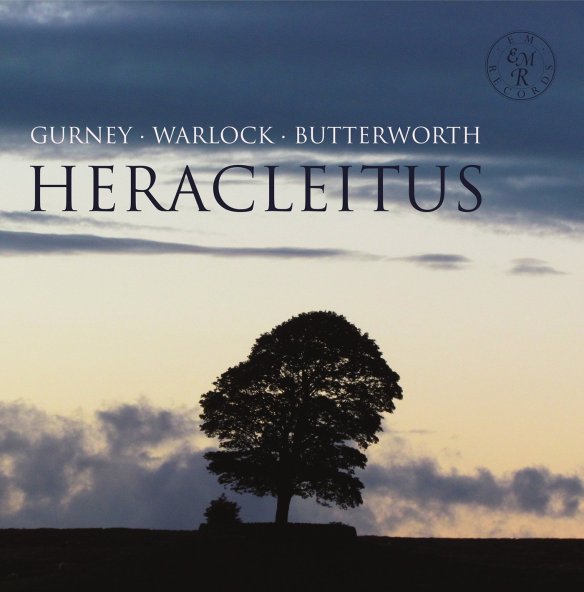
Butterworth: Songs (1910/11)*/** – When the Lad for Longing Sighs; Bredon Hill; On the Idle Hill of Summer; With Rue My Heart is Laden. Songa (1911/12)*/** – Fill a Glass with Golden Wine; On the Way to Kew
Gurney: Ludlow and Teme (1919)*/**/***. Adagio (1924)***. Songs*/** – The Cloths of Heaven (1918); Severn Meadows (1917); By a Bierside (1916).
The centenary of the Battle of the Somme has seen various commemorations in music, with this latest release from EM Records among the most significant. It centres on two composers – one of whom died during the Somme offensive, while the other never recovered from being gassed at Passchendaele the next year. The disc also opens-out appreciation of their output in featuring autonomous pieces for string quartet and as accompaniment to several of the songs.
What’s the music like?
All these forces are brought together in Ludlow and Teme, Ivor Gurney’s song-cycle on verse from A.E. Housman’s collection A Shropshire Lad. A notable though unstable creative force in those years after the cessation of war, it was long considered among Gurney’s largest and most inclusive works; its expressive range more than compensating for any lack of sustained intensity across its six songs. One of these, ‘On the Idle Hill of Summer’, was set by George Butterworth prior to the War – his version confirming both a greater emotional lightness and textural subtlety which are no less apposite. Also included are two Butterworth settings of W. E. Henley, suffused by that dry wit and wistful charm emblematic of the Edwardian era. The disc closes with more Gurney – moving backwards in time so the pathos of W.B. Yeats’s The Cloths of Heavens, and poignancy of the composer’s Severn Meadows, is rounded-off by the eloquence of John Masefield’s By a Bierside in what ranks among Gurney’s greatest settings.
Two songs by Peter Warlock (aka Philip Heseltine, who seems to have avoided conscription via a mixture of guile and happenstance) are among several conceived with accompaniment for string quartet, and have been idiomatically arranged as such by John Mitchell. Of these, Heracleitus is a setting of W.J. Cory (after Callimachus) as evinces the influence of Bernard van Dieren in its sombre tread and harmonic richness, while that of Thomas Dekker’s Sweet Content exudes the chic vacuity which is often to be encountered in Warlock’s lesser songs.
The other two works are also first recordings. Odd that Butterworth’s Suite for String Quartet should have had to wait 15 years since publication, as it is the composer’s largest extant piece and offers valuable insight into his wresting with abstract forms. The opening Andante is well argued, though the Scherzando and Allegro might profitably have been integrated, while the fourth movement is insufficiently contrasted with a final Moderato whose faltering progress is indication of a project lacking the ultimate focus. Not so the Adagio from a String Quartet in D minor, seemingly the only surviving chamber work from Gurney’s final manic outburst of creativity and whose heightened emotion bodes well for a hearing of the complete work.
Does it all work?
Yes, when seen as an overall programme that skilfully interweaves its vocal and instrumental items to give a thoughtful and revealing portrait of the two main composers featured herein.
Is it recommended?
Indeed, not least as the contribution of Charles Daniels (best known for his interpretation and editions of Baroque music) is so attuned to the songs in question. Michael Dussek is as ever an attentive accompanist, and the Bridge Quartet continues its persuasive exploration of English music. Both recording and annotations are up to the customary high standard of EM Records.
Richard Whitehouse
For more information on their extensive catalogue of English music, visit the EM Records website
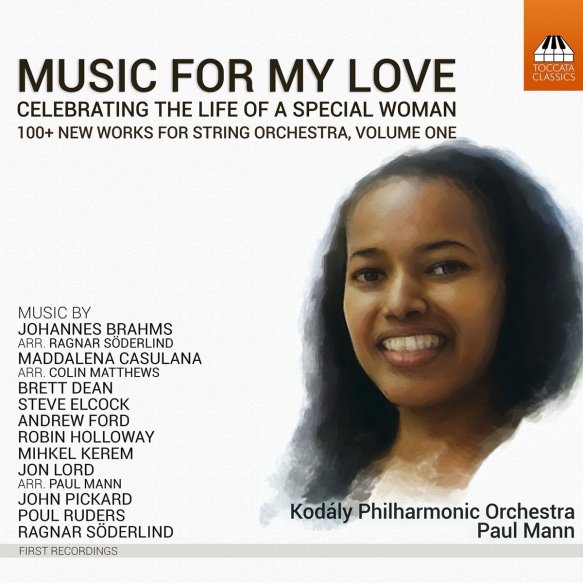
Brahms(arr. Söderlind) Von ewiger Liebe Casulana (arr. C. Matthews) Il vostro dipartir Dean Angels’ Wings (Music for Yodit) Elcock Song for Yodit, Op. 23 Ford Sleep Holloway Music for Yodit Kerem A Farewell for Yodit Lord (arr. Mann) Zarabanda Solitaria Pickard …forbidding mourning… Ruders Lullaby for Yodit Söderlind 15 Variations on a Norwegian Folktune
Kodály Philharmonic Orchestra / Paul Mann
Summary
The Music For My Love project has its basis in the life, cut short by cancer, of Yodit Tekle – the Eritrean-born partner of Martin Anderson, whose desire to commemorate her in music led to his contacting those composers he knew personally, resulting in over 100 pieces for string orchestra which he intends to record for his Toccata Classics label. This first volume takes in eight pieces and three arrangements, ranging from around two minutes to a full quarter-hour.
What’s the music like?
Appreciably more varied in expression than might be expected given the context.
Among the original pieces, Robin Holloway has written a pensive elegy whose dance-like central section offers but minimal contrast, whereas Poul Ruders contributes a wistful and affecting lullaby. Mikhel Kerem’s miniature amply sustains its rapt atmosphere, while Andrew Ford takes an earlier vocal setting for his gentle round-lay. Steve Elcock conveys a consolatory mood via the subtlest of means, then Brett Dean draws on an earlier piano piece in music of ethereally diffused harmony. John Pickard draws more obliquely upon an earlier cello piece for what is the most animated of these works in its textural contrasts, while Ragnar Söderlind takes the Norwegian folksong Oh, the cooling wind as the basis for 15 variations whose cumulative impact feels a little diffused in context – for all that its emotional consistency is undeniable.
Among the arrangements, the late Jon Lord’s evocative sarabande for string quartet responds effortlessly to Paul Mann’s skilful adaptation. Framing the sequence overall, Söderlind makes of Brahms’s song a threnody of Grieg-like plaintiveness, whereas Colin Matthews draws out the assertive eloquence inherent in a madrigal by the still little-known Maddalena Casulana.
Does it all work?
Indeed, given that it would have been all too easy to assemble a programme unrelieved in its emotional range. Thanks to judicious sequencing of the pieces at hand, this disc amply fulfils its commemorative function while also making for an hour’s absorbing listen in its own right.
Is it recommended?
Absolutely, not least as the Debrecen-based Kodály Philharmonic Orchestra responds with commitment to Paul Mann’s direction. The sound endows the string textures with plenty of space and definition, while booklet annotations are as comprehensive as ever from Toccata.
Richard Whitehouse
Further instalments in this worthwhile project are much anticipated: in the meantime, read more about its continuation via the Toccata Classics website
Romanian Cultural Institute, London; Thursday 3rd November, 2016
Enescu Prélude et Scherzo (1896)
Franck Prélude, Chorale et Fugue, Op. 21 (1884)
Liszt Mephisto Waltz No. 1, S514 (1862)
Enescu Piano Sonata in D, Op. 24 No. 3 (1935)
The Enescu Concerts Season at Romanian Cultural Institute continued tonight with a recital by Raluca Stirbat, the Vienna-based pianist whose advocacy of Enescu – his residencies as well as his music – has long been central to her activities.
Enescu’s music, what she termed the ‘frames’ of his piano output, book-ended this programme – opening with the Prélude et Scherzo which is the composer’s first piano work of real consequence. A little too rhetorical and rhythmically stolid as the Prelude may be, the Scherzo’s vivid alternating between devil-may-care impetus and (in its trio) elegant repose recalls the eponymous work with which the teenage Brahms announced himself some 45 years earlier. Good, also, that these pieces were heard together, as the resulting expressive duality was to inform Enescu’s thinking thereafter.
Franck had passed on by the time Enescu arrived at the Paris Conservatoire, yet his approach to harmony and texture undoubtedly left its imprint – not least the Prélude, Chorale et Fugue with which the mature composer returned to the solo medium after several decades. Keeping its discursive manner in check, Stirbat duly pursued a secure course through the Prelude and maintained a keen textural clarity in the Chorale, before the Fugue wended its eventful course to a culmination where cyclical ingenuity and emotional fervour were bound together as one.
If Liszt is a less discernible influence on Enescu, the sheer virtuosity and lack of inhibition in much of his piano music is an audible touchstone; not least as deployed in the First Mephisto Waltz. Stirbat despatched the opening pages of this ‘dance in the village inn’ with requisite abandon, and if the central section slightly hung fire, this is arguably as much Liszt’s fault in overly delaying the transformed return of that earlier music; the latter being projected here as characterfully as were the teasing insouciance then the surging irony of its heady conclusion.
The main programme (played without pause and from memory) ended with the Piano Sonata in D which was to have formed the final part of Enescu’s Op.24 sequence had he completed its central portion. Despite advocacy from such as Dinu Lipatti and John Ogdon, the present work enjoys only infrequent revival – doubtless owing to its technical difficulty but also its singularity as music that opens ostensibly in the world of the late Baroque only to close with that of a renewed Classicism.
Stirbat had the measure of the initial Vivace’s rhythmic agility, then brought understated eloquence to the central Andante with its improvisatory variants on a motive of blithe self-effacement, before the final Allegro evinced purposeful onward drive toward an apotheosis which superimposes all the salient themes in a truly joyful outpouring.
A demanding recital, then, which Stirbat rendered with unflagging commitment and resolve. She returned for two encores: first the Baccanale from the Third Piano Suite by Constantin Silvestri, given with due physicality, and the Bourrée from Enescu’s Second Piano Suite – which, as was pointed out, is linked to the finale of the Third Sonata thematically as well as in terms of key. It made for an exhilarating conclusion to an impressive recital that reaffirmed Raluca Stirbat’s authority in the piano music of her native country’s pre-eminent composer.
Richard Whitehouse
The next event in the Enescu Concert Season is a recital by soprano Valentina Naforniţă on Friday 2nd December. More information at the Romanian Cultural Institute website