Unknown's avatar

About Arcana

My name is Ben Hogwood, editor of the Arcana music site (arcana.fm)

Switched On – Various Artists: Ambientale: compiled by Charles Bals (Bureau B)

by Ben Hogwood

What’s the story?

Bureau B describe this compilation, put together by Charles Bals, as “a journey into otherworldly sounds from the years 1983 – 2000”, a journey that takes in a wide range of artists and musical styles. From Patrick Ryder’s notes, “Ambientale sees Charles leave the human world behind, exploring all the world’s wilderness on the scale of an IMAX epic. Rainforest, savanna, seascape and sand dune blur into one under digital manipulation, questioning the balance of nature and technology and wondering whether AI might discover the blueprint of all life and all planets. There’s also a little room on the mood board for the striking underwater cinematography and lush soundtrack of Luc Besson’s The Big Blue, a film he first saw in 1987 at an open-air theatre in the same Southern French resort that inspired ‘Club Meduse’.

What’s the music like?

Bals has chosen a wide variety of music in all shapes and sizes, but one thing that runs consistently through this compilation is its ability to paint a picture.

There are some striking sounds and vivid pictures here. Akira Mitake‘s duo, Yasha and Modernism, are memorable, typifying the weird and wonderful feel this compilation gives. Greece Ambientale, by Individual Sensitivity, has a cosmopolitan feel, like some of Jean-Michel Jarre’s far out ventures. Steve Shenan‘s evocative Evening In The Sahara has shady detective score overtones, underlaid by a lovely heat haze. The one that sticks in the memory most, however, is the nocturnal, saxophone-led Velvet Blue Circles, mournful yet uplifting like the soundtrack to a David Lynch film.

Does it all work?

Pretty much. The variety here is considerable – so there is a chance that there will be one or two tracks that don’t immediately appeal. Conversely, there will be new discoveries and sounds to enjoy, which is the joy of encountering a compilation like this.

Is it recommended?

It is – for music that’s easy on the ear but also rather different, Ambientale is a really good eye-opener. It will doubtless introduce you to some new names to chase up.

Listen / Buy

For streaming and purchase details, visit the Boomkat website

Published post no.2,493 – Thursday 3 April 2025
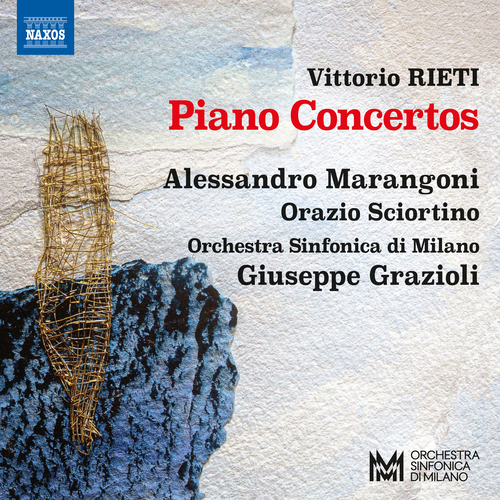
On Record – Alessandro Marangoni, Orazio Sciortino, Orchestra Sinfonica di Milano / Giuseppe Grazioli: Rieti: Piano Concertos (Naxos)

Rieti
Piano Concerto no.1 (1926)
Piano Concerto no.2 (1937)
Piano Concerto no.3 (1955)
Concerto for Two Pianos (1951)

Alessandro Marangoni, Orazio Sciortino (pianos), Orchestra Sinfonica di Milano / Giuseppe Grazioli

Naxos 8.564505 [80’27”]
Producer Stefano Barzan Engineer Cinzia Guareschi

Dates: 21-22 August 2022, 17-20 August 2023 (Piano Concerto no.3, Concerto for Two Pianos) at Auditorium di Milano

Reviewed by Richard Whitehouse

What’s the story?

Naxos continues its enterprising 20th Century Italian Classics with the concertante works for piano by Vittorio Rieti (1898-1994), the Egyptian-born Italian composer whose years in Paris then New York and Chicago afforded contact with a range of illustrious musicians and artists.

What’s the music like?

Dedicated to Poulenc and likely inspired by the success of Prokofiev’s Third Concerto earlier that decade, Rieti’s First Piano Concerto brings a deft touch to its ostensible neo-Classicism – whether in the martially-inflected playfulness of its initial Allegro, laconic but also beguiling ambivalence of its central Andantino, or the theatrical high-jinx of a final Allegro whose nod towards jazz rhythm marks this out as a piece decidedly yet always unaffectedly of its time. Seemingly forgotten following its premiere (by the composer?), its revival is well deserved.

Just over a decade on, the Second Piano Concerto emerged from material originally intended for a harpsichord concerto. On a similar scale to its predecessor, the opening Allegro has an impetus that denotes the uncertainty spreading throughout Europe at this time, and which is intensified by the central Adagio with its plangent discourse between soloist and orchestra; a quality the final Allegro (which follows with barely a pause) does not so much overcome as dismiss through an energetic repartee which brings about the nominally affirmative ending.

By the time of his Third Piano Concerto, Rieti was well established in the United States such that the present work is audibly in the lineage of American works for this medium of the post -war era. Any undue portentousness in the introductory Largo is dismissed with the vivacious Allegro that follows, then the central Andantino confirms that, while Rieti’s idiom might not have altered substantially over his career, it gained in subtlety and depth. Any more ominous expression is avoided in the final Allegro as it wends a capricious course to its decisive close.

Written in the wake of his relocation to the USA, the Two-Piano Concerto helped to establish Rieti’s reputation in a very different cultural climate. There is little moderate about either the tempo or character of the impetuous opening Allegro, then the central Allegretto comprises a set of variations’ which takes its unassuming theme through a diverse range of moods without losing focus on route to the pensive close. The final Allegro turns away from any encroaching inwardness with its energetic fugal interplay such as makes for an ending of pointed defiance.

Does it all work?

It does, provided one accepts Rieti as a product of his age rather than trailblazer or innovator. Stravinsky, Prokofiev and even Jean Françaix are prominent in the stylistic mix, with a more tensile aspect derived from Copland in the works of his American years. Not that this should offset enjoyment of music that feels never less than communicative and often engagingly so, particularly as regards the latter two pieces. Both of these were recorded way back in the LP era, but to have all four works rendered in such sympathetic readings is hardly to be gainsaid.

Is it recommended?

It is, not least when Alessandro Marangoni (alongside Orazio Sciortino) is so attuned to this music, while Giuseppe Grazioli obtains a committed response from the Milan orchestra. The succinct booklet notes are highly informative and further enhance the appeal of this release.

Listen & Buy

For purchase options, you can visit the Naxos website. For information on the performers, click on the names to read more about Alessandro Marangoni, Orazio Sciortino, Giuseppe Grazioli and the Orchestra Sinfonica Milano. An interview between Vittorio Rieti and Bruce Duffie can be read here

Published post no.2,492 – Wednesday 2 April 2025

In appreciation – Enrique Bátiz

by Ben Hogwood

Yesterday we learned of the sad news of the death of Mexican conductor Enrique Bátiz. A flourishing pianist, Bátiz soon turned to conducting, and in 1971 was founder of the State of Mexico Symphony Orchestra. where he worked until 1983, at which point he became music director of the Mexico Philharmonic Orchestra. In 1984 he became principal guest conductor of the Royal Philharmonic Orchestra, a post he held for several years.

Below is a link to a Tidal playlist containing a number of his colourful orchestral recordings, including an important series devoted to Mexican classical music on ASV in the 1980s:

https://tidal.com/browse/playlist/0b007840-2fc1-415d-8282-1890abd440b4

Published post no.2,491 – Tuesday 1 April 2025

On this day – the Violin Concertos of Henryk Wieniawski

by Ben Hogwood

Here is a chance to highlight a composer not often covered in these (or any) parts – for today marks 145 years since the death of Polish violinist and composer Henryk Wieniawski.

While not a prolific composer, Wieniawski was one of the first in his country to write substantial violin concertos, and the two he completed are both tuneful and characterful. You can listen below, in performances from Gil Shaham, with the London Symphony Orchestra conducted by Lawrence Foster:

Published post no.2,490 – Monday 31 March 2025

In concert – Matthew McKinney & Roelof Temmingh @ Bechstein Hall, London

Matthew McKinney (tenor), Roelof Temmingh (piano)

Program including songs by Robert and Clara Schumann, Richard Strauss. Full repertoire list at the bottom of this review

Bechstein Hall, London, 28 March 2025

by John Earls. Photo credit below (c) John Earls

Scottish tenor Matthew McKinney is the winner of the 2024 Kathleen Ferrier Awards and there was quite a sense of anticipation for this recital with pianist Roelof Temmingh at the suitably intimate Bechstein Hall.

Performance is of course the key element in voice and piano recitals such as this. But it is also exciting to be presented with a programme that has clearly been put together with such thought and care. Under the theme of Finding Freedom this programme consisted of two parts. The first was an alternating Clara and Robert Schumann affair, the second a more eclectic but no less engaging mix.

The Schumanns’ set consisted of rotating Clara and Robert Schumann songs neatly threaded together in a lovers’ exchange. It demonstrated not only the consideration and skill of the programming but the quality of Clara’s as well as Robert’s songwriting. McKinney’s singing was beautiful throughout.

The set also included two pieces of recited poetry, Afrikaans poet Breyten Breytenbach’s Red-breasted Dove and Rabindranath Tagore’s Unending Love, both of which deftly complimented the sentiment.

For the first half the audience was requested to save applause until the end of the set, entirely appropriate for the mood and respectfully observed. For the second half however McKinney advised “please do clap any time you want to”. And just as well as this was a much more varied affair including a couple of Robert Schumann solo piano pieces for Temmingh to shine.

Opening with Frank Bridge’s Love Went A-Riding it also included two Benjamin Britten songs, a forceful Batter My Heart (from The Holy Sonnets of John Donne) immediately followed by a tender Sonnetto XXX (from Seven Sonnets of Michelangelo), and a rendition of Tosti’s Marechiare that was full of brio and panache.

There then followed a lovely and affecting sequence. Rebecca Clarke’s I’ll Bid My Heart Be Still (originally composed for viola but ‘reimagined’ here for voice), Robbie BurnsAe Fond Kiss (McKinney unaccompanied) and Temmingh’s own Verjaarsdagbrief (Birthday Letter) based on a letter written by his grandfather to his grandmother and sang in Afrikaans by McKinney who then looped back to Ae Fond Kiss. The audience silence afterwards was marked and sincere.

The set concluded with a couple of well delivered Richard Strauss songs which led to the inevitable and deserved calls for an encore which McKinney admitted they didn’t have so we got a repeat of the magnificent Marechiare which was gratefully received.

Matthew McKinney and Roelof Temmingh performed the following repertoire:

Breytenbach Red-breasted dove
Clara Schumann and Robert Schumann songs interspersed:
Clara Ich stand in dunkeln Träumen Op.13/1, Liebeszauber Op.13/3, Volkslied, Lorelei,
Robert Der Nussbaum Op.25/3, Volksliedchen Op.51/2, Zwielicht Op.39/10, Kreisleriana Op.16/8 (solo piano), Mondnacht Op.39/5
Tagore Unending love
Clara Der Mond kommt still gegangen Op.13/4, Die stille Lotosblume Op.13/6
Robert Die Lotosblume Op.25/7, Widmung Op.25/1

Bridge Love went a-riding H.114
Weir Sweet Little Red Feet (from The Voice of Desire)
Robert Schumann Ritter vom Steckenpferd Op.15/9
Auden What’s in your mind, my dove, my coney?
Britten Batter my heart Op.35/2, Sonnetto XXX Op.22/3
Robert Schumann Vogel als Prophet Op.82/7
Tosti Marechiare
Clarke I’ll bid my heart be still (reimagined); Trad Scots Ae fond kiss
Temmingh Verjaarsdagbrief
Richard Strauss Befreit Op.39/4, Zueignung Op.10/1

John Earls is Director of Research at Unite the Union. He posts on Bluesky and tweets / updates his ‘X’ content at @john_earls

Published post no.2,489 – Sunday 30 March 2025