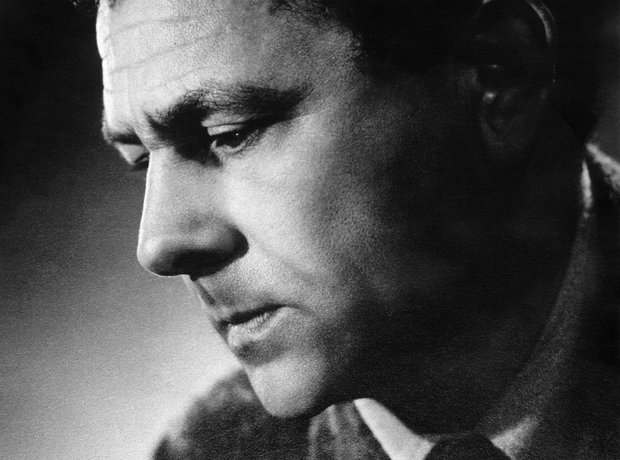
Today marks the anniversary of the death of composer Joaquin Rodrigo in 1999, at the age of 97.
Rodrigo can claim to have written one of the 20th century’s most popular pieces, the Concierto de Aranjuez, for guitar and orchestra. The concerto’s Adagio is especially treasured, and can be heard at the heart of this performance:
Another popular Rodrigo piece is the Fantasía para un gentilhombre, also for guitar and orchestra:
Eighty years ago today, two landmark operas of the 20th century received their world premieres.
Britten’s Peter Grimes, given its first performance at Sadler’s Wells under Reginald Goodall on 7 June 1945, is a breakthrough work in his output, one that would tie his music indelibly to the Suffolk coast. Telling the story of Grimes, the outcast fisherman, it captures the mysterious North Sea in rare clarity. You can read more about the opera’s history at my Good Morning Britten site, dedicated to the composer. The video links below are to a complete performance of the opera, with the Royal Opera conducted by Colin Davis:
Meanwhile the famous 4 Sea Interludes extracted from the work, Britten’s remarkably pictorial orchestral suite, are below – where you can follow the score:
Prokofiev‘s War and Peace is an altogether different beast – a mammoth project which first reached the public in the Great Hall of the Moscow Conservatory on 6 June 1945, where nine scenes from the opera were performed.
The finished opera is an epic dramatisation of Leo Tolstoy’s novel, which occupied Prokofiev from 1941 right up to the year of his death, 1953. Here is a famous recording conducted by Mstislav Rostropovich:
by Ben Hogwood Picture from the Bain Collection, Library of Congress
This day marks the centenary of the premiere of one of Prokofiev‘s most remarkable works, the Second Symphony. It was first performed in Paris on 6 June 1925, under the baton of Serge Koussevitsky.
It is difficult to imagine a work of greater contrast to the first symphony in the composer’s output, the much-loved ‘Classical’. Where that was a masterly updating of the classical style, bursting with good tunes, the Second initially impacts as a cacophony of noise and seemingly devoid of melody.
Listen more closely, however, and you will hear some distinctive themes beyond the bluster, some innovative orchestration and a highly original approach to form drawing initially from Beethoven’s 32nd and final piano sonata. Perhaps inevitably these qualities were lost on the first audience, who recoiled from the piece. Their reaction gave Prokofiev serious doubts about his ability as a composer.
Yet time has treated this piece relatively well, with no less a composer than Christopher Rouse showering it with praise. Listen below and see what you think:
This day marks the anniversary of the premieres of two Haydn symphonies, from the group of 14 known as the ‘London’ symphonies.
The two works in question are the Symphony no.97 in C major, and the last of Haydn’s symphonies, the one known as the ‘London’ symphony – no.104. Both can be heard below:
A personal post for today, which marks the 10th anniversary of the passing of my mother Coralie. If you’ve been reading Arcana for a while you might know that I have a lot to thank my mum for, not least in terms of musical inspiration! Here is a post I wrote nearly ten years ago, detailing her influence.
Here, though, I would like to leave one of her favourite classical pieces, Dvořák‘s Symphony no.8 in G major – not least because it’s a beautiful spring day in the UK, which she would have loved! Keep resting peacefully, Mum.