The annual Gramophone Awards, a celebration of the classical music recording industry, took place on Wednesday, giving critics and listeners alike a chance to recognise the creative excellence of the last year.
The Choral award went to an unlikely winner – this frankly amazing program of John Cage choral works, recorded under lockdown by the Latvian Radio Choir and conductor Sigvards Klava for the consistently excellent Ondine label from Finland. If you have thought of Cage as an unapproachable musical figure then this extract – among many other pieces – should persuade you to think again:
There is only one tune to start the day with today…and it’s the Eurovision anthem – or, as it is known in classical circles, the Prélude to Marc-André Charpentier’s Te Deum. Written in the final decade of the 17th century, this bright opener has shown itself to be an incredibly versatile piece of music, capable of beginning a larger-scale sacred piece but equally well-suited as a fanfare for trumpet and organ, or organ alone.
You can hear it in its original context – followed by the whole of the Te Deum…
If you’d prefer, here is the Prélude on its own:
Now, though, it is treasured as the music we hear before a certain singing contest gets underway – so without further ado, let’s celebrate!
The Coronation of King Charles III and Queen Camilla may only have been yesterday at Westminster Abbey, but you can already purchase the music thanks to Decca.
The official album includes all the pre-ceremonial music, featuring Sir Bryn Terfel and Roderick Williams, and also the 12 new, specially commissioned works from Andrew Lloyd Webber, Patrick Doyle, Iain Farrington, Sarah Class, Nigel Hess, Paul Mealor, Tarik O’Regan, Roxanna Panufnik, Shirley J Thompson, Judith Weir, Roderick Williams and Debbie Wiseman.
All of this was book-ended by two concerts of sacred music broadcast on BBC Radio 3 for Holy Week, both demonstrating what a unique and valuable choir they are.
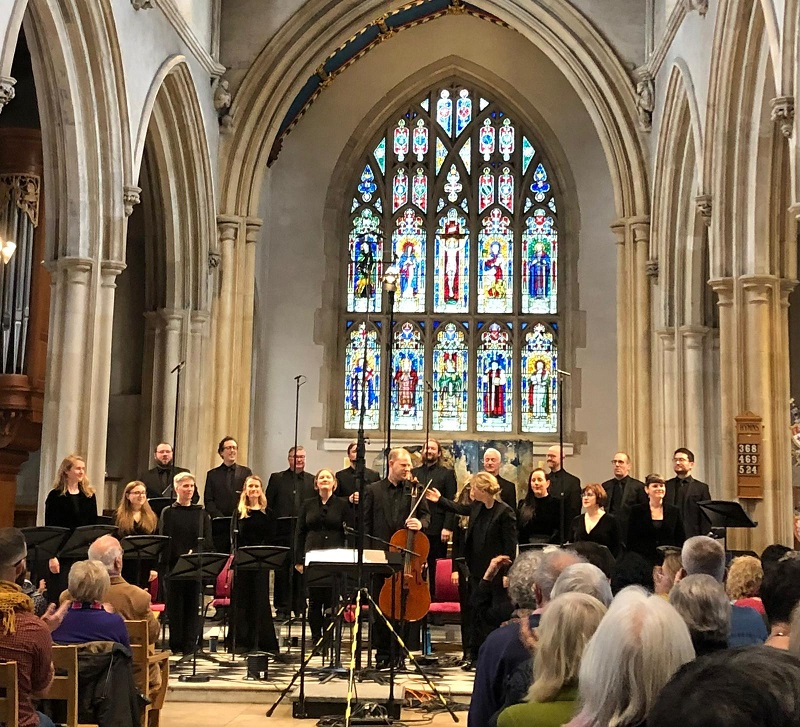
On 17th March they gave their first concert following the BBC’s shameful axing announcement at St Giles’ Cripplegate in London. It was inevitably a special and emotional occasion. The programme of choral and cello music went under the bitterly ironic title of All Will Be Well (after Roxanna Panufnik’s piece of the same name which concluded the programme). “I’m still the producer of the BBC Singers” said Jonathan Manners in his introduction to much applause.
The concert was a fitting example of the range and depth of the choir’s repertoire in terms of time (it opened with Hildegard von Bingen’s O cruor sanguinis from the 12th Century) and style. It displayed impressively their ability to convey a sense of comfort and balm such as in Lesia Dychko’s short piece Blessed be the name (Emma Tring a beautiful solo soprano) as well something more unsettling like Fac me tecum pie flere by Sven-David Sandström.
But this was a programme of choral and cello music and cellist Benjamin Hughes was individually expressive as well as combining powerfully with the choir, both in evidence in Knut Nystedt’s Stabat Mater.
A magnificent encore of Maurice Duruflé’s motet Ubi Caritas was followed by a rapturous and moving ovation (below)
Today, we were joined by cellist @benhughescello and Chief Conductor @sjeannin in a programme for choir and solo cello 🎶
Thank you to all who joined us at a packed out @stgilesc 👏
The concert was recorded for future broadcast, stay tuned for more information 📻 pic.twitter.com/JJcJDh2dX6
Less than three weeks later, and following the BBC statement announcing a suspension of the closure, the group performed a Music for Maundy Thursday concert of sacred pieces on the theme of ‘contemplation, sorrow and reflection’ for live broadcast on BBC Radio 3 at St Paul’s Church, Knightsbridge, London (above).
Yet again the programme highlighted the sweep of their repertoire opening with a meditative motet from the 1590s, Vittoria Aleotti’s Miserere mei, Deus (from the first published book of sacred music by a woman) and also featuring sacred pieces from the 21st Century (Karin Rehnqvist’s I raise my hands and Judith Bingham’s Watch with Me), as well as William Byrd’s 14th Century The Lamentations of Jeremiah.
But there were two pieces where the group really shone to spectacular effect. Domenico Scarlatti’s Stabat Mater à 10, with Richard Pearce on chamber organ, was stunning and utterly compelling in its detailed delivery. Francis Poulenc’s Quatre motets pour un temps de penitence made a glorious finale.
One must also acknowledge the key role of Chief Conductor, Sofi Jeannin, always assured yet empathetic. To watch her conduct is a mesmerising experience in itself.
The extent to which the BBC Singers and Jeannin develop and promote a diverse repertoire (they have a 50:50 gender policy for composers whose music they perform), engage in learning and community work, regularly perform commissions and broadcast on Radio 3 (making their phenomenal output available to such a wide audience) is all part of what makes them so unique.
I have seen them many times over many years and they never fail to move me. These two concerts only served to prove just why they are irreplaceable.
John Earls is Director of Research at Unite the Union and tweets at @john_earls






 Arcana.fm