BBC Proms #26 – The Labèques, BBC Symphony Orchestra / Semyon Bychkov: Julian Anderson premiere, Martinů & Rachmaninoff

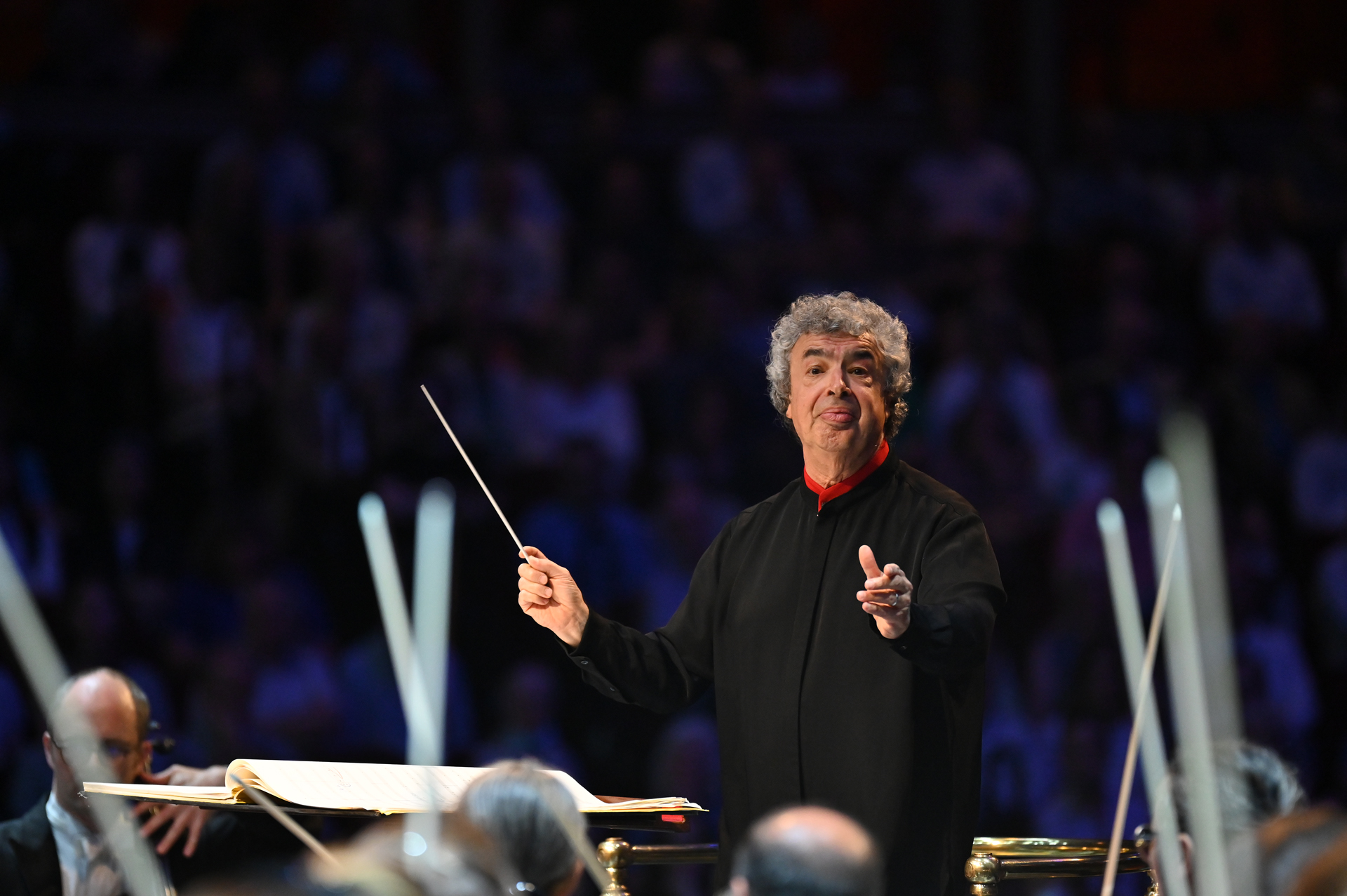
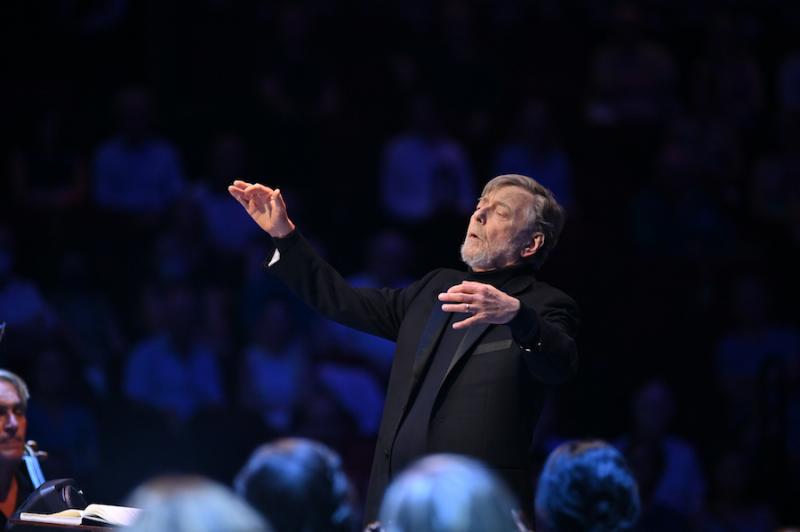
Prom 26 – Katia and Marielle Labèque (pianos), BBC Symphony Orchestra / Semyon Bychkov (above)

Anderson Symphony No. 2 ‘Prague Panoramas’ (2020-22) (BBC co-commission: World premiere of complete work)
Martinů Concerto for Two Pianos and Orchestra H292 (1943)
Rachmaninoff Symphonic Dances Op.45 (1940)

Royal Albert Hall, London
Friday 5 August 2022

Reviewed by Richard Whitehouse Photo (c) Chris Christodoulou

An unusually well-assembled concert this evening with what might be termed a programme of ‘three-by-threes’ – each of these three works having three movements which, in each case, results in a broadly symmetrical design, not least the Second Symphony by Julian Anderson (with the conductor, below).
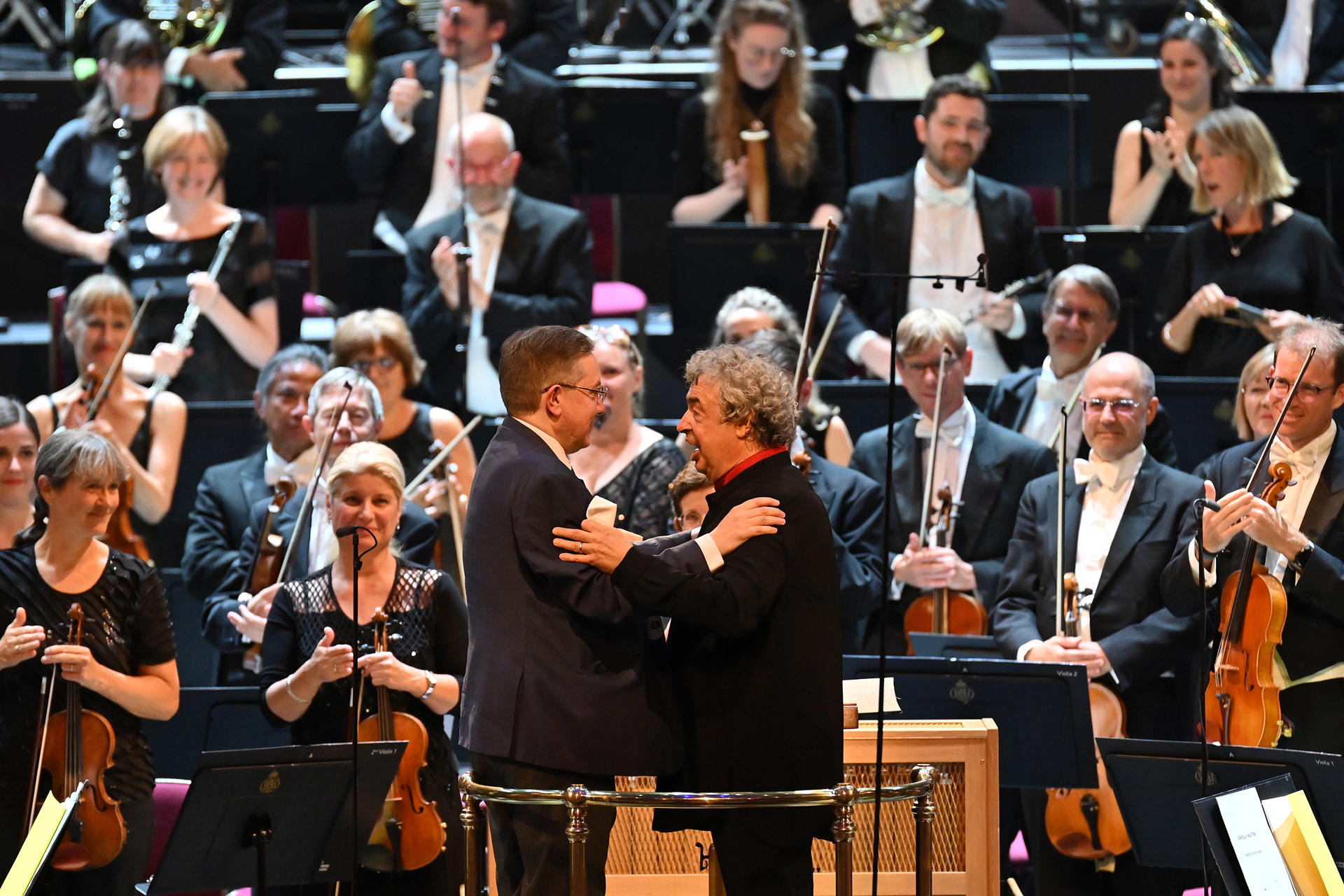
Inspired by Josef Sudek’s photographs of Prague while utilizing two medieval Czech hymns, Prague Panoramas (might Prague Pictures be even more apposite?) is typical in its fusing evocativeness with precision. Not least the preludial opening movement, its stark alternation of quick-fire chords and silence evolving into aspiring melodic lines as build to a tumultuous if quickly curtailed climax, though this linear aspect comes to dominate the nocturnal central movement with its expressive intensifications then fades against a backdrop of bell resonance and luminously modal polyphony. The finale is a deftly organized rondo – its energetic main material, inspired by Josef Lada’s almost Rabelaisian depictions of pub brawls, interspersed with more lyrical ideas through to the heady peroration later subsiding into a calm postlude.

Although its first two movements had been heard in Munich and Prague, this was the work’s first complete performance and found the BBC Symphony at its collective best – not least the lambently interweaving woodwind and strings, the visceral impact of brass and a substantial array of percussion whose contribution was pervasive. Semyon Bychkov (under-appreciated as an exponent of contemporary music) duly brought out that unity-within-diversity such as gave this work an underlying focus across the 32 minutes of its eventful yet cohesive course.
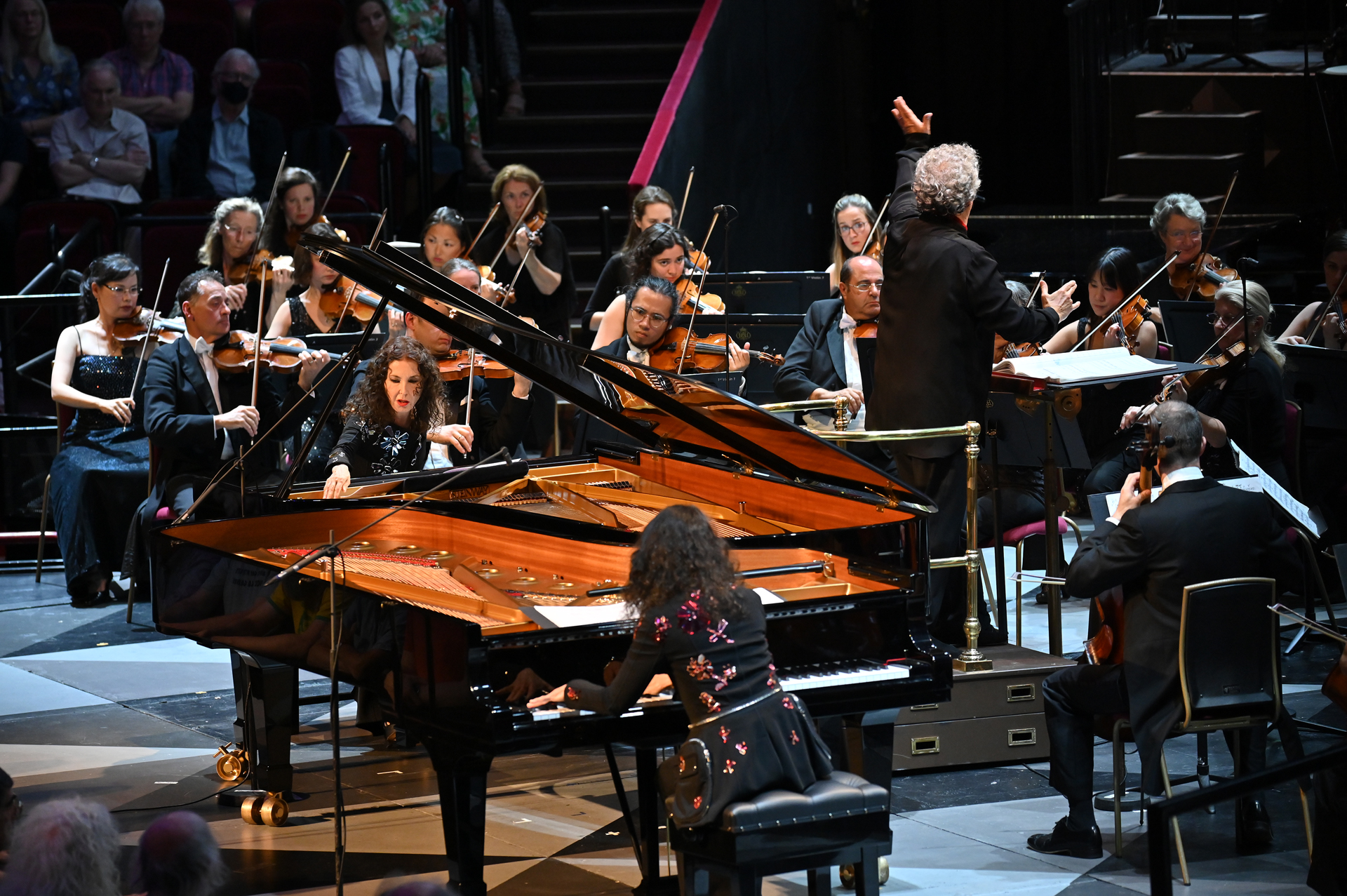
From Prague-inspired music by a British composer to that by a Czech composer in America – Martinů’s Concerto for Two Pianos may never have gained the plaudits of his earlier Double Concerto but it typifies this composer’s exile in a tried-and-tested interplay of folk-inflected melodicism with a harmonic acerbity recalling Prokofiev and rhythmic dexterity redolent of Stravinsky. Its undoubted highlight is a central Adagio whose almost ‘harmonie’ woodwind writing and circling piano figuration (had the composer come across the gamelan-influenced music of Colin McPhee?) feels mesmeric and affecting. Neither outer movement comes close in their audibly contrived amalgam of the rumbustious and lyrical, but this is music in which Katia and Marielle Labèque excel and tonight’s performance could rarely have been equalled.

Nor was there any doubting Bychkov’s authority in Rachmaninoff’s Symphonic Dances that followed the interval. Admittedly this now regularly played while technically exacting piece needed more rehearsal than the BBCSO was able to give it on this occasion, though the outer sections of the first dance had just the right ominous incisiveness and its middle part featured winsome alto saxophone from Martin Robertson. The second dance had irony and angularity aplenty, as was slightly offset by the strings’ less than unanimous response towards the close.

Its sombre ambivalence and intricate textures give the central span of the final dance a quality unique in this composer: if Bychkov might have endowed it with even greater intensity, there was no doubting his identity with this music here or on the way to its resplendent apotheosis.

For more information, click on the names of composer Julian Anderson – and for more on the artists, click on the names of Katia and Marielle Labèque, Semyon Bychkov and the BBC Symphony Orchestra. For more on this year’s BBC Proms as it continues, head to the Proms website

For more information, click on the names of composers Kalevi Aho and Kaija Saariaho – and for more on the artists, click on the names of Carolina Eyck, John Storgårds and the BBC Philharmonic Orchestra

BBC Proms #25 – Carolina Eyck, BBC Philharmonic Orchestra / John Storgårds: Kalevi Aho Theremin Concerto, Saariaho & Shostakovich

Prom 25 – Carolina Eyck (theremin), BBC Philharmonic Orchestra / John Storgårds

Aho Eight Seasons (Concerto for Theremin & Chamber Orchestra) (2011) (London premiere)
Saariaho Vista (2019) (Proms premiere)
Shostakovich Symphony no.15 in A major Op.141 (1971)

Royal Albert Hall, London
Thursday 4 August 2022

Reviewed by Richard Whitehouse Photo (c) Chris Christodoulou

John Storgårds has given some memorable Proms with the BBC Philharmonic in the decade since he became this orchestra’s guest conductor, and tonight was no exception for featuring a theremin concerto by Finnish composer Kalevi Aho. Its title Eight Seasons should be taken advisedly – the eight continuous sections encompassing a period from autumn to spring, as is reflected in the mostly restrained yet constantly changing textures which define a progression from the richness of Harvest to Midnight Sun with its serenity informed by new potential.

An instrument as fascinating to watch being played as it is to hear, the theremin has become the victim of its own ubiquity as an enhancer of atmosphere in film-scores and for musicians from Brian Wilson to Jonny Greenwood. Carolina Eyck was a dedicated exponent (evident in her encore-demonstration) – not least in the latter stages when her vocalise proved an enticing extension of her instrumental prowess, and the myriad timbral shifts more than compensated for the intermittent blandness of Aho’s acutely fastidious if not consistently involving music.

The layout of this piece (wind quintet and percussion alongside reduced strings) necessitated an early interval to prepare for those relatively lavish forces of Vista, Kaija Saariaho’s latest return to the orchestra and inspired by traversing the Californian coast from Los Angeles to San Diego. This is embodied over two cumulative movements – the expectancy of Horizons duly fulfilled with the mounting activity of Targets which itself subsides into an intensified recollection of the opening, now sounding as expansive as that ‘vista’ envisaged by the title.

Music so complex needs a sure hand to maintain its focus, the BBC Philharmonic responding with alacrity to Storgård’s attentive direction while he steered a convincing trajectory through what is likely Saariaho’s finest large-scale work for years – the intricacy and translucency of her writing having a panache which ensured this was manifestly a showpiece with substance. In particular, the sense of ideas being tentatively anticipated then vividly recalled added much to the evocative quality of music as formally substantial as it sounded expressively involving.

From recent Finnish orchestral works to Shostakovich’s last and most equivocal symphony is a fair step aesthetically, but Storgårds ensured the succession was a meaningful one. If it did not evince the ultimate in ominous irony, those laughs elicited from the opening movement’s stealthy activity and allusive inanity were for real – as, more regrettably, were those hesitant coughs denoting uneasy response to the slow movement’s emotional intensity as heightened by its sparseness of gesture, while not forgetting an eloquent response by cellist Peter Dixon.

Nor was the percussion found wanting in its almost concertante role, to the fore in a scherzo where the whimsical and sardonic found an unlikely accord. From its sombre initial gestures, Storgårds then had the measure of a finale whose central passacaglia built toward a powerful climax, and while tension dropped with the resumption of earlier ideas, the spectral transition into the coda was judiciously handled with the latter mesmeric in its deft profundity. Should the BBC Philharmonic need a new chief conductor, Storgårds might be worth approaching.

For more information, click on the names of composers Kalevi Aho and Kaija Saariaho – and for more on the artists, click on the names of Carolina Eyck, John Storgårds and the BBC Philharmonic Orchestra
BBC Proms #7 – Soloists, La Nuova Musica / David Bates: Purcell Dido and Aeneas

Purcell Dido and Aeneas (c1689)

Dido – Alice Coote (mezzo-soprano)
Aeneas – James Newby (baritone)
Belinda – Gemma Summerfield (soprano)
Sorceress – Madeleine Shaw (mezzo-soprano)
Second Woman – Nardus Williams (soprano)
Sailor – Nicky Spence (tenor)
Spirit – Tim Mead (countertenor)
First Witch – Helen Charleston (mezzo-soprano)
Second Witch – Martha McLorinan (mezzo-soprano)

La Nuova Musica / David Bates (harpsichord)

Royal Albert Hall, London
Tuesday 19 July 2022 (late night)

Reviewed by Richard Whitehouse Photo (c) Chris Christodoulou

After the existential confrontations of Vaughan Williams and Tippett earlier this evening, the more restrained yet no less acute expression of Dido and Aeneas came as a necessary tonic – with Purcell’s only through-composed work for the stage leaving a memorable impression.

The nature of its conception might remain as conjectural as the circumstances of its premiere, but there can be no doubt that this opera’s blazed a trail over the centuries that followed. Not the least of its attributes is a formal economy and a tensile dramatic trajectory whose ‘less is more’ aspect could scarcely be more evident. Neither is there any lack of expressive diversity in a score where elements of levity, even slapstick are aligned with a dramatic acuity which draws the three short but judiciously balanced acts into a cohesive and inevitable continuity.

Tonight’s concert performance manifestly played to these strengths. For the title-roles, Alice Coote brought gravitas and nobility of spirit to that of Dido, with James Newby an impulsive while knowingly fickle Aeneas. It was, however, Gemma Summerfield who stole the show as Belinda in rendering this most dramatically fluid of the opera’s parts with an emotional force, latterly foreboding, that was never less than captivating. Madeleine Shaw was larger than life if never overly parodic as the Sorceress, with Tim Mead a plangent Spirit whose intervention (from the organ console) seals the fate of the main protagonists. Credit, too, to Nicky Spence for an uproarious yet winning cameo as the Sailor in a scene whose Village People campery seemed entirely apposite in context and hence made this opera’s outcome the more affecting.

Directing La Nova Musica from the harpsichord, David Bates never lost sight of the dramatic continuity while ensuring an exemplary balance between chorus and ensemble. The former responded with a judicious combination of eloquence and discipline, whereas the emphasis on a continuo section of theorbos, harps and even guitar opened out but never obliterated the bracing string sonorities. Tempos were almost invariably well chosen, and though the final chorus was undeniably drawn out, this reinforced its postludial function to the work overall.

The past 58 seasons have since Dido and Aeneas given complete on four previous occasions, each time reflecting on how the opera was perceived at the time. Tonight’s performance was such a statement, and one as reaffirmed its greatness some 333 years after the first staging.

For more information on the 2022 BBC Proms season, you can visit the festival website. For more on the artists, click on the names for La Nuova Musica and David Bates.

BBC Proms #6 – BBC Philharmonic Orchestra / Sir Andrew Davis: Vaughan Williams & Tippett Fourth Symphonies

Prom 6 – BBC Philharmonic Orchestra / Sir Andrew Davis

Vaughan Williams Symphony no.4 in F minor (1931-4)
Tippett Symphony no.4 (1976-7)

Royal Albert Hall, London
Tuesday 19 July 2022

Reviewed by Richard Whitehouse Photo (c) Chris Christodoulou

Whether or not the Fourth Symphonies by Vaughan Williams and Tippett had previously been scheduled together, they made for a striking and provocative programme such as was its own justification. Omer Meir Wellber clearly thought so when this concert was planned and, even though indisposition had led to withdrawing from this year’s Proms, the presence of Sir Andrew Davis on the podium could hardly have been more conducive to the BBC Philharmonic Orchestra giving performances of the interpretive insight and technical conviction as were evident this evening.

Admittedly the Albert Hall’s opulent acoustic is never the best setting for VW4, the visceral impact of whose opening was inevitably diluted. Allowing for rather more expressive leeway than he might otherwise have done, Davis paced this explosive movement securely with just a slightly listless take on its coda detracting from the whole. The Andante was the highlight here – its fatalistic course exuding gravitas but never dragging, with the tritonal plangency of its main climaxes palpably in evidence and pathos of its final bars enhanced by an affecting contribution from flautist Alex Jakeman. This acoustic may have obscured something of the Scherzo’s contrapuntal ingenuity but not its sardonic humour or, in the trio, didactic coyness. The stealthy transition into the Finale could have had even greater cumulative focus, but what followed had all the requisite impetus – its central interlude raptly delineated, then the drama of its ‘epilogo fugato’ conveying increasing velocity through to the starkly inevitable return of the opening gesture and what is the most unequivocal four-letter ending of any symphony.

Interesting to recall the temporal distance between these pieces is now less than that between the Tippett and the present. Enthusiastically received at its Chicago premiere and one among a handful of his works still revived following his death, Tippett’s Fourth Symphony evinces  a ‘birth to death’ trajectory that differs – crucially so – from its assumed model of Sibelius’s Seventh in not being a cumulative design; its climax being rather the kinetic developmental paragraph at its centre and from where the piece fans out, in a sequence of evolving episodes, back to the launching of its introduction and onward to the passing of its coda. Although he may have directed performances of greater tautness, Davis here secured a persuasive balance between unity and diversity – bringing a metaphysical poise to its ‘slow movement’ then a deft whimsicality to its ‘scherzo’, whose respective qualities underlined the confrontational drama elsewhere. Lavish writing for brass and percussion helps makes this Tippett’s most virtuosic such statement, in which the BBC Philharmonic was rarely to be found wanting.

A less successful component of this reading was the latest attempt to represent the ‘breathing effect’ specified by the score, in which the real-time voice of CJ Neale seemed hardly more successful than those attempts of wind machine, sampler et al to realize Tippett’s speculative imagery. No matter – any such overreaching was part and parcel of this composer’s inherent ambition; an ambition, moreover, which his present-day successors would do well to emulate. Almost a century and half-century on, both these works pose challenges constantly to be met.

BBC Proms 2022 – a return to full fitness

by Ben Hogwood

How heartening it is to report on the announcement of a full-to-bursting BBC Proms season once again. The festival, now in its 127th year, is able to spread its wings post-pandemic, reaching out to the four corners of the British Isles to include large orchestral concerts and overseas artists once again.

There are of course far too many concerts to mention in full here, but some deserve an extra thick highlighter pen. From the small scale (Sir András Schiff playing Beethoven‘s last three piano sonatas) to the large (Sir Simon Rattle leading us and the London Symphony Orchestra from death to life in Mahler’s Resurrection Symphony) there looks to be something for almost everyone.

Concerts are spread much further afield this year, and an especially welcome move is the multi-region approach to the weekly chamber concerts, which will be broadcast from Belfast, Birmingham, Bristol, Cardiff, Glasgow, Liverpool, London and Truro. Outside of those appealing concerts, there really is such a huge variety

At a glance, the most appealing events include a tribute to Aretha Franklin curated by Jules Buckley, the wholly appropriate choice of Public Service Broadcasting to celebrate the centenary of the BBC in a newly commissioned piece, This New Noise, and concerts that bring centurion George Walker to the fore.

Lovers of British music will not be disappointed either. John Wilson conducts his Sinfonia of London band in Bax, Walton, Vaughan Williams, Elgar and the new Flute Concerto by Huw Watkins. The BBC Philharmonic Orchestra and Omer Meir Wellber will compare and contrast the Fourth Symphonies by Tippett and Vaughan Williams. Dame Ethel Smyth and Doreen Carwithen will get long-overdue appraisals – the Glyndebourne production of Smyth’s opera The Wreckers looks set to be essential, but so does her Mass in D major and Concerto for horn and violin. Meanwhile Carwithen’s String Quartet no.2 and Bishop Rock are welcome, though we could perhaps have done with one more piece from her.

Visitors from Germany (Berlin Philharmoniker), Austria (Vienna Radio Symphony Orchestra), Finland (Finnish Radio Symphony Orchestra) and Norway (Oslo Philharmonic Orchestra) provide four must-see concerts. To them we can add the Philadelphia Orchestra and Yannick Nézet-Séguin, who will perform Florence Price‘s Symphony no.1.

The music of Shostakovich will surely take on greater poignancy this season in the light of the awful tragedies unfolding in Ukraine – the Fifth, Tenth and Fifteenth Symphonies will all be loaded with extra meaning. The establishment of the Ukrainian Freedom Orchestra, however, will trump even these when they play the music of recently exiled composer Valentin Silvestrov, his Symphony no.7. Brought together by the Metropolitan Opera, New York, and the Polish National Opera, the brand new orchestra will by led by Canadian-Ukrainian conductor Keri-Lynn Wilson and will include recently refugeed Ukrainian musicians, Ukrainian members of European orchestras and leading musicians from Kyiv, Lviv, Kharkiv, Odesa and elsewhere in Ukraine.

This is just a flavour of the season, from which you will see that from first night Verdi to final night Sheku Kanneh-Mason and Lise Davidsen, there is so much to appreciate. Get over to the BBC Proms website and start planning!