You can listen to this Prom from its BBC broadcast here
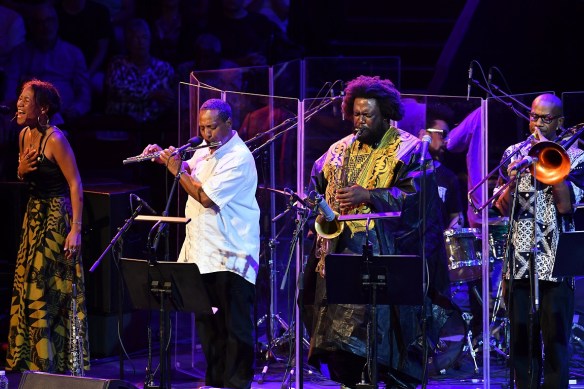
Late night Proms at the Royal Albert Hall are usually special – and this one even more so. Kamasi Washington arrived to a great fanfare in 2015, firstly for his work as orchestrator and band leader on Kendrick Lamar’s album To Pimp A Butterfly, then latterly for his extraordinary triple album Epic, released to great acclaim on Ninja Tune.
Washington, while perhaps not earmarked as the future of jazz, is definitely a figure to whom audiences are turning. Some approach him from the hip hop direction, from Lamar or Snoop Dogg, while others with jazz more embedded in their listening recognise the influences of Sun Ra and John Coltrane. But how would all these elements blend with a 32-voice choir and the strings of the City of Birmingham Symphony Orchestra?
Extremely well, as it turned out. It helps that Washington has a wonderful, almost beatific stage presence. He is a mixture of assertion and modesty, which suits his music too, for there were long, ecstatic phrases where the Royal Albert Hall itself seemed to be lifted from its foundations on a tide of good feeling. As the long phrases swelled from the ground up, supported by cellos, basses, the bass of Miles Mosley and the drums of Ronald Bruner Jr and Tony Austin, the treble instruments and assembled chorus were swept along on the good vibes.
That was certainly the case in Change of the Guard and The Next Step, while in The Magnificent 7 there was more of a soloistic approach, Washington’s band each invited to present their extraordinary virtuosity. Top of the pile were Mosley and pianist Brandon Coleman, both placed centre stage and forming a supple rhythmic base as well as a source of boundless musical enthusiasm.
However the praise for the effectiveness of the arrangements should also be directed at Jules Buckley, for whom this was a third appearance at this year’s Proms. Buckley is a master arranger, responsible for a lot of last year’s Ibiza Proms arranging but also this year taking on Quincy Jones and Jamie Cullum – each foils for the music of Washington, where he conducted the strings.
It also helps that Washington’s music is so well orchestrated, for although he allows his band solo time, in the quieter music things stripped back to allow the string orchestra room to be heard. Although they were swamped in the opener Change of the Guard there was plenty of room for the bittersweet cello lines of Henrietta, Our Hero to make a strong impact.
This was one of many high points in the concert, Washington introducing his father Rickey as they both paid homage to Kamasi’s grandmother in a song beautifully intoned by Patrice Quinn. There was a new piece, too, The Space Traveller’s Lullaby, which formed an effective mid-set interlude, stripping back to saxophone, trombone, voices and strings. Washington’s moving solo was backed by twinkling stars projected onto the backboard.
The music lingered long into the night. Some extraordinary phrases, both loud and quiet, issued from Washington’s saxophone, played with the utmost of care. His music has the power to move from tiny, quiet moments or through the massive, surging crests of the wave where all 80 performers were involved. Its wholly positive outlook won the day.
Alexey Stadler pictured during his performance of the Shostakovich Cello Concerto no.1, with the Royal Liverpool Philharmonic Orchestra conducted by Vasily Petrenko(c) Chris Christodoulou
The BBC Proms should be commended for their commitment to new music, though this does come with a caveat, for it is not often that a commission for the Proms makes it to a second or third performance. Hopefully that fate will not befall Emily Howard’s Torus, a joint commission with the Royal Liverpool Philharmonic Orchestra, who gave it a thoroughly committed and virtuosic first performance under Vasily Petrenko.
Torus is based on a mathematical phenomenon, but to Howard’s credit she did not make this the domineering feature of the piece – if she did, like all good composers, it was part of the essential framework rather than explicitly signposted. Instead we were able to enjoy the colours of the large symphony orchestra, and especially the percussion, the three players using bows on their cymbals to make the textures glint towards the end.
Though subtitled Concerto for Orchestra, there was no display of gravity defying, musical athletics for the sake of it. Rather we enjoyed the orchestra as an instrument, the melodic content taking on a distinctive falling motif as though the music were heading for a trap door.
Shostakovich’s popular Cello Concerto no.1 followed, with a last minute substitute, Alexey Stadler, standing in for the unfortunately ill Truls Mørk. Any doubts about inferiority were immediately quelled, the young Russian cellist finding the soul of the music in a searching account of the slow movement and cadenza in particular. Petrenko and the RLPO, so attuned to this composer’s music in their award winning accounts of his symphonies for Naxos, were superb in support, especially horn player Timothy Jackson – but Stadler rightly stole the show, adjusting to the acoustics of the Royal Albert Hall with commendable ease. His beautiful tone brought both pain and hope to the solo part in equal measure, and led to a gorgeous encore in the form of the Sarabande from Bach’s Solo Cello Suite no.2.
Finally Petrenko led his orchestra in the music of another composer with whom they share great familiarity – Rachmaninov. There are several warhorses in his output that are arguably overplayed in concert, but the Symphony no.3 is not one of them – and how wonderful it was in this account, with soulful melodies, sleights of hand from Petrenko and sudden bursts of light from the orchestra.
The tricky syncopations of the finale were expertly handled, the orchestra delivering the suddenly loud snaps like the slamming of a door, a thrilling effect in the live arena. Yet they were also alive to the music’s lyrical and occasionally less certain undercurrents, where leader Thelma Handy was a superb soloist.
As an encore Petrenko brought out Shostakovich’s arrangement of Youmans’ Tea For Two, and gave it a brilliant send-up, as though conducting the last night. It was a beautifully judged encore, and showed again just how much this orchestra and conductor enjoy working together – which is what it’s all about, surely!
Ask The Audience Arcana at the Proms This is the latest in the series where Arcana invites a friend to a Prom who does not normally listen to classical music. In an interview after the concert each will share their musical upbringing and their thoughts on the concert – whether good or bad! Here, Stuart Fitzsimon (above) gives his thoughts on Prom 53.
Alexey Stadler (cello), Royal Liverpool Philharmonic Orchestra / Vasily Petrenko
Emily Howard Torus (2016, world premiere); Shostakovich Cello Concerto no.1 (1959); Rachmaninov Symphony no.3 (1935-38)
It wasn’t particularly musical – music was never forced upon me – but I played the guitar as a school kid, and I did Grades 1 and 2 with classical guitar. I was in numerous choirs – the school choir, a chamber choir, the Queen’s Chapel of the Savoy Choir. I performed on Radio 4, and on tours in Switzerland and Italy. From a classical perspective I never played on a classical instrument. My brother played saxophone and keyboard, but I wouldn’t consider any of these to be orchestral instruments.
There were records in the house – more tapes than records – and I remember on holiday taking my mum and dad’s Beach Boys20 Golden Greats tape to France on holiday and playing it on loop. I remember their Beatles records, but I was never encouraged musically really – it just all happened!
I went to University. I originally wanted to be a policeman, but they wouldn’t offer me criminology as I didn’t have a law degree – they offered me part criminology, part sociology. I enjoyed the sociology far more, decided I didn’t want to be a policeman any more. So I did a degree, which didn’t have anything to do with what I wanted to do in my career or life!
So I started going to gigs, and meeting people who were into similar music as me – dirty London Indie of the time! I started managing bands, putting on bands, and realised then that I wanted to work in the music industry. I knew lots of people in bands and ended up going to a lot of those gigs for free, and thought why don’t I start putting on some bands? So that’s how my Flook night started that I did in London.
Could you name three musical acts you love, and why you love them?
Three acts I love are The Libertines, The Cribs and the Super Furry Animals.
The Super Furries are a band I fell in love with, having missed their first two albums. I got bored of the guitar because I couldn’t be bothered to practice around 14 or 15, and I stopped listening to pop music…but then I got into it again and went through the mandatory Oasis and Blur thing at the time in the mid-1990s. Then I started looking at the lesser bands I didn’t pick up at the time and Super Furries were one of them.
I remember listening to the Guerrilla album in the garden of my mate’s house, and it was the weirdest album I’d been introduced to by friends. Up until then it was dad rock, man rock, and then suddenly you’ve got this band writing stuff like intros before track 1 on the CD player! Playing a CD and immediately rewinding it to minus two minutes or whatever, like a secret hidden track, is pretty bizarre!
The rest of the album contains songs about chewing gum and mocking the concept of having a mobile phone. This was before they became ubiquitous! Super Furries saw all that kind of stuff coming, and knew how it was going to change people’s lives. It was a bizarre album for the instruments they used, the sound they made – the first weird band I got into!
I went to university and discovered a whole load of music I didn’t know about, the widest range of music from meeting different people. After that you settle into what you know and love and social groups that come off the back of that. After university I started gigging more and going on internet forums – before Facebook, MySpace – Face Party and Friendster were the networks of the time!
When I wasn’t doing data entry I was wasting time on internet forums, and the one I was on most was The Libertines.org. I met a hell of a lot of people through that – some of my very best friends today! It was a new thing in 2003-4, knowing people from log-in names and stuff. I remember when I first went to meet them in Camden and I told my mum, I think she was concerned I was going to get stabbed that night – what if they’re murderers?!
They didn’t kill me though, and the people I met from that social circle are very dear to me these days too. It all stems from the fact it was the Libertines board. My job is probably a result of people I met on that board, and knowing I wanted to get a job in music. I didn’t talk about the music to be fair! They were the band for a year-18 months who had their moment where they burned very brightly, and they pissed it all up the wall. They’re not the same band they were then, but I still love them for what they were.
The Cribs were one of the bands who got tagged on to what was known as the ‘Nigel’ scene, bands like Selfish C**t, The Unstrung, Special Needs. Some of the bands made the best out of being in that category, and The Cribs somehow got associated with it despite having nothing to do with London! They played a lot in Lodnon, stayed and crashed down here a lot, and I ended up going to a lot of their gigs.
They’re definitely my favourite live band, probably recorded band too, and I was fortunate to go in the studio when they recorded their second album, hearing Hey Scenesters! for the first time and recording with Edwyn Collins, an absolute legend. I was fortunate to record with them (on the song Martell) – they’re lovely blokes and a brilliant band. They’ve done very well to hold on to what they had in their early 20s.
What has been your experience of classical music so far?
I don’t really have any, although I was in choirs – I sang famous pieces like Verdi’s Requiem, Handel’s Messiah and Zadok the Priest. On the basis they are classical pieces it’s probably through those, singing them in concerts. In terms of going to watch music I can’t think of many situations other than the 6Music Prom with Laura Marling in 2013. I saw Carmen at the Royal Albert Hall but would say that was an opera rather than classical.
How would you rate your first Proms experience?
It was very interesting. I’d never considered going to a classical concert and standing up, like you do in the arena, ‘in the pit’. That was quite surreal, with people standing, sitting, lying down – all in their own world. It was a different type of person at the sides, a bit older, wiser, maybe richer. I really enjoyed it, I wasn’t expecting to stand but it was unexpected and enjoyable!
I’ve always thought of the Proms as a classical music event but as I was listening to the first piece I didn’t think it sounded classical! I would say it was more orchestral than anything else. The orchestra pinned it all together. The first piece she was talking about science and mathematics had influenced her, and it didn’t sound classical in the same way that the Shostakovich did, the more sorrowful, mournful Russian piece. The symphony screamed ‘classical’ at me though!
What might you improve about the experience?
It had the formula you spoke about before the concert, where you might get a piece you didn’t know to start with, and then the cellist – who was exceptional! – and then the symphony, the larger piece with all the instruments. I think that approach works well. If you started with the symphony people would probably leave when they’ve heard the bit they know, so I understand why it works that way.
I don’t know if I would necessarily change anything but I might do something more aligned to my personal tastes – musicians I love, a piece I have an affinity with – thinking about films I love with classical or orchestral music in. There are definitely things I would want to do but I don’t think I would change the theme of tonight’s event, I enjoyed it. The symphony was what I would expect from a night out at the Proms – quiet and then loud – but I loved it.
Would you go again?
Yeah, definitely. It’s not something I’ve ever gone and bought tickets for but I didn’t know you could do the standing option, and I’d do that again. You didn’t tell me what this night was about and I didn’t research it, but I was pleasantly surprised. If I was looking through a Proms calendar there is no reason why I would have chosen tonight, but it was probably a perfect example about what they are about. I would definitely go again, and probably go to a random Proms event – it would be as rewarding as someone you know. So after that I would wholeheartedly recommend going to watch the Proms!
For an hour Louis Lortie managed to transport the Cadogan Hall audience to even sunnier climes – to Venice and Napoli, to be exact. He did this through a well constructed program painting pictures of the Italian cities and regions from afar, for none of the chosen composers were Italian.
All except Rossini, that is – though the two Soirées Musicales chosen for this concert were given in arrangements made by Liszt. Typically these were hyped up for concert audiences, but as in most of Liszt’s transcriptions there is a sensitive side staying true to the original, and Lortie found that unerringly in the humour of La danza.
We transferred from Venice to Naples for Francis Poulenc’s brief but vivid three-movement portrait. The central Nocturne was the great find here, a really lovely bit of descriptive music bookended by two fast movements typical of Poulenc in their wit and, in the Caprice italien, a deceptively soft heart that Lortie delighted in showing us.
It was especially good to hear two of Fauré’s Barcarolles included, especially as Louis Lortie has realised his love of the composer’s music in a new disc from Chandos. The Barcarolles are real diamonds, perfect for listening at either end of the day, and are highly original in their elevation of an older art form all but ignored by other composers. Lortie showed concert audiences need not be dissuaded by them either, with a darkly shaded Barcarolle no.7, which found some of the Fauré’s shadowy writing encroaching from the edges like the approach of night. Meanwhile the distinctive motif of the Barcarolle no.5 was ever-present, though towards the end of this the pianist was too full with his volume at the bell-like top end of the register.
That said, his playing throughout was remarkably accurate and expressive, and both qualities were evident in a superb performance of Venezia e Napoli, the epilogue to part two of Liszt’s piano travelogue Années de Pèlerinage. The virtuosity on show was breathtaking in the final Tarantella, but it was the poetic depiction of the gondola and the slower Canzone, with its majestic interpretation of Rossini’s Otello, that really hit home.
Ask The Audience Arcana at the Proms This is the continuation of a series where Arcana invites a friend to a Prom who does not normally listen to classical music. In an interview after the concert each will share their musical upbringing and their thoughts on the concert – whether good or bad! Here, Tim Squier gives his thoughts on Prom 34.
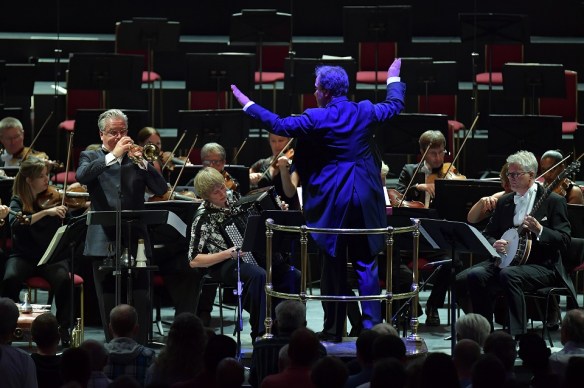
Håkan Hardenberger (trumpet), Claudia Buder (accordion), Mats Bergström, BBC Symphony Orchestra / Sakari Oramo
Dutilleux Timbres, espaces, movement (1990)
Gruber Busking (2007)
Beethoven Symphony no.5 in C minor (1804-1808)
It was my mum that brought me up, and in terms of music it’s not worth going there really! It was very middle of the road – Cliff Richard, some of The Beatles. I discovered most things myself pretty much, she would have the radio on sometimes – but when I first discovered my own music it was via an alarm clock, an FM radio that she gave me. It was all the pop of the time in 1984-1986 – Madonna, Prince, A-ha, your Now 1984. Certainly in my early years there was Band Aid – and I wasn’t particularly cool. There wasn’t anything of a classical background in there!
Could you name three musical acts you love, and why you love them?
Harold Budd is a big one for me. I do love my ambient and he doesn’t seem to put a foot wrong really. He just seems to have a certain emotion and style where you can just get lost in it. It can be background but it can be foreground as well. I can work to it, and not be fully tuned in, or I can be sitting down and listening to it and it works just as well.
I’m going for artists who have been with me for a long time, and Fleetwood Mac are an act that I could never really get enough of. They’ve gone through different phases like the 1980s pop side but I can also do the Peter Green stuff, and the Stevie Nicks especially. I just keep discovering new things off the albums too, like Oh Daddy from Rumours recently. Stevie Nicks solo – just brilliant, too. Not every single track but she’s the sort of person you can see her rehearsal footage on YouTube and it’s amazing. I’m watching it thinking it’s better than the album version!
For the third one I’ll go for someone electronic – Carl Craig. Certainly between 1990 and 1996 where he couldn’t put a foot wrong. He could do an ambient track, a banging techno track, stuff that doesn’t all into a genre – something for the dancefloor, something for the home. Carl recorded a lot of that on cassette tape, it didn’t sound very good but still did the business!
What has been your experience of classical music so far?
I think almost unintentionally my first experience of anything like classical music would have been through film scores. One of my best friends in London has been responsible for playing me some classical music but not so much for a long time now. I have been to one Prom before but it was a long time ago and I can’t remember the actual pieces – but I know I enjoyed it. I quite enjoy listening to it but I don’t know much about it. I’ve heard some Ravel before, and quite enjoyed that.
How did you rate your first Proms experience?
The Royal Albert Hall is always a joy, it’s a great venue – and the acoustics are really good for classical rather than pop I think. I really rated the first piece (the Dutilleux) and enjoyed that the most I think.
What did you think of the Dutilleux?
It was thoroughly enjoyable, I’m a real sucker for that deep sound from the lower strings – there is a certain orchestral sound I really love, the lower frequency, and you get a lot of that in film scores. There was a lot of that coming through and it flowed really well. I wasn’t bored at all, I really loved it.
What did you think of the HK Gruber?
It started out interesting, and the introduction was good, but the trumpet was too much of a focal point and I found myself drifting out. I was trying to listen to the background more but because of the positioning I was trying to hear what was going on my right hand side, but every time I tried I could hear the trumpet. There was a variety of devices going on (the mutes and three different trumpets – Ed) I’ll always give things a chance, and I tried but it didn’t work out!
And the Beethoven?
That was really enjoyable, a nice take on it – it’s been a while since I heard the entire piece and I think it really worked. There were some quirky moments, it was great watching the whole orchestra. There was one really young player who really stood out (oboist Henry Clay), he was really good. Another thing going back to the first piece, the Dutilleux – the percussion was great. With the Beethoven I loved the whole thing and there was a really nice stereo effect coming through, the clarity was there more and I could pick up on certain things, especially being a bit of an audiophile.
There are bits you forget as well – you don’t get them played on Capital Radio four times a day after all! It was good to hear those. So I think the Dutilleux first, then the Beethoven, then the Gruber.
Would you go again?
Absolutely, for sure. I’m quite open to new musical experiences and will try most things but would do this again!
Verdict: SUCCESS
You can read Arcana’s review of the whole Prom here – and you can listen to it on the BBC iPlayer




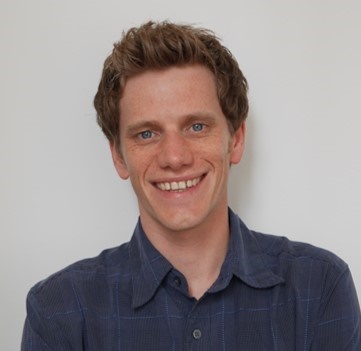 This is the latest in the series where Arcana invites a friend to a Prom who does not normally listen to classical music. In an interview after the concert each will share their musical upbringing and their thoughts on the concert – whether good or bad! Here, Stuart Fitzsimon (above) gives his thoughts on Prom 53.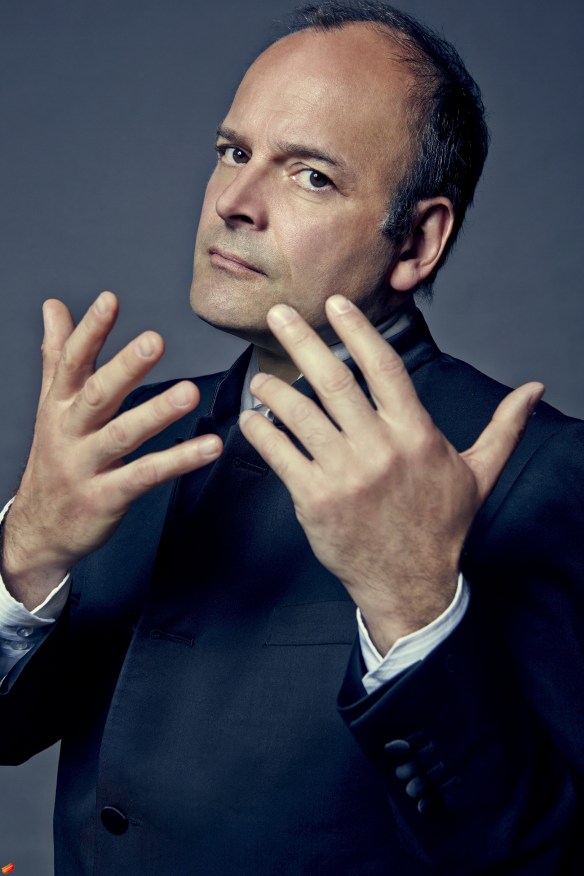
 This is the continuation of a series where Arcana invites a friend to a Prom who does not normally listen to classical music. In an interview after the concert each will share their musical upbringing and their thoughts on the concert – whether good or bad! Here, Tim Squier gives his thoughts on Prom 34.
 Arcana.fm