In concert – Alexander Roslavets, Gidon Kremer, LPO / Andrey Boreyko @ Royal Festival Hall: A Dark Century

Alexander Roslavets (narrator / bass), Gidon Kremer (violin), London Philharmonic Choir (men’s voices), London Philharmonic Orchestra / Andrey Boreyko

Schoenberg A Survivor from Warsaw Op.46 (1947)
Weinberg Violin Concerto in G minor Op.67 (1959)
Shostakovich Symphony no.13 in B flat minor Op.113 ‘Babi Yar’ (1962)

Royal Festival Hall, London
Wednesday 27 November 2024

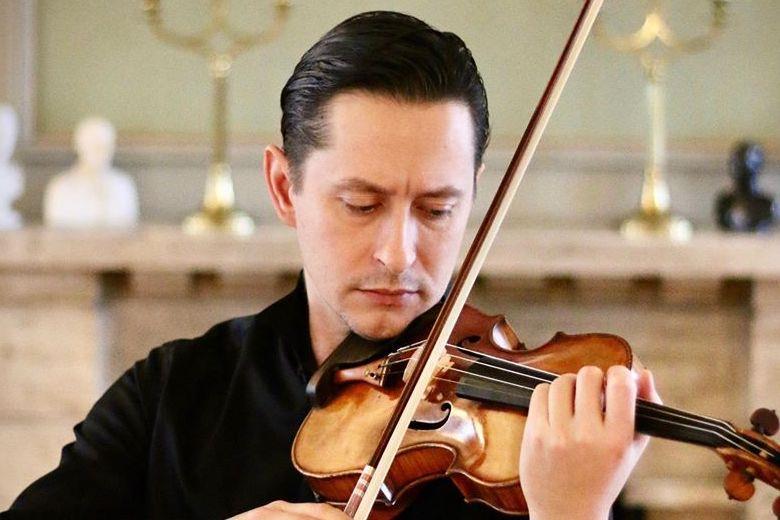
Reviewed by Richard Whitehouse Pictures (c) Richard de Stoutz (Andrey Boreyko), Angie Kremer (Gidon Kremer)

Anyone who heard one or other of these works for the first time at this concert by the London Philharmonic Orchestra could be forgiven for thinking that the twentieth century, if not a ‘dark century’ per se, was at the very least a troubled one for all that the quality of its music was undeniable.

With its elements of melodrama and cantata, Schoenberg’s A Survivor from Warsaw is one of his most original conceptions and necessarily so, given the unnerving immediacy of its text in which a speaker has to take on the roles of survivor and officer in just six minutes. Alexander Roslavets rose to this challenge, bringing out emotional contrasts as surely as he instilled his words with that ominous dread whose culmination in the prayer Shema Yisrael was intoned by the London Philharmonic Choir with the right balance between desperation and defiance.

One composer who witnessed something of such atrocities was Mieczysław Weinberg, and if his Violin Concerto demonstrably continues the ‘Romantic’ tradition, this is still an inherently personal statement. Gidon Kremer has championed the composer extensively in recent years and, while technical issues seemingly inhibited the respectively incisive and impetuous outer movements, the restless searching of its intermezzo-like Allegretto then confiding eloquence of its Adagio were abundantly in evidence. For all its outward virtuosity, the music’s essential inwardness is what prevails as the soloist remains musing when the orchestra fell silent at the close of the finale. Kremer was in his element here, as in a touching rendition of Silvestrov’s Serenade which made for an apposite encore and was dedicated to all the people of Ukraine.

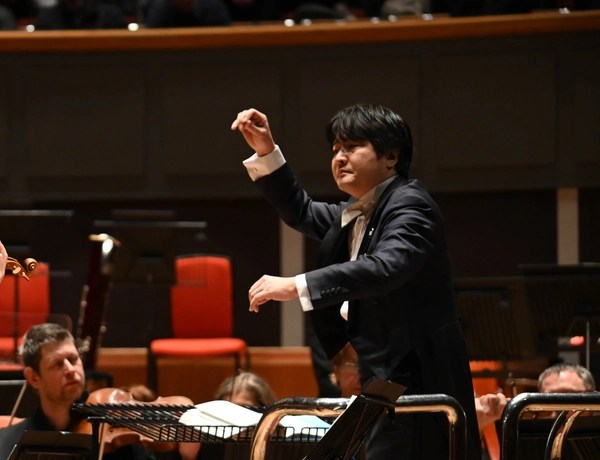
Best known for giving the posthumous premiere of Gorecki’s Fourth Symphony with the LPO 10 years back, Andrey Boreyko is well established as an exponent of Shostakovich so that his take on the Thirteenth Symphony did not disappoint. At a distance of over six decades, it can be hard to recapture the provocation of that most eminent Soviet composer using verse by the most populist younger poet, as Yevgeny Yevtushenko then was, but this setting of Babi Yar retains all its expressive force through the immediacy and resourcefulness in which it relates official indifference to the Jewish massacre as that ravine outside Kyiv was transformed into landfill. Broodingly restrained, Roslavets emerged into his own with Humour – its scabrous send-up of bone-headed officialdom inspiring one of Shostakovich’s most scurrilous scherzos.

Fashioning the last three movements into a cohesive if cumulative unity, Boreyko underlined the potency of Shostakovich’s creative vision as he takes the Soviet establishment to task for various failings economic as In the Store, political as in Fears and cultural as in A Career. Implacable then volatile, these first two are rounded off by Yevtushenko’s considering of the relationship between society and the individual; framed by an undulating melody, for flutes then strings, which is one of its composer’s most evocative as well as affecting inspirations.

It duly brought this work, and this performance, to its subdued yet spellbinding close. As the relationship between East and West becomes ever more confrontational, Shostakovich’s 13th remains a testament to rationality and compassion whose denigration is to everybody’s cost.

For details on the 2024-25 season, head to the London Philharmonic Orchestra website. Click on the names to read more about soloists Alexander Roslavets and Gidon Kremer

Published post no.2,373 – Monday 25 November 2024

In concert – Matthew Taylor 60th birthday concert @ Smith Square Hall

Poppy Beddoe (clarinet), Mira Marton, Viviane Plekhotkine (violins), Sinfonia Perdita / Daniel Hogan

Arnold Serenade Op.26 (1950)
Taylor Clarinet Concertino Op.63 (2021)
Taylor Violin Concertino Op.52 (2016)
Arnold Double Violin Concerto Op.77 (1962)
Arnold Clarinet Concerto no.2 Op.115 (1974)
Taylor Symphony No. 6 Op.62 (2021)

Smith Square Hall, London
Friday 22 November 2024

Reviewed by Richard Whitehouse

It was good to see that not a few of those in the audience for Matthew Taylor’s 60th Birthday Concert had been at such events 10, 20 and even 30 years before – deserved recognition, if such were needed, of this composer’s contribution to new music across recent decades.

Malcolm Arnold has been a notable influence on Taylor’s latter-day work, so that hearing his music in this context seemed more than apposite – not least with a sparkling account of Arnold’s airily ambivalent Serenade to set proceedings in motion.

The first half featured two of Taylor’s recent concertante pieces, a genre where he is always at home. As was Poppy Beddoe in the Clarinet Concertino written for her – whether its pensive but not necessarily serene Andante, its unsettling intermezzo, or its genial Allegretto that rounds off a work demonstrably more than the sum of its parts. Mira Marton then took the stage for the Violin Concertino, less unpredictable while always engaging – whether in the not undue deliberation of its opening Hornpipe, the poetic delicacy of its central Aria or the heady syncopation of its energetic Finale. Once again, there could be no mistaking Taylor’s identity with the instrument at hand, nor that judicious marshalling of his ideas into a format the more communicative for its brevity and understatement.

Arnold came into focus with two comparable works either side of the interval. Marton was partnered by Viviane Plekhotkine for the Double Violin Concerto from his more settled years which finds due outlet in the methodical incisiveness of its opening movement and unbridled panache of its finale: the central Andantino yet leaves the most enduring impression, a ‘duet without words’ whose melting pathos never feels overly emotive. This could hardly be said of the Second Clarinet Concerto, a product of Arnold’s troubled Dublin period, though Beddoe found cohesion in its Allegro through the ingenuity of her cadenza, while its ominously unsettled Lento had soloist and conductor in enviable accord, before she threw caution to the wind with a Pre-Goodman Rag finale that enthused her admirers even more second-time around.

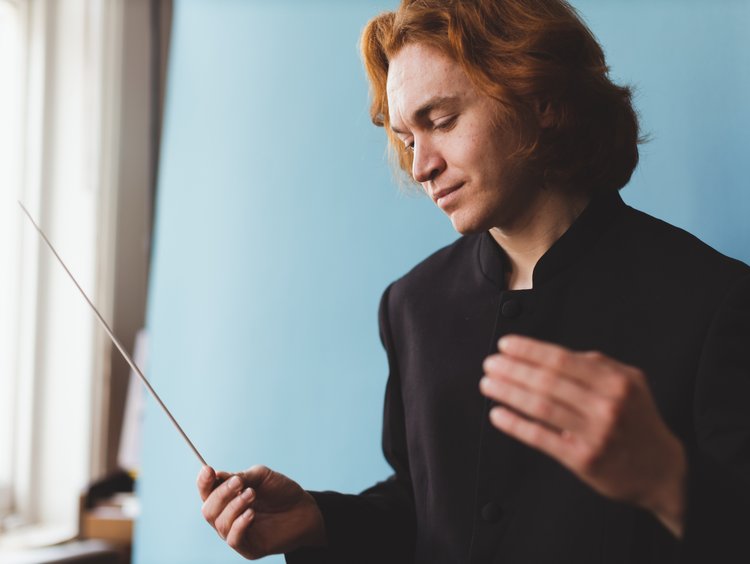
Astute in support, Daniel Hogan (above), came into his own with Taylor’s Sixth Symphony that ended this concert. Commissioned by the Malcolm Arnold Trust and dedicated to Arnold’s daughter Katherine, it complements its celebratory and fatalistic predecessors via an affirmation kept in check until the very last. Premiered by Martyn Brabbins then recorded by the composer, this was arguably its finest performance yet – Hogan unfolding the first movement’s introduction as a cumulative arc of intensity, before infusing the main Allegro with an impetus abetted by its translucency of scoring. This is even more apparent in the Andante, its writing for harp and piano just the most arresting aspect of its calmly fugal textures, before the final Vivo evoked an authentic Arnoldian spirit with its capricious humour and its deftly sardonic payoff.

Music that provokes as surely as it pleases is an ability shared by few composers of Taylor’s generation, and Sinfonia Perdita did it proud as the climax of an evening that reaffirmed this composer at its forefront. One looks forward to further symphonies…and future anniversaries.

For details on the 2024-25 season, head to the Sinfonia Smith Square website. Click on the names to read more about composers Matthew Taylor and Malcolm Arnold, conductor Daniel Hogan and soloists Poppy Bedoe, Mira Marton and Viviane Plekhotkine

Published post no.2,373 – Monday 25 November 2024

In concert – Orchestra of the Age of Enlightenment: Bach Brandenburg Concertos @ Queen Elizabeth Hall

Orchestra of the Age of Enlightenment

J.S. Bach
Brandenburg Concertos:
no.1 in F major BWV1046 (dir. Huw Daniel)
no.3 in G major BWV1048 (dir. Margaret Faultless)
no.5 in D major BWV1050 (dir. Margaret Faultless)
no.4 in G major BWV1049 (dir. Huw Daniel)
no.6 in B flat major BWV1051 (dir. Oliver Wilson)
no.2 in F major BWV1047 (dir. Rodolfo Richter)

Queen Elizabeth Hall, London
Wednesday 13 November 2024

Reviewed by Ben Hogwood Pictures (c) Mark Allan

The music of Bach proves a great source of consolation for many in uncertain times, and the underlining feeling from this packed concert was that the Orchestra of the Age of Enlightenment had offered just that, deep into their tour of the great master’s complete Brandenburg Concertos.

The six concertos, written for a variety of instrumental ensembles, were published just over 300 years ago in 1721 and sent to Christian Ludwig, Margrave of Brandenburg. In a crowded field, they have become one of Bach’s best-loved groups of works, and although they were not designed to be played together they respond extremely well to a concert such as this.

It is difficult to imagine a better set of performances than those given by the OAE, playing without a conductor in the spirit of the compositions, assigning the direction of each concerto to the uppermost string player. The program was introduced with a spark by violinist Margaret Faultless, whose enthusiastic demeanour set the tone for the evening. As the notes of the Brandenburg Concerto no.1 in F major lifted off the page Bach’s inspiration was immediately apparent, like walking into a room of animated conversation. The horns of Ursula Paludan Monberg and Martin Lawrence were front and centre, pointed aloft in a necessary but striking pose. The balance between the 13 players was ideal, not just in the busy first movement but in the emotive Adagio, led by the beautiful tones of oboe trio Clara Espinosa Encinas, Sarah Humphrys and Grace Scott Deuchar. Yet the horns took centre stage, powering the bright Allegro, before a perky series of Menuetto dances were bisected by a bracing second trio.

One of the many joys of the concert was the different sonorities of each piece, which changed to nine string instruments for the Brandenburg Concerto no.3 in G major. This had the requisite spring in its step for the quicker outer movements, especially the jovial dialogue of the third. Meanwhile the ensemble elaborated on Bach’s two written chords that make up the slow movement, where the focus was on violin (Faultless) and harpsichord (Steven Devine) Their tasteful improvisations were an ideal foil.

Completing the first half was the Brandenburg Concerto no.5 in D major, in effect an early keyboard concerto. The seven players were positioned closer to the audience, allowing greater intimacy and the chance to appreciate some of the wondrous sequences in the first movement. Taking the lead here were flautist Lisa Beznosiuk, who recorded the concertos with the orchestra back in 1987, alongside Faultless and Devine. They delivered a sublime Affettuoso second movement, a moment of reflection from the fast movements where Devine was a revelation, his virtuosic brilliance never too showy even in the trickiest of cadenzas.

To begin the second half of the concert the mellow sonorities of the recorders took the lead in the Brandenburg Concerto no.4 in G major, with beautiful clarity achieved by Rachel Beckett and Catherine Latham. Violinist Huw Daniel mastered the busy figuration of his part with considerable flair, while the poise of the accompanying ensemble was consistently satisfying. This concerto is deceptively forward looking, with pointers towards Beethoven in the slow movement, which here benefited from the weighty support of viola da gamba (Richard Tunnicliffe) and double bass (Cecilia Bruggemeyer), both ever presents through the evening. The pugnacious finale, with one of Bach’s many earworms, was great fun in the hands of these nine players.

The colours darkened appreciably for the Brandenburg Concerto no.6 in B flat major, whose highest instrument is the viola. Bach’s scoring here is remarkably inventive, and was brought to life as Oliver Wilson led a fluent account of the first movement. The violas showed their versatility as melody instruments in the reduced scoring of the Adagio, reduced from seven to four players and enjoying its elegant dance-like figurations, before the syncopations of the Allegro were winningly delivered.

Finally the Brandenburg Concerto no.2 in F major was a suitably upbeat piece on which to finish, with soloist David Blackadder – having waited an hour and a half to play – enjoying his moment on stage. He made the trumpet line look – and sound – straightforward, when with this instrument it is anything but! Again the balance was carefully wrought, so that the intricate violin contributions of director Rodolfo Richter could be clearly heard. A lightness of touch from the 11 players brought the phrasing of the Andante to life, with some typically spicy harmonies stressed, before the brilliant colours of the closing Allegro assai, and a celebratory closing statement.

It was a treat to hear the six Brandenburg Concertos presented in this way, a reminder that – in the words of Huw Daniel – these concertos deserve to be the centre of attention. The humming of the audience afterwards was testament to their lasting appeal, 300 years on.

You can listen to the Orchestra of the Age of Enlightenment’s recordings of the Brandenburg Concertos from 1987-88 for Virgin Classics below:

Published post no.2,362 – Thursday 14 November 2024

In concert – CBSO Strings / Eugene Tzikindelean: Bach: Goldberg Variations

City of Birmingham Symphony Orchestra Strings / Eugene Tzikindelean (above)

J.S. Bach arr. D. Sitkovetsky Goldberg Variations BWV988 (c1740)

Town Hall, Birmingham
Sunday 10 November 2024, 3pm

Reviewed by Richard Whitehouse Picture (c) Beki Smith

Having already made his mark other than as leader of the City of Birmingham Symphony Orchestra with his performances in recent seasons of concertos by Nielsen and Walton, Eugene Tzikindelean this afternoon directed the orchestra’s strings in a performance of Bach’s Goldberg Variations.

First published 323 years ago, the ‘Goldbergs’ launched the series of works from Bach’s final decade in which formal and technical procedures take on an almost arcane dimension, though this music is always realizable in practical terms whatever its abstraction. Taken up by leading virtuosos in the wake of Liszt, notably Busoni who fashioned his ‘concerto without orchestra’ in 1914, it became synonymous with Glenn Gould whose 1955 recording launched his career internationally as surely as it established Bach’s work in the minds of listeners the world over.

More recently the variations have been arranged for a variety of media, among which that by the violinist Dmitry Sitkovetsky has become among the most familiar – firstly as realized for string trio in 1984, then for string ensemble eight years later. The question as to how large a body of strings is left to the musicians: the present account amounted to 38 players including harpsichord, ideal for the acoustic of Birmingham Town Hall and what was a commendably sizable house. Not the least attraction of this arrangement is the skill with which Sitkovetsky has translated the timbral and textural possibilities of the harpsichord original, such that they sound entirely idiomatic in this context as well as capable of a variety of interpretive nuance; with this aspect proving crucial to the overall persuasiveness of the performance heard here.

The duration of the ‘Goldbergs’ can vary widely, according to just how many of the first-half or second-half repeats of its 30 variations are taken. Those anticipating an account around 78 minutes (given in the programme) might have been disconcerted with the hour-long rendition that resulted, but Tzikindelean’s approach in this respect was wholly consistent in placing the emphasis on those variations which mark strategic formal and expressive junctures. Thus the 15th with its starkly fatalistic aura; the 25th, described by harpsichordist Wanda Landowska as the ‘‘black pearl’’ and an adagio of simmering emotional charge; then the 30th, unfolding as a ‘quodlibet’ of popular melodies which seems intent on countering any previous austerity as it builds to a culmination where the Aria da Capo can bring the whole concept full circle.

Such was certainly true of this superbly realized reading, directed by Tzikindelean with that combination of focus and spontaneity as characterizes his work as leader. It would be wrong, moreover, not to single out those other section-leaders whose contributions were hardly less vital to its success – hence second violinist Lowri Porter, violist Chris Yates, cellist Bozidar Vukotic and double bassist Anthony Alcock; Martin Perkins was a lively continuo presence who enhanced successive variations without ever interposing himself on the overall sound.

A fine demonstration of the collective prowess of the CBSO strings, and there will be similar opportunities to hear the orchestra’s woodwind then brass and percussion at Sunday afternoon concerts in January and March next year, which will hopefully prove to be just as memorable.

For details on the 2024-25 season A Season of Joy, head to the City of Birmingham Symphony Orchestra website. Click on the names to read more about violinist Eugene Tzikindelean and arranger / violinist / conductor Dmitry Sitkovetsky

Published post no.2,359 – Monday 11 November 2024

In concert – Steven Osborne, CBSO / Kerem Hasan: Coleman, Grieg & Beethoven

Steven Osborne (piano), City of Birmingham Symphony Orchestra / Kerem Hasan (above)

Coleman Umoja: Anthem for Unity (2001, orch. 2019)
Grieg Piano Concerto in A minor Op.16 (1868)
Beethoven Symphony no.4 in B flat major Op.60 (1806)

Symphony Hall, Birmingham
Thursday 7 November 2024, 2.15pm

Reviewed by Richard Whitehouse Picture (c) Tristan Fewings

Highly regarded for his work with Welsh National Opera and his five years at the helm of the Tyrolean Symphony, British-Cypriot conductor Kerem Hasan’s is a relaxed though attentive presence that resulted in no mean rapport with the City of Birmingham Symphony Orchestra.

Such was evident from the outset of Valerie Coleman’s Umoja. Written for wind quintet, this ‘Anthem for Unity’ (the latter word in Swahili being the title) went through incarnations for wind sextet and concert band before being expanded to a commission from the Philadelphia Orchestra. Essentially a sequence of free-flowing variations on a theme stated by solo violin after an atmospheric introduction, it emerges in sharply contrasted guises before arriving at   a culminative statement – its evocation of ‘unity’ the more powerful for such overt restraint.

If the remainder of this programme consisted of repertoire staples, there was nothing routine or predictable about the performances. Steven Osborne has doubtless given more consistently accurate accounts of Grieg’s Piano Concerto, but his determination here to throw caution to the wind almost always paid off. Not least in an opening movement at its most perceptive in an unusually cohesive development, then a cadenza which ably sustained emotional tension through to a thunderous close. Building to a fervent rendering of its main theme, the Adagio evinced no lack of pathos, and Hasan secured a seamless transition into the finale – its virile main theme tellingly contrasted with that rapturous flute melody (Marie-Christine Zupancic on fine form), which emerged duly transformed as a majestic apotheosis towards the close.

That Hasan was out to make the case for Beethoven’s Fourth Symphony was evident from an introduction whose speculative mystery was tangibly conveyed, thus making contrast with the first movement’s main Allegro the more potent. Nor was the repeat of the exposition a carbon copy of what preceded it, Hasan channelling its impetus into an eventful development whose hushed transition into the reprise brought a surge of adrenalin no less palpable than that of the brief if thrilling coda. The ensuing Adagio might be felt to lack the drama or heroism of those in the symphonies either side, though its wistful main theme accrued considerable profundity on its successive and varied reappearances – not least through the unforced eloquence of the CBSO woodwind in what becomes something of an all-round showcase for that department.

Hasan drove the scherzo sections of the third movement hard, yet there was never any lack of articulation, while the trio sections had all the ingratiating charm needed. Taking the finale at anything that approaches the composer’s metronome marking can easily become a hostage to fortune, but the CBSO held its collective nerve throughout what was an eventful as well as an exhilarating ride – one fully underpinned by Beethoven’s irreverent humour such as comes to the fore in the tonal and emotional punning of those captivating bars that round off this work.

A persuasive case, then, for Beethoven Four as for Hasan’s conducting. Meanwhile, Sunday afternoon brings an intriguing event in the guise of Bach’s Goldberg Variations arranged by Dmitry Sitkovetsky for string ensemble and directed by CBSO leader Eugene Tzikindelean.

For details on the 2024-25 season A Season of Joy, head to the City of Birmingham Symphony Orchestra website. Click on the names to read more about pianist Steven Osborne, conductor Kerem Hasan, and composer Valerie Coleman

Published post no.2,357 – Saturday 9 November 2024