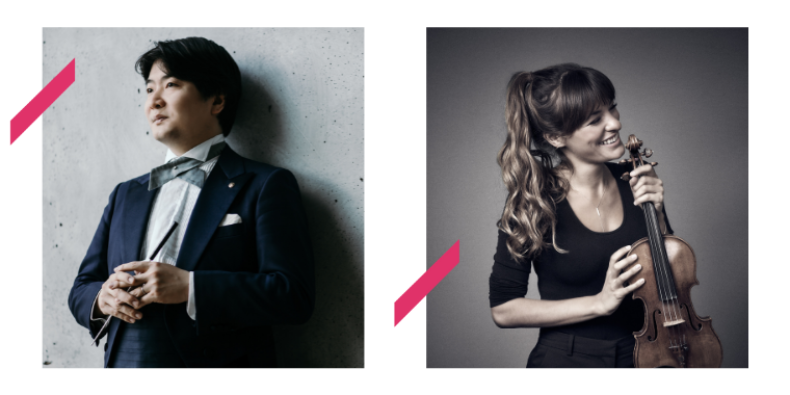
In concert – Nicola Benedetti, CBSO Chorus and Symphony Orchestra / Kazuki Yamada: Dvořák, Mendelssohn & Grigorjeva

Dvořák Carnival Overture, Op. 92 (1892)
Mendelssohn Violin Concerto in E minor, Op. 64 (1844)
Grigorjeva In Paradisum (2012)
Dvořák Symphony no.9 in E minor Op.95 ‘From the New World’ (1893)

Nicola Benedetti (violin), CBSO Chorus, City of Birmingham Symphony Orchestra / Kazuki Yamada

Symphony Hall, Birmingham
Tuesday 20 September 2022

Reviewed by Richard Whitehouse

It may have been a largely mainstream programme, but tonight’s concert by the City of Birmingham Symphony Orchestra drew a capacity house at the beginning of a season in which Kazuki Yamada takes on the reins for what looks an eventful new era near the start of the orchestra’s second century. The CBSO’s response in Dvořák’s Carnival Overture more than confirmed it was ready for the challenge – Yamada ensuring the nocturnal evocation at its centre worked its evocative spell, then building an irresistible momentum going into the thrilling final bars.

Mendelsohn’s Violin Concerto cannot have been absent from many of the CBSO’s previous 102 seasons and made its appearance this evening, Nicola Benedetti tackling a piece she must herself have played on many occasions. Not that there was anything routine about a reading such as abounded in subtle touches – especially the opening Allegro’s cadenza, which more than usually fulfilled its role as this movement’s structural fulcrum. In the Andante, Benedetti pointed up the expressive contrast between its main themes; the second of which was notable for a tonal astringency that brought out its plangency in full measure. If there was nothing so arresting in the finale, the interplay of soloist and orchestra was astutely judged through to the effervescence of the closing bars. Certainly, a performance to make one enjoy the piece anew.

Introducing the second half, Yamada requested the audience remain silent during the pause between pieces – the first a setting of In Paradisum by Ukrainian-born Galina Grigorjeva (b 1962), its lucid harmonies and heady culmination bringing the best out of the CBSO Chorus.

From here to the New World Symphony was no great step. Once again, a work rarely absent from the CBSO’s schedule seemed largely revitalized. Not that all of Yamada’s interpretative decisions came off – after an introduction of no mean gravitas the opening Allegro unfolded a little fitfully, though so interventionist an approach might have gained from the exposition repeat to place these in greater context. There were similar touches in the Largo, yet here the focus of Yamada’s conception and the raptness of the player’s concentration were their own justification – not least towards the close, with the front desks combining to poignant effect. Without being driven as ruthlessly as is often the case, the Scherzo has the requisite impetus and, throughout its trio, a whimsical elegance which proved as engaging as the charged coda.

Heading into the final Allegro with minimal pause, Yamada brought out its inherent force but also the ruminative eloquence of its second theme; the transition to which, in the reprise, was ideally judged. Nor did the apotheosis lack for drama as those closing bars melted into silence.

Prior to the start of this concert, a minute’s silence was observed then (most of) the audience joined in possibly its first rendering of God Save the King. A more localized farewell was paid later in the evening to Colin Twigg, first violinist for over 31 years and whose retirement will hopefully see more of his own compositions as have featured in Centre Stage recitals over the years. A miscellany is featured on a Toccata Classics release and worth anyone’s investment. The CBSO will be back in action on Saturday with a major new commission from Brett Dean.

You can read all about the 2022/23 season and book tickets at the CBSO website. For further information on the night’s artists, click on the names for composer Galina Grigorjeva, and for artists Nicola Benedetti and Kazuki Yamada

BBC Proms #49 – Louise Alder, Dame Sarah Connolly, CBSO Chorus, London Symphony Chorus, London Symphony Orchestra / Sir Simon Rattle – Mahler ‘Resurrection’ Symphony

Prom 49 – Louise Alder, Dame Sarah Connolly, CBSO Chorus, London Symphony Chorus, London Symphony Orchestra / Sir Simon Rattle

Birtwistle Donum Simoni MMXVIII (2018)
Mahler Symphony no.2 in C minor ‘Resurrection’ (1888-1894)

Royal Albert Hall, London
Wednesday 24 August 2022

Reviewed by Ben Hogwood Photos (c) Chris Christodoulou

“A symphony must be like the world. It must contain everything.”

The words of Gustav Mahler were never more appropriate than in the context of this exceptional BBC Proms concert, as Sir Simon Rattle and assembled forces from London and Birmingham threw body and soul into a spectacular performance of the composer’s Symphony no.2.

This, Mahler’s ‘Resurrection’ symphony, puts its listener through the emotional wringer on a journey inhabiting life and death itself. The work has become a calling card for Rattle, too – he marked the opening of Birmingham’s Symphony Hall with a memorable performance in 1991, and took his leave of the CBSO with the same piece. Here, as he prepares to step down as Music Director of the London Symphony Orchestra, he was marking the turning of a page through a move to pastures new in Bavaria, where he will become Chief Conductor of the Symphonieorchester des Bayerischen Rundfunks and the Bavarian Radio Chorus.

The pastures were a standout feature of this performance – but we began in turmoil, the huge first movement funeral march rumbling into gear with lines hewn from granite in the lower strings. Rattle pushes this movement forward much more than he once did, keeping a firm hand on the tiller, but with immediate and full immersion in Mahler’s thoughts. As the first movement took shape the horrors of death revealed themselves – along with hopes of sunnier climes through some beautifully shaded rustic scenes. Yet the chill winds kept returning, ultimately sweeping these away as the movement closed in their bleak acceptance.

Many accounts of the ‘Resurrection’ lose their focus at this point, but not this one. Instead we had a balletic triple time Ländler, danced with grace as the feather-light strings had their charming way. The main theme swelled like a newly budding flower, and although ghoulish reminders of the first movement persisted, this was the abiding impression. As Rattle pressed on without a break, however, the reveries were abruptly quashed by the hammer and tongs of the third movement Scherzo. Here the music twisted and turned sharply, the LSO responding to its conductor with peerless virtuosity in music of fire and brimstone. Percussion, wind and brass were superb.

Then, as the music teetered on the point of collapse, it was time to be borne away with the consoling tones of Dame Sarah Connolly (above, right). A consummate Mahlerian, she sang with compelling strength and grace, a powerful stage presence in league with Rattle, who presided over accompaniment of the greatest clarity. Connolly’s Urlicht was beautifully judged, taking us ever nearer to the wondrous entry of the choir.

Now time stood still. The audience, especially in the arena, were rooted to the spot at the massed choirs of the CBSO Chorus and London Symphony Chorus, singing as one in magically hushed tones. As the finale took shape it was by turns earth-moving and tender. Scenes flashed before the eyes, and an especially vivid episode from brass and percussion in the gallery observed a village-band intimacy. Here the Royal Albert Hall was utilised to its full potential, managing the wide scope of Mahler’s vision to perfection.

At the centre of this apocalyptic finale, percussion depicted the rising of the dead and the release of their chains, Rattle intentionally dragging his feet here to heighten the seismic impact. And then we were free, the resurrection itself met with blazing colours all around as the choirs sang Friedrich Klopstock’s text ‘Aufersteh’n, ja aufersteh’n wirst di’ (‘Rise again, yea rise again, shalt thou’) as though their lives depended on it. Was it fanciful to suggest three years’ worth of pent-up emotion being released at this point? Probably not, when you consider the day-to-day roles of the choral singers themselves – carers, key workers, parents and children alike – with all finding the time and the need to bring us this music of the utmost quality.

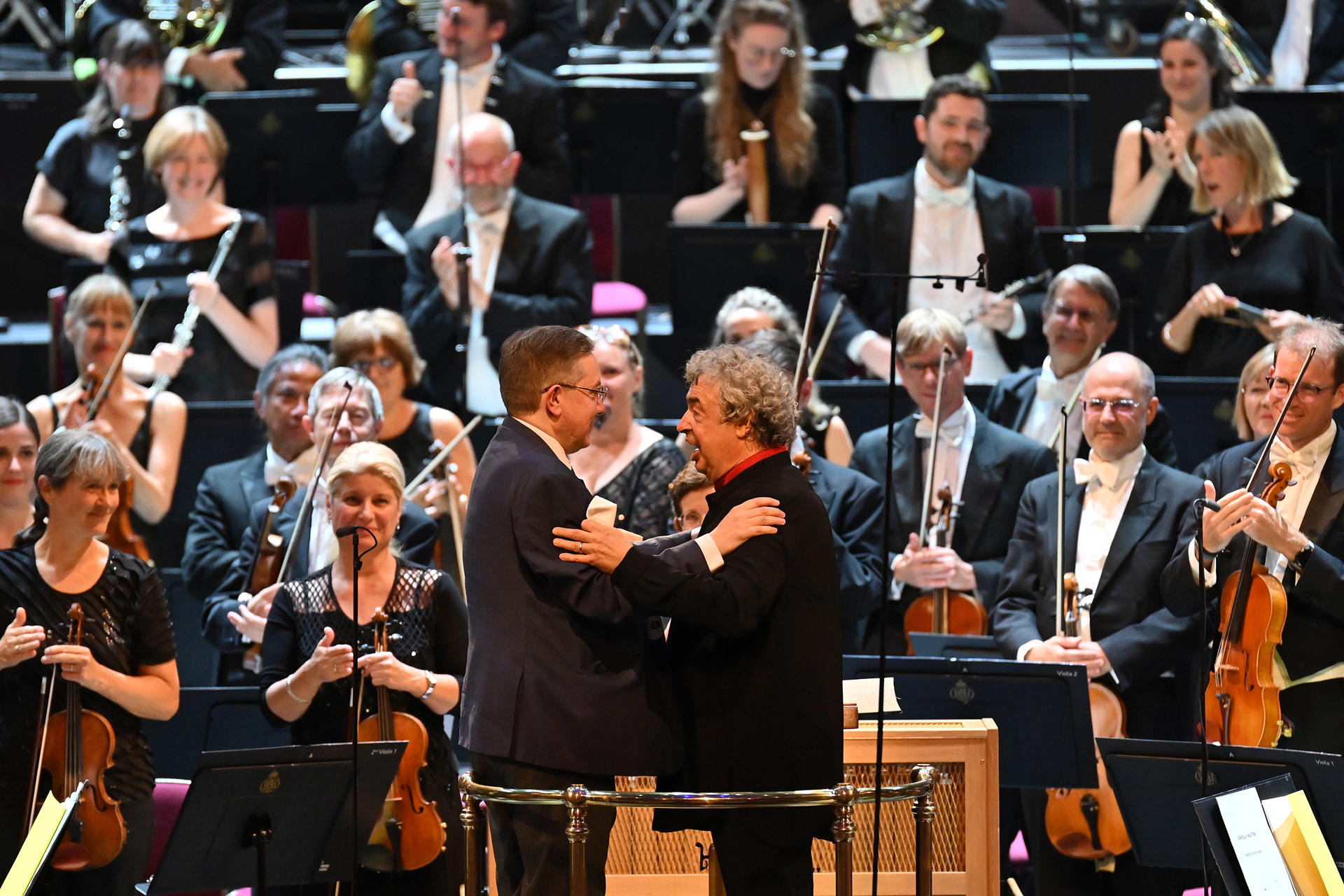
Great credit should go to chorus director Simon Halsey for securing such discipline and humanity in the texts, and to soprano Louise Alder (both above with Dame Sarah Connolly and Sir Simon Rattle). Alder sang above the masses with perfectly judged dynamics and phrasing, like Connolly fully aware of the scope of her role. Organist Richard Gowers added the icing on the cake, underpinning the throng with ideally judged balance.

This was a performance to talk about for years to come, a throwing-open of the doors to proclaim that music can – really – triumph over pretty much anything, the ‘Resurrection’ symphony, clearing everything in its path.

As an upbeat to the symphony we heard a short gift to Rattle from Sir Harrison Birtwistle, to whose memory the Prom was dedicated.  Donum Simoni MMXVIII was typical of its composer, a spiky and even snarky postcard firing out missives from the (superb) percussion section against barbed comments from wind and brass. Lasting barely four minutes, it served its function well – but for tonight, as Mahler would have wished, the symphony was everything.

You can listen to Sir Simon Rattle’s recording of Mahler’s ‘Resurrection’ symphony on Spotify below, where the CBSO Chorus and Symphony Orchestra are joined by soloists Arleen Auger and Dame Janet Baker:

BBC Proms #44 – Soloists, BBC Symphony Chorus & Orchestra / Sakari Oramo: Ethel Smyth ‘Mass’ & Debussy ‘Nocturnes’

Prom 44 – Nardus Williams (soprano), Bethan Langford (mezzo-soprano), Robert Murray (tenor), Božidar Smiljanić (bass), BBC Symphony Chorus, BBC Symphony Orchestra / Sakari Oramo

Debussy Nocturnes (1897-9)
Smyth Mass in D (1891, rev. 1924) [Proms premiere]

Royal Albert Hall, London

Saturday 20 August 2022

Reviewed by Richard Whitehouse Photos (c) Chris Christodoulou

His third Prom this season found Sakari Oramo conducting the BBC Symphony Orchestra in an unlikely yet, in the event, thought provoking double-bill of pieces composed at either end of the same decade and which duly played to the strengths of all those who were taking part.

The music of Ethel Smyth has been a prominent feature of this season and while her Mass in D comes too early in her career to be considered ‘mature’, it does evince many of those traits as defined the operas that followed. Written during a brief flush of adherence to Anglicanism, this is demonstrably a concert rather than liturgical setting (which makes its apparent status as the first Mass heard publicly in England for almost 300 years the more ironic) and, moreover, one of a ‘symphonic’ rather than ‘solemn’ conception despite the audible debt to Beethoven.

Smyth reinforces this aspect by placing the Gloria at the close – thereby making it the finale of a sequence in which the Kyrie, building gradually to a baleful climax before returning to its initial sombreness, becomes an extended introduction to the Credo whose numerous sub-sections facilitate a sonata-form design of no mean formal cohesion and expressive breadth. For their part, the Sanctus, Benedictus and Agnus Dei function as extended slow movement whose (for the most part) emotional restraint enables the soloists to come to the fore – after which, the Gloria takes its place as a finale not least in terms of drawing on previous themes and motifs through to the forceful though never merely bathetic culmination. That Smythe did not essay a symphony given her evident structural command seems the more surprising.

Tonight’s performance was no less assured than that which Oramo gave at the Barbican (and subsequently recorded, albeit with different soloists) three seasons ago. The soloists made the most of their contributions – Nardus Williams bringing a plaintiveness and elegance that was ideally complemented with Bethan Langford’s warmth and understated fervency, and though Robert Murray’s ardency showed signs of strain, he was no less ‘inside’ his part than Božidar Smiljanić, whose solo was more affecting for its burnished eloquence. The BBC Symphony Chorus responded as one to the full-on contrapuntal writing of those main movements, while Richard Pearce ensured the (too?) extensive organ part did not muddy the orchestral textures. Oramo directed with clear enjoyment a work that, for the most part, justified its 62 minutes.

In the first half, Oramo presided over a searching account of Debussy’s Nocturnes – its three movements still sometimes encountered separately but far more effective heard as a complete entity. Not its least impressive aspect was the ease with which these followed on from each other with a cumulative inevitability – the fugitive shading of Nuages (melting cor anglais playing by Helen Vigurs) leading to the half-lit activity of Fêtes, with its darting gestures and a central march-past of vivid understatement, then on to the sensuous allure of Sirènes.

As enticing as the women’s voices of the BBCSC sounded in this closing movement, it was the fervency with which Oramo infused its recalcitrant content such as made it the natural culmination of the sequence – the final bars dying away with a tangible sense of fulfillment.

Click on the artist names for more information on Nardus Williams, Bethan Langford, Robert Murray, Božidar Smiljanić and Sakari Oramo and for more information on the BBC Symphony Orchestra head to their website. For more on composer Dame Ethel Smyth, click here

BBC Proms #26 – The Labèques, BBC Symphony Orchestra / Semyon Bychkov: Julian Anderson premiere, Martinů & Rachmaninoff

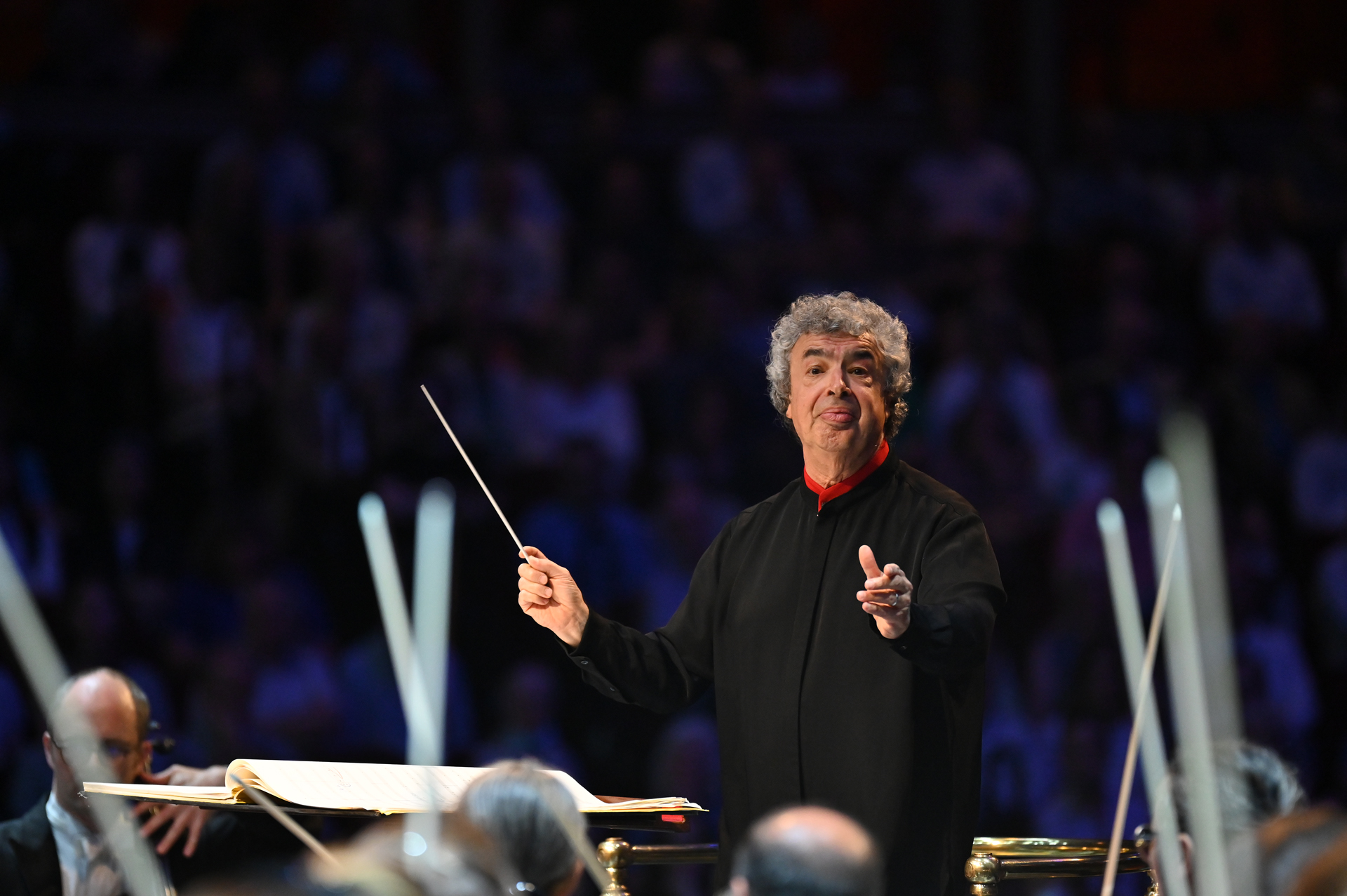
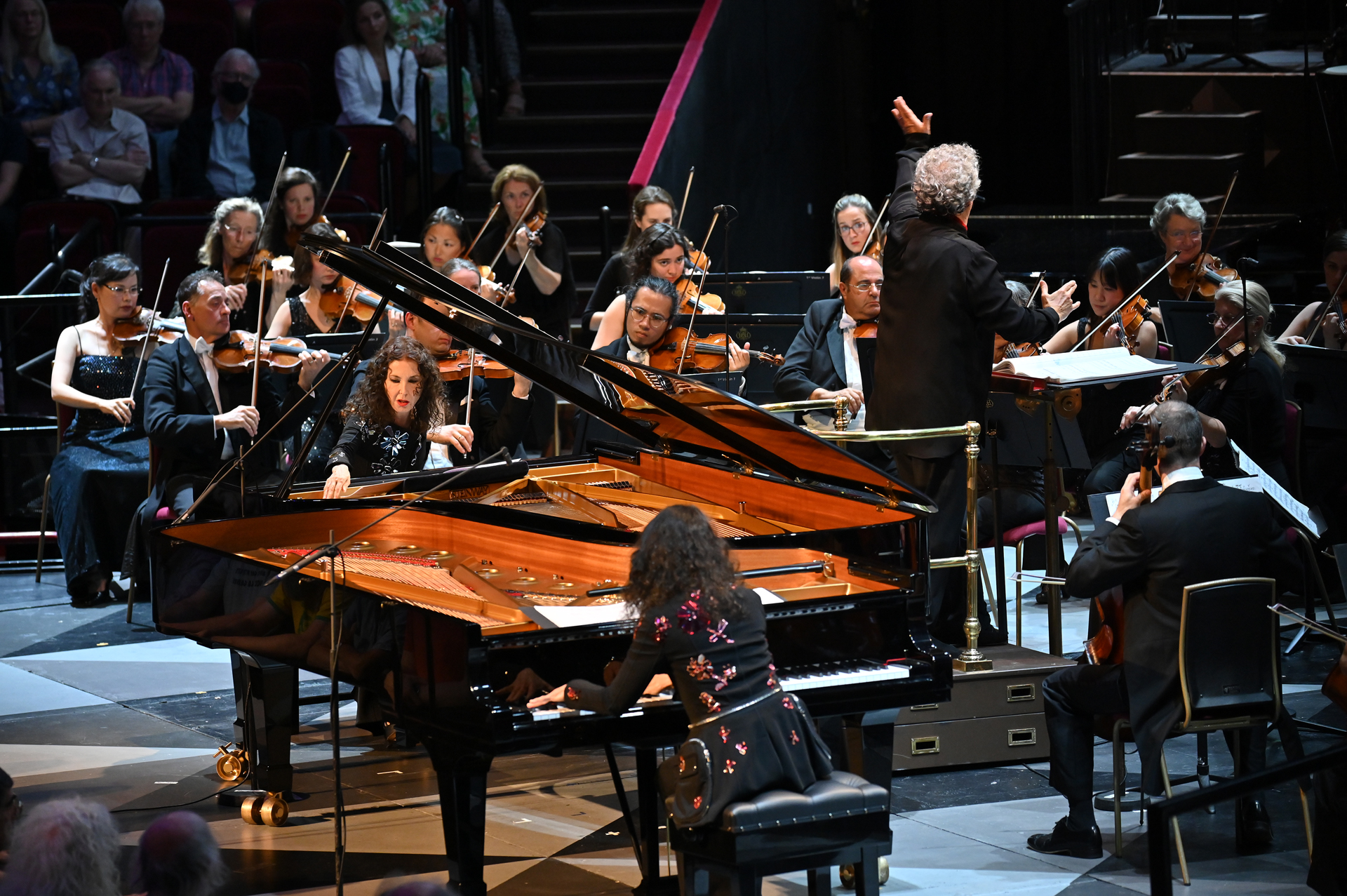
Prom 26 – Katia and Marielle Labèque (pianos), BBC Symphony Orchestra / Semyon Bychkov (above)

Anderson Symphony No. 2 ‘Prague Panoramas’ (2020-22) (BBC co-commission: World premiere of complete work)
Martinů Concerto for Two Pianos and Orchestra H292 (1943)
Rachmaninoff Symphonic Dances Op.45 (1940)

Royal Albert Hall, London
Friday 5 August 2022

Reviewed by Richard Whitehouse Photo (c) Chris Christodoulou

An unusually well-assembled concert this evening with what might be termed a programme of ‘three-by-threes’ – each of these three works having three movements which, in each case, results in a broadly symmetrical design, not least the Second Symphony by Julian Anderson (with the conductor, below).

Inspired by Josef Sudek’s photographs of Prague while utilizing two medieval Czech hymns, Prague Panoramas (might Prague Pictures be even more apposite?) is typical in its fusing evocativeness with precision. Not least the preludial opening movement, its stark alternation of quick-fire chords and silence evolving into aspiring melodic lines as build to a tumultuous if quickly curtailed climax, though this linear aspect comes to dominate the nocturnal central movement with its expressive intensifications then fades against a backdrop of bell resonance and luminously modal polyphony. The finale is a deftly organized rondo – its energetic main material, inspired by Josef Lada’s almost Rabelaisian depictions of pub brawls, interspersed with more lyrical ideas through to the heady peroration later subsiding into a calm postlude.

Although its first two movements had been heard in Munich and Prague, this was the work’s first complete performance and found the BBC Symphony at its collective best – not least the lambently interweaving woodwind and strings, the visceral impact of brass and a substantial array of percussion whose contribution was pervasive. Semyon Bychkov (under-appreciated as an exponent of contemporary music) duly brought out that unity-within-diversity such as gave this work an underlying focus across the 32 minutes of its eventful yet cohesive course.

From Prague-inspired music by a British composer to that by a Czech composer in America – Martinů’s Concerto for Two Pianos may never have gained the plaudits of his earlier Double Concerto but it typifies this composer’s exile in a tried-and-tested interplay of folk-inflected melodicism with a harmonic acerbity recalling Prokofiev and rhythmic dexterity redolent of Stravinsky. Its undoubted highlight is a central Adagio whose almost ‘harmonie’ woodwind writing and circling piano figuration (had the composer come across the gamelan-influenced music of Colin McPhee?) feels mesmeric and affecting. Neither outer movement comes close in their audibly contrived amalgam of the rumbustious and lyrical, but this is music in which Katia and Marielle Labèque excel and tonight’s performance could rarely have been equalled.

Nor was there any doubting Bychkov’s authority in Rachmaninoff’s Symphonic Dances that followed the interval. Admittedly this now regularly played while technically exacting piece needed more rehearsal than the BBCSO was able to give it on this occasion, though the outer sections of the first dance had just the right ominous incisiveness and its middle part featured winsome alto saxophone from Martin Robertson. The second dance had irony and angularity aplenty, as was slightly offset by the strings’ less than unanimous response towards the close.

Its sombre ambivalence and intricate textures give the central span of the final dance a quality unique in this composer: if Bychkov might have endowed it with even greater intensity, there was no doubting his identity with this music here or on the way to its resplendent apotheosis.

For more information, click on the names of composer Julian Anderson – and for more on the artists, click on the names of Katia and Marielle Labèque, Semyon Bychkov and the BBC Symphony Orchestra. For more on this year’s BBC Proms as it continues, head to the Proms website

For more information, click on the names of composers Kalevi Aho and Kaija Saariaho – and for more on the artists, click on the names of Carolina Eyck, John Storgårds and the BBC Philharmonic Orchestra

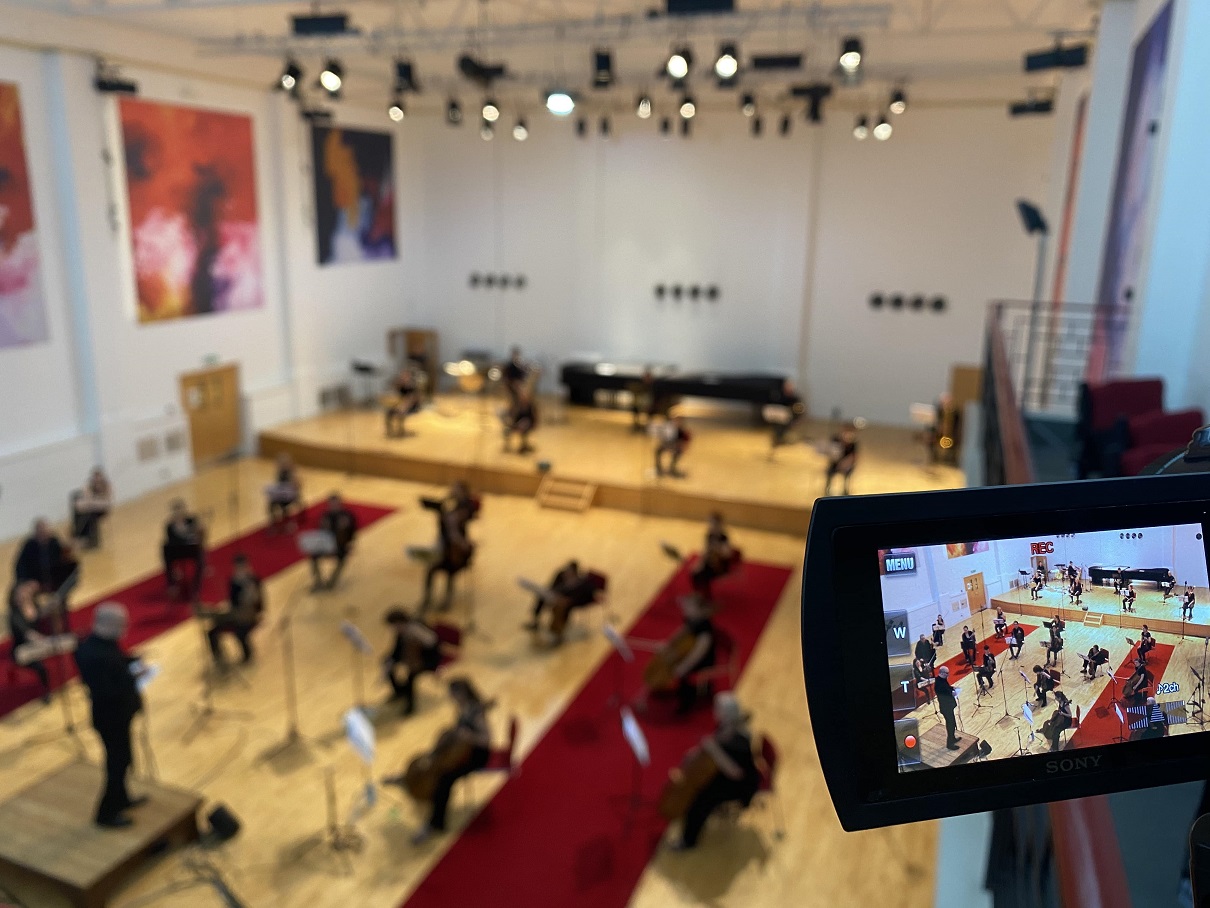
Online concert – English Symphony Orchestra / Kenneth Woods: Music from Wyastone – Sibelius: Symphony no.6 & Tapiola

Sibelius Symphony no.6 in D minor Op.104 (1923); Tapiola Op.112 (1926)

English Symphony Orchestra / Kenneth Woods

Recorded at Wyastone Concert Hall, Monmouth, 1-2 March 2022

by Richard Whitehouse

A cycle of Sibelius symphonies by the English Symphony Orchestra got underway last year with an impressive account of the Seventh, making this second instalment the more pertinent for showing just how the composer had arrived at that work and where he went from there.

Only if the Sixth Symphony is viewed as neo-classical does it feel elusive, rather than a deft reformulation of Classical precepts as here. The first movement duly unfolded as a seamless evolution whose emotional contrasts are incidental – Kenneth Woods ensuring its purposeful course complemented the circling repetition of the following intermezzo, with its speculative variations upon that almost casual opening gesture. Ideally paced, the scherzo yielded a more incisive tone which the finale then pursued in a refracted sonata design as gained intensity up to its climactic mid-point. Tension dropped momentarily here, quickly restored in a disarming reprise of its opening and a coda whose evanescence was well conveyed; a reminder Sibelius Six is as much about eschewal of beginnings and endings in its seeking after a new cohesion.

A suitably expanded ESO then tackled Tapiola – Sibelius’s last completed major work, whose prefatory quatrain implies an elemental aspect duly rendered through the near/total absence of transition in music of incessant evolution. A quality to the fore in this perceptive reading with Woods finding the right balance between formal unity and expressive diversity throughout its underlying course. Just occasionally there was a lack of that ‘otherness’ as endows this music with its uniquely disquieting aura, yet a steadily accumulating momentum was rarely in doubt towards the seething climax, then a string threnody whose anguish can bestow only the most tenuous of benedictions. A reminder, too, that not the least reason Sibelius might have failed to complete his Eighth Symphony was because he had already realized it in the present work.

The ESO being heard to advantage in the spacious clarity of Wyastone Hall, these accounts will be worth getting to know on commercial release (with the Seventh Symphony) early next year, when this cycle will itself continue with recordings of the Fourth and Fifth Symphonies

These works are available for viewing on the English Symphony Orchestra website from 29 July – 1 August, then through ESO Digital by way of a subscription. Meanwhile click on the names for more on the English Symphony Orchestra and Kenneth Woods