Live review – Sinfonia Tamesa & Matthew Taylor – Ethel Smyth Serenade & Brahms Third Symphony

Sinfonia Tamesa / Matthew Taylor

St James’s, Sussex Gardens, London
Saturday 9th March 2019

Schumann Genoveva Op.81 – Overture (1850)
Smyth Serenade in D major (1890)
Brahms Symphony no.3 in F major Op.90 (1883)

Written by Richard Whitehouse

Now into its eighteenth season, Sinfonia Tamesa has never been an orchestra afraid to ring the changes when it comes to programming. Tonight was no exception, with a rare hearing for Dame Ethel Smyth‘s Serenade to commemorate International Woman’s Day.

Not that this substantial piece proved unworthy of revival on its own merits. Brahms (whom Smyth admired above all others) is the obvious influence here, but Dvořák is equally evident in the rhythmic lilt and deft woodwind writing of its inner movements, an energetic scherzo followed by a hardly less animated intermezzo, and Matthew Taylor secured playing as lithe as it was incisive. He also brought out those expressive contrasts as make up for the opening Allegro’s lack of textural variety and ensured an underlying propulsion that carried the rather repetitious finale on to its decisive close. No major rediscovery, but a likeable and engaging work by a composer who wrote all too little purely orchestral music; should Tamesa choose to schedule Smyth’s masterly Double Concerto for Horn and Violin, then so much the better.

Framing this piece was music by Schumann and Brahms. The former’s only opera, Genoveva was a failure at its premiere and only infrequently revived today, but its melodic appeal helps compensate for some foursquare characterization – the overture making an effective concert item on its own terms. Some shaky intonation robbed the introduction of mystery, but what followed found a viable balance between agitation and an affirmation which (as also in the opera) ultimately wins through – evident here in the surging optimism of those closing bars.

After the interval came Brahms’s Third Symphony, its quiet ending merely one of the reasons why this is the least-often heard of the cycle. From the outset, Taylor secured the right tempo for an opening movement that can easily lose shape and direction; finding winsome charm in the second theme, before judging the development’s relaxation then accruing of momentum with assurance. The coda’s transfigured poise (Brahms’s riposte to Tristan?) carried over into the Andante, whose melodic simplicity belies an emotional ambiguity which was teased out from its ruminative asides before being made explicit in those confiding final pages. Good to hear what followed taken not as an unintentional slow movement, but rather an intermezzo whose pathos is accentuated by its deftly propelled motion. The finale brought a culmination in all respects, and though ensemble faltered during more dynamic passages, a sure impetus was sustained across the reprise (the thrilling modulation into which was tangibly conveyed) then a coda that recalls the work’s initial motto with a mingling of aspiration and benediction.

Make no mistake, this was a convincing and insightful take on a symphony of which such readings are still an exception to the rule. A fine showing, too, for Sinfonia Tamesa, which will return to St James’s on 6th July for a Rachmaninov programme under Matt Andrews.

For further information on Sinfonia Tamesa, visit the orchestra’s website – and for more on Matthew Taylor, click on this link

Live review – Mirel Iancovici & Jeroen Riemsdijk – The Legacy of Music: Enescu and His Teachers

Mirel Iancovici (cello), Jeroen Riemsdijk (piano)

Romanian Cultural Institute, London
Thursday 7th March 2019

R. Fuchs Cello Sonata no.2 in E flat minor Op.83 (c1908)
Enescu (arr. Iancovici) Romanian Rhapsody no.2 in D major (1901)
Enescu Tre Canti (1905/1903/1938); Sonata-Torso in A minor (1911)
Massenet Thaïs – Méditation (1894)
Fauré Cello Sonata no.2 in G minor Op.117 (1921)

Written by Richard Whitehouse

The significance of Enescu‘s teachers throughout his formative years in Vienna and Paris has often been remarked but seldom reflected in performance, so making this evening’s recital as part of the Romanian Cultural Institute’s Enescu Concerts Series the more worthwhile.

Regarded more highly as a teacher than composer in his lifetime, Robert Fuchs (1847-1927) is best remembered for his orchestral Serenades. His Second Cello Sonata (its unusual key a response to the E minor of Brahms’s First Sonata?) is characteristic in its emotional reticence and intensive interplay between instruments, not least in the equable opening Allegro that duly makes way for a ruminative Adagio then a relatively animated finale. In the hands of Mirel Iancovici and Jeroen Riemsdijk, it certainly made its case for more frequent revival.

All the Enescu pieces featured were arrangements by Iancovici, beginning with that of the Second Romanian Rhapsody whose emphasis on song rather than dance makes it well suited to this medium. The Three Songs derive from various sources: the plaintive Doina (Lament) from a folk-inspired song, grandly rhetorical Preludio monodico from the initial movement of the First Orchestral Suite, then the mercurial Lăutarul (The Fiddler) from the opening movement of Impressions d’enfance. Together these made for an attractive and contrasted sequence, but it was the transcription of the Sonata-Torso that left the strongest impression – the intensely interiorized emotion and rhapsodic progress of this intriguing while undeniably discursive piece arguably better served in this guise than by the violin-and-piano original.

Just before this, the evergreen Méditation from the opera Thaïs by Massenet (a composer who wrote little or no chamber music) made for an easeful and not too indulgent interlude. The recital ended with Fauré‘s Second Cello Sonata, typical of his late music in its eliding of form into expression as confirmed by the fluid unfolding of its initial Allegro then the distanced soulfulness of its Andante, before the final Allegro affords a measure of robust humour and wistful poise as this elusive piece heads to its unexpectedly decisive close.

Throughout this recital, Iancovici’s playing was of an insight and discernment complemented by Riemsdijk’s lucid and attentive pianism. Hopefully they will return in this series; hopefully including either (or both!) of Enescu’s cello sonatas and more of Iancovici’s arrangements.

Further information on the Enescu Concerts Series at can be found at the Romanian Cultural Institute website

Live review – CBSO Youth Orchestra / Cristian Măcelaru: Copland Symphony 3, Clyne & Szymanowski with Tasmin Little

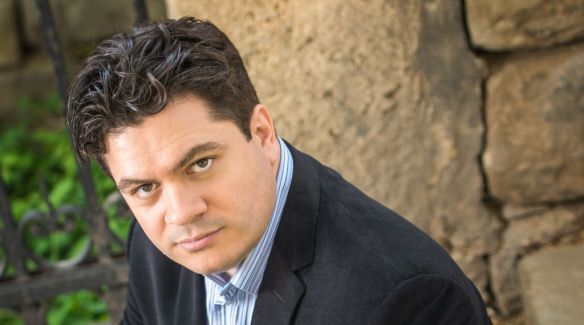
Tasmin Little (violin) CBSO Youth Orchestra / Cristian Măcelaru (below)

Symphony Hall, Birmingham
Sunday 24 February 2019, 3pm

Clyne This Midnight Hour (2015)
Szymanowski Violin Concerto no.1 Op.35 (1916)
Copland Symphony no.3 (1946)

Written by Richard Whitehouse

Concerts from the CBSO Youth Orchestra have long been a regular and welcome fixture on the Symphony Hall calendar, with this afternoon’s programme offering a judicious selection such as ranged across almost a century of music by British, Polish and American composers.

Many CBSO Youth Orchestra concerts feature a world or local premiere, and today started with a first Birmingham outing for Anna Clyne’s This Midnight Hour. Drawing inspiration (albeit obliquely) from poems by Juan Ramon Jiménez and Charles Baudelaire, this compact piece initially alternates between energy and rumination with steadily accumulating impetus. A pity, then, that the second half rather loses focus through an uneasy amalgam of waltz-like flaccidness and folk-inflected juvenilia; the whole seeming rather less than the sum of its parts.

Tasmin Little (above) then joined the orchestra for Szymanowski’s First Violin Concerto, now firmly established as a repertoire item after many years on the periphery. Not the least fascinating aspect is its formal ambiguity – the continuous span interpretable both as a three-movement form as well as an extended sonata design.

It was a measure of Little’s insight that she elided between these possibilities in a performance which stressed the music’s organic inevitability as much as its heady sensuousness, abetted by Cristian Măcelaru’s attentive handling of an orchestration as by no means ‘plays itself’ in terms of overall balance. This was evident not least in the rapturous main climax – after which, Little vividly despatched the brief cadenza prior to the coda’s poignant recollection then the disarming evaporation of those final bars.

Copland’s Third Symphony is another piece to have garnered regular hearings in recent years – consideration of its being an anomaly in the composer’s output, by dint of its monumental aspirations, having become secondary to the sheer impact invested into its relatively modest (Brahmsian rather than Mahlerian) dimensions. A quality Măcelaru kept in mind throughout what was a cohesive and convincing account – whether in the steadily arching accumulation of tension then release across the first movement, tensile interplay of energy and nonchalance in the scherzo, or the calmly unfolding sequence of variants on a wistful opening theme that is the slow movement. Not the least significant aspect is the degree to which Copland secures thematic consistency across the broader span in the interests of formal and expressive unity.

The CBSO Youth Orchestra responded admirably, not least when being tested to the limit by the music’s polyphonic intricacy and textural density. Gratifying, too, that the best was saved until last – the finale powerfully launched by a paraphrase on Fanfare for the Common Man, before it heads into intensive discussion of the various thematic strands then builds inevitably to a majestic peroration. In Măcelaru’s hands, the latter conveyed affirmation without bathos – as though to confirm that emotional oneness no doubt at the heart of Copland’s conception.

The performance assuredly left its mark on the Symphony Hall audience, which responded with a well-deserved ovation. Next up is a concert by the CBSO Youth Orchestra Academy – for a programme of Weber, Shostakovich and Dvořák – at Town Hall on Sunday 28th July. You can find out more on the orchestra’s website

Further listening

Unfortunately there are no recording of Anna Clyne‘s This Midnight Hour online currently, but you can hear a recording of her orchestral piece Night Ferry on Spotify below:

Meanwhile Tasmin Little‘s recording of both violin concertos by Szymanowski for Chandos Records can be heard here, coupled with a scarcely recorded concerto by Mieczysław Karłowicz:

Finally Copland‘s Symphony no.3 can be heard below in a famous recording where the New York Philharmonic Orchestra is conducted by Leonard Bernstein:

Live review – City of Birmingham Symphony Orchestra / Mirga Gražinytė-Tyla: Grieg Peer Gynt; Sibelius, Rautavaara & Salonen

Klara Ek (soprano), CBSO Youth Chorus, CBSO Chorus, City of Birmingham Symphony Orchestra / Mirga Gražinytė-Tyla

Symphony Hall, Birmingham
Thursday 14 February 2019

Salonen Dona nobis pacem (2010)
Rautavaara Cantus Arcticus (1972)
Sibelius Rakastava Op.14 (1893/8)
Sibelius En Saga Op.9 (1892/1902)
Grieg Peer Gynt – incidental music (selection), Op.23 (1875)

Written by Richard Whitehouse

You can listen to the concert as broadcast on BBC Radio 3 by clicking on this link

It may not have been a typical Valentine’s Day concert, but this evening’s programme from the City of Birmingham Symphony Orchestra certainly had an abundance of rapture and wonder.

Not least in its welcome revival of Cantus Arcticus, the ‘Concerto for Birds and Orchestra’ with which Einojuhani Rautavaara had confirmed a decisive turning away from the twelve-note procedures of the previous decade. Its utilizing his recordings of birdsong from the Finnish marshland may be nearer conceptually to Respighi’s Pini di Roma than Messiaen’s Oiseaux éxotiques, but the interplay with orchestra is deftly and poetically carried through – from the stark backdrop of The Bog, through the searching poise of Melancholy then to the gradual build-up of Swans Migrating, its hymnic apotheosis duly becoming a Rautavaara hallmark.

Mirga Gražinytė-Tyla secured a warm and euphonious response from the CBSO, which was no less attuned to the emergent drama of Sibelius’s En Saga. After an atmospheric opening, the ensuing episodes unfolded a little sectionally for momentum to be gauged consistently, though the magical passage with solo strings before the climactic section was spellbindingly delivered – then, after a suitably fraught culmination, the closing pages affectingly mingled poignancy and resignation; qualities evident not least in the clarinet playing of Oliver Janes.

Prefacing each of these works were short but pertinent a-cappella choral pieces. The upward striving of Esa-Pekka Salonen’s Dona nobis pacem gave the CBSO Youth Chorus its chance to shine, while a rare hearing for Sibelius’s The Lover brought the CBSO Chorus to the fore for a melting account of three settings from the Kanteletar – their tales of yearning, encounter then farewell between lover and beloved eloquently rendered with no trace of false sentiment. Maybe Gražinytė-Tyla will tackle the almost as seldom heard version for strings before long?

After the interval, Grieg’s incidental music for Ibsen’s Peer Gynt. What to include became far less straightforward after publication of the complete score, but tonight’s selection centred on the familiar two suites and three additional items. Gražinytė-Tyla secured a lively response in the Overture, then brought out the pathos of ‘Ingrid’s Lament’ and encroaching menace of In the Hall of the Mountain King. The influence upon Sibelius of The Death of Åse was no less evident than that of Morning on Debussy, while the Arabian Dance had nonchalance to spare and Anitra’s Dance an alluring poise. Peer Gynt’s Homecoming sounded suitably windswept, and inclusion of the soulful Whitsun Hymn gave the CBSO Chorus its moment in the spotlight. Klara Ek was soloist in Solveig’s Song and Solveig’s Cradle Song, both of which she sang simply and affectingly, avoiding the operatic overkill often encountered. A pity the grotesquely comical Dance of the Mountain King’s Daughter was not included, but what remained was a more than plausible overview – skilfully and evocatively rendered.

It more than set the seal on this well planned and rewarding concert, some of whose relative unfamiliarity was outweighed by its undoubted appeal. The Peer Gynt selection can be heard again on Saturday on BBC Radio 3, alongside the UK premiere of tone poem The Sea by Mikalojus Čiurlionis.

Further listening

Here is a Spotify playlist of music from the concert, including the whole incidental music to Peer Gynt (with the exception of the Salonen, which has not yet been recorded):

Further information on this concert can be found here

Live review – RTÉ Contempo Quartet & members of Ad Libitum & Arcadia Quartets: Enescu & Bartók

RTÉ Contempo Quartet [Bogdan Sofei & Ingrid Nicola (violins), Andreea Banciu (viola), Adrian Mantu (cello)]; members of the Ad Libitum Quartet [Remus Azoitei (violin) and Filip Papa (cello)] and Arcadia Quartet [Rasvan Dumitri (violin) and Traian Boala (viola)]

Wigmore Hall, London
Sunday 30 December 2018, 11:30am
Given in association with the Romanian Cultural Institute, London and RTÉ

Bartók (arr. Naughtin) Romanian Folk Dances BB68 (1915)
Enescu Octet in C major Op.7 (1900)

Written by Richard Whitehouse

This last of the Sunday Morning Concerts for 2018 at Wigmore Hall proved a culmination in every respect – a performance of the Octet for strings with which the teenage Enescu saw in the twentieth century, and which remains among his most innovative and impressive works.

Completed in 1900, the Octet then had to wait almost a decade for its first public hearing and subsequent performances were more likely from string orchestras; even when this piece was given as intended, the eight instruments were often coordinated by a conductor – testament to a contrapuntal intricacy and emotional intensity that ensembles have only recently felt able to take in their collective stride. Such was undoubtedly true of the present reading, in which the RTÉ Contempo Quartet was partnered by members of the Arcadia and Ad Libitum Quartets.

In his own Octet the teenage Mendelssohn had 75 years earlier hinted at an overall unity, via long-term thematic links, which Enescu takes much further by designing his first movement an extended exposition that is ‘developed’ across two successors before the finale brings an intensified reprise and climactic apotheosis. Not that this account took risks with the work’s formal or expressive audacities; rather its numerous insights were unassumingly drawn into an ongoing continuity which proceeded from an alternately febrile and languorous Scherzo, then raptly eloquent slow movement, to a finale whose heady rhetoric was vividly channeled into the culmination – a fervent augmentation of the work’s opening theme, propelled by an elemental waltz motion, that the young Enescu arguably never surpassed for sheer panache.

A technical as well as interpretative challenge, then, that was triumphantly brought off – any flaws in intonation or ensemble far outweighed by the cumulative impact of this performance. Not its least notable aspect was the tangible interplay between musicians responsive not only to their own parts but also to those of their colleagues, so rendering superfluous any need for a conductor. Certainly, the near-capacity audience responded with real enthusiasm to a piece that, if they were unfamiliar with beforehand, they had evidently taken to heart by the close.

An as entree into the main work, the RTÉ Contempo gave a fluent and atmospheric reading of Bartók’s Romanian Folk Dances – here in an idiomatic while texturally slightly too fussy arrangement by Matt Naughtin as set the scene for what followed in suitably bracing terms.

For more information on the RTÉ Contempo Quartet, visit their website. A Spotify playlist of the music given in this concert is included below, with the Romanian Dances in the more frequently heard version for string orchestra: