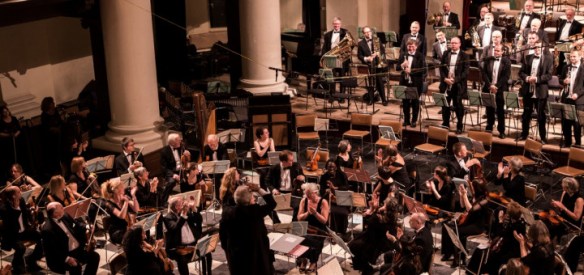
Benjamin Baker, Salomon Orchestra / Holly Mathieson – Berg: Violin Concerto & Schmidt: Symphony no.4

Benjamin Baker (violin), Salomon Orchestra / Holly Mathieson

St John’s, Smith Square, London; Monday 16 October 2017

Richard Strauss, arr. Rodziński Der Rosenkavalier – Suite (1945)

Berg Violin Concerto (1935)

Schmidt Symphony No. 4 in C (1933)

Reviewed by Richard Whitehouse

Never an ensemble to shirk a challenge, the Salomon Orchestra’s current season continued tonight with what, aesthetically, was an almost perfectly balanced programme – and whose second half brought a timely revival (in the UK) of the Fourth Symphony by Franz Schmidt.

With its catalyst in the tragically unexpected death of his daughter, this work was consciously intended as an ‘in memoriam’ and this is reflected in a formal design as fuses the customary four movements into an unbroken continuity; expressively also in that salient themes return almost as memories being recollected. From which perspective this performance succeeded admirably – Holly Mathieson having the measure of an overall design as though akin to the ‘journey of a life’, whose ending is tangibly (thereby inevitably) anticipated in its beginning.

The exposition’s themes – the first as introspective as the second, with its Magyar overtones, surges forth – were judiciously contrasted, and if the development was a little too rhetorical, it evinced the right cumulative intensity leading into an Adagio whose anguished climax was set into relief by the inward eloquence on either side. A touch stolid rhythmically, the scherzo did not lack impetus as it headed – lemming-like – over its cliff of disaster; in the aftermath of which the reprise gradually re-established momentum as the work came resignedly full-circle.

Its unity within diversity aside, the Fourth Symphony is a stern test of orchestral skill such as the Salomon met head on. The strings evinced the burnished warmth necessary for this music, and while woodwind intonation was on occasion wanting, it did not undermine an orchestral texture through which brass emerged with the appropriate impact. The solo contributions were well taken, not least from trumpeter John Hackett and cellist Kate Valdar, and Mathieson can take considerable credit for her advocacy of a piece whose repertoire status is still not secure.

Photo credit: Kaupo Kikkas

Before the interval, Berg’s Violin Concerto had provided the ideal complement. Similarly inspired by the premature death of a woman (in this instance the teenage Manon Gropius), it also focusses on that continuum between life and death, as well as the transfiguration which may result. Here again the four movements, divided into two parts, can be difficult to make cohesive and though Benjamin Baker (above) was not lacking consistency, his rather unvaried tone leading to an expressive uniformity as made this, ultimately, an interpretation in the making.

Mathieson, though, was attentive and always responsive in support. Beforehand, she presided over an enjoyable account of a suite arranged towards the end of the Second World War from Der Rosenkavalier. Probably undertaken by the conductor Artur Rodziński, it takes in several of the highlights from Richard Strauss’s sprawling comedy – rather as does Robert Russell Bennett’s ‘symphonic picture’ derived from Gershwin’s Porgy and Bess, which likewise has the result of reducing the larger work to a succession of glib purple-patches devoid of any real context.

Rendered with aplomb, it was surely possible, even so, to find a more fitting concert-opener – Zemlinsky’s Sinfonietta would have been ideal temporally and conceptually. That aside, this evening was a fine demonstration from the Salomon and auspicious occasion for Mathieson.

For more concert information from the Salomon Orchestra, head to their website

Franz Welser-Möst‘s pioneering recording of Schmidt’s Symphony no.4, with the London Philharmonic Orchestra, can be heard on Spotify below:

Jennifer Pike and friends – Polish Music Day @ Wigmore Hall

Jennifer Pike (violin), Guy Johnston (cello), Tom Poster (piano)

Wigmore Hall London; Saturday 14 October 2017

Szymanowska Polonaise in F minor / Nocturne in B flat (both c1825)

Knapík Partita (1980)

Górecki Pozegnaie (2009)

Chopin Piano Trio in G minor, Op. 8 (1829)

Reviewed by Richard Whitehouse

This evening’s concert formed the final instalment of an all-day event – as curated by Jennifer Pike (above) – that surveyed Polish chamber music from the Renaissance to the present, so enabling a much wider out-look on this (not least in the UK) little explored area than is usually the case.

Even so, not many such programmes can have opened with pieces by Maria Szymanowski (née Wołowska), whose death in 1831 at only 42 robbed the musical world of an evidently fine pianist and, as evinced by the elegant Polonaise and wistful Nocturne that were played with real poise and feeling by Tom Poster (below), an able composer and the plausible link between Hummel or Field and Chopin, who was surely familiar with her output. No great rediscovery, maybe, but a welcome opportunity to open-out the context of this period within Polish music.

The major discovery came with Partita by Eugeniusz Knapík. Now in his mid-60s, he seems to be among the younger members of a generation as moved away from post-war modernism towards a more traditional, though by no means reactionary discourse. Lasting for almost 30 minutes, this work unfolds from its imposing ‘Entrée’ – far more substantial and emotionally varied than its title might suggest – via a lyrical ‘Air’ in which the influence of Messiaen (this composer’s one-time teacher) was unmistakable; thence on to a central ‘Mouvement’ whose capricious interplay of violin and piano brought with it the most inventive music of the whole work, before a brief while forceful ‘Récitatif’ (mainly for violin) segued into a second though appreciably more sombre ‘Air’ which saw this piece through to a conclusion of tenuous calm.

An uneven though arresting work, then, which Pike gave with unstinting commitment, ably accompanied (an understatement in this instance) by Poster. Hopefully more of his Knapík’s will be heard in due course (his 1971 Violin Sonata just might be a worthwhile place to start).

After the interval, music by Mikołaj Górecki – his brief though undeniably affecting Farewell is not so far removed from some of the later pieces by his father Henryk; albeit with a degree of emotional detachment in keeping with one to has pursued a distinctively classicist idiom.

The main programme concluded with Chopin’s Piano Trio – not a work that tends to receive overmuch praise, but which proved highly enjoyable when rendered with the insight afforded here. A performance such as made light of the awkward tonal follow-through in the opening Allegro, then found due vivacity in the scherzo with its appealingly lilting trio. The Adagio had pathos without undue sentiment, while the finale made much of its folk-inflected themes and underlying krakowiak rhythm as it headed through to a decisive if peremptory close. All three players, not least Guy Johnston (above), made much of their sometimes restricted though never limited roles; suggesting the mature Chopin (his valedictory Cello Sonata uppermost in mind) likely had a masterpiece to contribute to this medium had it not been for his untimely death.

As an encore, Pike introduced a touching piece by Michał Kleofas Ogiński (1765-18330 – his polonaise for piano Farewell to my Homeland (1794) heard in an idiomatic arrangement for piano trio by her father, rounding-off this enjoyable and enlightening evening in fine style.

Photo credits: Jennifer Pike (Eric Richmond); Tom Poster (Toby Poster)

For more concert information on the Wigmore Hall head to their website

Wigmore Mondays: Lise de la Salle plays Bach, Liszt & Brahms

Lise de la Salle (piano) photo (c) Nicolas Brodard

J.S. Bach Italian Concerto in F major BWV 971 (1735)

Liszt Fantasie and Fugue on the Name B-A-C-H S529 (1855)

Brahms Variations and Fugue on a Theme by Handel, Op.24 (1861)

Wigmore Hall, London; Monday 9 October 2017

Written by Ben Hogwood

A nicely planned hour’s recital from Lise de la Salle, focussing on the collision between two different historical periods in music.

The so-called ‘Romantic’ composers rediscovered the music of Bach half way through the nineteenth century, and this led to a series of important performances and rearrangements of the composer’s music. Liszt paid his own characteristically larger than live homage in a fantasy based on the notes of the composer’s name (B-A-C-H translating in German as Bb – A – C – B natural, or H). Brahms, while not directly referencing Bach, built a hugely impressive seam of variations and a fugue on a theme from one of Handel’s Harpsichord Suites. Lise began her recital with Bach’s own act of homage, though this was a concerto for piano only written in the style of his Italian contemporaries.

Follow the music

The broadcast can be heard on the BBC iPlayer by clicking here

Bach Italian Concerto (12 minutes, beginning at 1:39 on the broadcast)

Listen out for the lively first movement, marked ‘Allegro’ (from 1:39), then an intensely lyrical slow movement marked ‘Andante’, written in the style of an aria (5:12). Then the last movement brings a lively conclusion to the piece, packed as it is with a stream of melodic content (10:56)

Liszt Fantasie and Fugue on the Name B-A-C-H (13 minutes, from 14:45)

Liszt’s gestures are typically bold at the start, where the B-A-C-H theme is stated boldly – but then because of the chromatic nature of the theme the music becomes very mysterious around five minutes in (20:00 or so). Then, from 21:30, we get ‘high voltage’ Liszt in the form of some tempestuous piano writing, where de la Salle responds to the challenge very impressively. Then, from 25:09, we get a big piece of chorale (hymn like) writing, before the theme is stated again and a thoroughly convincing ending ensues.

Brahms Variations and Fugue on a Theme by Handel, Op.24 (27 minutes, from 28:50)

In a prolific burst, Brahms wrote no fewer than 25 variations on Handel’s theme. The theme itself is played in the original form, and then the variations begin at 30:02. Brahms achieves a staggering variety of moods, speeds and phrases, moving away from Handel’s outline to explore new tonalities and rhythms. For a notable contrast listen out to the light footed, graceful Variation 3 (31:43) and the following Variation 4 (32:24), a strident march. On more than one occasion Brahms moves to the relatively downbeat minor key, dramatically so in Variation 13 (40:20) – which he follows with the capricious Variation 14 (41:54). The variations are noticeably more playful at this point in the work, but once again Brahms’ serious side exerts itself as we lead towards the fugue. This begins at 51:22, Brahms stating the melody and then bringing in each part with incredible precision, each strand fusing seamlessly.

Thoughts on the concert

This was a fascinating combination of pieces, played with technical brilliance by de la Salle – though her projection was at times on the loud side, meaning that the Bach especially felt as though it was played in capital letters – and the last movement felt rushed.

The Liszt was impressive and big boned, while the Brahms – though perhaps not getting the full contrast of moods – was beautifully and affectionately worked. The staccato eighth variation was especially impressive in its clarity, as was the quickfire fourteenth, though when the Fugue appeared it was initially difficult to grab the rhythm. That said, an impressive reading from a pianist growing in stature.

Further listening and reading

If you like the idea of Romantic composers taking their lead from the Baroque, then I think you’ll like this album from Murray Perahia. It brings together the ultimate Bach revival composer – Mendelssohn – with arrangements of Bach by Busoni.

You can catch up with Lise de la Salle at her website

Meanwhile her Liszt album from 2011 is available on Spotify below:

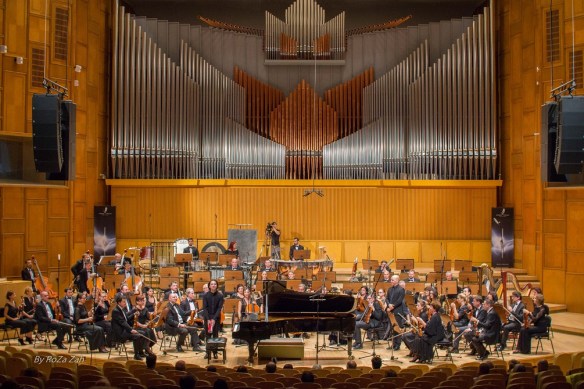
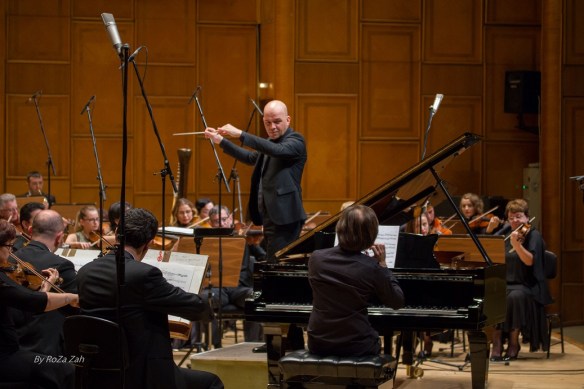
George Enescu Festival 2017 – Cristian Lupeş conducts contemporary works

Vassilis Varvaresos (piano), ‘Mihail Jora’ Philharmonic Orchestra – Bacău / Cristian Lupeş (conductor)

Radio Hall, Bucharest, Friday 22nd September 2017 @ 1pm

Măniceanu OEN (2015)

Hess Piano Concerto (2007)

Iorgulescu Signals (1993)

Glanert Frenesia (2013)

Reviewed by Richard Whitehouse

One of the most gratifying features in the current George Enescu International Festival was its emphasis on contemporary music, primarily through the Music of the 21st Century series. Alongside concerts and recitals, a programme of seminars (through the International Forum of Composers) featured composers from across Europe and the United States as to underline the essentially international character of this festival. One of these highlights was a concert by the ‘Mihail Jora’ Philharmonic Orchestra from Bacău with the conductor Cristian Lupeş.

Whatever else, Bacău has an orchestra of far from provincial standard. That this concert had been performed two days before did not account for the confidence with which these players tackled a demanding programme, opening with OEN by Mihai Măniceanu. Its title referring to transpositions of the octave (with a covert spatial element), this piece took in portentous unisons, strident outbursts, pointillist delicacy and modally inflected melodic lines across its eventful course, even if any greater continuity or momentum proved as inscrutable as its title.

Would Nigel Hess had shown any such ambition in his Piano Concerto, written in memory of Queen Elizabeth, the Queen Mother. This piece was as expected from one adept in music for film and TV – its three movements moving from the enervated charms of The Smile, via the Romantic blandishments of The Love (whose main tune might have given Claude François and Jacques Revaux pause for thought), to the martial strains of The Duty with its dutifully triumphal conclusion. A notable platform for the scintillating pianism of Vassilis Varvaresos (laureate of the 2014 Enescu Competition), who responded with Fantasie um Johann Strauss by Moriz Rosenthal as an uproarious encore and will soon take on the rather more rewarding assignment of Nikos Skalkottas’s Third Piano Concerto with the Basel Symphony Orchestra.

More Romanian music followed the interval. With its several dynamic sections separated by interludes of relative stasis, Signals by Adrian Iorgulescu unfolded with those ‘signals’ of its title audible at every level; with an emerging sense of that ‘greater whole’ such as sustained the work through to a virtuosic conclusion. The Bacău orchestra met its numerous challenges head on, duly motivated by Lupeş’s disciplined as well as perceptive direction to result in a gripping account of a piece that more than held the attention and was certainly worth revival.
Nor was Detlev Glanert’s Frenesia plain-sailing. Commissioned by the Royal Concertgebouw to mark the 150th anniversary of the birth of Richard Strauss, its complex yet enticing sound-world belied a formal trajectory which focussed this by no means always frenzied evocation of ‘modern man’ with its headlong energy but also thoughtful expectancy. Suffice to add the musicians were not outfaced by those of the Concertgebouw (whose premiere can be heard on the RCO compilation ‘Horizon 6’) in making the most of this showpiece with substance.

An impressive showing by the Baçau players as well as being a notable occasion for Cristian Lupeş, who had earlier enjoyed comparable success with the Sibiu Philharmonic in a Festival Square concert. A major engagement at the next Enescu Festival in 2019 must surely beckon.

For more information on the Enescu Festival, head to the festival website

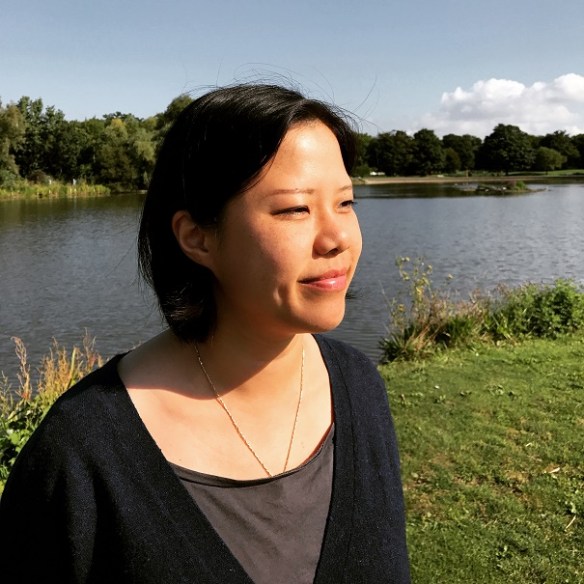
Ask the Audience at the BBC Proms – Leanne Mison on the Royal Stockholm Philharmonic Orchestra with Renée Fleming

The final Ask The Audience from the 2017 BBC Proms is with Leanne Mison, who promotes and endorses an impressive roster of electronic music artists for Bang On PR. Leanne talks to Arcana about a Prom given by the Royal Stockholm Philharmonic Orchestra and their chief conductor Sakari Oramo, – with two solo vocal turns from the superstar New York soprano Renée Fleming.

Prom 61: Renée Fleming (soprano), Royal Stockholm Philharmonic Orchestra / Sakari Oramo

Andrea Tarrodi Liguria

Barber Knoxville: Summer of 1915 Op.24

Richard Strauss Daphne – Transformation Scene, ‘Ich komme – ich komme’

Nielsen Symphony No 2 ‘The Four Temperaments’

Royal Albert Hall, Wednesday 30 August 2017

You can listen to this Prom on the BBC iPlayer here

ARCANA: Leanne, how would you describe your musical upbringing?

My parents attempted to introduce me to classical music from quite an early age, but I didn’t show too much interest in it at the time. My mum joined a classical music vinyl club and would be sent a record every month, but we rarely ever played them. I’d love to dig them out now and see what she had! My proper introduction to music was via piano which I learnt to play from the age of seven, so pieces by Beethoven, Chopin, Mozart and Mendelssohn. I did get really into it at one point as I had an inspiring teacher who was about 80 years old and I’d get to practise on her baby Steinway. I reached Grade 7 but as the expectations grew for me to practise for an hour and more a day, my interest waned. At that age, it doesn’t earn you very much kudos with other kids so I gave in to peer pressure. My parents said I would regret it and they was right of course!

My parents listened to things like The Carpenters and The Cars.  Around the age of 9, I started listening to things like Salt ‘n’ Pepa, En Vogue and Bobby Brown. I still like that music now, it’s super fun. When I about 15, I tried to fit in and listen to the same kind of music my friends were into like Bon Jovi, Oasis and The Verve but it didn’t really stay with me to be honest. When I was 12, I randomly picked up a Telstar tape of rave music for 99p at Woolworths and I heard things like The KLF and 808 State for the firs time. I was like ‘Wow, what was that?!’ – there were no reference points, I had no idea about rave culture. I didn’t hear music like that again for quite a long time but that was the start of me getting into electronic music.

Could you name three musical acts that you love and say why you love them?

I really love what Factory Floor do. Their music can get so madly intense and mesmerising, and live – you can’t help but dance but you can also have a very cerebral experience with it too.

I’ve been really enjoying listening to Nick Hakim of late. His album Green Twins has this irresistible, other worldliness to it – all hazy psychedelic R & B.

And then there is the master entertainer Chilly Gonzales. He puts classical music and pop music in the same space, weaving them together and presenting their common thread. Then he throws in a heavy dose of comedy, a bit of history and a piano tutorial and we just lap it all up! I wish he’d been around when I was growing up, I probably would have been inspired to carry on and do my Grade 8!

Are you ever tempted to go back to the piano?

Obviously I’d love to be able to play now, who knows I might get back into it at some point (probably when I’m retired!)
One of the great benefits of having instant access to music on Youtube and Spotify is that you can actually hear what the piece is supposed to sound like and what you should be aiming for. It’s more inspiring than back in the old days!

What did you think of the Andrea Tarrodi piece tonight?

It was really pretty, delicate and playful. Lots of shimmers of light but then it went on a dramatic roller coaster later.

I really enjoyed it, so much so I wanted to go to the front to get the full experience!  I was quite surprised when you said the composer was younger than both of us.

If you didn’t know that piece was about anything, did it conjure up any images?

That’s a good question, I wasn’t really thinking along the line of images  – but now you mention it maybe rolling fields and mountain tops?

What about the Barber, with Renée Fleming?

This was very enjoyable too, and took me a bit more out of my comfort zone as I’m not used to listening to an operatic voice accompanied by that many musicians.  Sadly I’m more used to listening to things on laptop speakers so it’s a real treat to experience that breadth of sound and visually it’s very impressive too.

What did you think about the Strauss?

There was a lot going on here, I found the soaring operatic voice quite dramatic and emotional, I think I was more taken by what was happening with the strings. I should listen to more music like this and try and understand it. I found my mind wandering a bit more with this one, I started looking at the audience and observing their facial expressions and they seemed pretty serious on the whole. Perhaps they were intensely into it! The musicians facial expressions themselves were a lot more expressive, especially the conductor’s.

Working in music PR, I spend a lot of time reading reviews and people’s thoughts on music. Tonight it was a clean slate, I was listening to music I’m very rarely exposed to and with no idea what critics have said about it and that was very refreshing.

What did you think about the Proms, and what did you enjoy about it?

The music was actually quite accessible and experiencing that range and depth of sound in a space as beautiful as the Royal Albert Hall brings out all sorts of different feelings in you. It’s quite unique and I can see why people enjoy it so much.

Would you change anything about your Proms experience?

Not at all, I only wish I’d come to more. I went once about 10 years ago but my recollections of it are vague.
I’d read some of your Ask the Audience pieces before and was really intrigued by it and really glad you invited me!

My experience of seeing classical music is quite limited, I’ve seen some experimental music with orchestras such as Varèse performed at the Royal Festival Hall which was really dark. Also Helmut Lachenmann and Lou Reed’s Metal Machine Music, all quite challenging and let’s face it, not nearly as fun as tonight!

Would you go again?

Yes, definitely. Here’s to next year and thanks very much for inviting me.

Verdict: SUCCESS