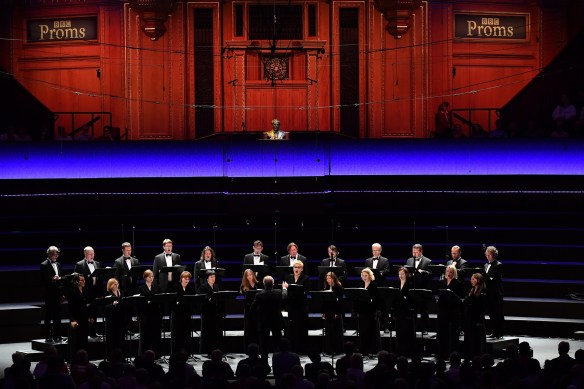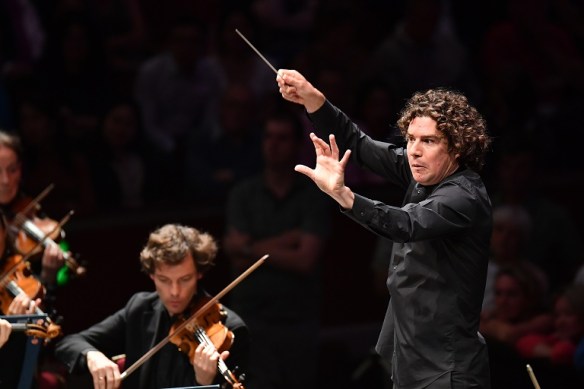
Prom 40: Christian Tetzlaff (violin), Scottish Chamber Orchestra / Robin Ticciati
Brahms Tragic Overture Op.81 (1880)
Berg Violin Concerto (1935)
Thomas Larcher Nocturne – Insomnia (first UK performance) (2008)
Schumann Symphony no.3 in E flat major Op.97, ‘Rhenish’ (1850)
Royal Albert Hall, Tuesday 15 August 2017
You can listen to this Prom here for 28 days from the date of the performance
The Scottish Chamber Orchestra are one of the UK’s finest ensembles, and they proved their worth once again with outgoing chief conductor Robin Ticciati leading a fine Prom tracing a course from darkness to light.
Brahms’s Tragic Overture is one of the composer’s deepest orchestral statements, and Ticciati was determined to present its steely side. Often the strings were without vibrato, the lean sound complemented by raucous horns and open textures in the woodwind. Lower strings growled ominously, and only the softer woodwind passages offered occasional respite in their beautifully choreographed choir.
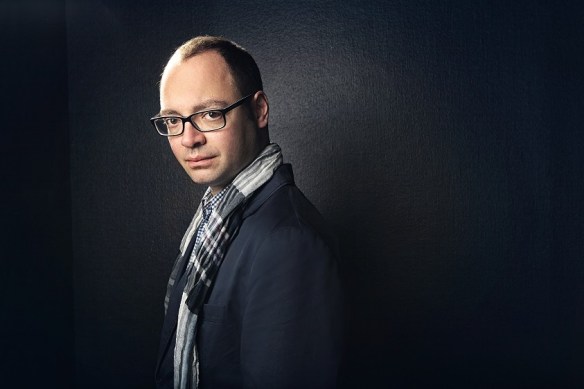
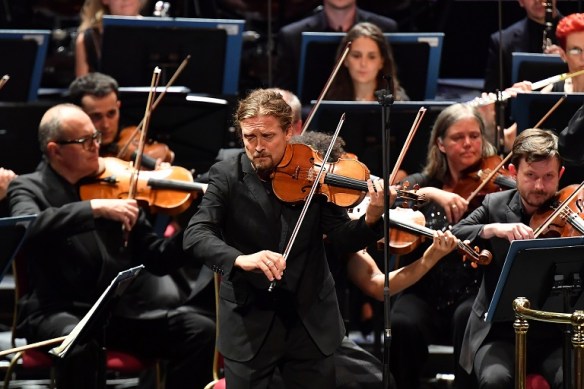 Berg’s Violin Concerto contains music of similarly ominous qualities, in this case uncannily heralding the composer’s final year despite its dedication elsewhere. Though the violin begins with elegiac tones it has a broad emotional range, and Christian Tetzlaff (above) rose magnificently to the occasion, finding Berg’s many and varied colours but crucially balancing them with the excellent orchestral contributions.
The coded messages Berg inserts into the music were on occasion stripped bare, and the anger at the heart of the second movement was almost completely unconcealed. Its crowning moment lies in quiet simplicity, however, and when the quotation of Bach’s chorale Es Is Genug arrived on clarinets the mellow tones were deeply moving. Capping the concerto with his rise to a high ‘G’ at the end, Tetzlaff held the note at a barely audible volume so that it sounded like one last breath in his ascent to another world.
As the evening progressed the darkness drew in ever more closely for Thomas Larcher’s Insomnia – Nocturne, an orchestral piece receiving its first UK performance. Written for a relatively small orchestra of eighteen, it was an uncomfortably accurate portrayal of sleep’s refusal to take hold, with a high pitched glockenspiel tone becoming particularly tiresome. Sitting in the background, its tone made an uncomfortable backdrop for the increasingly fractious instrumental activity in front, which finally subsided into a fitful slumber, the sort where it is already too late in the night to be rescued. The piece began with promising tonal material, but in a manner akin to insomnia this was rendered much less appealing by the end.
Thankfully Schumann’s Rhenish Symphony was on hand to pierce the darkness with music of unrestrained joy. The opening surge is one of the happiest in all classical music, and like the river on which it is based it takes everything with it downstream. The Scottish Chamber Orchestra were superb, the lofty horns enhancing the open-air sound while the woodwind worked together in beautifully shaded colours, as did the strings with more vibrato this time.
If anything the second movement Ländler was even better, flowing forward with purpose and charm, while the Intermezzo following also had a softer heart. The mood became solemn for Schumann’s powerful evocation of Cologne Cathedral in the fourth movement, the symphony turning inwards with self-doubt and contemplation, but from this the finale emerged with resolve and conviction.
A strong Prom, then, the Scottish Chamber Orchestra giving us something old (Brahms and Schumann), something new (Larcher), something borrowed in the Berg and something blue in the mood that ran throughout. Thankfully the shade of this particular blue changed from deep and dark at the outset to a bright and breezy azure by the end.
Ben Hogwood
Stay tuned for the next in Arcana’s Ask The Audience series, where Sam Hogwood will give her verdict on the Scottish Chamber Orchestra Prom. Coming shortly!


 The Germanic second half began in more restrained mood with Schumann’s Cello Concerto. Rarely performed for decades (and more often in the transcription for violin), this deceptively genial piece is among its composer’s most ingenious in terms of form and motivic continuity. Alban Gerhardt (above) maintained a determined while never merely inflexible course across its three continuous movements, the BBC Philharmonic providing support as attentive yet unobtrusive as the music required. Interesting to hear that the soloist thought the finale musically the least successful, as this emerged as arguably the most successful part – not least with its engaging dialogue kept on its toes and with no sense of dourness or grittiness as regarded the orchestral texture. Overall, a perceptive and convincing account of a work still too easily overlooked.
 Storgårds then rounded-off the programme with a taut and tensile reading of the symphony that Hindemith derived from his opera Mathis der Maler. This retelling of cultural meltdown and social antagonism during the Thirty Years War proved too ‘contemporary’ for the Nazi regime to stomach, and it was no surprise that the premiere of the complete opera took place in Zurich. Storgårds had the measure of the Angelic Concert with its austere chorales and angular though never impersonal polyphony. The Entombment of Christ was affecting for all its brevity, while the climactic Temptation of St Anthony built surely and impulsively from its stark introduction, through a central interlude of tangible pathos, to a culmination such as blazed forth in affirmation. All credit to Storgårds for ensuring so cathartic an impact.
 It was down to Alexander Melnikov (above) to supply the effective contrast in excerpts from Shostakovich’s largest piano work, the 24 Preludes and Fugues, Op.87. A homage both to Bach and to his pianist friend Tatiana Nikolaeva, the cycle contains some of the composer’s most intimate and confidential thoughts. Running through each of the 24 major and minor keys, the work progresses as a ‘cycle of fifths’, with a Prelude and Fugue in each major key (for instance ‘C’) immediately followed by its relative minor key (in this case ‘A’).