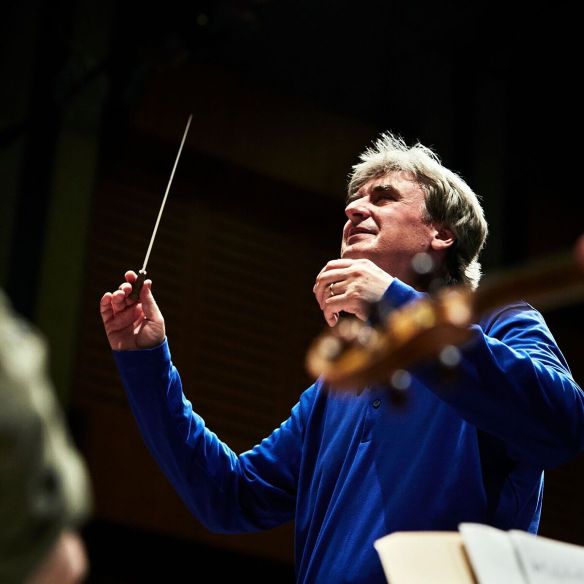
Having made an auspicious start to his tenure with the BBC Scottish Symphony Orchestra, Thomas Dausgaard tonight brought the orchestra to the BBC Proms for its most ambitious concert this season – Mahler’s I, given in the ‘performing edition’ by Deryck Cooke.
Left unfinished at Mahler’s death in 1911, the work was partially premiered in 1924 though it was not for another four decades that a complete rendering was heard – Berthold Goldschmidt conducting the London Symphony Orchestra at the Proms in Cooke’s realization. Since when his (subsequently revised) edition has become the preferred option for those tackling Mahler’s last symphony in its entirety. Dausgaard recently won praise for his recording with the Seattle Symphony, and his account this evening proved no less successful as an overall interpretation.
Other than the notably deliberate tempo for the violas’ initial theme, such as made it almost an epigraph to the movement overall, the opening Adagio was flexibly paced; the wrenching theme heard on massed strings finding contrast with the sardonic, waltz-like music as passed between solo woodwind. The development’s polyphonic intricacy was eventfully unfolded, then the climactic dissonance – with its piercing trumpet note – was pointedly drawn into the whole so that the lingering coda evinced a serenity whose fulfilment was at best provisional.
The first Scherzo emerged even more impressively. Texturally the least cohesive movement as Mahler left it, its contrapuntal density allied to elliptical harmonic progressions make it the most radical (the earlier music of Hindemith and Weill tangibly within reach) and Dausgaard expertly integrated its increasingly close-knit sections into a stretto of mounting excitement. The brief, fulcrum-like Purgatorio which follows was a little matter-of-fact for its glancing irony wholly to come through, and Dausgaard ought to have made an attacca into the second Scherzo (the three movements of this second part ideally form a continuous whole). Not that there was much to fault in this latter as it pivoted between anguish and appeasement, before vanishing into that ‘tunnel’ of darkness whose nihilistic overtones were palpably to the fore.
Come the Finale and Dausgaard might ideally have deleted the opening drum stroke, while the climax of the central Allegro really needed underpinning from drums for its intensified reprise of the first movement’s dissonance to make its fullest impact. But these were minor flaws in a perceptive rendering overall – sepulchral opening brass making way for the most eloquent flute melody in the symphonic literature (not least as played by Charlotte Ashton), transformed into a radiant string threnody which brings about this work’s cathartic ending.
An impressive reading was fittingly programmed within the context of Schubert’s Unfinished, of which Dausgaard has made a fine account with the Swedish Chamber Orchestra. While his rapid take on the first movement (little ‘moderato’ about this Allegro) did not transfer ideally onto full orchestra (at least in the resonance of the Albert Hall acoustic), the ensuing Andante had no lack of poise: the hushed dynamics of its coda no less arresting than the blissful final cadence in which Mahler’s transcendent leave-taking, 88 years on, was not hard to perceive.
Richard Whitehouse (photo of Thomas Dausgaard (c) Thomas Grøndahl)
You can listen to Dausgaard’s recordings of these pieces on the Spotify playlist below:
Fresh performances of seldom-heard repertoire. That sums up the fourth of the BBC Proms’ weekly visits to Cadogan Hall, downsizing as they do on a Monday lunchtime.
This was an invigorating hour, documenting the emergence of the cello as a solo instrument in the 1700s. Until then it was largely used as part of the ‘continuo’ – that is, the small section of instruments responsible for providing the harmonic base of the music – but thanks to composers such as Platti, Vivaldi and Boccherini the instrument’s own melodic potential began to be fully realised.
The first item in the concert provided some helpful context, a lean performance of the stern Grave by Johann Adolf Hasse, followed immediately by a Fugue rooted in dance forms. The authorship of this remains in doubt – Hasse is a contender, but a more likely composer was Franz Xaver Richter, a fellow Mannheimer. Whatever the outcome, the two pieces dovetailed nicely, setting the scene for the much brighter Cello Concerto in D major by the Italian composer Giovanni Benedetto Platti, employed in the German city of Würzburg.
His bright and breezy work showed off the cello’s new capabilities, if not quite raising it above the level of the surrounding violins. Edgar Moreau brought plenty of energy and pizzazz to the performance, however, with brilliant technique and studious interaction with the finely honed instrumental sextet Il Pomo d’Oro, and their charismatic leader Maxim Emelyanychev. His contribution on the harpsichord was a constant delight, punctuating the music and cajoling his players.
Vivaldi was next, one of the 20+ concertos he completed with the cello centre stage. This one, in A minor, had some tricks up its sleeve in the outer movements that Moreau enjoyed showing off, but the serene and rather beautiful melody in the central Andante stole the show.
Il Pomo d’Oro then took over for some forward looking music by Telemann. The German master’s Divertimento in B flat major contains glimpses of classical practice with its use of five light hearted ‘scherzo’ movements out of the six in total. There was plenty of variety within them however, and the poise and dexterity of the ensemble was a joy to watch.
Finally the cello got its best workout in one of Italian composer Luigi Boccherini’s 12 concerti. This one, the Cello Concerto in D major G479, sparked into life immediately, helped by Moreau’s immaculate control in the higher register, where most of the writing for cello could be found. This was a striking change in comparison to the Platti, the cello now much more dominant, and the duet with Zefira Valova’s violin in the slow movement felt more like a ballet score. Boccherini relocated to Spain, and the last movement betrayed this somewhat in its Fandango flavouring, where Moreau enjoyed the rapid dancing and energetic conclusion.
To bring us back to earth there was an encore of solo Bach, the Sarabande from the Solo Cello Suite no.3 in C. If Boccherini and co raised the cello to the heights in the concerto, then it was Bach who revolutionised the instrument in a solo capacity – and it was a nice touch to include that point here.
Arcana returns to the BBC Proms in the company of friends – and for our second visit this season we are dipping into one of the festival’s themes, the music of John Adams. Offering his thoughts was Steve Hodges (above)
J.S. Bach arr. Stravinsky Canonic Variations on Vom Himmel hoch, da komm, ich her (1956)
Ravel Shéhérazade (1904)
Adams Naive and Sentimental Music (1999)
You can listen to this Prom on the BBC iPlayer here
Arcana: Steve, what was your musical upbringing?
Personally, I would say it was broad. It started with The Beatles, The Monkees and The Rolling Stones. I grew up through the 1970s and enjoyed glam, and Sparks, and Elton John. Then after meeting people who had some really broad taste, I lapped up everything through electronica, David Bowie and punk.
I’ve gone on from there really, and gone sideways as much as I possibly could. I like to reflect on music and on what was going on at the time, socially, and what it actually represents. I think that’s an important factor about music. I really enjoyed the punk ideals that said anybody could do it, it made a new wave of music that was enormously important. Just because people could make a record didn’t mean they necessarily should, because some of them were awful, but there was so much choice and so many good things in the 1980s. Since then we’ve been through house and drum ‘n’ bass as well. My classical representation is a bit smaller, but I enjoy what I enjoy!
Could you name three musical acts you love, and why you love them?
Starting with an old one, The Beatles – that was through my father’s record collection, which was a great influence as a young person. I appreciated them as they were. Then The Human League, as a lot of the Sheffield music was important to me, because at the time I was fortunate to be dabbling in music myself. It really crossed over, and Manchester music was a reference as well – so I would put Ultravox! in there as well. Those were the things that mattered really.
Turning to the concert, what did you think of the Bach / Stravinsky?
I thought there were subtler things here, I was surprised at the quiet volume, there were not so many people on stage I suppose. I was fascinated by the people playing, and the movement between the sections. I was watching for the technical side as much as the musical side. It was a nice ‘warmer-upper’ for the rest of it.
What about the Ravel?
I was much more in to this, and felt reflections of 1960s TV in the music, there were flurries that I kind of recognised. I really liked it. For the singer to remember the words was good, and being able to follow along in the book was interesting. I liked the shape of the music.
And the John Adams?
There was much more to think about with that one! I think the first movement built up, and we had the pleasure of seeing the orchestra and the punctuation, the offset rhythms, the bouncing around of the parts. There was a lot more percussive use here and the intricacies of the first piece were astonishing. He was definitely testing the technical abilities of the musicians. The crescendo at the end was almost human madness in my mind, it was almost too much to bear. The build up at the end, it went from the crossrhythms going on that were clear and observed, you could feel the pulses, and then that broke down at the end and it was completely consuming. You almost wanted to put your hands over your head.
The second movement was really nice at the start, I really liked that one. Because I’ve worked with sequencing a lot you could feel the repetition, the softness of the play, again testing the musicians in a different way at the limits of musicality. The lightness of touch stood out, and it was mostly driven by the harps to start with, and that was the bass, the pulse that drove it along to start with. I liked the guitar in there, I hadn’t spotted him and wondered where that was coming from.
What I liked about it most was where he was getting the strings to crescendo, it was like reversing an attack, and it was going round and round in a really interesting way. It was powerful and really interesting to hear that executed. I enjoyed that one most of all for sure. The arpeggios on the strings were really good, it was so delicate and ambient in its way. Even though it was gentle it was really strong.
How did you find the Proms as an experience?
Very nice. The reverence for the music was striking, and full marks for the quality of what you saw. The audience were obviously there to enjoy it, and treated it with the respect it duly deserved. It was a beautiful environment to hear such things. I’m almost a little disappointed it was quieter at the beginning but I guess we should have stood closer at the start. After a while though, you tune your ears into it. Everybody shut up so that we could all hear.
Having said that, the volume at the end of was enormous! The variety of the use of the instruments, like bowing the percussive instruments in the last piece, that was a softer element. It wasn’t orchestral techno by any means but there was a lot of crossover. It really was a testing thing for the musicians, and it really resonated how much was being put on them.
Is there anything you would change about the experience?
I did browse the catalogue and felt it was something I would like to do. I don’t think there is anything I would particularly change about it, and I’d be inclined to come again. I heard a few things on the TV last week, and I think I shall be listening out for more!
Monteverdi Choir, English Baroque Soloists /Sir John Eliot Gardiner (above)
Schütz Nun lob, mein Seel, den Herren, SWV 41; Nicht uns, Herr, sondern deinem Namen, SWV 43; Danket dem Herren, denn er ist freundlich, SWV 45 (all c1617)
J.S. Bach Cantata No.79, ‘Gott der Herr ist Sonn und Schild’ (1725); Cantata No.80, ‘Ein feste Burg ist unser Gott’ (1716, revised 1720s-1735)
Royal Albert Hall, Wednesday 2 August 2017 (late night)
After the earlier evening headiness of John Adams’ Naïve and Sentimental Music from the Philharmonia, it was quite a stylistic shift to the night’s second Prom, which began with three canzonas / hymns of Heinrich Schütz, written some 400 years ago.
Yet as the ear gradually adjusted and the members of the Monteverdi Choir and English Baroque Soloists quickly found their level, it was clear we were listening to something quite special. Under the fastidious but loving direction of Sir John Eliot Gardiner, an old hand at these scores, Schütz’s own minimalism came to light, helping the transition from first Prom to second. The choir were carefully positioned and instrumental soloists stood where possible for their contributions, an effective technique that spotlit them for the audience but also ensured the Royal Albert Hall acoustic was keenly observed.
Though the Schütz was very good, the two J.S. Bach cantatas took this late night concert to the next level. First was Gott der Herr ist Sonn und Schild, where the vocal soloists Amy Carson (soprano), Reginald Mobley (alto) and Robert Davies (bass) were particularly fine, and the small continuo* (*accompanying) section negotiated their tricky lines with deceptive ease.
The second cantata, Eine feste Burg ist unser Gott, became the focus of the evening, Bach’s Lutheran cantata a cornerstone not just of his sacred compositions but of Baroque music and the Reformation in general. Gardiner took every opportunity to depict the ‘mighty fortress’, whether through the strength of the choral sound or the meaty orchestral textures, capped at the bottom end by the extraordinarily satisfying rasp on Stephen Saunders’ bass sackbut, an ancestor of the trombone. Brought to the front for the Prommers’ benefit, it was a wonderful thing to witness.
This was just the tip of the iceberg though. One of the great assets of the Monteverdi Choir is that its members are all potential soloists, making it a great team of individuals. Soprano Miriam Allan and bass Robert Davies dueted in the Aria and Chorale, and complemented each other very nicely, then tenor Hugo Hymas sang beautifully for the Recitative, while Mobley (above) once again impressed with his passionate and full-bodied tones in a duet with the tenor. The orchestra were once again on top form, though this time oboist Leo Duarte was keenly in focus, moving between the conventional wooden oboe, an oboe d’amore and an oboe di caccia (which looks rather like a banana!) with great dexterity and flair.
The chorus were impeccable with their diction and ensemble, and Bach’s music had that life-giving energy that comes across in successful performances such as this. Eliot Gardiner has written a whole book (Music In The Castle of Heaven) on his love of Bach’s music, and listening to his charges here was akin to standing on the turrets of that building, faces turned skywards. It really was that enlightening.
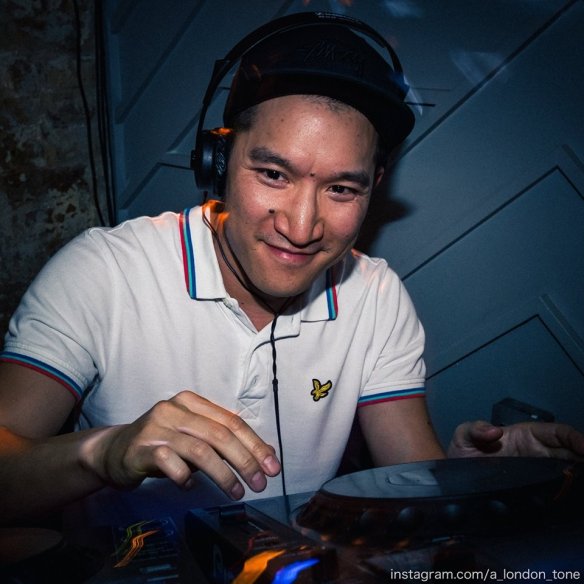
Last year Arcana went on a charm offensive, introducing friends to the BBC Proms, some for the first time. For the 2017 season we will continue to bring the festival to people in this way, discovering fascinating musical facts and insights as we go. For our first visit we chose the concert commemorating Sir Malcolm Sargent, one-time conductor of the Proms in the 1960s. The program replicated his 500th Prom, given in 1966 – and to offer an appraisal we invited Rob Chung (above)
Rob is DJ Chug, a drum ‘n’ bass DJ who runs his own Elements night in East London, and he has releases forthcoming this summer on Soul Deep and Co-Lab Recordings. Yet, as he revealed to Arcana, he has a classical past.
Beatrice Rana (piano), BBC Symphony Orchestra / Sir Andrew Davis
arr. Sir Henry Wood The National Anthem; Berlioz Le carnaval romain Overture, Op.9 (1844); Schumann Piano Concerto in A-minor, Op.54 (1845); Elgar Cockaigne (In London Town) Op.40 (1900-01); Walton Façade – Suite No.1; Popular Song (1922-28); Holst The Perfect Fool – Ballet Music (1918-22); Delius On Hearing the First Cuckoo in Spring (1912); Britten Variations and Fugue on a Theme of Purcell (The Young Person’s Guide to the Orchestra), Op.34 (1945)
You can listen to this Prom on the BBC iPlayer here
Arcana: Rob, what was your musical upbringing?
It was quite an extensive one – mainly from my sisters, when I was little. They would have anything from Duran Duran to Wham!, the big pop hits of the 1980s. My parents had a bit of Motown on vinyl, then as my sisters got older the influence came into early ‘80s R&B, swing, hip hop, De La Soul, Public Enemy, a lot of gangster rap – and then some jazz – Courtney Pine, Julian Joseph. And then it was on to drum ‘n’ bass, to Goldie and 4Hero, that kind of stuff. So that was the influence from my sisters, and then because there wasn’t any local radio in East Anglia – it was just Radio 1 or nothing, no pirate radio – I used to listen to a lot of dance DJs in the evening, such as Dave Pearce, Danny Rampling and Tim Westwood. I used to record Tim Westwood’s shows every Saturday, and fell in love with hip hop basically!
My sister came to university in London, and used to record all the drum ‘n’ bass in London, off the pirate radio stations, and she used to send me the tapes back. From there I learned what was going on in London. Then at about 15 or 16 there was a new pirate station in Norwich, of all places, called Flight FM, so I used to listen to that all the time. A lot of local DJs were playing garage and drum ‘n’ bass, and that’s when I discovered UK garage, and bought my first set of decks. I was buying anything and everything – house music, hip hop, drum ‘n’ bass, and it all went from there.
At the same time I played the piano and violin as a kid, at school. I played the violin from six years old to 18, and I was in an orchestra – I got to grade seven. I was in an orchestra at school, we used to play in the chapel and the cathedral, which you take for granted now. I have this recurring nightmare about playing on the second desk of the violins, losing my place and trying to pretend I was playing for the next hour or so. It still haunts me to this day, and I still bring it up with my school mate whenever I see him!
Have you had any other classical music experiences beyond orchestra?
Not really. I used to go to the odd concert with my parents, at Christmas carol time, otherwise not really. Not since school days.
Could you name three musical acts you love, and why you love them?
Currently, Robert Glasper – a great jazz pianist, fusing hip hop, R&B and jazz, three forms I really like. He’s an amazing musician and great live. I’ve seen him about five times now, he blows me away every time.
Stevie Wonder I think is the greatest musician I’ve ever seen. I’ve seen him at Glastonbury, and at Hyde Park last year. He’s got an amazing repertoire, great albums and a great voice. He plays any instrument amazingly well, he just blows me away.
For the third one…a drum ‘n’ bass producer called Serum, who is absolutely smashing it on the drum ‘n’ bass scene at the moment. He covers all styles, has in your face, stupid jump up tunes. Anything he releases at the moment I would listen to it and probably buy it.
How did you rate your first Proms experience?
I would give it 10/10, it was awesome – amazing. Everything about it, the experience, the sound, the crowd, the quality of the orchestra, the conductor – it was a really good experience. I forgot what it was like to be at a concert but the stereo width of the sound blew me away, following the music. I was really impressed with it, and it was the Royal Albert Hall of course. The sound was crystal clear, not loud but you could hear every single thing. It was really impressive.
What was your favourite piece?
I haven’t actually decided on that yet…probably the Elgar piece…or the Schumann, with the piano. I’ll go for that one, I liked the call and response between her (Beatrice Rana) and the orchestra, with the clarinet and the cellos, going back and forth. I really enjoyed that and she was pretty special. It took you all over the place but she was the focal point as well.
You mentioned how you knew it was Elgar during the piece.
Yeah, I don’t know why – and the same with Britten as well. It feels like an English tune, I don’t know what it is. They always used to play Nimrod at the end of every year at our school, and I think it was the harmonics or the chord progression, as soon as they started playing – and how the strings come in and out, with a slow attack.
What was your least favourite?
I think it was The Perfect Fool. I got a bit lost, and couldn’t keep up with what was going on. That was the intention, right?! I couldn’t really follow it. I liked the Walton piece though, it was a bit of fun in the middle, and the fact you could get a crowd laughing at a random ending, that was pretty special. That was where the percussion came out and were really getting into their element.
What did you think of the Delius piece, On hearing the first cuckoo in spring?
I quite liked that, again – spring, the strings coming in, it was a nice, short, to the point piece.
Do you think in terms of the length of the pieces some was too long?
It’s hard to keep up for that length of time. Some of the Schumann I struggled with a bit at the end, but at the same time in the Walton when it was short and sweet I sometimes felt it was too short, a little poem rather than a chapter. It was a nice change, a bit like listening to a Disney score.
It can be quite mentally tiring trying to take all of the music in, you start wandering. But I was comparing tonight to when I saw James Blake play at Shepherd’s Bush, and it was a sensory overload with all the lights and everything, there was a lot to take in. it was like that tonight, with lots of different things going on and trying to keep up – it was a good workout for the brain.
I thought it was also interesting how someone in the orchestra can have just one small part in 30 minutes, but when you come in you can’t miss a place. The Elgar piece I felt a lot of tension building, the Walton piece – I forget you can have things in triple time. These days everything I listen to is in four!
What did you think of the concert as an experience?
It was a lot more informal than I was expecting. I enjoyed the laid back atmosphere, it seems very open – which is not what I expected at all. We had people reading their books, people lying down, a guy reading along to the music which I thought was quite cool. I liked the crowd involvement – not a lot but traditional, it was really nice. The National Anthem at the start threw me a bit (and me! – ed) but at the same time it is nice to do these things, it doesn’t happen very often.
The acoustics vary differently where you are, it’s interesting to compare down in the Arena with up in the gods. I would be interested in how they mic everything up and do the soundchecks. There is the depth of sound as well, you really feel the depth with the violins to the tuba. I liked how the organ just snuck in during the Elgar too. Nobody was out of sync, either! I was trying to spot someone…but not gonna happen!
What we said about the conductor, how much control he has over everything – I was impressed with that, how he sped it up, slowed it down and brought people in. I forget how much hard work that must be. You’ve got to know the pieces inside out, and it was very impressive.
Was there anything you would change about how the concert was staged or presented?
Not really. I guess I’m used to having members of the band introduced, pointing out a certain lead – but I guess that’s done in the programme notes. I don’t think I would change anything.



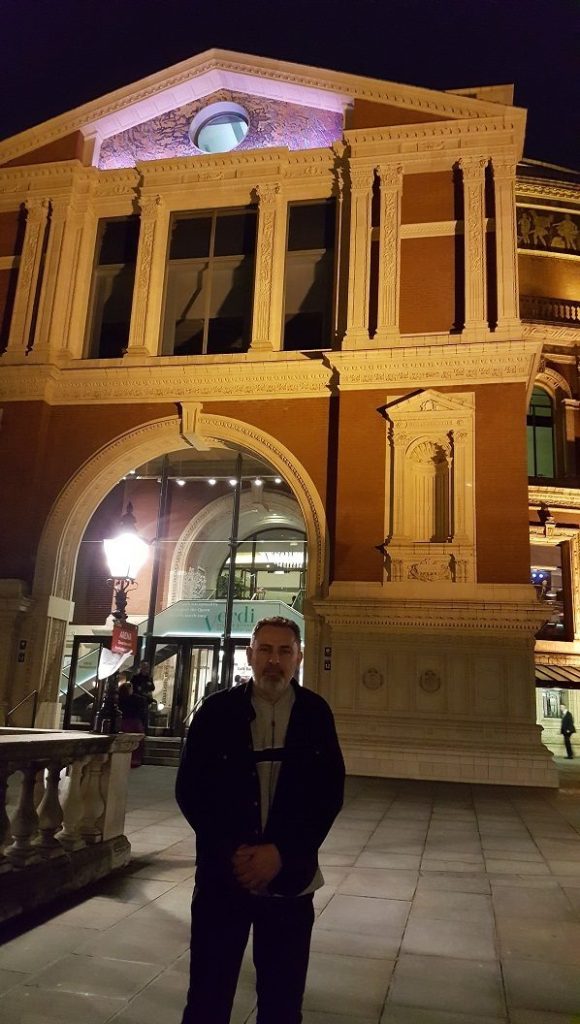 Arcana returns to the BBC Proms in the company of friends – and for our second visit this season we are dipping into one of the festival’s themes, the music of John Adams. Offering his thoughts was Steve Hodges (above)
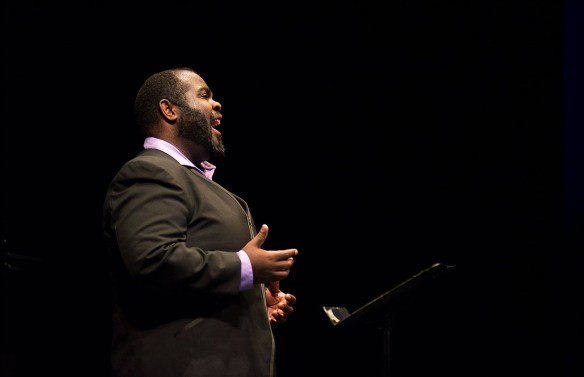 This was just the tip of the iceberg though. One of the great assets of the Monteverdi Choir is that its members are all potential soloists, making it a great team of individuals. Soprano Miriam Allan and bass Robert Davies dueted in the Aria and Chorale, and complemented each other very nicely, then tenor Hugo Hymas sang beautifully for the Recitative, while Mobley (above) once again impressed with his passionate and full-bodied tones in a duet with the tenor. The orchestra were once again on top form, though this time oboist Leo Duarte was keenly in focus, moving between the conventional wooden oboe, an oboe d’amore and an oboe di caccia (which looks rather like a banana!) with great dexterity and flair.