The Genesis of Minerva: Schumann and the Young Brahms – Minverva Piano Trio

minerva-piano-trio

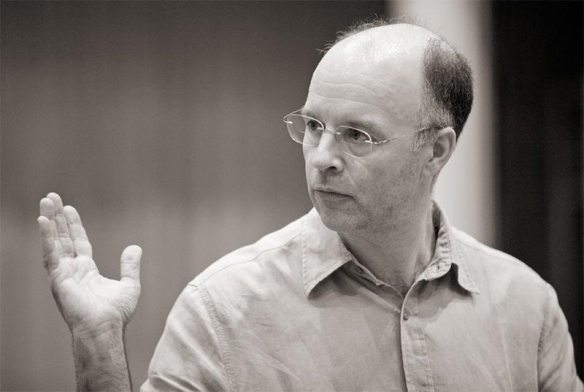
Minerva Piano Trio (above): Michal Cwizewicz (violin), Richard Birchall (cello), Annie Yim (piano)

St John’s Smith Square, London; Sunday 23rd October, 2016

Schumann Piano Trio No.1 in D minor Op.63 (1847)

Birchall Contours (2014)

Brahms Piano Trio No. 1 in B, Op. 8a (original 1854 version)

A season-long residency as Young Artists at St John’s is enabling the Minerva Piano Trio to schedule several worthwhile recitals. None fitted the bill more than this afternoon’s programme, culminating in a rare revival for the First Piano Trio of Brahms as heard in its original version.

Completed when he was barely into his twenties, this is the only work from the outset of Brahms’s maturity to have survived essentially as it was conceived. That the composer substantially re-wrote it in 1889 (after his temporary ‘retirement’ from composition) but allowed the versions to co-exist suggests that, dissatisfied though he may have become with them, he was unable to suppress those earlier thoughts. One does not look to the 1854 version for formal unity or finesse, but it certainly has the edge in terms of expression and tonal cohesion.

The opening Allegro is as much about charting an emotional course through its constituent themes than fashioning them into a logical argument, yet such is the imaginative resource with which Brahms elaborates his material that the movement as it evolves becomes its own justification. The Minerva audibly appreciated this with playing as perceptive as the music required, then was equally inside the Scherzo with its alternately brusque and elegant ideas – and an intriguingly fugitive ending that the revision streamlines into something less arresting.

With its multiple allusions to the then nascent Lieder tradition, the Adagio casts a magnetic if unsettling spell and the Minerva accordingly brought out its exquisite ambiguity in full measure. No less impressive was a Finale which, irrespective of how convincing – or otherwise – is its reworking (and Clara Schumann’s strictures cannot be lightly dismissed), the audacious homecoming in B minor is here suffused with inevitability such as the older and wiser Brahms was unable to achieve by modulatory means alone: a QED in every sense.

A commanding performance, then, and the Minerva had been hardly less inside the idiom of Schumann’s own First Piano Trio at the start of this recital. Whether or not the emergence of his wife Clara’s masterly work for the medium just a year before was indeed the catalyst, the present piece harnesses those sombre hues often to the fore in Schumann’s later music with a textural translucency which never spills over into opacity. This, at least, was the impression left by a reading that plotted a resolute course through the discursive design of the opening movement then clarified the scherzo’s rhythmic intricacy without sacrificing its poise. The plangent ‘song without words’ that follows was seamlessly dovetailed into the finale, which unfolded with no lack of incident on its way to a decisive while tenuously affirmative close.

Coming between these expansive staples of the repertoire, Contours by the Minerva’s cellist Richard Birchall proved a diverting entity – its four brief movements amounting to a discreet unity that, with its evocative Nocturne and engaging Fast Waltz, confirmed a real grasp of this difficult medium. There was further music at the close – when, in response to generous applause, the Minerva gave an easeful reading of the Andante from Clara Schumann’s Piano Trio in G minor. An eloquent conclusion to an impressive recital by an ensemble which is clearly going places.

Richard Whitehouse

The Minerva Piano Trio returns to St John’s for further concerts on 9th March and 1st June 2017. Further information can be found at the St John’s website. You can hear more of the trio below:

BBC Symphony Orchestra & Semyon Bychkov – Beloved Friend: Tchaikovsky Project

semyon-bychkov

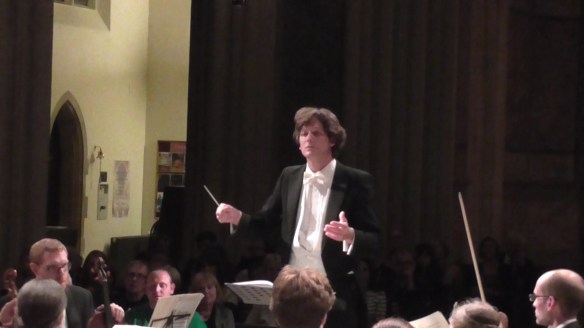
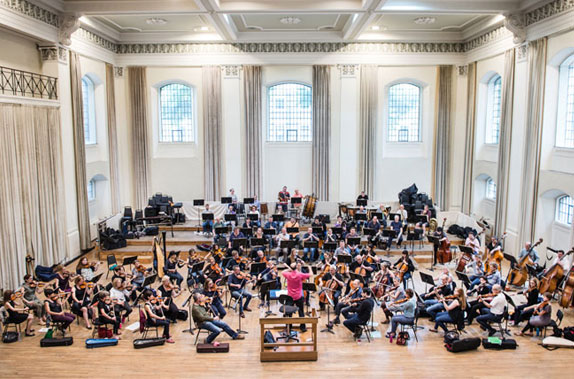
Richard Whitehouse on the BBC Symphony Orchestra, conducted by Semyon Bychkov (above) in the second of their Tchaikovsky-themed concerts

Tchaikovsky Serenade for strings in C major, Op. 48 (1880)

Tchaikovsky Piano Concerto No.3 in E flat major, Op. 75 (1893)

Taneyev Overture: The Oresteia, Op.6 (1889)

Tchaikovsky Francesca da Rimini, Op. 32 (1876)

Kirill Gerstein (piano), BBC Symphony Orchestra / Semyon Bychkov

Barbican Hall, London; Monday 24 October

The Beloved Friend series being curated by Semyon Bychkov provides a revealing overview of Tchaikovsky through some lesser performed works. Not the least of which is the Serenade for strings that, though its individual movements emerge frequently on radio, is not so often encountered in concert. Too short to occupy a second or even first half, it makes for a lengthy yet viable opening item when, as tonight, a full-sized string section is deployed with panache.

Bychkov ensured a fervent response in the first movement, its animated main sections framed by the rhetorical motto theme that ultimately returns as an apotheosis, then found suavity as well as elegance in the Waltz. Despite lack of inwardness, the Elegy yielded real clarity in its denser passages, while the Finale proceeded briskly yet characterfully to its resolute close.

kirill-gersteinNext followed a rare revival of the Third Piano Concerto, itself reworked from an abandoned symphony and what would doubtless have become a three-movement entity had Tchaikovsky completed its Andante and Finale to his satisfaction prior to his death (these latter, as realized posthumously by Taneyev, make an effective whole – as Alexander Markovich demonstrated in a Royal Festival Hall account eight years ago).

As a stand-alone piece, the Allegro brillante (best known in its ballet incarnation by George Balanchine) unfolds a quirky and characterful sonata design – its themes distinctive for their emotional restraint, with a stealthy interplay between piano and orchestra that Kirill Gerstein (above) audibly relished. Momentum faltered marginally after a scintillating cadenza, but the final pages strode onwards to a decisive if peremptory ending.

Overall, a convincing account of music which warrants greater exposure. Hopefully Gerstein will yet tackle this work’s three-movement incarnation: for now, he returned for a reading of Méditation – the fifth of Tchaikovsky’s Op. 72 collection – that oozed eloquence and poise.

More discussed than played in the West, Sergey Taneyev was as least as much a composer as pedagogue; a notable output of orchestral and chamber music capped by his ambitious opera The Oresteia. Beginning life as this latter’s introduction, the present overture expanded into an autonomous entity that surveys the opera’s dramatic content and is an eventful symphonic poem in its own right. Its complementary halves representing an archetypal ‘war and peace’ in dramatic as well as musical terms, the piece is harmonically questing and often texturally adventurous – not least in its extensive though never self-conscious writing for harps. Some 15 years after Taneyev last enjoyed a fair measure of exposure in London, Bychkov directed a fastidious performance to remind listeners that they are the poorer for this music’s neglect.

Even in an era intent on ‘concerto and symphony’ programming, Tchaikovsky’s Francesca da Rimini has never lacked for performances – this symphonic fantasia mingling drama with pathos to a heady degree even for this composer. Bychkov accordingly upped the ante in the tempestuous opening, then secured a suitably rapt response from woodwind and strings in the central section depicting Paolo and Francesca. Its balletic continuation drifted as is often the case, but the final pages portrayed the hapless lovers’ descent into hell with unerring ferocity.

Recorded by BBC Radio 3 for future broadcast in Afternoon on 3, and available for 30 days thereafter via the Radio 3 website

Wigmore Mondays – Nelson Goerner plays Debussy & Chopin

nelson-goerner

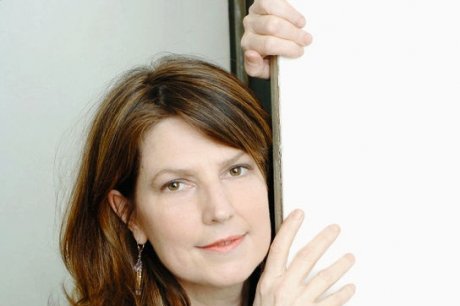
Nelson Goerner (piano) © Jean-Baptiste Millot

Chopin Polonaise in F# minor Op.44 (1841) (11 minutes)

2 Nocturnes Op.62 (1846) (12 minutes)

Polonaise in A flat major Op.53 (1842-3) (7 minutes)

Listen to the BBC Radio 3 broadcast here, until 23 November

Arcana’s commentary

For both Chopin and Debussy the piano became arguably their primary means of musical expression. Both used relatively traditional forms – studies, preludes for instance – but stretched them from conventional structures to suit their own means.

Here we heard seven of the twelve Préludes Debussy wrote as a book, the first of two, published in 1909 and 1910. These are character pieces where he was painting a picture or an impression, without always specifying his exact stimulus. Some were more obvious; others were left to the player for interpretation.

Nelson Goerner made each of these his own. The languid, humid atmosphere of Danseuses de Delphes (1:32 on the broadcast), with control and shading, set the scene and led to an enjoyable and mysterious La serenade interrompue (4:35). This was playful but wary too – dancing but not wanting to fully let itself go.

The ‘underwater rolling of pebbles’ from Verlaine’s poem could be sensed in Le vent dans la plaine (7:00), while the simplicity of La fille aux cheveux de lin (9:09) was rather moving. La danse de Puck (11:24) could have found the Midsummer Night’s Dream character in a more playful mood perhaps, while the thick atmospherics of Les sons et les parfums tournent dans l’air du soir (14:02) hung heavy on the air. Finally Les collines d’Anacapri (17:58) danced and shimmered, controlled but letting itself run wild too. The last four high notes were hammered out convincingly (20:37)

Goerner’s Chopin was rather different. The first of the Polonaises (22:14) was Chopin’s most ambitious work to use the dance form, using a Polonaise in its outer sections but a Mazurka in the middle (from 26:56). This central section had more charm but the outer sections were stern, almost obsessive – and brilliantly played. Their return after the Mazurka (30:05) was like two bolts of lightning, the mood almost that of a Tango from Goerner’s native Argentina.

The Nocturnes (33:40) and (40:12) could have done with a bit more air and relaxation; Goerner seemed rather anxious to push on with them. That said the trills of the first (from 37:55) were expertly managed, while the second was really nicely pointed.

The Polonaise (45:53) was heroic indeed, strutting its stuff but frequently dazzling, especially in Goerner’s white hot ostinato (49:02)

There was an encore to finish, an Impromptu of poise and grace (53:48), more of a Nocturne than the other two arguably.

Further listening

There is something rather special about Polish piano music – and to continue from the Chopin the Spotify playlist below offers up some lesser-heard treats in the form of piano concertos by Paderewski and Moszkowski, prefaced by a sprinkling of exotic Mazurkas from Szymanowski.

by Ben Hogwood

Wigmore Mondays – Vilde Frang & Aleksandar Madžar play Bartók and Schubert

vilde-frang-aleksandar-madzar

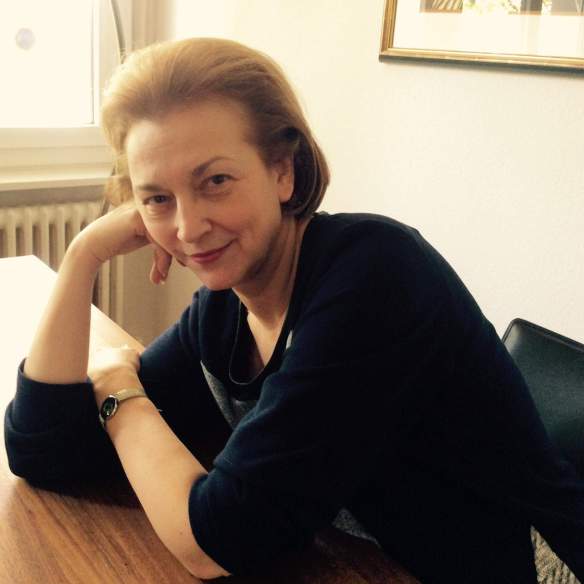
Vilde Frang (left, violin), Aleksandar Madžar (right, piano)

Bartók Violin Sonata no.1 (1921) (33 minutes)

Schubert Fantasy in C major D934 (1827) (21 minutes)

Listen to the BBC Radio 3 broadcast here, until 16 November

Arcana’s commentary

It is easy to see why Vilde Frang is held in such high regard. This contrasting program of Bartók and Schubert showed a steely side to her playing in the former, but also a purity of tone that could be easily appreciated throughout.

These qualities served her well in a powerful rendition of Bartók’s massive Violin Sonata no.1, but she could not have made this impact without Aleksandar Madžar’s superb piano playing, notable for its clarity and rhythmic precision.

Bartók and rhythm are inseparable, and the hold that folk music has on his compositions was all too clear in the syncopations and cross rhythms that Frang and Madžar exploited here. The angular tunes of the first movement (first heard at 2:07) had an assertive mood, brilliantly played.

Richard Bratby’s excellent program note reminded us how modern the music must have sounded in 1922, when Bartók himself played piano with violinist Jelly d’Aranyi, who became an important creative muse. Frang and Madžar powered through the first movement, making light of its technical difficulties, but in the second movement time stood still. Frang’s sweet but thoughtful tune, initially heard alone (from 14:26), was complemented by a solemn and mysterious chorale from Madžar (16:00), the two forces gradually aligning but still lost in a distant world.

The finale arrived with a flourish (25:15), both performers tackling it with some relish and achieving a remarkable unity of ensemble at the end (from 32:30), finishing with a terrifically spicy, bluesy chord.

Schubert’s Fantasy in C major can seem like a long piece in the wrong hands, but here it came alive. Completed in the last year of his life, it is conceived in a single span of four distinct sections, and is a very original piece of writing. Balance between the violin and piano is key, and this was spot on for the moving opening statement, where Madžar had a lot of work to do but was always responsive to Frang’s soft intonation (from 37:09)

A bracing Allegretto section (from 40:23) led to the centrepiece, a Theme & Variations (45:44) The origin of the theme, a Schubert song, was abundantly clear in this lyrical performance, while there was some sparkling playing from Madžar as the variations took hold (try 48:57) This flair and musicality continued to the return of the soft first movement theme, now shaping up in the finale (52:36), an emotional reunion in these hands before a convincing finish (from 57:40).

This was a superb concert, affirming Vilde Frang as one of the best violinists of her generation on the concert circuit, but also illustrating just what a fine pianist Aleksandar Madžar is too. Hear this if you can!

Further listening

You can hear more of Vilde Frang in an early album recorded for Warner Classics with Michail Lifits. Here she brings a sunny tone to violin sonatas by Grieg (no.1) and Richard Strauss, full of youthful exuberance, while there is more Bartók in the form of his Sonata for solo violin, a tour de force:

by Ben Hogwood

Ensemble L’imaginaire play the music of Richard Barrett at St John’s Smith Square

ensemble-limaginaire

Ensemble L’imaginaire (above): Keiko Murakami (flute), Adam Starkie (clarinet),        Philippe Koerper (soprano saxophone), Maxime Springer (piano), Adaq Khan (sound engineer)

St John’s Smith Square, London; Sunday 16th October, 2016

the light gleams an instant (1996)
Zungenentwurzeln (1997)
fold (2016)
Katasterismoi (1999)
dying words II (2013)
epiphyte (2016)
interference (2000)

The Sunday afternoon concert series from St John’s has been a welcome development on the London calendar – not least when it means the appearance of such as Ensemble L’Imaginaire, the Strasbourg-based group currently touring this programme of music by Richard Barrett.

Swansea-born and now Belgrade-based, Barrett (b1959) has long had a cult following in the UK with just the occasional high-profile premiere (notably by the BBC) serving to reacquaint listeners of his importance. An ambitious and questing conceptualist, numerous pieces have been planned as components of larger and evening-length projects – making this afternoon’s selection of works from the past quarter-century a viable ‘composition’ in itself; not least in its focussing on those scientific and arcane issues that have long been central to his activities.

This sequence began with the light gleams an instant – part of the larger work Tract, whose interplay of filigree activity in the right hand with headlong motion in the left gives rise to an exacting and meaningful virtuosity that Maxime Springer took audibly in his stride. Between these instrumental pieces came electronic ‘interludes’ themselves related to larger projects – the first being Zungenentwurzeln (‘‘the uprooting of tongues’’), with its inspiration in Paul Celan and visceral anatomical sound-imagery. Next was fold, originating as a piece for oboe and here transformed for soprano saxophone that underlined antecedents in Roscoe Mitchell (and a reminder that Barrett has enjoyed a productive association with Evan Parker) besides setting a tough assignment for the performer which Philippe Koerper acquitted with panache.

This was followed by Katasterismoi (‘‘transformations into stars’’), embodying astronomical reflections past and present through a tactile process of developing variation. Its sound source was the biwa, making for a tangible link into Dying Words II – whose flautist also intones an ancient Japanese text on the impermanence of things in the natural world and in which Keiko Murakami’s performing from memory was an unarguable fete. The last electronic item was epiphyte, its analogy to intruding while not parasitic plant growth represented by a dextrous texture unfolding in stealthy terms. Finally, interference alludes both to electromagnetic and quantum theories via a circuitous solo for contrabass clarinet informed by bass drum strokes and apocalyptic fragments from Lucretius as Adam Stirkie coordinated with evident aplomb.

The fact that this programme was presented as a continuous sequence lasting for just under an hour should evince no qualms, but it was a pity that the sequence could not have been heard without interruption so as to underline its highly integrated nature as both the composer and performers intended. All four of the performers – not forgetting sound engineer Adaq Khan, who throughout secured an impressive sense of musical space and definition in the reverberant acoustic of St John’s – duly took the stage at the close for renewed and enthusiastic applause.

The audience of barely more than two-dozen punters was regrettable given the stature of this composer. Not that Barrett will be tempted to succumb to the blandishments of much present-day music, but his combative and provocative work deserves much wider acknowledgement.

Richard Whitehouse

Ensemble L’imaginaire ends its UK tour of Richard Barrett at Canterbury University on Wednesday 19th October at 1.10pm. Further information can be found at the Ensemble l’imaginaire website