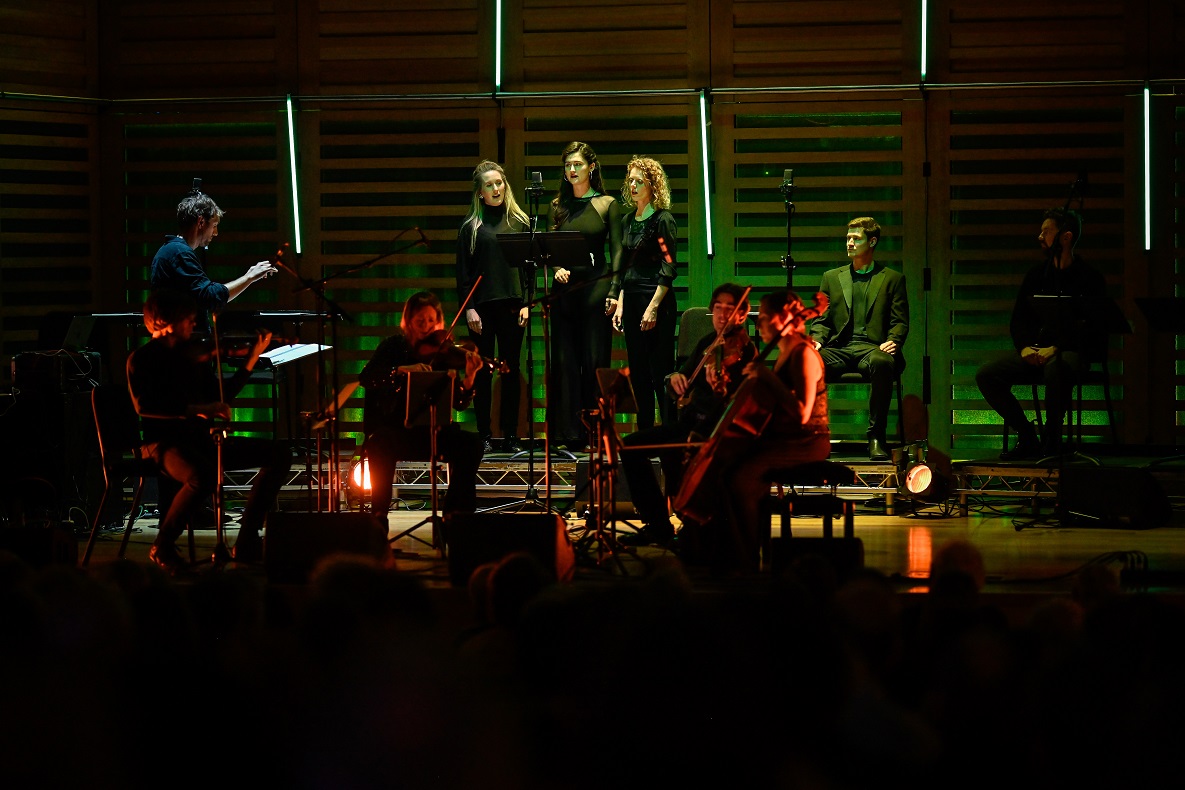
In concert – Eugene Tzikindelean, CBSO / Kazuki Yamada: Elgar Violin Concerto & Walton Symphony no.2

Eugene Tzikindelean (violin, above), City of Birmingham Symphony Orchestra / Kazuki Yamada (below)

Elgar Violin Concerto in B minor Op.61 (1909-10)
Walton Orb and Sceptre (1952-3)
Walton Symphony no.2 (1957-60)

Symphony Hall, Birmingham
Wednesday 4 December 2024

Reviewed by Richard Whitehouse

His tenure so far as music director of the City of Birmingham Symphony Orchestra has shown Kazuki Yamada to have real sympathy for British music, hence it was no surprise to encounter this programme of works by Elgar and Walton, which itself proved (unexpectedly?) satisfying.

Following on his highly regarded performances of Nielsen and Walton over previous seasons, CBSO leader Eugene Tzikindelean took on Elgar’s Violin Concerto for a reading which was fine if not consistently so. The opening movement, in particular, lacked forward momentum in its restless first theme so that not enough contrast was established with its rapt successor – the highlights being Yamada’s vigorous handling of its orchestral introduction and a development as powerfully sustained as it was combatively rendered. Tzikindelean was more fully at home with the central Andante, its variously reflective and heartfelt melodies drawn into a seamless continuity enhanced by a notably beguiling response from the CBSO woodwind. Whether or not the most profound of Elgar’s slow movement, this is arguably his most perfectly achieved.

The finale was, for the most part, equally successful – this being hardly the first performance setting off at a suitably incisive tempo, only to lose impetus once the poised second theme has entered the frame. Not that there was insufficient energy to make the emergence of its lengthy accompanied cadenza other than startling – this latter proceeding with a suffused mystery and poignancy, not least in recalling previous themes, as finds Elgar as his most confessional; the movement then resuming its earlier course as it surged on to a decisive and affirmative close.

Although his later orchestral works have never quite fallen into obscurity, Walton’s tended to fare better in the US than in the UK. Not least the coronation march Orb and Sceptre – all too easily denigrated next to the opulent grandeur of predecessor Crown Imperial, but evincing a jazzy lack of uninhibition and, in its trio, a suavity Yamada clearly relished in the company of an orchestra that made benchmark recordings with Louis Frémaux almost half a century ago. Even the latter could not summon the pizzaz conveyed here with that trio’s infectious return.

Walton’s Second Symphony has been equivocally regarded ever since its Liverpool premiere, but Yamada clearly harboured few doubts as to its conviction. The opening Allegro unfolded methodically if remorselessly, its main themes subtly yet meaningfully differentiated not least in bringing out the compositional mastery of sizable orchestral forces. Nor was there any lack of pathos in the ensuing Lento, its ominous tones denoting music shot through with intensely ambivalent emotion. Much the most difficult movement to sustain, the final Passacaglia was no less successful – Yamada binding its successive variations into a tensile if never inflexible whole, while making a virtue of Walton’s premise that a 12-note theme can resolve effortlessly in tonal terms at the peroration: a journey as fascinating as its destination proved exhilarating.

Interesting to note this concert was ‘being recorded for future release;, given the Walton was undoubtedly an account to savour. Yamada is back with the CBSO next week in a programme which pairs Mozart’s penultimate piano concerto and Bruckner’s (unfinished) final symphony.

For details on the 2024-25 season A Season of Joy, head to the City of Birmingham Symphony Orchestra website. Click on the names to read more about CBSO leader, violinist Eugene Tzikindelean – and the orchestra’s principal conductor Kazuki Yamada

Published post no.2,386 – Saturday 7 December 2024

In concert – King Creosote @ Union Chapel, London

Union Chapel, London, 29 November 2024

by John Earls. Photo credit (c) John Earls

I fell in love with King Creosote (real name Kenny Anderson) in 2006 with the release of the special edition of KC Rules OK (which included superb sleeve notes by author Ian Rankin) and have been smitten ever since. He is a great singer-songwriter.

I first saw him live at London’s 100 Club in 2009 playing to about 100 people and then again at Union Chapel in 2011 where he performed the masterpiece Diamond Mine album with Jon Hopkins.

As an aside, I also met him on a bus in London in 2013. I was going to a concert at the Barbican and he hopped on with crutches and his ankle in a cast. He was utterly charming and it says something about him that he was on his way to play a gig (yes, on a bus and on crutches).

Needless to say I was looking forward to seeing him again at Union Chapel which is a stunningly beautiful venue. So let me get a couple of gripes out of the way.

Firstly, the sound system. Kenny Anderson is not just a superb singer – he is also a consummate wordsmith. It was therefore particularly disappointing that his words were often unintelligible (at least where I sat in the fifth pew). One can patch things up if familiar with the lyrics, but what a shame for those coming to KC for the first time. I’ve seen a number of live acts at Union Chapel (including, as mentioned, KC himself) without the same issue.

Secondly, the concert was performed in front of a screen which showed graphics accompanying the music. These were an interesting visual accompaniment and I get that they would be effective against the usual stage setup, but when gifted with such a magnificent backdrop as the wonderful stained glass East Window above Union Chapel’s pulpit and stage why obscure it? (again, this may have been more of an issue from my vantage point).

So to the concert which mostly consisted of a performance of the excellent 2023 I DES album in full. Inevitably, this will seem as much a review of that album (which I think will also be regarded as a masterpiece) as of the gig itself, for which KC was joined by an excellent seven piece band (including Emily Barker who performed a very good solo opening set) featuring acoustic guitar, accordion, fiddle, keyboards, synths, drum machines and percussion.

The performance effectively portrayed the album’s themes of love, loss and mortality, as well as its sense of optimism, hope and gratitude and opened with It’s Sin That’s Got Its Hold Upon Us with thumping beats and sweet strings.

We then had what Anderson has referred to as his “death trilogy” starting with the wonderful Blue Marbled Elm Trees. There can’t be a better song about one’s own funeral (I recommend listening to the fabulous episode of Nicola Meighan’s Kick Up The Arts: All Back To Mine with Anderson, where he says of this song “it had to be a jaunty death”). Burial Bleak and Dust complete the trilogy, which is then followed by the melancholic Walter de la Nightmare, the very bouncy Susie Mullen and Love Is a Curse.

The piano ballad Ides is one of the standout songs of the album (in my view it’s one of Anderson’s best ever), a perfect example of his unparalleled combination of voice and lyrics. Take the opening verse which amounts to a short story in itself:

When I said ‘excuse me, please’
You asked oh what did I want
I wanted someone to lie with on a Tuesday afternoon
Let’s say sometime around one o’clock
You must have looked shocked I fast changed tack
Right enough Thursdays are better for me
Once the clocks have gone back.

Mournful and beautiful, he sings, “But once I heard your voice / Like a punch to the chest / A kick in the gut / And a blow to the head all at once” and it takes my breath away.           

The I DES section of the show closes with Please Come Back I Will Listen, I Will Behave, I Will Toe the Line, shorter than the 13-minute album version but equally absorbing with fine backing vocals.

The rest of the concert consists of four numbers, a lovely So Forlorn, a lively No One Had It Better (from 2009’s Flick the Vs), Spystick (from 2007’s Bombshell) which (movingly for this reviewer) includes a taste of Not One Bit Ashamed (from KC Rules OK), and a groovy cover of Amanda Lear’s disco banger Follow Me. Kenny and the band then take a bow and are gone. As I left Union Chapel I said to myself “Thank God for Kenny Anderson”, a unique voice – lyrically, musically and literally.

John Earls is Director of Research at Unite the Union. He posts on Bluesky and tweets / updates his ‘X’ content at @john_earls

Published post no.2,370 – Friday 22 November 2024

In concert – Alexander Roslavets, Gidon Kremer, LPO / Andrey Boreyko @ Royal Festival Hall: A Dark Century

Alexander Roslavets (narrator / bass), Gidon Kremer (violin), London Philharmonic Choir (men’s voices), London Philharmonic Orchestra / Andrey Boreyko

Schoenberg A Survivor from Warsaw Op.46 (1947)
Weinberg Violin Concerto in G minor Op.67 (1959)
Shostakovich Symphony no.13 in B flat minor Op.113 ‘Babi Yar’ (1962)

Royal Festival Hall, London
Wednesday 27 November 2024

Reviewed by Richard Whitehouse Pictures (c) Richard de Stoutz (Andrey Boreyko), Angie Kremer (Gidon Kremer)

Anyone who heard one or other of these works for the first time at this concert by the London Philharmonic Orchestra could be forgiven for thinking that the twentieth century, if not a ‘dark century’ per se, was at the very least a troubled one for all that the quality of its music was undeniable.

With its elements of melodrama and cantata, Schoenberg’s A Survivor from Warsaw is one of his most original conceptions and necessarily so, given the unnerving immediacy of its text in which a speaker has to take on the roles of survivor and officer in just six minutes. Alexander Roslavets rose to this challenge, bringing out emotional contrasts as surely as he instilled his words with that ominous dread whose culmination in the prayer Shema Yisrael was intoned by the London Philharmonic Choir with the right balance between desperation and defiance.

One composer who witnessed something of such atrocities was Mieczysław Weinberg, and if his Violin Concerto demonstrably continues the ‘Romantic’ tradition, this is still an inherently personal statement. Gidon Kremer has championed the composer extensively in recent years and, while technical issues seemingly inhibited the respectively incisive and impetuous outer movements, the restless searching of its intermezzo-like Allegretto then confiding eloquence of its Adagio were abundantly in evidence. For all its outward virtuosity, the music’s essential inwardness is what prevails as the soloist remains musing when the orchestra fell silent at the close of the finale. Kremer was in his element here, as in a touching rendition of Silvestrov’s Serenade which made for an apposite encore and was dedicated to all the people of Ukraine.

Best known for giving the posthumous premiere of Gorecki’s Fourth Symphony with the LPO 10 years back, Andrey Boreyko is well established as an exponent of Shostakovich so that his take on the Thirteenth Symphony did not disappoint. At a distance of over six decades, it can be hard to recapture the provocation of that most eminent Soviet composer using verse by the most populist younger poet, as Yevgeny Yevtushenko then was, but this setting of Babi Yar retains all its expressive force through the immediacy and resourcefulness in which it relates official indifference to the Jewish massacre as that ravine outside Kyiv was transformed into landfill. Broodingly restrained, Roslavets emerged into his own with Humour – its scabrous send-up of bone-headed officialdom inspiring one of Shostakovich’s most scurrilous scherzos.

Fashioning the last three movements into a cohesive if cumulative unity, Boreyko underlined the potency of Shostakovich’s creative vision as he takes the Soviet establishment to task for various failings economic as In the Store, political as in Fears and cultural as in A Career. Implacable then volatile, these first two are rounded off by Yevtushenko’s considering of the relationship between society and the individual; framed by an undulating melody, for flutes then strings, which is one of its composer’s most evocative as well as affecting inspirations.

It duly brought this work, and this performance, to its subdued yet spellbinding close. As the relationship between East and West becomes ever more confrontational, Shostakovich’s 13th remains a testament to rationality and compassion whose denigration is to everybody’s cost.

For details on the 2024-25 season, head to the London Philharmonic Orchestra website. Click on the names to read more about soloists Alexander Roslavets and Gidon Kremer

Published post no.2,373 – Monday 25 November 2024

In concert – Quatuor Danel: Shostakovich & Weinberg #7 with François-Frédéric Guy @ Wigmore Hall

François-Frédéric Guy (piano), Quatuor Danel [Marc Danel & Gilles Millet (violins), Vlad Bogdanas (viola), Yovan Markovitch (cello)]

Shostakovich String Quartet no.10 in A flat major Op.118 (1964)
Weinberg String Quartet no.11 in F major Op.89 (1965-6)
Weinberg Piano Quintet in F minor Op.18 (1944)

Wigmore Hall, London
Monday 25 November 2024

by Richard Whitehouse Photo (c) Marco Borggreve

This latest instalment in Quatuor Danel’s parallel cycle of string quartets by Shostakovich and Weinberg comprised one of the former composer’s most understated pieces followed with two of the latter’s most characteristic yet, at least in terms of expression, utterly contrasted works.

Written during just 11 days, the Tenth Quartet is something of a standalone in Shostakovich’s cycle – coming as it does between the four innately personal quartets that preceded it and the four related to members of the Beethoven Quartet (who premiered all except the first and last of this cycle) that followed. Yet, as its dedication to Mieczysław Weinberg suggests, this is no less specific in intent – hence the musing ambivalence of its initial Andante and visceral force of its scherzo. The Danel savoured their respective essence, cellist Yovan Markovich coming into his own in the ensuing Adagio with its emotionally restrained variations. The link to the finale was seamlessly effected, then the movement built methodically towards a heightened restatement of the passacaglia theme before tentatively retracing its steps to a wistful close.

Written months later, Weinberg’s Eleventh Quartet is by no means lesser by design or intent. Its fugitive opening Allegro exudes a scurrying motion such as resurfaces at key moments in the overall design, akin to that of the Shostakovich in equivocation, and if the scherzo could hardly be more different in its fleeting delicacy (the original such movement it replaced was likely much more demonstrative), the solemn alternation of ensemble and solo writing in its Adagio conjures up a similarly processional aura. Contrast is again pronounced in the finale where, instead of channelling the musical loose-ends towards a formal and expressive unity, Weinberg leaves matters in abeyance; despite (or because of) the most tentative recollection of that scurrying motion which flits across the already fragmented texture at the very close.

If the Danel had long mastered Weinberg at his most refractory, it proved equally adept with the communicative power of his Piano Quintet. At almost 45 minutes this is also his largest chamber work, its five movements unfolding as a discursive if never random sequence such that the furtive questioning of its opening Moderato finds accord with the unsettled humour of its ensuing Allegretto – an intermezzo next to the scherzo-like energy of its central Presto, in which the interplay between François-Frédéric Guy and the Danel was at its most incisive.

Much the longest movement, the Largo accumulates intensity through juxtaposing passages in rhythmic unison with those during which piano and strings predominate. Its impassioned culmination is exceeded by that of a final Allegro whose impetuous main ideas bring about    a climactic return to the work’s opening theme. Even more remarkable is what follows: the intensity soon subsiding prior to this movement’s initial idea returning, quietly transformed, as though to suggest its composer having been reborn as a sentient being and creative artist.

Hearing this work, performances of which have fortunately become more frequent these past two decades, is an experience like few others in the chamber domain; suffice to add that Guy and the Danel were as one in their realizing the scale and impact of this modern masterpiece.

You can hear the music from the concert below, in recordings made by Quatuor Danel -including their most recent cycle of the Shostakovich quartets on Accentus:

For more information on the next concert in the series, visit the Wigmore Hall website. You can click on the names for more on composer Mieczysław Weinberg, Quatuor Danel and pianist François-Frédéric Guy

Published post no.2,378 – Saturday 30 November 2024

In concert – Matthew Taylor 60th birthday concert @ Smith Square Hall

Poppy Beddoe (clarinet), Mira Marton, Viviane Plekhotkine (violins), Sinfonia Perdita / Daniel Hogan

Arnold Serenade Op.26 (1950)
Taylor Clarinet Concertino Op.63 (2021)
Taylor Violin Concertino Op.52 (2016)
Arnold Double Violin Concerto Op.77 (1962)
Arnold Clarinet Concerto no.2 Op.115 (1974)
Taylor Symphony No. 6 Op.62 (2021)

Smith Square Hall, London
Friday 22 November 2024

Reviewed by Richard Whitehouse

It was good to see that not a few of those in the audience for Matthew Taylor’s 60th Birthday Concert had been at such events 10, 20 and even 30 years before – deserved recognition, if such were needed, of this composer’s contribution to new music across recent decades.

Malcolm Arnold has been a notable influence on Taylor’s latter-day work, so that hearing his music in this context seemed more than apposite – not least with a sparkling account of Arnold’s airily ambivalent Serenade to set proceedings in motion.

The first half featured two of Taylor’s recent concertante pieces, a genre where he is always at home. As was Poppy Beddoe in the Clarinet Concertino written for her – whether its pensive but not necessarily serene Andante, its unsettling intermezzo, or its genial Allegretto that rounds off a work demonstrably more than the sum of its parts. Mira Marton then took the stage for the Violin Concertino, less unpredictable while always engaging – whether in the not undue deliberation of its opening Hornpipe, the poetic delicacy of its central Aria or the heady syncopation of its energetic Finale. Once again, there could be no mistaking Taylor’s identity with the instrument at hand, nor that judicious marshalling of his ideas into a format the more communicative for its brevity and understatement.

Arnold came into focus with two comparable works either side of the interval. Marton was partnered by Viviane Plekhotkine for the Double Violin Concerto from his more settled years which finds due outlet in the methodical incisiveness of its opening movement and unbridled panache of its finale: the central Andantino yet leaves the most enduring impression, a ‘duet without words’ whose melting pathos never feels overly emotive. This could hardly be said of the Second Clarinet Concerto, a product of Arnold’s troubled Dublin period, though Beddoe found cohesion in its Allegro through the ingenuity of her cadenza, while its ominously unsettled Lento had soloist and conductor in enviable accord, before she threw caution to the wind with a Pre-Goodman Rag finale that enthused her admirers even more second-time around.

Astute in support, Daniel Hogan (above), came into his own with Taylor’s Sixth Symphony that ended this concert. Commissioned by the Malcolm Arnold Trust and dedicated to Arnold’s daughter Katherine, it complements its celebratory and fatalistic predecessors via an affirmation kept in check until the very last. Premiered by Martyn Brabbins then recorded by the composer, this was arguably its finest performance yet – Hogan unfolding the first movement’s introduction as a cumulative arc of intensity, before infusing the main Allegro with an impetus abetted by its translucency of scoring. This is even more apparent in the Andante, its writing for harp and piano just the most arresting aspect of its calmly fugal textures, before the final Vivo evoked an authentic Arnoldian spirit with its capricious humour and its deftly sardonic payoff.

Music that provokes as surely as it pleases is an ability shared by few composers of Taylor’s generation, and Sinfonia Perdita did it proud as the climax of an evening that reaffirmed this composer at its forefront. One looks forward to further symphonies…and future anniversaries.

For details on the 2024-25 season, head to the Sinfonia Smith Square website. Click on the names to read more about composers Matthew Taylor and Malcolm Arnold, conductor Daniel Hogan and soloists Poppy Bedoe, Mira Marton and Viviane Plekhotkine

Published post no.2,373 – Monday 25 November 2024