Arcana at the Proms – Prom 43: Paul Lewis, CBSO / Kazuki Yamada – Ravel, Mozart, Holmès & Mussorgsky / Wood

Ravel Ma mère l’Oye – suite (1910-11)
Mozart Piano Concerto No. 27 in B flat, K595 (1790-91)
Holmès La Nuit et de l’Amour (1888)
Mussorgsky arr. Wood Pictures at an Exhibition (1874, orch. 1915)

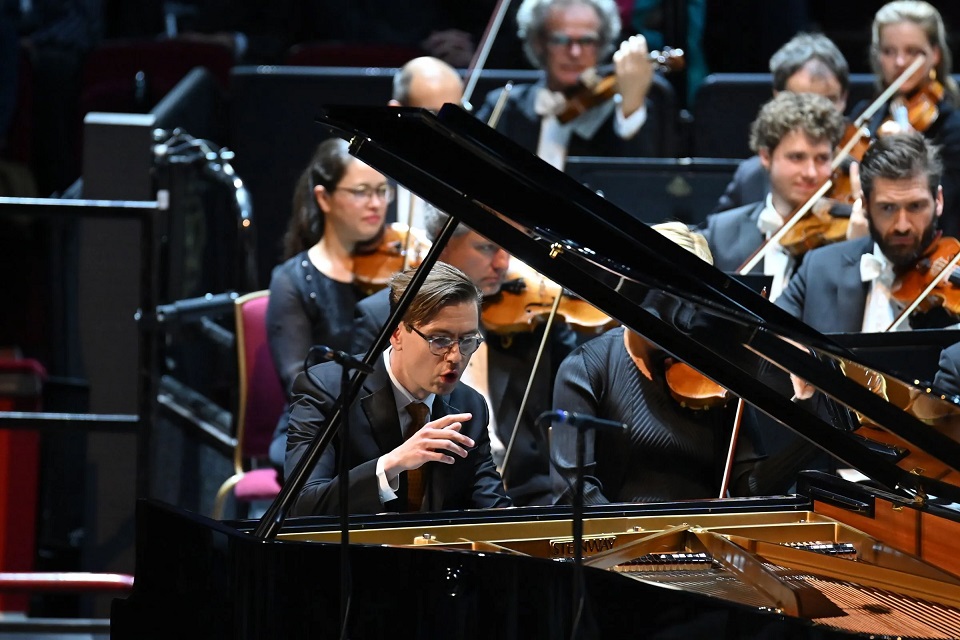
Paul Lewis (piano, above), City of Birmingham Symphony Orchestra / Kazuki Yamada

Royal Albert Hall, London
Thursday 22 August 2024

reviewed by Ben Hogwood Photos (c) Sisi Burn

A colourful Prom from the CBSO this year, reaching a deafening climax with Proms founder Sir Henry Wood’s arrangement of Mussorgsky’s Pictures At An Exhibition. More of that anon, but the orchestra, under principal conductor Kazuki Yamada, began with music by Ravel – whose orchestration of the Mussorgsky we tend to hear.

Mother Goose was cool to the touch but given a winning performance, Ravel’s colours spread across the orchestra as the music came to life. The CBSO strings were elegant and refined, leaving the starry moments to the woodwind, who excelled – particularly the gruff contrabassoon in Conversation of Beauty and the Beast, winningly played by Margaret Cookhorn. The hues of the closing The fairy garden were ideal, too – though Yamada’s decision to bring the music to a near standstill before the final, wondrous tune won’t have been to all tastes, no matter how skilfully it was achieved.

Elegance was the watchword for Paul Lewis’s Mozart, too – a thoughtful and graceful account of the composer’s last piano concerto, published in his final year but thought to have begun three years prior. This is Mozart in relatively subdued form, but still cracking a smile in the attractive first movement. Soloist and orchestra took a little while to align within the Royal Albert Hall acoustic, but once they did the first movement dialogue, complete with Mozart’s own cadenza, was fluent and balletic. The slow movement lullaby was a treat, Lewis with stylish phrasing of the melodies, while the finale enjoyed its lightfooted dance, a theme so simple and yet so memorable; classic Mozart.

Following the interval we heard the brief but romantic La Nuit et de l’Amour by Augusta Holmès, a pupil of César Franck whose music was appearing at the Proms for the first time. It was a charming miniature with a memorable tune, whose presence shone through. It acted as an upbeat to Sir Henry Wood’s arrangement of Mussorgsky’s tour through the gallery, a version predating the celebrated Ravel by seven years.

Unlike the Frenchman, Wood goes for broke on several occasions during Pictures At An Exhibition. His decision to include only the first Promenade, where Mussorgsky describes his observer walking around the exhibition, means the pictures are a little squashed together, but in this performance the dramatic impact was heightened. Gnomus was frankly terrifying, while The Old Castle was headed by a sensitive and touching euphonium solo; Becky Smith projecting beautifully from the gallery.

Wood’s version is brassy on occasion, and the CBSO players excelled – as did the wind and percussion, whose unpredictable interventions had the audience jumping on several occasions! They were a feature of Bydlo, the old carriage rumbling into action with all its bells rattling, the lower strings and brass in deep toil. Nothing quite prepared the throng for the final Great Gate of Kiev, however – not even the sinister outlines of the preceding Baba Yaga. The gate itself came slowly into view, the toll of the nine bells of the Liverpool Philharmonic bells up in the gallery both solemn and unexpectedly chilling. Soon all notions of reserve were brushed aside, however, Wood’s orchestration demanding the nine bells at full volume – delivered in a brilliant peal from the gallery by Graham Johns. However – from the arena at least – they did rather swamp the combined forces of the orchestra and organ, who were barely audible at times.

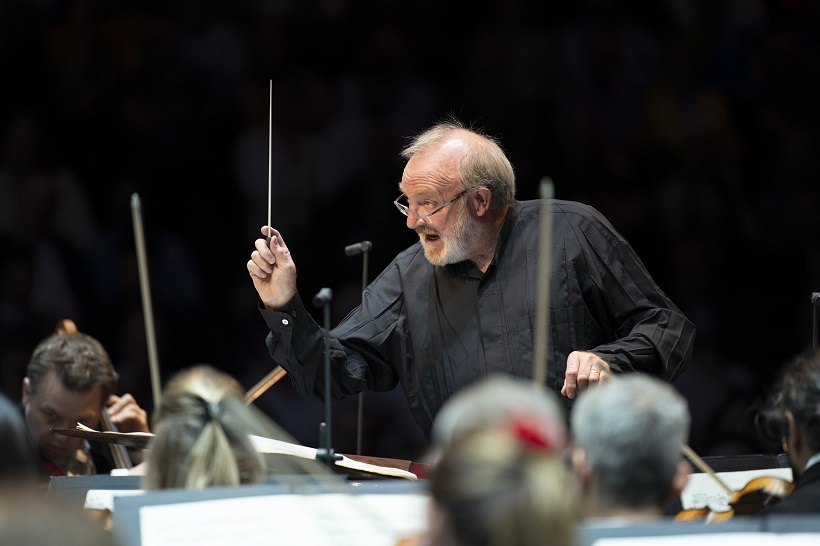
Excesses like these no doubt helped Emerson Lake and Palmer in their decision to arrange Pictures for rock group in 1971 – and certainly had a positive impact on the Proms audience, who were thrilled by the drama and the sheer volume. So too was Yamada, who had already been dancing on the podium, but as the Gate reached its tremendous conclusion he pivoted to urge the audience into applause, long before the final chord had rung out. How refreshing to see a conductor living in the moment, reading the occasion and the audience, and crowning a memorable Prom with shattering, exhilarating noise.

The playlist below collects the music from this concert, including the only available recording of the arrangement of Pictures At An Exhibition by Sir Henry Wood:

Published post no.2,283 – Saturday 24 August 2024

In concert – Paul Lewis, CBSO / Kazuki Yamada: Ravel, Mozart, Holmès & Mussorgsky / Wood

Paul Lewis (piano, above), City of Birmingham Symphony Orchestra / Kazuki Yamada

Ravel Ma mère l’Oye – suite (1910-11)
Mozart Piano Concerto No. 27 in B flat, K595 (1790-91)
Holmès La Nuit et de l’Amour (1888)
Mussorgsky arr. Wood Pictures at an Exhibition (1874, orch. 1915)

Symphony Hall, Birmingham
Wednesday 21 August 2024

Reviewed by Richard Whitehouse

Although the CBSO has not put on its own Proms season for many years, a concert featuring the programme for its annual Proms appearance has been a regular fixture and this evening’s event proved to be much more than merely a ‘dry run’ for tomorrow’s Royal Albert Hall date.

Despite the timing, this was indeed the suite as orchestrated by Ravel from his Mother Goose piano duets before being expanded into a ballet. It took a while to get going – Pavane of the Sleeping Beauty feeling impassive and Little Tom Thumb enervated, yet Laideronette had the requisite playfulness. Conversations of Beauty and the Beast was ideally poised between whimsy and pathos, before The Enchanted Garden concluded this sequence with an inward rapture made more so thanks to its exquisite contribution from leader EugeneTzikindelean.

Paul Lewis must have played Mozart’s 27th Piano Concerto on innumerable occasions (and several times with the CBSO) but his perspective constantly varies. The opening movement had a spaciousness resulting in an unusually moderate Allegro, albeit never at the expense of a subtly incremental intensity unerringly sustained through to a cadenza of limpid eloquence. Even finer was the Larghetto – dependent, as with much of Mozart’s late music, on what the performer brings to it; here yielding a serenity informed by not a little fatalism. After which the finale provided an ideal complement in its buoyancy and unforced humour, leading into a cadenza (how fortunate Mozart’s own have survived) of pensive understatement, then a coda launched with a guileless interplay of soloist and string that set the seal on this performance.

Opening the second half was Augusta Holmès’s La Nuit et l’Amour – actually, an interlude from Ludus pro Patria, her ‘Ode-Symphonie’ which, even if it might not sustain the present piece’s enfolding passion, should certainly be worth at least a one-off hearing in its entirety.

In Henry Wood’s orchestration, Mussorgsky’s Pictures at an Exhibition proved a highlight of last season. Wood retains only the first appearance of the Promenade but is not unfaithful to the original’s essence. Hence the shock-horror of Gnomus, sombre aura of The Old Castle with its baleful euphonium, playful insistence of The Tuileries or fatalistic tread of Bydlo with its evocative percussion. The whimsical Ballet of the Unhatched Chicks contrasts with the grim realism of Samuel Goldberg and Schmuÿle or the frantic bustle of The Market at Limoges.

Respighi surely took note of this glowering Catacombs with its plangent recollection of the promenade refrain hardly less effective than in Ravel, and while Baba Yaga is unnecessarily curtailed here, its sudden dispersal more than prepares for the crescendo of offstage bells that launches The Great Gate[s] of Kiev. This set the tone for a realization which, if its opulence borders on overkill, could not prevent the CBSO from projecting Wood’s cinematic sonics to the maximum. Those present once again erupted during that echoing resonance at its close.

Quite a way, then, to end an impressive performance and memorable concert. Kazuki Yamada and the orchestra will be doing it all over again tomorrow evening at their Prom, at which this orchestration of the Mussorgsky will be heard in the environs as envisaged by its orchestrator.

The playlist below collects the music from this concert, including the only available recording of the arrangement of Pictures At An Exhibition by Sir Henry Wood:

For details on the 2024-25 season A Season of Joy, head to the City of Birmingham Symphony Orchestra website. Click on the names to read more about pianist Paul Lewis and chief conductor Kazuki Yamada

Published post no.2,279 – Friday 23 August 2024

Arcana at the Proms – Prom 35: BBC Scottish Symphony Orchestra / Ilan Volkov – Ellington, Braxton and Mary Lou Williams

Ellington orch. Gould Solitude (1934), Mood Indigo (1930), Sophisticated Lady (1932), Caravan (1936)
Mary Lou Williams Zodiac Suite (1944-6) [UK premiere]
Braxton Composition no.27 (+ nos. 46, 59, 63, 146, 147, 151 & Language Music) (1972-91) [Proms premiere]

Mikaela Bennett (soprano), Aaron Diehl (piano), James Fei (saxophone/conductor), Gregory Hutchinson (drum kit), Ingrid Laubrock (saxophones), Brandon Lee (trumpet), Chris Lewis (clarinet/saxophone), David Wong (double bass), Katherine Young (bassoon/conductor), BBC Scottish Symphony Orchestra / Ilan Volkov

Royal Albert Hall, London
Thursday 15 August 2024

reviewed by Richard Whitehouse Photos (c) Sisi Burn

Never a conductor to take the path of least resistance, Ilan Volkov centred his latest Prom with the BBC Scottish Symphony Orchestra (whose Creative Partner he remains) around jazz – not that there was anything orthodox about the repertoire or the follow-through in what was heard.

The four Duke Ellington numbers heard tonight became standards in the Depression era, their pioneering spirit stylishly offset in orchestrations by Morton Gould (the first three on 1957’s Blues in the Night and the fourth on 1956’s Jungle Drums). Solitude ranks among Ellington’s most affecting tunes, while his sultry Mood Indigo proved an inspired co-write with Barney Bigard. The present arrangement fully enhanced the teasing elegance of Sophisticated Lady, before the expressive impetus of the Juan Tizol co-write Caravan left its evocative imprint.

Pianist and arranger for artists from Ellington to Cecil Taylor, Mary Lou Williams’ music only posthumously came to the fore. She wrote nothing more ambitious than Zodiac Suite – a series of 12 tributes to musicians born under various star signs, as went through several incarnations at the end of the Second World War and remains a trailblazer for symphonic jazz. As realized here, each item left room for contributions by the assembled jazz or orchestral musicians: thus the incisiveness of Brandon Lee’s trumpet or mellifluousness of Chris Lewis’ clarinet and alto sax, besides stealthy interplay by the Aaron Diehn Trio (above) or a soulful violin solo by guest-leader Kate Suthers. The sequence concluded with Pisces and an agile vocal (lyrics not printed) by Mikaela Bennett – its manner (surprisingly?) redolent of mid-20th century American art-song.

From here to Anthony Braxton proved a fair conceptual leap, but a meaningful one within this context. One, moreover, for which Volkov has prepared painstakingly across almost a decade – working with several of Braxton’s longer-term collaborators (notably George Lewis), while performing several Braxton compositions duly rendered as the superimposed totality he openly encourages. What resulted was Composition No. 27 as a framework for this performance, into which elements from six later ‘Compositions’ were integrated – this whole entity underpinned by recourse to Language Music, collating 12 musical parameters in what is the codification of Braxton’s practice over six decades. The creative aspect arises at a point when the fullest extent of compositional systematization links with the furthest extent of improvisational spontaneity.

The interaction between jazz and orchestral musicians was intricate and unpredictable, so that saxophonist James Fel and bassoonist Katherine Young – but not the always inventive Ingrid Laubrock (above) – were often conductors next to Volkov in determining the overall trajectory. There were occasions when continuity felt tentative or uncertain, yet these were outweighed by the translucent allure in much of the ensemble playing as well as the resolve with which all those participating headed toward a culmination the more definite for its seeming inconclusiveness. Not that this performance commended itself to all those present, with several dozen exiting the auditorium as though insects under siege. Those who stayed were rewarded with music-making such as encouraged an active participation all too rare in present-day concertgoing.

For more on this year’s festival, visit the BBC Proms website. For further information, click on the artist names for more on Ilan Volkov and the BBC Scottish Symphony Orchestra, and on the composer names for information on Duke Ellington, Mary Lou Williams and Anthony Braxton.

Published post no.2,275 – Monday 16 August 2024

Arcana at the Proms – Prom 33: Christopher Maltman, BBC Symphony Orchestra / Martyn Brabbins – Elgar, Holst, Stanford & Vaughan Williams London Symphony

Elgar Overture ‘Cockaigne’ (In London Town) Op.40 (1901)
Holst Hammersmith (Prelude and Scherzo) Op.52 (1930)
Stanford Songs of Faith Op. 97 (1906): no.4 (To the Soul), no.5 (Tears), no.6 (Joy, ship-mate, joy); An Irish Idyll in Six Miniatures Op.72 (1901): no.2 (The Fairy Lough)
Vaughan Williams A London Symphony (Symphony no.2) (1912-13, rev. 1918-20)

Christopher Maltman (baritone), BBC Symphony Orchestra / Martyn Brabbins

Royal Albert Hall, London
Friday 9 August 2024, 6pm

reviewed by Richard Whitehouse

Concerts devoted to British music are by no means an unknown quantity at the Proms, but to have one as judiciously planned as that featuring Martyn Brabbins with the BBC Symphony Orchestra, on the conductor’s 65th birthday, was as unexpected as its realization ‘on the night’ proved consistently impressive.

Whether or not this account of Elgar’s Cockaigne ranked among the best of the previous 70 or so hearings at these concerts, it assuredly did the piece justice. Not its least attraction was Brabbins integrating this evocation of London on the cusp of Victorian and Edwardian eras with due perception of its ingenious sonata design, resulting in a reading as characterful as it was cohesive. Such as the emergence of the marching band at its centre and final peroration (Richard Pearce making his presence felt at the organ console) were the highpoints intended.

Whereas Elgar conveys London in its midst, Holst renders Hammersmith at a remove – his Prelude and Scherzo evoking those sights and sounds where the latter long made his home with a poise and precision no less involving for its objectivity. The orchestral version might be less often revived than its wind-band original but it yields little, if anything, in terms of expressive immediacy; not least with Brabbins mindful to underline how its two sections do not just succeed each other but are juxtaposed, even superimposed, prior to the rapt ending.

In the centenary of Stanford’s death, this selection of songs provided a welcome reminder of its composer’s prowess in the genre. The final three Songs of Faith denote an appreciation of Walt Whitman comparable to that of the next generation – whether in the eloquent musing of To the Soul, surging anguish of Tears or effervescence of Joy, shipmate, joy. Christopher Maltman then brought his burnished tone and clarity of diction to an affecting take on Moira O’Neill’s The Fairy Lough – proof Stanford could do ‘lightness of touch’ where necessary.

Whereas Stanford’s songs have barely featured here for almost a century, Vaughan Williams’s A London Symphony has accrued 36 performances, but what might be thought its ‘intermediate version’ had not been heard in nine decades. Actually, this is much closer formally to the final version of 1933 than the original – its main differences centring on those more extensive codas in the Lento and finale which, by aligning them more audibly with the introduction to the first movement, arguably ensures a more thematically close-knit trajectory across the work overall.

The performance was very much in accord with Brabbins’ recording (Hyperion). An unforced traversal of the opening Allegro, impetuous in its outer sections and affecting in that rapturous passage for solo strings at its centre, then a slow movement whose brooding introspection did not omit a sustained fervency at its climax. Nor did the Scherzo lack those ambivalent asides that find focus in its sombre close, while the nominally discursive finale built purposefully to a seismic culmination then an epilogue which drew solace from the aftermath of catastrophe.

‘‘The river passes – London passes – England passes’’. Whether the closing words from H.G. Wells’ Tono-Bungay determined or even influenced it, a sense of renewal was palpable as the music faded towards silence at the end of this persuasive performance and memorable concert.

For more on this year’s festival, visit the BBC Proms website – and to read more on the artists involved, click on the names: baritone Christopher Maltman, conductor Martyn Brabbins and the BBC Symphony Orchestra. Click on the name for more on The Stanford Society

Published post no.2,270 – Wednesday 14 August 2024

Arcana at the Proms – Prom 27: Silja Aalto, Anssi Kartunen, Seong-Jin Cho, BBC Symphony Orchestra / Sakari Oramo – Saariaho, Mozart & Richard Strauss ‘Alpine’ Symphony

Saariaho Mirage (2007) [Proms premiere]
Mozart Piano Concerto no.9 in E flat major K271 ‘Jeunehomme’ (1777)
Richard Strauss Eine Alpensinfonie Op.64 (1911-15)

Silja Aalto (soprano), Anssi Karttunen (cello), Seong-Jin Cho (piano), BBC Symphony Orchestra / Sakari Oramo

Royal Albert Hall, London
Friday 9 August 2024, 6pm

reviewed by Richard Whitehouse Photos (c) Mark Allan

Soon to begin his 12th season as chief conductor of the BBC Symphony Orchestra, Sakari Oramo made his second Proms appearance this season for what proved a typically diverse and resourceful programme whose stretching over 230 years of Western music was the least of its fascinations.

Her untimely death last year made a memorial to Kaija Saariaho more necessary and Mirage was a judicious choice, its setting lines by Mexican shaman María Sabina drawing a suitably theatrical response from Silja Aalto (above) – alongside who, Anssi Karttunen (long-time collaborator with this composer) weaved between the vocal and orchestral writing almost as an ‘alter-ego’ of subdued if beneficent presence. Musically the piece is typical of Saariaho from this period in aligning intricate texture with a mounting fervour at times ecstatic and ultimately fulfilled.

It may have been a ‘jeunefemme’ for whom Mozart actually wrote his Ninth Piano Concerto, but this remains its composer’s earliest unequivocal masterpiece and one with which Seong-Jin Cho (below) evidently feels real affinity. Not least in an opening Allegro whose arresting repartee at the start set the tone for an incisive traversal whose pianistic agility, not least in the first of Mozart’s cadenzas, was never without its inward asides. Such introspection came to the fore in the Andantino, its interplay of archaic and ‘modern’ harmonies yielding a plangency which found soloist and conductor as one. Nor was the finale’s central Menuetto without ruminative poise, set in relief by the buoyant Presto sections either side. Impressive music-making, then, that Cho continued with his deftly eloquent take on the second movement of Ravel’s Sonatine.

The last and most inclusive of Richard Strauss’s tone poems, An Alpine Symphony has received more than its share of tendentious reviews (and perfunctory programme notes), so credit to Oramo for emphasizing those purely musical qualities which, much more than its being a ‘bourgeois travelogue’ or even existential statement, duly determine this most formally and expressively integrated of its composer’s such works. As was evident at the outset: Alpine vistas emerged via a preludial crescendo that headed seamlessly into the ascent with its assembly of offstage horns, placed to advantage on the right of the gallery, then frequently arduous traversal above the treeline and on to the glacier prior to the summit. Its attendant ‘Vision’ drew an affecting soliloquy from oboist Tom Blomfield, then resplendent response from a 125-strong BBCSO.

What goes up tending to come down makes the following portion most difficult to sustain in terms of its ongoing momentum. The present account marginally lost focus here, but not in a mesmeric evocation of that eerie calm before the thunderstorm; organ and percussion adding to the overall mayhem before the relative calm of encroaching sunset. Ausklang is no mere epilogue – here, it afforded transcendence in the amalgam between those human and natural domains, while ensuring an overall fulfilment in the face of night with its inevitable closure.

The piece has come into its own since first appearing at these concerts 42 years ago and, if tonight’s reading did not quite touch all relevant bases, it conveyed the work’s measure like few others in tribute to the continuing creative partnership of this conductor and orchestra.

For more on this year’s festival, visit the BBC Proms website – and to read more on the artists involved, click on the names: Seong-Jin Cho, Silja Aalto, Anssi Karttunen, the BBC Symphony Orchestra and their chief conductor Sakari Oramo, and the official website of Kaija Saariaho and her works

Published post no.2,268 – Monday 9 August 2024