In concert: Steven Isserlis, Orchestra of the Age of Enlightenment / Maxim Emelyanychev – Saint-Saëns Cello Concerto no.1 & ‘Organ’ Symphony

Saint-Saëns
Phaéton Op.39 (1873)
Cello Concerto no.1 in A minor Op.33 (1873)
Danse macabre Op.40 (1874)
Symphony no.3 in C minor Op.78 ‘Organ’ (1885-6)

Steven Isserlis (cello, below), Matthew Truscott (violin), Orchestra of the Age of Enlightenment / Maxim Emelyanychev (above)

Royal Festival Hall, London
Thursday 26 January 2023

Reviewed by Ben Hogwood Steven Isserlis picture (c) Satoshi Aoyagi

Top marks to the planning team of the Orchestra of the Age of Enlightenment, for scheduling a night of Saint-Saëns in January! They chose a rousing quartet of works as part of the orchestra’s Sounds For The End Of A Century series, in what may have been a first live encounter for the orchestra with the French composer’s music.

They were matched with a suitably dynamic conductor, Maxim Emelyanychev throwing heart and soul into the music as we explored numerous links between Saint-Saëns and Liszt. This was done through a pair of symphonic dramas, one to open each half, the Cello Concerto no.1 and the Symphony no.3, the Organ, dedicated to Liszt himself.

The first drama told the story of Phaéton. Drawn from Greek mythology, it tells how the child of sun god Helios drives his chariot recklessly across the sky – from which he is felled by Jupiter’s lightning bolt. The action was thrillingly conveyed here, the vehicle veering wildly from the start in the quickfire violin lines. The warm second theme offered a little respite but all too quickly the thunderbolt arrived, delivered with maximum drama by three timpanists, Adrian Bending, Florie Fazio and Tom Hunter.

The second drama was Danse macabre, originally a song but now a seasoned favourite in its orchestral guise. The devilish solo violin role was taken up by orchestra leader Matthew Truscott with some relish, playing with vigour from his position just behind the woodwind. Emelyanychev’s pacing was ideal, and while the dance initially felt a little soft it transpired he had been saving the full fury of the orchestra for the final rendering of the theme, unleashed in a thoroughly satisfying blast.

Steven Isserlis joined the notably reduced orchestral forces for the Cello Concerto no.1, another popular piece full of melody and incident. Isserlis has championed the music of Saint-Saëns throughout his career, and this performance found him in his element, lovingly attending to the tender second theme of the first movement and the opulent Allegretto, while fully opening up to the virtuoso demands of the outer sections. Dialogue with the orchestra was brisk and full of smiles, while the structure of the concerto – a single movement in line with the piano concertos of Liszt – was expertly handled in league with Emelyanychev.

As a thoughtful encore Isserlis marked what would have been the 78th birthday of Jacqueline du Pré, choosing the most appropriate encore – The Swan from Saint-Saëns Carnival of the Animals. Accompanied by Emelyanychev on the orchestra piano, the cellist gave a serene yet searching account.

Finally we had the rare chance to hear the Organ Symphony in period instrument guise, with a blast from the Royal Festival Hall organ and James McVinnie. While the third is by some distance Saint-Saëns’ most popular symphony, it should be noted that a concert of either the fine Symphony no.2 or the work titled Urbs Roma would not go amiss before too long.

Here, however, was a piece written in dedication to Liszt at the surprising invitation from the Royal Philharmonic Society, and premiered at the long-demolished St James’s Hall near Piccadilly in London. It is easy to forget just how original a piece this is, with a large orchestra including not just organ but a piano (with two pianists), two harps and more. There is also an impressive resourcefulness on the part of the composer with his thematic material, which Emelyanychev took the chance to illustrate throughout.

The nervy first movement harked back to the motion of Phaéton’s chariot, albeit now riddled with anxiety, its syncopated nature leaving room for doubt. Consolation was on hand in the form of the substantial section marked Poco adagio, a noble utterance whose poise unexpectedly anticipates Elgar in style. The entrance of the organist here was expertly handled by McVinnie, whose familiarity with the Royal Festival Hall instrument enabled him to achieve an ideal balance with the orchestra. He did this through some wholly rewarding registration choices.

As a consequence the slow movement was deeply emotional, its quiet moments accentuated by Emelyanychev and the soft strings, played with little vibrato. The hurried Scherzo was a vivid contrast to this, and brilliantly played, before the doors were flung open for the famous finale.

McVinnie led with authority, securing a lovely, grainy sound from his instrument for the thunderous C major chord at the start. The two pianists, playing what seemed to be a modern instrument, caressed the upper reaches of the texture with delicate arpeggios. Emelyanychev steered clear of sentimentality in his interpretation, a move which actually heightened the impact of the piece and carried us to a thrilling conclusion.

A blast of C major to see January into the long grass was most welcome – what more could a concert goer want?!

You can read all about the 2022/23 season and book tickets at the Orchestra of the Age of Enlightenment website.
In concert – Southbank Sinfonia – Journeys Through Worlds (Álvarez, Woolrich, Burell and Glass); Eruptions of Sound and Colour (Simpson and Mozart)

Journeys Through Worlds
Álvarez Metro Chabacano (1986, rev. 1991)
Woolrich Ulysses Awakes (1989)
Burrell Das Meer, das so gross und weit ist, da wimmelt’s ohne zahl, grosse und kleine Tiere (1992)
Glass Symphony no.3 (1995)
Southbank Sinfonia / Owain Park

Eruptions of Sound and Colour
Mark Simpson Geysir (2014)
Mozart Serenade no.10 in B flat major K361 ‘Gran Partita’ (1781-2)
Southbank Sinfonia / Nicholas Daniel

St John’s, Smith Square, London
Thursday 19 January 2023 @ 7pm and 9pm

Reviewed by Richard Whitehouse

A typically diverse programme by Southbank Sinfonia; actually two programmes, each of which lasted just over and hour and offered respective showcases for the strings then woodwind of this enterprising outfit – now into the second season of its St John’s residency.

Journeys Through Worlds featured four works by contemporary composers, opening with the energetic and purposeful intricacy of Javier Álvarez’s Metro Chabacano. Inspired by Mexico City’s busiest subway station, it made for an engaging concert opener and a telling foil to the restraint of John Woolrich’s Ulysses Awakes. Obliquely reworking an aria from the opera by Monteverdi, this brought viola and strings into ruminative if at times sombre accord – Peter Fenech drawing no mean eloquence from the solo writing. It may have one of the longest-ever titles, but Diana Burrell’s piece (translating as The vast and wide sea, wherein are things swarming innumerable, both great and small animals) brought the most dissonant music – its densely wrought textures needing scrupulous balance for their inner intensity fully to register.

This it received in part owing to attentive conducting from Owain Park, who went on to direct an impressive account of Philip Glass’s Third Symphony. Free from extra- or, for that matter, ‘other’ musical references, this modest work affords something of a neo-classical conception across its four movements – a moderately paced opener duly making way for a scherzo-like interplay of harmonic and pizzicato writing, then the soloistic writing of a fatalistic chaconne finding real contrast with the vigorous ensemble of a short while pointedly conclusive finale.

Eruptions of Sound and Colour, following a suitable interval, featured Southbank Sinfonia’s woodwind in two decidedly contrasted items. Established both as clarinettist and composer, Mark Simpson packed no mean activity into Geysir – its irresistibly upwards progress aptly evoking those Icelandic hot-springs of its title (which was evidently suggested by composer Simon Holt). These emerge out of an anticipatory calm to which the music at length returns, though the closing bars seem anything but tranquil given the activity that went before them.

Nicholas Daniel directed an assured account of this piece, then had prepared that of Mozart’s Gran Partita which followed (the Simpson having been commissioned for such a purpose). Still the finest and most likely longest work for wind ensemble, it also remains the canniest example of ‘functional’ music raised to a level transcending its ostensible purpose. Not least in the way that its orchestration – pairs of oboes, clarinets, basset horns and bassoons joined by four horns and double-bass – suggests possibilities both profound and far-reaching. It was a testament to the excellence of these musicians one never suspected (or would have noticed has this been a radio broadcast) the absence of any ‘guiding hand’ – such was their unanimity in pursuing the felicity and finesse of what ranks among its composer’s greatest achievements.

It proved a memorable way to close an evening of varied and consistently fine music-making. Southbank Sinfonia is returning to its home venue later this month in a Beethoven double-bill then over the coming months for repertoire established and unfamiliar but always worthwhile.

You can read more about the Southbank Sinfonia at their website. Click on the artist names for more on conductors Owain Park and Nicholas Daniel, while for more on the composers click on the names Javier Álvarez, John Woolrich, Diana Burrell, Philip Glass and Mark Simpson

In concert – CBSO / Gergely Madaras: Mahler Symphony no.1

Mahler Blumine (1884)
Larcher Symphony no.3 ‘A Line above the Sky’ (2018-19) [CBSO Centenary Commission: UK Premiere]
Mahler Symphony no.1 in D major (1887-88. rev. 1898)

City of Birmingham Symphony Orchestra / Gergely Madaras

Symphony Hall, Birmingham
Thursday 12 January 2023

Reviewed by Richard Whitehouse Pictures below (c) Hannah Fathers

Following on its customary Viennese New Year concert, the City of Birmingham Symphony Orchestra continued 2023 with this coupling of Austrian symphonies – Mahler’s first such effort being juxtaposed with one of the most substantial among the orchestra’s Centenary Commissions.

Chamber and vocal pieces having established his name, Thomas Larcher has since tackled the symphonic genre with a vengeance – his Third Symphony, inspired by the ultimately tragic exploits of mountaineer Tom Ballard, considering notions of the elevated and sublime across two (more or less) continuous movements as articulated by an orchestra awash with untuned percussion plus an arresting ‘keyboard’ section of piano, celesta, cimbalom and accordion. The timbral and textural range was accordingly wide, though the tendency to veer between passages of amorphous pitch and those where an insipid modality too often failed to afford resolution or fulfilment – whether in those abrupt contrasts of the initial movement or more cumulative unfolding of its successor – meant the whole felt less than the sum of its parts.

Not in doubt was the excellence of the performance, the CBSO audibly attuned to the many expressive nuances of Larcher’s writing with Gergely Madaras (above) securing a traversal which endowed the piece with a logic and cohesion as might otherwise have been more apparent than real. Already performed in Brno, Bregenz, Amsterdam and Valladolid, this marks a further intriguing stage in its composer’s symphonic odyssey and certainly asks the right questions even if the answers seem, at least on a first hearing, to be less than convincing.

Much the same was doubtless levelled at Mahler’s ‘Symphonic Poem in Two Parts’ on its Budapest premiere in 1889 and while what had become his First Symphony almost a decade later does away with even a vestigial programme, it remains a difficult piece to make cohere. Madaras succeeded admirably for the most part – adroitly negotiating the first movement’s quirky unfolding from shimmering miasma, via folk-like geniality, to ecstatic arrival; then imbuing the scherzo with an appealing rusticity, though not even such subtle inflections of phrasing could make the trio sound less mundane than it is. As so often, the highlight was a ‘funeral march’ whose gaunt double-bass melody (eloquently rendered by Anthony Alcock) launched a movement whose intermingled irony and pathos was judiciously characterized.

Madaras duly had the measure of an infernal finale whose martial opening stage brought a visceral response from the CBSO (above), its strings heard to enticing effect in the languorous (but not too cloying) melody that follows. The central climax was finely prepared, and if more might have been made of that otherworldly passage where the main motifs are recalled as though through the ether, the approach to the peroration was vividly sustained – standing horns and trombones adding to the impact of the closing pages in their unabashed overkill.

It was astute programming to open with Blumine, salvaged by Mahler from earlier incidental music as second movement in early hearings of this symphony only to be excised thereafter. With trumpeter Jason Lewis heard to enticing effect, it here made for an atmospheric entrée.

You can read all about the 2022/23 season and book tickets at the CBSO website. Click on the artist names for more on conductor Gergely Madaras and composer Thomas Larcher

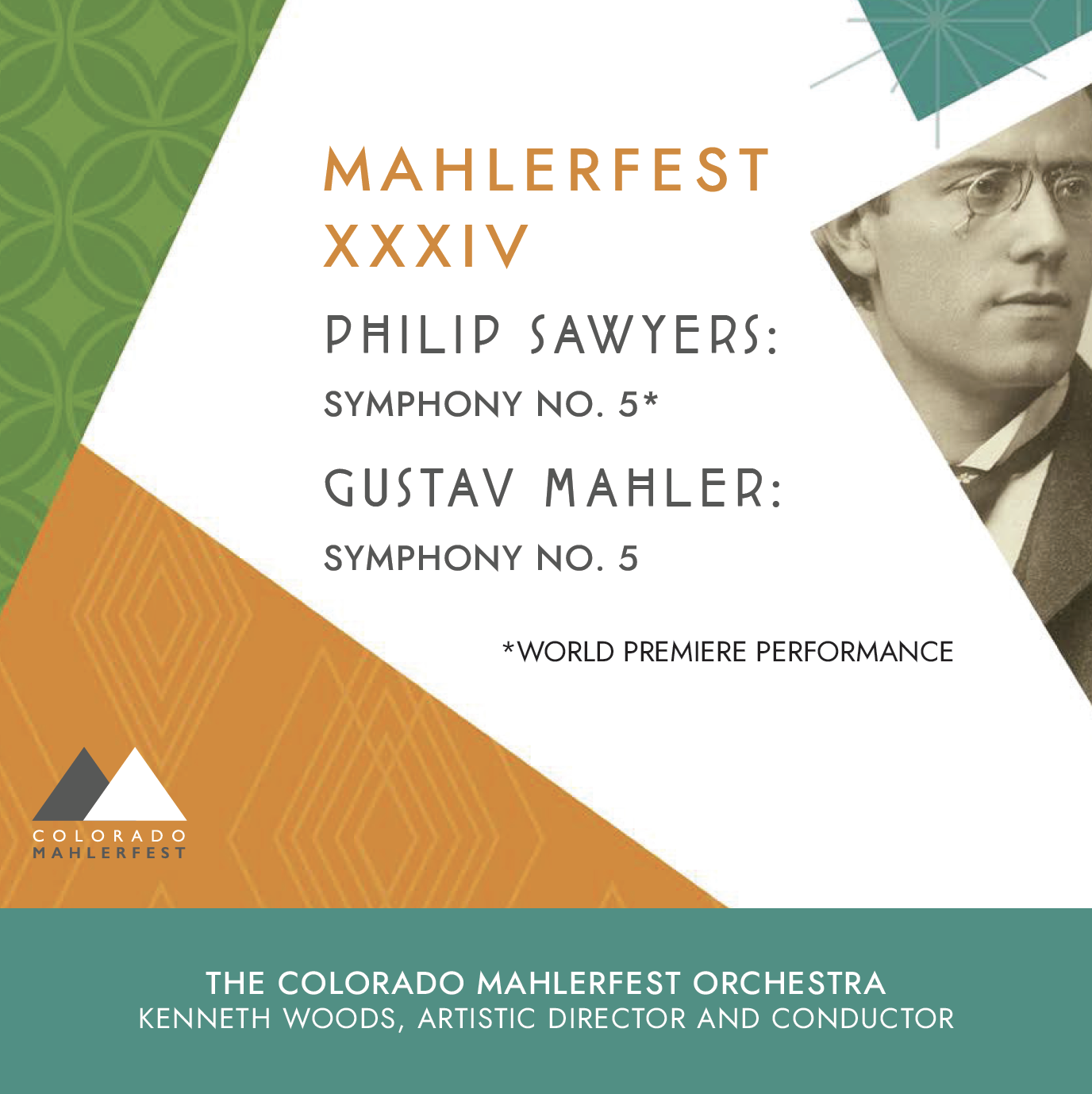
On Record: Colorado MahlerFest Orchestra / Kenneth Woods – MahlerFest XXXIV: Sawyers & Mahler: Fifth Symphonies (Colorado MahlerFest)

Sawyers Symphony no.5 (2021) [World premiere]
Mahler Symphony no.5 in C# minor (1901-02)

Colorado MahlerFest Orchestra / Kenneth Woods

Colorado MahlerFest 195269164287 [two discs, 111’45”]

Recorded Live performances at Macky Auditorium, Boulder, Colorado, 28 August 2021

reviewed by Richard Whitehouse

What’s the story?

Two five-movement Fifths brought the 34th Colorado MahlerFest to an impressive ending. Mahler’s cycle is often seen as ‘end of the line’ for the symphony, yet its further evolution is not hard to discern, and Kenneth Woods is rightly making this a crucial aspect of his tenure.

What’s the music like?

Philip SawyersFifth Symphony pursues a stylistic path comparable to those two before it. Its predecessor ended with an expansive Adagio, and this work continues from such inward seriousness in a Moderato that overrides clear-cut sonata procedures for a gradual unfolding whose thoughtful initial theme takes on greater emotional intensity as it builds to an ominous climax, before closing in a mood of no mean ambivalence. The writing, for an orchestra with fifth horn and harp though no percussion other than timpani, is never less than resourceful.

From here an Allegro increases the tempo to capering and, in its middle stages, wistful effect. The central Lento pursues a sustained course over cumulative paragraphs, the latter climaxing with the work’s most anguished music, before an affecting coda. The ensuing Presto affords greater expressive contrast between impulsive outer sections and a chorale-like trio of musing poise. The final Allegro is the most orthodox movement in its energetic and reflective themes, taking in an intensive development and subtly modified reprise prior to a decisive apotheosis.

Pacing is crucial in Mahler’s symphonies, his Fifth being no exception. The opening Funeral March is ideally judged – its development not too histrionic, then a coda whose eruptive force subsides into numbed uncertainty. Proceeding without pause, its successor steers securely to a climactic yet ill-fated chorale, and if the final return of its initial music lacks vehemence, the pulsating expectancy of the closing bars is tangibly rendered. Woods’ handling of the central Scherzo contrasts a rustically evocative trio with the ländler-infused coyness and contrapuntal contrivance either side, the coda wrapping up this overlong movement with real decisiveness.

The remaining two movements are finely realized, the Adagietto taken at a flowing if flexible pace that enables its inherent rapture to emerge without any risk of indulgence. The deftest of transitions duly prepares for a finale whose elaborate interplay of rondo and sonata elements is replete with a cumulative impetus here carried through to a fervent peroration, the chorale blazing forth during a close in which affirmation and nonchalance are irresistibly combined.

Does it all work?

Almost always. Sawyers’ Fifth symphony is a cohesive and absorbing piece – less arresting in overall content than either of its predecessors, though with an unfailing formal logic and expressive eloquence that are not to be gainsaid. Interesting, moreover, that this Fifth marks something of a rapprochement with ‘classical’ tonality, whereas Mahler’s Fifth sets in motion a fractious discourse which informs almost all this composer’s subsequent symphonic works.

Is it recommended?

Certainly. The playing of the Colorado MahlerFest Orchestra is of a high standard, testifying to the excellence of these musicians in their collective responsiveness to Woods’ technical acumen and interpretive insight. To hear this work so authoritatively realized and within the context of a major new symphonic statement says much for the significance of MahlerFest.

Listen & Buy

Online concert – English String Orchestra / Kenneth Woods: Elgar Festival 2022

Elgar arr. Fraser Nursery Suite (1931 arr. 2022) World premiere of this arrangement
David Matthews Shiva Dances Op.161 (2021) World premiere

English String Orchestra (soloists Zoë Beyers, Suzanne Casey (violins), Carl Hill (viola) and Joely Koos (cello) / Kenneth Woods

Filmed at the Guildhall, Worcester, Friday 3 June 2022

by Richard Whitehouse

Welcome listening for the new year provided by the English String Orchestra, as taken from a programme at this year’s Elgar Festival and which featured the premiere of that composer’s last notable work in what is an idiomatic and often perceptive arrangement by Donald Fraser.

His previous Elgar arrangements ranging from miniatures to the Piano Quintet, Fraser duly captured the wistful charm of the initial Aubade then discreet pathos of The Serious Doll. The ESO steered a secure course through the headlong intricacy of Busy-ness, with the deft profundity of The Sad Doll afforded full rein. Solo strings against an implacable rhythmic ostinato offset any lack of visceral impact in The Waggon (sic) Passes, then the high spirits of The Merry Doll were jauntily in evidence. The extended finale, Dreaming is a threnody of tangible emotional import and a resume of earlier themes on its way to a forthright if not a little regretful coda. Kenneth Woods ensured this had gravitas without losing focus, while a bravura showing from Zoë Beyers was but the last in a sequence of solos all admirably taken.

Solos are by no means absent from Shiva Dances by David Matthews. The combination of string quartet and string orchestra has potent Elgarian connotations, of which the composer avails himself in this continuous sequence inspired as much by Aldous Huxley’s description of the Hindu god Shiva as by Indian classical music. Moving from a slow introduction given piquancy by its modal intonations, the work comprises four dances that between them outline the four elements: an impetuous workout representing ‘earth’, a quixotic interplay for soloists and ensemble that of ‘water’, the scherzo-like agility of ‘air’, and an animated waltz for ‘fire’. This latter builds to a forceful restatement of the opening theme, before a coda intensifies the overall expression such that what came before is rendered from a more ethereal perspective.

It says much for the prowess of the ESO that this first hearing betrayed few signs of caution or uncertainty, Woods directing a confident account with which Matthews must have been well pleased. Those listening to this online programme can also hear an encore in the guise of Nimrod from Elgar’s Enigma Variations, taken from a performance during last year’s Elgar Festival and which exudes a searching eloquence as seems to look beyond forthcoming celebrations to that overtly commemorative atmosphere from only a matter of weeks later.

This concert could be accessed free until 1 January 2023 at the English Symphony Orchestra website, but remains available through ESO Digital by way of a subscription. Meanwhile click on the names for more on the English Symphony Orchestra and Kenneth Woods, or on composer David Matthews