
In Concert – Martin Fröst, Roland Pöntinen & Sébastien Dubé @ Wigmore Hall: Night Passages – A Musical Mosaic

Martin Fröst (clarinet), Roland Pöntinen (piano), Sébastien Dubé (double bass)

Debussy Première rhapsodie (1909-10)
Chausson Andante and Allegro (1881)
Poulenc Sonata for clarinet and piano (1962)
Night Passages – A musical mosaic (with arrangements by the performers)
Domenico Scarlatti Sonata in D minor Kk32
Chick Corea Children’s Song no.15 (1978)
Rameau Les Indes galantes: Air pour les Sauvages (1735-6)
Purcell Incidental music for Oedipus, King of Thebes Z583: Music for a while (1692)
J.S. Bach Sinfonia no15 in B minor BWV801 (c1720)
Chick Corea Armando’s Rumba (1976)
Purcell Hornpipe in E minor Z685
Handel Menuet in G minor (1733)
Traditional Polska från Dorotea
Göran Fröst Klezmer Dance no.2 (2011)

Wigmore Hall, London
Wednesday 21 December 2022

Reviewed by Ben Hogwood

In 2019, Arcana was at the Wigmore Hall to see Martin Fröst and Roland Pöntinen give a concert of largely French music for clarinet and piano. Their encore hinted at an intriguing sequence of arrangements exploring connections between classical music and jazz. Three years on, that sequence has grown in stature, realised in recorded form as the Sony Classical album Night Passages, and given meaningful content by personal and world events.

Through lockdown, Fröst experienced intense bouts of Ménière’s disease, whose symptoms include unexpectedly severe bouts of vertigo and tinnitus. The clarinettist experienced one such bout while driving his car, which he thankfully negotiated without injury, but which bred a number of accompanying fever dreams. Expressed in the program notes, they lent a vivid written complement to the music.

Since 2019 the double bass of Sébastien Dubé has been added to the instrumental thinking, an essential musical component taking the arrangement style towards Jacques Loussier without ever resorting to parody. Unexpectedly, the group’s colourful arrangements did not always include the piano, allowing Fröst and Dubé the chance to explore the rewarding combination of clarinet and double bass through imaginative techniques and compelling improvisation.

The course of Night Passages led from a solemn sonata by Domenico Scarlatti to a Klezmer dance from Fröst’s brother Göran, by way of arrangements exploring the versatility of Baroque music. These were matched by jazz-inflected work from Chick Corea, with Armando’s Rumba presenting some vibrant syncopations, along with a celebration of the Swedish polska.

Frost’s artistry was almost beyond criticism, the clarinettist able to make even the most demanding technical passages appear nothing more than a walk in the park, airily improvising or running through sharply edged cadenzas. Dubé was no less impressive, and a remarkably wide range of colours issued from the double bass, whether bowed or plucked. His chemistry with Fröst was compelling, and the occasional use of vocals added to the mix. Roland Pöntinen also made the most of his chances to shine, providing the rhythmic verve to the dances but also a welcome, cleansing clarity which ran through the Baroque arrangements, tastefully and affectionately realised.

Prior to the interval we heard three short pieces by French composers for clarinet and piano. Debussy’s Première rhapsodie tells its story through a set of contrasting thoughts, initially set out in a humid atmosphere but becoming more outward facing as it gains in confidence. Fröst and Pöntinen had its many twists and turns instinctively under their fingers, finishing each other’s sentences as they did in the romantic, lyrical writing of Chausson’s Andante and Allegro, played with evident affection.

Yet it was Poulenc’s Sonata for clarinet and piano, completed in the year before his death, that made the most lasting impression. What a profound work this is, paying tribute to his friend and fellow composer Arthur Honegger. The slow movement holds the emotional centre of the work, with melancholy on occasion spilling over into outright sadness. Fröst’s quieter asides encouraged the audience to lean closer to the music, but these intimate thoughts were swept away by the exuberant finale, throwing caution to the winds. Fröst and Pöntinen played with great feeling throughout, typifying the approach of a concert that may not have been generous in length but which amply compensated through musical quality.
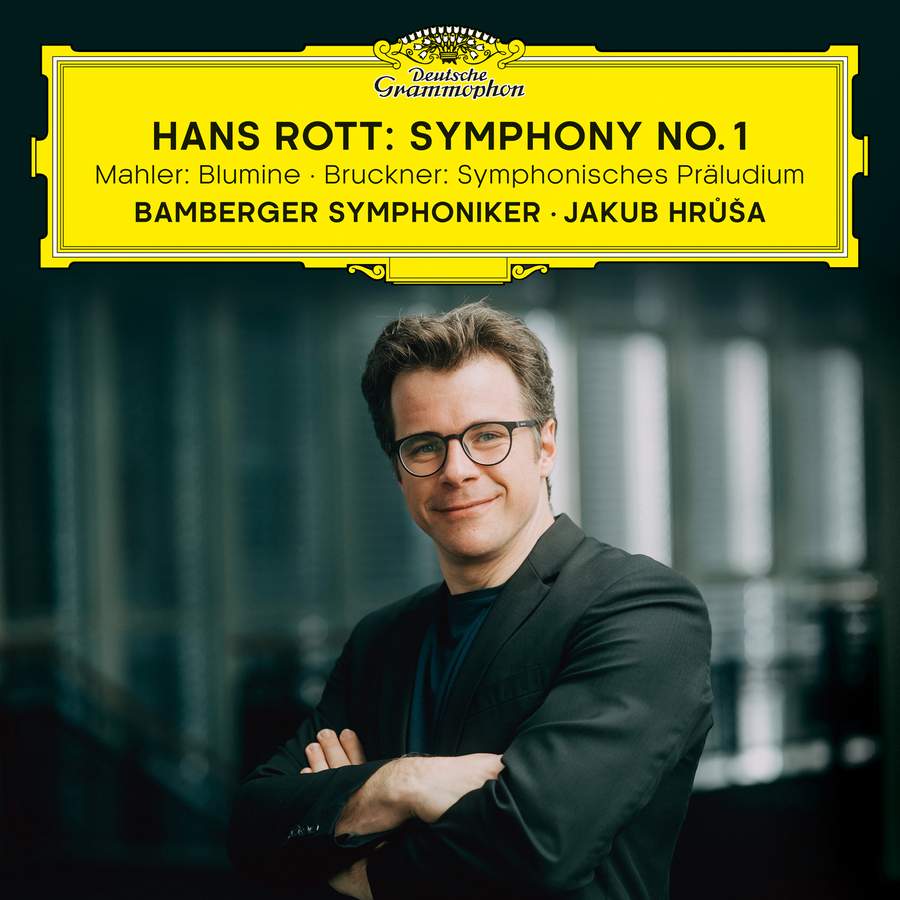
On Record: Bamberger Symphoniker / Jakub Hrúša – Hans Rott: Symphony no.1 (Deutsche Grammophon)

Rott Symphony [no.1] in E major (1878-80)
Mahler Andante allegretto in C major ‘Blumine’ (1884)
Bruckner Symphonic Prelude in C minor WAB297 (1876)

Bamberger Symphoniker / Jakub Hrúša

DG 486 2932 [70’11”]

Producers Sebastian Braun (Rott, Bruckner), Johannes Gleim (Mahler)
Engineers Markus Spatz (Rott), Christian Jaeger (Mahler), Thorsten Kuhn (Bruckner)

Recorded September and October 2021 (Rott), December 2021 (Mahler), March 2022 (Bruckner) at Joseph-Keilberth-Saal, Konzerthalle, Bamberg

reviewed by Richard Whitehouse

What’s the story?

Jakub Hrúša makes its debut on Deutsche Grammophon with a new account of the Symphony by Hans Rott (1858-84), whose belated premiere some 33 years ago prompted a reassessment (still ongoing) as to the evolution of this genre during those final decades of the 19th century.

What’s the music like?

Much time and space has been expended on the indebtedness (or otherwise) of Mahler to this work – elements from which can be found in at least five the younger composer’s symphonies – yet equally fascinating is the audible influence it had upon those who came before and after; hence the first movement from Bruckner’s Seventh and the second movement from Schmidt’s First – both of which are similarly grounded in E major). Without seeking to present it as an unalloyed masterpiece, Hrúša makes a persuasive case for a piece that Rott would doubtless have overhauled had his mental state not deteriorated soon after its completion. He finds the right balance between grandeur and introspection in the preludial Alle breve, as between that raptness which briefly though pointedly erupts into anguish in the Sehr langsam that follows.

The Scherzo is the most convincingly realized movement and Hrúša has the measure of its animated main theme with undertones of polka, broadening into the ländler-derived suavity of its trio before regaining its earlier vigour vis an ostinato-like impetus barely held in check – the accelerando not necessary in this instance. Nor does he disappoint in the finale. Much the longest movement, this is easily criticized for diffuseness but, as Hrúša makes plain, the formal ground-plan – prelude-chorale-fantasia-fugue-stretto-postlude – (such as the organist Rott likely extemporized before committing to paper) is readily perceivable and is invested with cumulative momentum sustained to the beatific concluding bars. That the composer so nearly brought off this ambitious conception is surely more significant than any shortcoming.

Couplings have been judiciously chosen to open-out the context of the main work. Included in early hearings of his First Symphony, Blumine is a remnant from Mahler’s early orchestral projects lost to history and Hrúša brings out those expressive ambiguities as offset the lilting trumpet melody. Once attributed to Mahler, Symphonic Prelude is now believed an exercise from Bruckner’s composition class and Hrúša, adhering to the original orchestration rather than that by Albrecht Gürsching, duly makes the most of its ominous and plaintive musings.

Does it all work?

It does. In his accompanying booklet observation, Hrúša reflects on the musical and historical relevance of Rott’s Symphony and there can be little doubt that, among the dozen or so other recordings of this piece, this is the most convincing in terms of all-round cohesion as also the excellence of the playing by the Bamberg Symphony (whose chief conductor Hrúša has been since 2018). A little too forwardly balanced in tuttis, sound otherwise reflects the excellence of the orchestra’s home-venue – Rott’s extensive use of triangle kept within sensible bounds.

Is it recommended?

It is. Those coming to the main work for the first time should certainly makes its latest release their first port-of-call, and it would be worthwhile DG continuing this association with Hrúša and the Bamberg in other mid-European music from the late Romantic and early Modern era.

Listen

Buy

You can listen to clips and get purchase options from the Deutsche Grammophon website

In concert – Allan Clayton & Kate Golla: A Winter’s Journey

A Winter’s Journey

Schubert Winterreise D911

Allan Clayton (tenor), Kate Golla (piano), Lindy Hume (director), David Bergman (videographer)

Barbican Hall, London
Wednesday 7 December 2022

Reviewed by John Earls

Before the start of this performance it was announced that Allan Clayton had a chest infection but didn’t want to disappoint the audience who were asked to bear with him. As it turned out there was nothing to bear with and it certainly didn’t disappoint.

Many people think that Schubert’s great song-cycle Winterreise shouldn’t be tampered with beyond concentrating on the singing and piano playing in this remarkable work of 24 songs. They would prefer a ‘straight’ concert performance such as that given by Ian Bostridge and Thomas Adès in this same hall in January 2015, which was indeed unforgettable (incidentally, Bostridge has written a magnificent book on Winterreise called Schubert’s Winter Journey: Anatomy of an Obsession).

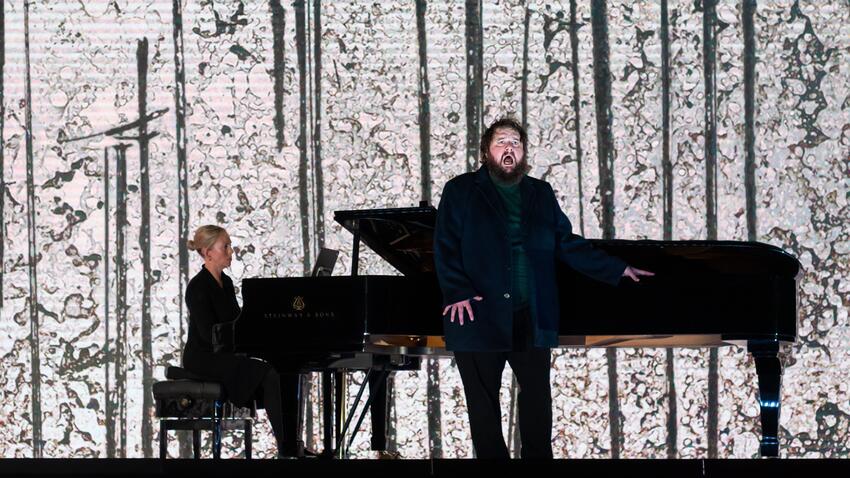
This particular ‘production’ featured video projections of abstract paintings by the late Australian artist Fred Williams on two right-angled screens behind the piano. These gave a sense of landscape although not always the landscapes one might usually associate with this work. It was deftly and beautifully done. Full credit to David Bergman (videographer).

Credit, should also be afforded to director Lindy Hume and artistic director Paul Kildea. Clayton was allowed to wander around the stage although didn’t stray too far from the piano with the exception of cutting a strikingly remote figure at the side of the stage at the beginning and end. There was no overkill, just delicate touches of theatre such as Clayton lying down to sleep under the piano using his coat as a pillow in Rast (Rest). And I wasn’t the only one who chuckled (is one allowed to chuckle during Winterreise?) when a mocking finger was pointed at the pianist sounding the posthorn in Die Post (The mail-coach).

Kate Golla provided fine piano accompaniment. But it was Clayton’s show. Despite the aforementioned ailment his singing was clear, dramatic and immensely moving, Die Nebensonnen (Phantom suns) a case in point. This, combined with his considered theatricality, gave a real sense of going on the journey with him. This will come as no surprise to anyone who saw his stunning performance as Peter Grimes at the Royal Opera House earlier this year.

There is a risk that adding visual accompaniments to this masterpiece detracts (and distracts) from the power and atmosphere of the work itself. In this case they were respectful, complementary and engaging. It was an utterly compelling experience.

John Earls is Director of Research at Unite the Union and tweets at @john_earls

In concert – Eugene Tzikindelean, CBSO / Alpesh Chauhan: Brahms, Nielsen & Shostakovich

Brahms Tragic Overture Op. 81 (1880)
Nielsen Violin Concerto DF61 (1911)
Shostakovich Symphony no.5 in D minor Op.47 (1937)

Eugene Tzikindelean (violin), City of Birmingham Symphony Orchestra / Alpesh Chauhan

Symphony Hall, Birmingham
Wednesday 7 December 2022 [2.15pm]

Reviewed by Richard Whitehouse

A gratifyingly large house greeted this afternoon concert given by the City of Birmingham Symphony Orchestra with its former assistant conductor Alpesh Chauhan, taking in works long established in the repertoire and a concerto which remains on or about its periphery.

Tackling Brahms’s Tragic Overture depends on whether one sees it as an overture pure if not so simple, or as a tone poem with its ‘programme’ subsumed into the music’s inner workings. Chauhan favoured a viable mid-way course, his steady if never flaccid approach keeping its sonata design firmly in view but with enough expressive license to bring out the pathos in its second main theme and, especially, that spellbinding transition to its reprise when a wistful vulnerability steals over the music as if denying the implacable fatalism otherwise dominant.

CBSO leader Eugene Tzikindelean then took the stage as soloist. A bold if unexpected choice for such an appearance, Nielsen’s Violin Concerto has never quite received its due outside of Denmark but that it makes a cogent impression was never in doubt in a reading as insightful as this. Its Praeludium keenly yet sensitively rendered, Tzikindelean despatched the ensuing Allegro with the right chivalrousness and suavity. A broken string in the development caused only minimal delay as he produced its replacement then restrung his instrument with alacrity.

Its self-sufficient halves make sustaining an overall trajectory the crucial factor in this piece and Tzikindelean succeeded admirably, drawing inward rapture from the second movement’s lengthy Poco adagio before steering a never too hasty course through its lightly ironic Rondo. Tzikindelean responded to the enthusiastic response with the opening ‘Country Musicians’ section from Enescu’s Impressions d’Enfance as a delectable encore: maybe we can expect that composer’s Caprice Roumain or Pascal Bentoiu’s Violin Concerto on a future occasion?

Throughout this performance, Chauhan proved steadfast and attentive in support, then came into his own after the interval with an impressive take on Shostakovich’s Fifth Symphony. If the earlier stages of the Moderato seemed a little reined-in, the development accumulated the requisite intensity on the way to a powerfully conceived reprise, then a coda of aching regret. Steadier and less capricious than usual, the ensuing Allegretto yielded a keen impetus and, in its trio, a deftly ‘knowing’ contribution from Tzikindelean having retaken the leader’s chair.

It was the Largo that proved the highlight of this performance. Chauhan sustained its heartfelt interplay of themes with unforced rightness, CBSO woodwind heard to advantage in its rapt central episode before a climax of wrenching eloquence that subsided into expectant stillness. Launched (almost) attacca, the final Allegro unfolded with due emphasis on its ‘non troppo’ marking; its calculated aggression pointedly undercut by musing circumspection, before the heady ascent towards an apotheosis which was more than usually defiant in its equivocation.

A performance that provided ample indication of Chauhan’s emergence as a conductor of the front rank. Hopefully he will be returning to the CBSO soon, the latter’s activities continuing with the customary Christmas and Viennese New Year concerts with which to see out 2022

You can read all about the 2022/23 season and book tickets at the CBSO website. Click on the artist names for more on Alpesh Chauhan and Eugene Tzikindelean

In concert – Zoë Beyers, English String Orchestra / Kenneth Woods – Journeys of Creation and Renewal: Vaughan Williams, Pritchard, David Matthews and Elgar

Vaughan Williams Fantasia on a Theme of Thomas Tallis (1910)
Pritchard Violin Concerto ‘Wall of Water’ (2014)
David Matthews Shiva Dances Op.160 (2021)
Elgar Introduction and Allegro Op.47 (1905)

Zoë Beyers (violin), English String Orchestra / Kenneth Woods

Holy Trinity Church, Hereford
Thursday 24 November 2022

Reviewed by Richard Whitehouse

Just a day after The Journey Home, the ESO reverted to its ‘String’ guise for this judiciously sequenced programme with two contrasted commissions framed by classics of the repertoire for string orchestra – these latter written not so far away from where this concert took place.

Acclaimed at its premiere in Gloucester Cathedral some 112 years ago, Vaughan Williams’s Fantasia on a Theme of Thomas Tallis has never been so popular as it has become this past decade. This performance did it justice – the placing of the ‘echo’ orchestra, behind the altar-screen in the imposing Victorian confines of Holy Trinity Church, abetting those antiphonal exchanges in the central section. Solo string quartet building steadily toward an impassioned culmination, from where Tallis’s theme is movingly recalled prior to the final evanescence.

Next came the welcome revival of an earlier ESO commission by Deborah Pritchard. Inspired by an eponymous series of paintings by Maggi Hambling, Wall of Water is a violin concerto which makes tangible reference to these 13 canvases as it unfolds. Their projection to the rear of the orchestra underlying a visceral as well as imagistic allure, even though the work itself is fully intelligible on its own terms – not least with a three-movement trajectory coalescing out of continuous 13 sections. Elements of Penderecki and Lutosławski can be discerned over its course, but a distinct and engaging personality is also in evidence along with a technical finesse with regard both to the solo writing and that for the strings. Zoë Beyers gave a superb account of a piece which seems sure to enter the repertoire of 21st-century violin concertos.

As too does Shiva Dances by David Matthews. The combination of string quartet and string orchestra is a potent one (see below), of which the composer has availed himself fully in this continuous sequence likely inspired as much in a description of Hindu god Shiva by Aldous Huxley as by Indian classical music. Proceeding from a slow introduction given piquancy by its modal intonations, the work comprises four dances which between them outline the four elements: an impetuous workout that represents ‘earth’, a quixotic interplay for soloists and ensemble that of ‘water’, the scherzo-like agility of ‘air’, then a lively waltz for ‘fire’ – this latter building to a forceful restatement of the opening theme, before the coda opens-out the overall expression such that what went before is rendered from a more ethereal perspective.

Kenneth Woods secured an engaging account of this appealing work, as he did of Elgar’s Introduction and Allegro that concluded the evening. As he pointed out, its main melody is a rare instance of this composer using an actual folksong, yet that never entails a lessening of formal intricacy in what becomes a latter-day recasting of the concerto grosso – reaching its emotional apex in a developmental fugue that bristles with technical challenges. A tough test for the London Symphony Orchestra, with whom Elgar enjoyed a productive association.

Suffice to add the ESO was equal to this task as in the sustained fervency of the final pages. It rounded off another worthwhile evening from this always enterprising ensemble. December brings the seasonal performance of Handel’s Messiah, with further concerts in the new year.

For more information on the artists in this concert, click on the links to read about Zoë Beyers, Kenneth Woods and the English Symphony Orchestra. For more on the composers, click on the names Deborah Pritchard and David Matthews