In concert – Daniel Pioro, London Philharmonic Orchestra / Andrew Manze – Vaughan Williams: Symphony no.9, Lark Ascending & Tallis Fantasia; Tom Coult Violin Concerto

Vaughan Williams Fantasia on a Theme by Thomas Tallis (1910)
Tom Coult Pleasure Garden: Concerto for Violin and Orchestra (2020) (London premiere)
Vaughan Williams The Lark Ascending (1914-20); Symphony no.9 in E minor (1956-57)

Daniel Pioro (violin), London Philharmonic Orchestra / Andrew Manze

Royal Festival Hall, London
Wednesday 26 October 2022

Reviewed by Ben Hogwood. Concert pictures with thanks to the London Philharmonic Orchestra; picture of Andrew Manze (c) Benjamin Ealovega

Subtitled Visions of England, this concert from the London Philharmonic Orchestra and Andrew Manze was a celebration of Vaughan Williams, marking 150 years since the composer’s birth. As part of an extremely full conducting CV, Manze has a recently recorded cycle of the composer’s nine symphonies under his belt with the Royal Liverpool Philharmonic Orchestra, and clearly holds a special affection for his music.

Two of RVW’s most popular pieces began each half of the concert, but the main act was a relatively rare encounter with composer’s final symphony, completed a year before his death. The Ninth Symphony is a work needing repeated listening before its treasures can be fully revealed, but more recently it has started to get the performances it needs to make an impact. As Manze himself told us from the platform, it also has a deep resonance for the London Philharmonic Orchestra themselves. On the morning of 26 August 1958 they were rehearsing with the composer’s friend and advocate, Sir Adrian Boult, when news came through that Vaughan Williams had died.

This performance delved into the spidery textures that seem to provide a link to the afterlife itself, rather like one of Holst’s later Planets. Also evident were a series of cloudy, watery vistas, such as those found in Debussy’s Nocturnes. Manze probed deeply into the first movement, helped by the baleful colouring of three saxophones, beautifully managed by Martin Robertson, Tim Holmes and Shaun Thompson to enhance the unusual orchestral textures. The tension between the ‘home’ note of E and its immediate neighbour F was ideally weighted, the thoughtful mood tinged with a sense of foreboding.

These emotions underpinned a convincing performance, with references to earlier, angrier music from the Sixth symphony sharply noted and delivered. There were also moments of calm acceptance, as though the composer was reappraising his life with some satisfaction, the darkness held at bay by silvery strings and consoling woodwind.

The second movement, with its curious rhythmic profile, had nicely balanced syncopations, while the scherzo danced as though in an empty room, the music never quite leaving the leash on which it was held. Segueing directly to the finale, Manze’s control and passion could be felt in equal measure, a sense of resolution hard to come by but ultimately found as the music headed for its final three chords, the ‘E’ and ‘F’ finally resolving their dispute. This beautiful symphonic ending offered genuine light in the darkness, a similar sensation to Shostakovich’s final symphonic statement if seen through very different eyes.

The concert opened with the ubiquitous Fantasia on a Theme by Thomas Tallis, less elusive music perhaps but equally profound when casting its eyes back over time. This ideal concert opener speaks as loudly as it surely did in 1910, providing consolation for the fevered brow through subtle but far-reaching statements. On this occasion the performance did not quite have the ‘tingle’ factor, but it did feature beautiful string playing and finely wrought balance between the ‘choir’ of ten instruments, elevated a little at the back of the stage. Meanwhile the main orchestra could boast excellent contributions from four section principals, Pieter Schoeman and Tania Mazzetti (violins), Richard Waters (viola) and Pei-Jee Ng (cello).

The Lark Ascending holds a similarly treasured status among lovers of Vaughan Williams, remaining one of the calling cards of 20th century English music. In the right performance it creates a magical evocation of George Meredith’s lark, as it ‘drops the silver chain of sound’. Daniel Pioro played the solo part with great sensitivity and more than a little panache, choosing not to overindulge in a relatively straightforward opening sequence, but appearing to add a few extra ‘blue’ notes as the violin warmed to its characterisation, ‘lost on his aerial wings’. Manze’s pacing, initially quite fast, settled to a satisfying pace, with ideal balance between soloist and orchestra. The hall responded with commendable silence to the absolute quiet at the end.

A busy evening for Pioro included a role as soloist in the first London performance of Tom Coult’s Pleasure Garden. A four-movement concerto for violin and carefully chosen orchestra, it is effectively a compilation of four very distinct tableaus, taking its lead from constructed ‘natural spaces’ in and around congested living areas.

The first movement, Starting to rain – Zennyo Ryuo appears, found as vivid a portrayal of rain as you could wish to hear – in my mind I was checking the roof for a leak! Throughout the concerto Coult’s keen ear for orchestral colour was evident at every turn, as was his assured writing for violin, brilliantly played by Pioro. The coloristic effects were enjoyable and easy on the ear, harmonies largely consonant but never over-simplified, and the description of events in Dyeing the lake blue for Queen Victoria, Francesco Landini serenades the birds and The art of setting stones was easy to follow. The birds in particular were vividly portrayed by the soloist.

There was however a fragmented feel to the green spaces, as though they had not fully germinated, and this was exaggerated by the stopping of each movement to pause the descriptive process. When the piece did finally finish there was still an element of unfinished business, in spite of its 27-minute length. Repeated hearing would be welcome to give a more thorough appraisal and understanding, as the warm reception would suggest Coult hit the mark for the vast majority of listeners. His music has many attractive traits and he is a gifted orchestrator, so his is most definitely a space to keep under watch.
In Concert – The Dream Syndicate @ Lafayette

The Dream Syndicate Plays The Days of Wine and Roses and more

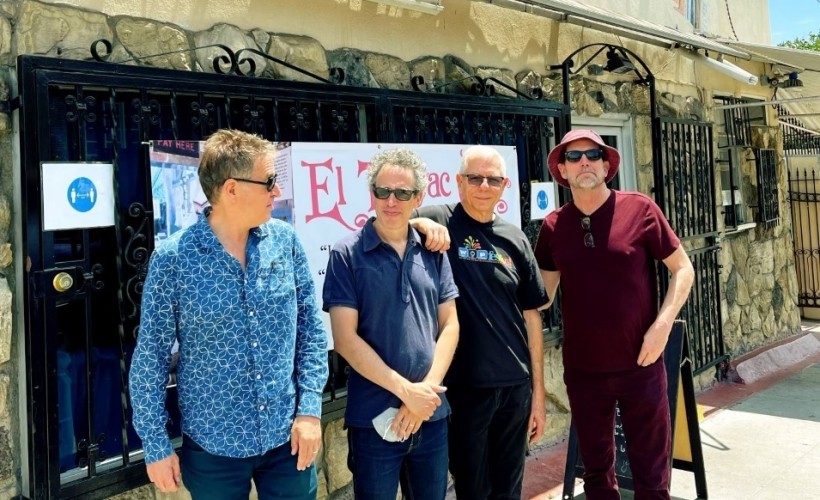
The Dream Syndicate [Steve Wynn (guitar / vocals), Jason Victor (guitar), Mark Walton (bass guitar), Dennis Duck (drums)]

Lafayette, Kings Cross, London; 18 October 2022

Reviewed by Richard Whitehouse

Can it really be 40 years since The Dream Syndicate launched The Days of Wine and Roses on an unsuspecting public beholden to the false promise of the New Romantics or wanton hubris of Hair Metal? Judging by the effusive reception from this capacity ‘we were there’ house (by no means restricted to males edging towards their seventh decade) at Lafayette, those first impressions of its Velvets-meets-Stooges amalgam have not worn thin – nor has this band’s penchant for unleashing visceral alt-rock with an ease born of intuition.

Taking the stage with unstudied casualness, DS needed no warm-up as it launched a suitably blistering take on Bullet Holes – Steve Wynn duly acknowledging those present before the mock-hedonism of Out Of My Head, then a driving account of Put Some Miles On. If the band’s reformation in 2012 after a 23-year sabbatical was unexpected, the consistency of its four-album run this past decade has been heartening. The spiralling enticement of 2017’s How Did I Find Myself Here, pulsating song-set of 2019’s These Times, daring leap into the dark of 2020’s The Universe Inside and now the heady synthesis of European with American traits of just-released Ultraviolet Battle Hymns and True Confessions between them confirm an outfit which has never yet repeated itself whether four, eight or (why not?) 12 albums in.

This latest offering was next up in the moody soulfulness of Damian, then an incendiary take on Burn underlined just why it remains a candidate for the greatest-ever DS song – and one to whose deep-cutting groove the engaging catchiness of Every Time You Come Around made a perfect foil. Hard To Say Goodbye exuded a pathos not without regret, and the engaging irony of Trying To Get Over rounded off a judiciously chosen trio from the new album. DS was never averse to taking risks frowned upon by its hide-bound peers, the disciplined riffing of How Did I Find Myself Here a riposte to those unable to grow old creatively while still rocking-out as instinctively as their younger selves. A ‘half of life’ classic to rank with the finest, Glide brought this first set towards its ecstatic touchdown.

A decade on, the current line-up gratifies with its stability and impresses with its flexibility – Wynn’s resourceful rhythm playing a sure incitement to Jason Victor’s combustible flights of fancy, with Mark Walton as unobtrusive or as playful as the song required, and Dennis Duck a model of proactive time keeping (no place this time for Chris Cacavas’s multi-layered keys – hopefully next tour). All of which were honed to perfection for a complete traversal of DS’s debut album that, as Frank Sinatra’s mellow tones faded out, took up most of the second set.

Its initial rimshot riveting attention, Tell Me When It’s Over compelled in its overlapping guitars and sneering vocal, as did Definitely Clean with its new-wave abrasiveness. It may have resorted to something like its initial arrangement, but the vamping riff of That’s What You Always Say assuredly took no prisoners, while Then She Remembers took on Iggy and the Asheton’s at their own game to secure at least a ‘score-draw’. Hallowe’en proved intriguing as ever with its inscrutable provocation then, after a brief pause for ‘turning over’, When You Smile cast a hypnotic spell via its glancing feedback and baleful power-chords. Wynn may no longer indulge in those verbal volleys that once articulated the latter stages of Until Lately but this fable of disillusion still packs its punch, while Too Little Too Late brought Linda Pitmon to front of stage for this insinuating take on a number once graced by Kendra Smith. Its dark humour unleashed, The Days of Wine and Roses surged forth on a twin-guitar rave of epic proportions thrown into relief only when brought to a shuddering halt.

What it showed, apart from the intrinsic excellence of DS, was the relevance of this album to the musical present – its ‘way of doing things’ formidably conveyed through the ambience of Lafayette, well on its way to becoming a mid-sized venue of choice for such gigs. The band returned for an inexorable take on Donovan’s Season of the Witch, before it tore into the inevitable curtain-closer of John Coltrane Stereo Blues with a vengeance. Is a 2024 tour featuring a 40th-anniversary rendition The Medicine Show on the cards? We can only hope.

You can read more about The Dream Syndicate at their website – while for more on Steve Wynn click here For information on Lafayette, head to the venue website

In Concert – Silesian Quartet & Wojciech Świtała: Bacewicz, Weinberg & Zarębski

Wojciech Świtała (piano, below), Silesian Quartet [Szymon Krzeszowiec and Arkadiusz Kubica (violins), Łukasz Syrnicki (viola), Piotr Janosik (cello)]

Bacewicz String Quartet No. 4 (1951)
Weinberg String Quartet No. 3 in D minor, Op. 14 (1944)
Zarębski Piano Quintet in G minor, Op. 34 (1885)

Wigmore Hall, London
Monday 17 October 2022

Reviewed by Richard Whitehouse

In existence now for 44 years and with only a change of leader during that time, the Silesian Quartet has amassed a broad repertoire taking in the extent of the Austro-German tradition along with that of its Polish heritage – as was evident from this latest Wigmore Hall recital.

The rapid upsurge of interest in women composers has been of real benefit to those such as Grażyna Bacewicz, whose sizable output of essentially abstract music went too long under the radar and not least a minor masterpiece as her Fourth Quartet – its first prize at the Liège Competition in 1951 vindicated. Its three movements are dominated by the first of these – a sombre Adagio introduction as variously infiltrates the lively ensuing Allegro, such that the coda essentially becomes a stretto between such contrasted expression. The central Andante finds this composer at her most lyrical, with the ‘giocoso’ marking of the final Allegro not necessarily implying any lessening of formal and emotional focus, as this builds toward an impetuous conclusion that clinches the unorthodox if methodical design of the whole work.

The Silesian gave a superb account of a piece it knows well – having recorded all Bacewicz’s quartets – as it did of Mieczysław Weinberg’s Third Quartet. On a similar scale, this also has a similarly overarching intensity – not least when attacca markings between movements were scrupulously observed as to give the overall design its unity within diversity. The unchecked energy of the initial Presto is by no means offset by the bittersweet poise of the Andante – its taciturn unease continued in an Allegretto affording only the most tenuous, even provisional closure. One reason, surely, why the composer restructured this piece when recasting it more than three decades later as his Second Chamber Symphony, which is hardly to deny the sheer fascination of the music at a crucial stage on the way to Weinberg’s mastery of this medium.

Had he died before writing his last work, Juliusz Zarębski would barely have been a footnote in musical history. His Piano Quintet confirms an acute feeling for Lisztian harmony, allied to a commanding formal sense as should have been the springboard into an eventful maturity and is not so far behind those by Brahms, Dvořák and Franck in being a major contribution to its medium. The Silesian had the measure of the first movement’s quirky take on sonata form – its vividly contrasted ideas merged in a tensile development then varied reprise and dynamic coda. The Adagio frames its lilting central section with a melody of rapt fervency, as is itself framed by music of ‘Forest murmurs’ aura, while the Scherzo likewise frames its wistful trio with music of an intently rhythmic propulsion. The final Presto is essentially a cyclical reprise of earlier ideas as this picks up where its predecessor left off, before pursuing a sonata-rondo trajectory such as culminates in a fervent recollection of the work’s opening theme. That this piece remains the summa of Zarębski’s creativity does not lessen the extent of its attainment.

The Silesian and Wojciech Świtała had prepared no encore, instead reprising the final pages of the Zarębski to close this programme in fine style. It is part-way through a recorded cycle of Weinberg’s quartets, another of which will hopefully feature in a future Wigmore recital.

For more information on the performers, click on the names to visit the websites of the Silesian Quartet and Wojciech Świtała – and for more on the composers, click on the names of Juliusz Zarębski, Mieczysław Weinberg and Grażyna Bacewicz

In concert – Kathryn Rudge, English Symphony Orchestra / Kenneth Woods – Across The Sea: Mendelssohn, Elcock, Britten & Elgar

Mendelssohn Calm Sea and Prosperous Voyage Op.27 (1828)
Elcock Wreck Op.10 (1998) [World Premiere]
Britten Four Sea Interludes from Peter Grimes Op.33a (1945)
Elgar Sea Pictures Op.37 (1899)

Kathryn Rudge (mezzo-soprano), English Symphony Orchestra / Kenneth Woods

Malvern Theatres, Great Malvern
Saturday 15 October 2022

Reviewed by Richard Whitehouse

This first full-length concert in the English Symphony Orchestra’s new season focussed on the sea in all its varied qualities, taking in four works whose encompassing a span of almost two centuries also identified crucial aesthetic differences as to what music itself can express.

Not least as it comes between masterpieces of the early Romantic era (A Midsummer Night’s Dream and The Hebrides), Mendelssohn’s Calm Sea and Prosperous Voyage has often been overlooked on its own merits. Yet this concert overture, as inspired by two of Goethe’s best- known poems, is a fine example of the still-teenage composer’s prowess – Kenneth Woods securing a rapt intensity in its introductory phase, then steering its characterful continuation through to a grand while not unduly bathetic peroration with the sea accorded the final word.

From here to Steve Elcock’s Wreck is to encounter more elemental, even existential forces – what the composer refers to as a ‘‘symphonic allegory’’ portraying a ship’s struggle against intemperate weather at sea. This unfolds as a constantly evolving design, juxtaposing music of unchecked aggression with that of fraught serenity, while highlighting Elcock’s mastery of large-scale formal and expressive contrasts, toward a seismic culmination whose gradual subsidence makes possible the sustained closing section. Here, off-stage mezzo sings in an invented (hence unknown) language what he describes as ‘‘a message of salvation beyond despair, of consolation beyond grief’’ but even this is tempered by encroaching doubt. The ESO gave its all in a piece as demonstrably commended itself to the appreciative audience.

Marine vignettes rather than epics came after the interval. Woods had an audible grasp of the diverse moods in the Four Sea Interludes that Britten drew from his opera Peter Grimes, but more notable was his successful segueing between them – the keening plangency of Dawn leading into the equivocal assurance of Sunday Morning, emergent tonal and emotional blur of Moonlight, then the visceral conflict of Storm with its yearning oasis of calm and brutal closing onslaught. A few failings of ensemble hardly offset the intent continuity of the whole.

The ESO previously recorded Elgar’s Sea Pictures in an arrangement with chorus by Donald Fraser, but it was good to hear this song-cycle as Elgar realized it for mezzo – not least when Kathryn Rudge (taking her customary place at front of stage) proved so eloquent an exponent. The troubled pathos drawn from Roden Nole’s Sea-Slumber-Song was duly complemented by the whimsical charm of Alice Elgar’s In Haven (Capri) – tension rising accordingly for Elizabeth Barrett Browning’s Sabbath Morning at Sea, its larger emotional contrasts well defined. Expressive nuances in Richard Garnett’s Where Corals Lie might have been more subtly pointed, but there was no doubt as to Rudge’s identification here or in Adam Lindsay Gordon’s The Swimmer with its anxious though determined progress to certain affirmation.

It set the seal on a rewarding programme and fine start to what will hopefully be an eventful season for the ESO. More concerts will be announced soon, but for now the recent release of Adrian Williams’s First Symphony (Nimbus NI6432) confirms this as an orchestra on a roll.

For more information on the artists in this concert, click on the links to read about Kathryn Rudge, Kenneth Woods and the English Symphony Orchestra. For more on composer Steve Elcock, click here

In concert – Alison Balsom & Anna Lapwood @ Chapel of St Augustine, Tonbridge School

Trad. arr. Oskar Lindberg Old Swedish Folk Song (unknown)
Kristina Arakelyan Modal Reeds (2021, world premiere)
Albinoni arr. Balsom / Lapwood Concerto in D Minor (1722)
Debussy arr. Lapwood Clair de Lune (1905); Syrinx (1913); The Girl with the Flaxen Hair (1910)
Britten arr. Lapwood Sunday Morning from Peter Grimes (1945)
Eben Okna (Windows): Green Window ‘Issachar’; Gold Window ‘Levi’ (1976)
J.S. Bach arr. Balsom / Lapwood Chorale Erbarm dich BWV 721 (unknown)
Owain Park Images (2018)
Alain arr. Balsom Litanies (1937)

Alison Balsom (trumpet), Anna Lapwood (organ), Sam Mendes (lighting director)

Chapel of St. Augustine, Tonbridge School, Tonbridge

15 October 2022

by Ben Hogwood

This was an inspirational evening of music, cleverly conceived and executed as the first in an impressive set of concerts to celebrate the 60th anniversary of the Tonbridge Music Society. In its existence the society has attracted a stellar cast of classical and jazz artists to the Kent town, where they have a number of fine performing venues at their disposal. Even by their standards, however, this was an auspicious event.

Powered by a series of common musical denominators (and a shared love of Chelsea buns!), trumpeter Alison Balsom and organist Anna Lapwood created an immersive sequence of music for the striking Chapel of St Augustine in Tonbridge School. One of the many inspirations behind this was Alison’s teacher from the Guildhall School of Music, and her thank you gift took the form of an inspiring and memorable evening for many young performers, who in a ceremony afterwards were presented with a series of Diamond Music Awards given by TMS to support local musicians between the age of 5 and 18.

Both performers have a strong belief in giving back to their communities and passing on to the next generation of performers. The week leading up to the concert featured a master class given by Balsom for students of the school, and Lapwood’s continued personal and virtual encouragement for her many followers under the #playlikeagirl hashtag is bearing fruit if the young audience was anything to go by. Both showed why they can be lasting inspirations, their craft borne of a shared passion for the music they play.

Complementing the music was a lightshow, under the direction of Sam Mendes – Balsom’s husband, clearly relishing a more vocational night away from his film director profession. Running smoothly and logically, the music began with solo organ – and few would have been prepared for the immediate and bare emotion of the Old Swedish Folk Song arranged by Oskar Lindberg. We heard a counterpoint from Kristina Arakelyan, who was present for the world premiere of her similarly moving Modal Reeds. A cinematic piece led by Balsom, this had striking parallels to the film music of Thomas Newman in its rich harmonic palette and distinctive, bright textures. It made a strong impression.

The chapel was bathed in blue at this point, a subtle counterpoint to the music. Balsom then fell under the spotlight, moving to the organ loft for a spirited account of Albinoni’s Oboe Concerto in D minor, its natural arrangement for trumpet making much of the heartfelt second movement, proving there is more than one Adagio bearing the composer’s name! Lapwood’s choice of registrations on the organ throughout the evening was ideal, but here especially she found a rewarding balance and sensitive phrasing.

A Debussy triptych followed – a mellow-voiced Clair de Lune, in the organist’s own arrangement, segueing neatly into Balsom’s account of Syrinx, the solo flute piece taking flight in its arrangement for trumpet. Both instruments combined in a plaintive account of The Girl With The Flaxen Hair.

The evening’s centrepiece was to follow, prefaced by a fiendishly difficult arrangement of Sunday Morning, second of Britten’s Four Sea Interludes from Peter Grimes. The longest stop on the organ came into play, rumbling beneath a vividly pictorial account where Balsom added a treble line. From here we moved to two substantial segments from Petr Eben’s Okna (Windows), a 1976 piece inspired by four of Marc Chagall’s stained glass windows. Coincidentally, only three miles down the road stands Tudeley parish church, the only site in England to feature original windows by the artist.

This piece is clearly special to Balsom, and the two gave a penetrating insight into Eben’s writing, taking two substantial excerpts. Lapwood exploited the organ’s colour, the mottled Green Window gathering intensity with some raucous interventions against Balsom’s fluid line. The steady build in the Gold Window was something special indeed, reaching an apex in what Balsom termed ‘the loudest B flat chord ever for non-amplified instruments’. It certainly left its mark here!

Great control was required for the floated melody of Bach’s chorale Erbarm dich before the evocative Images from Owain Park, to which the trumpet added a playful yet poignant treble line. Jehan Alain’s Litanies also benefited from this, the organ piece given an extra-ceremonial air to close proceedings. We were not fully done, however, as a softly played encore arrangement of Shenandoah held the audience rapt a little while longer.

Both artists should be applauded for their creativity and collaboration here, two words that sit towards the forefront of their thinking. The balance was ideal, a notable achievement given the familiar problems of tricky sightlines and the distance between the two performers. Mendes, too, should be credited for a sensitive response that cast a spell on those in the chapel, moving from cool blue hues to dramatic outlines in gold. A special evening indeed – how about reproducing it as a late-night Prom?

For more information on Anna Lapwood’s new Images album, featuring the piece from Owain Park, click here. Meanwhile for more on Alison Balsom’s recent release Quiet City, click here – and for more information on her debut album for EMI Classics (latterly Warner), containing a complete account of Petr Eben’s Okna, click here