
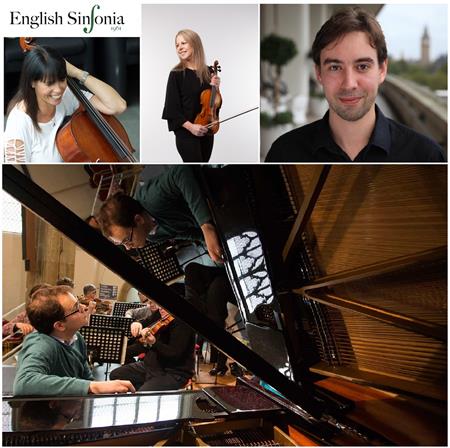
Members of the English Sinfonia: Janice Graham (violin), Nick Bootiman (viola), Julia Graham (cello) Chris Hopkins (piano)
Vaughan Williams The Lark Ascending (1914)
Bridge Miniatures – Book 2, H88 (1910)
Coleridge-Taylor Piano Trio in E minor (1893)
Holst String Trio in G minor (1894)
Bax Piano Quartet in One Movement (1922)
St. John’s, Smith Square, London, 15 December 2020 (lunchtime)
Reviewed by Richard Whitehouse
Celebrating its 60th anniversary next year, the English Sinfonia will be remembered by older listeners for those valuable recordings of British music with Neville Dilkes (not least the first modern account of Moeran’s Symphony). Its current incarnation as ensemble-cum-chamber orchestra enables it to tackle a wide repertoire, and even though only the core personnel was featured in this afternoon’s concert, the works that were chosen offered a more than plausible overview of British chamber music composed across the late 19th and early 20th centuries.
Easy to forget that, long before his music assumed a more radical mindset, Frank Bridge was a composer of lighter fare. Hence those three sets of Miniatures for piano trio – classy salon music of which the second set moves from a soulful while never cloying Romance, via an infectious and decidedly scherzo-like Intermezzo, to a Saltarello with more than a hint of menace in its hectic dash. By comparison, the Piano Trio of Samuel Coleridge-Taylor tries a little too hard to impress. If this early piece is hardly the equal of such as the later Clarinet Quintet, its three compact movements are never less than eventful – whether in the vehement Allegro with its portentous opening, a Scherzo whose unremitting energy brings little respite, or Finale whose distinctive furiant rhythm sees the whole work through to a forthright close.
Unlike the above, Holst composed relatively few chamber pieces in his maturity. While his String Trio evinces little sense of what he went on to achieve, this does not lack for incident. Idiosyncratic, too, in that its compact and forthright opening movement is followed by one which, over twice as long, integrates a slow movement, scherzo and finale that add up to an unlikely if cohesive whole; the fugal intricacies of that final section a stern test of ensemble such as the present players despatched with evident resolve. Appreciably more characteristic is the Piano Quartet by Bax – its tensile single movement packing a wide range of ideas and moods into little more than 10 minutes; and following an essentially conflicted to triumphal trajectory recalling that of the combative First Symphony which immediately preceded it.
Opening this afternoon’s programme, Janice Graham gave an affecting account of The Lark Ascending in the version for violin and piano first heard in public exactly 100 years ago. Now the orchestral version has become ubiquitous, this chamber guise can feel almost a reduction, yet the lucidity of its formal layout becomes even more explicit, and the understated poise of its piano part – as rendered by Chris Hopkins – belies any doubts as to Vaughan Williams’s limitations when writing for the instrument. An eloquent start to an enterprising programme.
Further information at https://www.englishsinfonia.org.uk/

 Hugh Bonneville (narrator), Wanda Sobieska (illustrations, above), English Symphony Orchestra / Kenneth Woods
 Matthew Schellhorn (piano)
Herbert Howells
Phantasy (1917)
Harlequin Dancing (1918)
My Lord Harewood’s Galliard (1949)
Finzi: His Rest (1956)
Summer Idyls (1911)
Siciliana (1958)
Pavane and Galliard (1964)
Petrus Suite (1967-73)
Naxos 8.571382 [65’52”]
Producers Rachel Smith<
Engineer Ben Connellan
Recorded 19-21 August 2019 at The Menuhin Hall, Stoke D’Abernon
Written by Richard Whitehouse
What’s the story?
Naxos continues its coverage of Herbert Howells with this initial instalment (presumably one more to follow) of his piano music, all pieces being previously unrecorded and authoritatively rendered by Matthew Schellhorn in what is a notable addition to the composer’s discography.
What’s the music like?
Long before his death (at the age of 90), Howells’s reputation rested firmly on his output of choral and organ works. Only quite recently has his considerable earlier output of orchestral and chamber music received serious re-evaluation, so revealing one whose distinct change of outlook in his early forties came about as much through cultural as personal reasons. Modest in scope and dimension, his piano music features no extended or career-defining works, yet its technical poise and always idiomatic feel for this instrument makes for a rewarding listen.
The present selection interleaves miniatures and cyclical works in chronological order. As to the former, Phantasy finds the recently graduated composer assured in his handling of those impressionist aspects derived from Debussy and Ravel, while Harlequin Dreaming inhabits a world of Satie-esque whimsy and nonchalance as a reminder that Howells was then close friends with Bliss. Moving on to the Renaissance-inspired piano pieces of his later years, My Lord Harewood’s Galliard fuses its recherche manner with engaging harmonic astringency, whereas Finzi: His Rest is a pensively ambivalent in-memoriam to a younger colleague. The Siciliana is a languorous if non-indulgent take on the characteristic dance rhythm, while the Pavane and Galliard juxtaposes the confessional and combative with stark emotional acuity.
The suites come from either end of Howells’s career, with all that implies for a half-century timespan. Summer Idyls [sic] formed a part of his portfolio for the Royal College of Music; its stylistic indebtedness to the mid- and late Romantics – not least Rachmaninov – would soon be left behind, but the appeal in these evocations of rural environs no doubt familiar from his childhood endures. Pick of the seven is the wistful rumination of ‘Near Midnight’, with the central ‘Minuet Sine Nomine’ similarly dominating the Petrus Suite in its limpid refinement. Otherwise, the seven pieces evince a sinewy counterpoint and tensile linearity as are audibly a product of Howells’s late style, yet the origin of several in sketches made decades before confirms an overriding consistency of approach heightened by experience.
Does it all work?
Yes, allowing that Howells never sought to suffuse this music with the degree of emotional intensity reserved, at least in his maturity, for the larger choral works. Yet his quintessential expression is arguably to be found in those many shorter choral or organ pieces intended for liturgical purpose; in which case, the expressive focus and restraint of what is recorded here is its own justification. It could hardly have a more persuasive advocate than Schellhorn, who credits the late Stephen Cleobury for introducing him to the extent of Howells’s piano music.
Is it recommended?
Indeed. The closely unduly defined sound is ideal for piano music of this kind, and Jonathan Clinch’s annotations (along with a reminiscence by the pianist) are succinct and informative. The follow-up volume, mainly of better-known music, will doubtless prove just as rewarding.
Listen & Buy
You can listen to clips from the recording and purchase, either in physical or digital form, at the
Matthew Schellhorn (piano)
Herbert Howells
Phantasy (1917)
Harlequin Dancing (1918)
My Lord Harewood’s Galliard (1949)
Finzi: His Rest (1956)
Summer Idyls (1911)
Siciliana (1958)
Pavane and Galliard (1964)
Petrus Suite (1967-73)
Naxos 8.571382 [65’52”]
Producers Rachel Smith<
Engineer Ben Connellan
Recorded 19-21 August 2019 at The Menuhin Hall, Stoke D’Abernon
Written by Richard Whitehouse
What’s the story?
Naxos continues its coverage of Herbert Howells with this initial instalment (presumably one more to follow) of his piano music, all pieces being previously unrecorded and authoritatively rendered by Matthew Schellhorn in what is a notable addition to the composer’s discography.
What’s the music like?
Long before his death (at the age of 90), Howells’s reputation rested firmly on his output of choral and organ works. Only quite recently has his considerable earlier output of orchestral and chamber music received serious re-evaluation, so revealing one whose distinct change of outlook in his early forties came about as much through cultural as personal reasons. Modest in scope and dimension, his piano music features no extended or career-defining works, yet its technical poise and always idiomatic feel for this instrument makes for a rewarding listen.
The present selection interleaves miniatures and cyclical works in chronological order. As to the former, Phantasy finds the recently graduated composer assured in his handling of those impressionist aspects derived from Debussy and Ravel, while Harlequin Dreaming inhabits a world of Satie-esque whimsy and nonchalance as a reminder that Howells was then close friends with Bliss. Moving on to the Renaissance-inspired piano pieces of his later years, My Lord Harewood’s Galliard fuses its recherche manner with engaging harmonic astringency, whereas Finzi: His Rest is a pensively ambivalent in-memoriam to a younger colleague. The Siciliana is a languorous if non-indulgent take on the characteristic dance rhythm, while the Pavane and Galliard juxtaposes the confessional and combative with stark emotional acuity.
The suites come from either end of Howells’s career, with all that implies for a half-century timespan. Summer Idyls [sic] formed a part of his portfolio for the Royal College of Music; its stylistic indebtedness to the mid- and late Romantics – not least Rachmaninov – would soon be left behind, but the appeal in these evocations of rural environs no doubt familiar from his childhood endures. Pick of the seven is the wistful rumination of ‘Near Midnight’, with the central ‘Minuet Sine Nomine’ similarly dominating the Petrus Suite in its limpid refinement. Otherwise, the seven pieces evince a sinewy counterpoint and tensile linearity as are audibly a product of Howells’s late style, yet the origin of several in sketches made decades before confirms an overriding consistency of approach heightened by experience.
Does it all work?
Yes, allowing that Howells never sought to suffuse this music with the degree of emotional intensity reserved, at least in his maturity, for the larger choral works. Yet his quintessential expression is arguably to be found in those many shorter choral or organ pieces intended for liturgical purpose; in which case, the expressive focus and restraint of what is recorded here is its own justification. It could hardly have a more persuasive advocate than Schellhorn, who credits the late Stephen Cleobury for introducing him to the extent of Howells’s piano music.
Is it recommended?
Indeed. The closely unduly defined sound is ideal for piano music of this kind, and Jonathan Clinch’s annotations (along with a reminiscence by the pianist) are succinct and informative. The follow-up volume, mainly of better-known music, will doubtless prove just as rewarding.
Listen & Buy
You can listen to clips from the recording and purchase, either in physical or digital form, at the 
 Arcana.fm