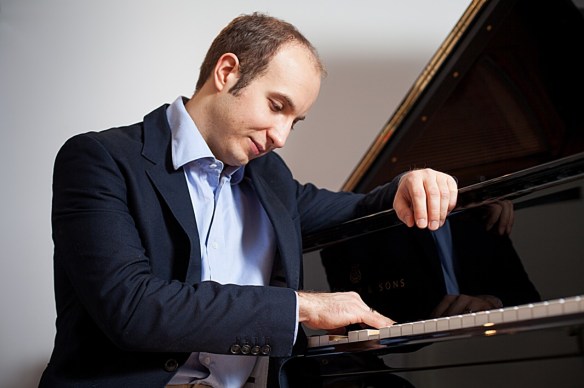
François Le Roux & Olivier Godin – Henri Dutilleux birthday concert

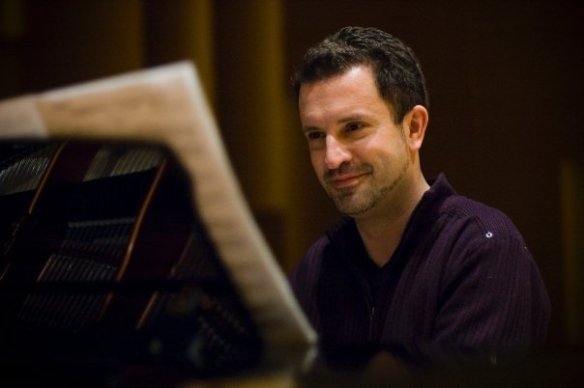
François Le Roux (baritone, above), Olivier Godin (piano, below)

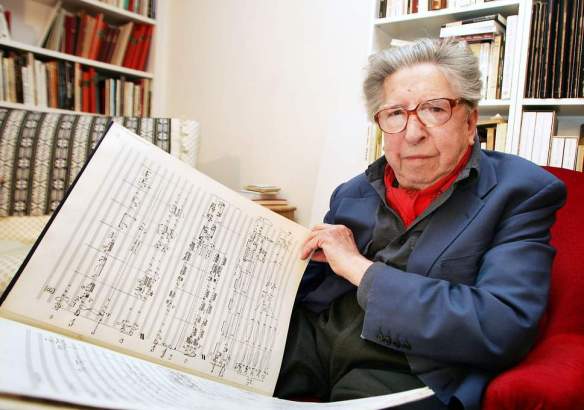
Henri Dutilleux (1916-2013)
4 mélodies (Féerie au clair de lune, Pour une amie perdue, Chanson au bord de la mer, Fantasio)
Au gré des ondes: Prélude en berceuse
3 mélodies inédites (L’Ange pleurer, Vers de Ronsard, La Faute en est à toi)
Improvisation
Regards sur l’infini
Hommage à Bach
Chanson de la déportée
3 sonnets de Jean Cassou (Éloignez-vous (XVII) (Leave us), La geôle, Il n’y avait que des troncs déchirés
J’ai rêvé
Petit air à dormir debout
San Francisco Night

Wigmore Hall, London
Tuesday 22 January 2019

Review by Ben Hogwood

This was a remarkable hour of music; the only regret being that not more people were present at the Wigmore Hall to see it. In a relatively rare Tuesday lunchtime concert at the venue, François Le Roux and Olivier Godin treated us to an hour-long celebration of the birthday of Henri Dutilleux, one of France’s finest 20th century composers – which is certainly saying something!

Dutilleux (below), who died as recently as 2013, left a small but perfectly formed musical canon, consisting mostly of works for the orchestra or the piano. His songs are little known and for good reason, as the composer himself did not think greatly of them, preferring to suppress their performance and recording. There are however enough to form more than an hour of music.
Only the baritone François Le Roux performs them regularly, and with pianist Olivier Godin he has recorded them all on a single disc. From that disc came much of the music performed here; songs written in the 1940s when the composer was establishing his mature voice.

Dutilleux was very hard on himself, it has to be said – and to explain why we had the peerless programme notes of Roger Nichols to guide us. They told us of Charles Panzera, a distinguished baritone who became the muse of the first eight songs in the recital, all written for performance on French radio.

The first of the 4 mélodies was Féerie au clair de lune (Moonlight of Fairies), which had bluesy undertones to its sparkling piano part, brilliantly played – and a vividly pictorial response to the words which Le Roux had no trouble in communicating. This was a feature of the recital, the baritone’s open performance style, extending through a simple but moving Pour une amie perdue (For a Lost Lady-Love), with its straightforward stepwise progressions, and then a slow, meandering Chanson au bord de la mer (Song by the Sea). The direct responses contained flashes of humour in the entertaining Fantasio, a setting of André Bellessort with the opening line (translated), ‘Death caught you costumed for the fancy ball’.
The concert was helpfully bookmarked with some of Dutilleux’s solo piano output, about which he was once again dismissive – but which once again far exceeded his evaluations in my opinion! The Prélude en berceuse was an attractive pairing with an easy charm and hints of Ravel. A later Improvisation enjoyed its freedom, while Hommage à Bach was clarity personified, an ideal bit of pastiche writing.

By then Le Roux had given us the Borsent setting L’Ange pleurer (The Weeping Angel), then a very cheeky Vers de Ronsard to make even the most liberally minded audience members blush a little! The same poet’s Le Faute en est à toi (Love, blame yourself) was perfectly clear but also given an extra sense of yearning by a slight husk to the singer’s voice.

1941 was a good year of songwriting for Dutilleux – we heard Chanson de le deportee (Song of the departed woman), a downhearted and rather powerful lament. Then we moved to four settings of Jean Cassou, the startling violence within Éloignez-vous (XVII) (Leave us) making a strong impact, together with a cold coda. After that, the descriptive powers at work in La geôle were equally startling, notably for the full range of the piano expertly used by Godin. Il n’y avait que des troncs déchirés (Only torn tree-trunks) was also remarkable, a wild-eyed and rather stark setting, before J’ai rêvé (I dreamed), which inevitably inhabited a much more languid world.

Dutilleux was never a composer for unnecessary or lengthy discourse – as the short piano piece Petit air à dormer debout proved. The final song, too, San Francisco Night – with words by Paul Gilson – took much longer for Le Roux to explain than it did to sing. His storytelling was rather wonderful though, as was the song – a beautifully judged and very poignant tribute to Francis Poulenc, and part of a collection commissioned by the American soprano Alice Esty. Dutilleux’s final song, it effectively marked the end of the French mélodie begun by Berlioz – but what a lovely, bittersweet way to finish.

Further listening

Unfortunately François Le Roux and Olivier Godin’s disc of Dutilleux’s songs is not available on any streaming services currently. However you can listen to a wonderful disc of Anne Queffélec playing the composer’s piano works on Spotify here:
Wigmore Mondays – Juilliard Quartet play Lembit Beecher & Dvořák ‘American’ string quartets

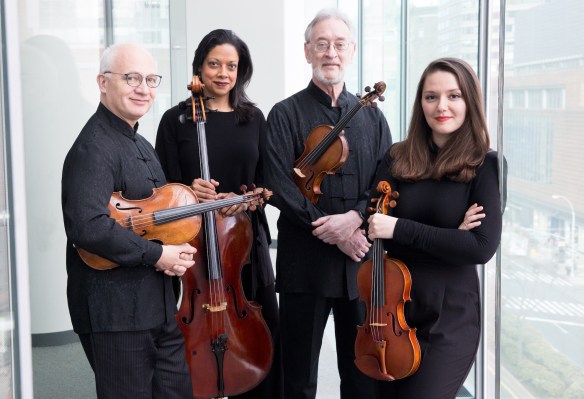
Juilliard String Quartet: Areta Zhulla, Ronald Copes (violins), Roger Tapping (viola), Astrid Schween (cello) (photo: Claudia Papapietro)

Lembit Beecher One Hundred Years Grows Shorter Over Time (2018) (2:25-23:52 on the link to BBC Sounds below)
Dvořák String Quartet in F major Op.96 ‘American’ (1893) (26:42-54:11)

Wigmore Hall, London
Monday 14 January 2019

To hear the BBC broadcast through BBC Sounds, please follow this link

Commentary and Review by Ben Hogwood

The Juilliard String Quartet are a very different proposition now to when they were formed in 1946. In the analogue recording years string quartets were almost wholly formed of white male players, and it has been very satisfying to see the trend broadening in the last couple of decades. The Juilliards themselves appear to have hit on a perfect blend of youth and experience, with first violinist Areta Zhulla joining their ranks for the 2018/19 season. On this evidence it has given them a real shot in the arm, helped by their willingness to bring with them a new work from Lembit Beecher. This gave their Wigmore Hall lunchtime concert a symmetrical feel, for Beecher’s new work for string quartet draws from Europe and more specifically Estonia – while Dvořák’s most celebrated ‘American’ String Quartet finds him writing in America but using a melodic style common to both the USA and the Czech Republic.

Beecher first, and the European premiere of One Hundred Years Grows Shorter Over Time. The intriguing title takes as its lead an Estonian melody, a waltz written by Beecher’s grand uncle Ilmar Kiiss, now in his mid-90s. This meaningful piece of music puts its head above the parapet in the first two of the three movements making up the quartet, before fully revealing itself in the third. The movements themselves represent different generations and their telling of the same story, which becomes less detailed as one generation passes to the next. As a result the first contains more definitive incidents, the second is more shadowy and less focussed in detail but poignant in mood, and the third, while recalling the attractive waltz in charming detail, is slower in its movements.

In concert this is a very effective piece of music not just to listen to but to watch. The busy conversations of the first movement (2:25 on the broadcast link) feel as though Beecher had set words to music, removing them just before performance, and making the first violin the loudest voice. This reaches a natural apex through Zhulla’s faultless higher register playing (from 5:10), before subsiding in volume and intensity, to some unusually emotional figures around 7:15 that simply dies on the string.

The second movement (from 11:51) uses subtle but effective techniques such as harmonics to create the shadowy effects, while from 14:51 a sudden injection of pace and volume gets an excitable conversation going again. The tender waltz theme would seem to be from 16:58 on the viola, before the violin ascends to the heights.

The third movement (from 18:39) has mottled textures and a slight lethargy, as though the memories are more difficult to place. Again the violin’s voice is loudest, but the shady movements of the others and the closing tremolos (from around 22:25) give a fragile and autumnal air to proceedings. All these elements were superbly marshalled in performance by the Juilliard Quartet, and made you want to hear more of Beecher’s music.

The Juilliard’s performance of the Dvořák, meanwhile, was a joy. This much-played work – one of the most popular string quartets there is, together with the Debussy and the Ravel works – rediscovers its freshness here. This is thanks in part to Zhulla’s clear affection for the piece. After Roger Tapping’s viola gives a silvery exposition of the first tune, she leads with a beautiful tone once again (26:57), enjoying the outdoor nature of the pentatonic melodies – which, as Gerald Larner’s programme note helpfully point out, seem to be equal parts Bohemia and Iowa. (The pentatonic scale, as its name implies, is made up of just five notes – in this case F (the home key), G, A, C and D). Although Dvořák was on a lengthy vacation when he wrote the string quartet, and was doubtless influenced by the melodies he heard in America, there is never the feeling that his Czech heritage is far away. The sentimental second theme (28:21) bears this out.

Meanwhile Zhulla and cellist Astrid Schween capture the bittersweet main melody of the slow movement to perfection (37:18) and (38:03), the rocking motion of its accompaniment acting as a lullaby. The ensemble enjoys the scampering figures of the Scherzo (44:47) before a brief Trio section (46:58) brings forward what the composer believed to be the song of the scarlet tanager in the first violin. The Scherzo resumes shortly after at 47:44.

The finale (48:52) is bold and positive in this performance, the quartet enjoying the abundance of tunes available to them – most of them taking in the pentatonic scale once again, with a rustic, outdoor feel.

With the bonus of a Haydn encore in the same key and mood (the Minuet from his Op.77/2 quartet at 56:06), this was the ideal January concert, an inspiring and optimistic pairing of works that celebrate the diversity of culture but also look at the heritage of each and bring them together. A lesson for the future in this country, perhaps?

Further Listening

Lembit Beecher’s One Hundred Years Grows Shorter Over Time is not currently available online; however you can listen below to his previous work for string quartet, Small Infinities:

The Juilliard String Quartet recorded Dvořák’s American string quartet all the way back in 1968 – yet that version does not appear to have yet reached Spotify. The below link is to a recent disc from the Škampa Quartet, coupling the quartet with the String Quintet in E flat major published immediately after. It is similarly free-spirited:

Further Reading

Lembit Beecher’s composer website contains detailed information on his output, with a healthy dose of videos and audio tracks. Meanwhile you can read more about the Juilliard String Quartet at their website. For a biography of Antonin Dvořák, this dedicated site to the composer is recommended.

In concert – Alberto Portugheis: My Favourite Schumann

Alberto Portugheis (piano)

Schumann
Papillons Op.2 (1831)
Toccata in C major Op.7 (1836)
Faschingsschwank aus Wien Op.26 (1839)

St James’s Church, Piccadilly, London
Friday 11 January 2019

Review by Ben Hogwood

What do you want to be doing at the age of 78? A strange question with which to begin a concert review, you might think, but have a think about your answer before reading on. If you are blessed with the faculties of Argentinian pianist Alberto Portugheis, you will be able to give a recital of Schumann in a central London church, a free concert with which you can illustrate your clear love of music.

There is a steady twinkle in the eyes of this particular pianist, which was clear as he modestly took the applause for three of his favourite pieces by one of the piano’s very best 19th century composers. He began with the early Papillons Op.2, a collection of postcard-sized illustrations full of melody and character completed in Schumann’s twentieth year. Its main theme is a Chopinesque waltz, which Portugheis played with clear affection, before the music goes on to pay clearer homage to Schubert. The ear took a while to adjust to the relatively reverberant acoustic of the church, but the phrasing was clear. Perhaps inevitably there were some technical issues with the most congested and loudest writing, the pianist occasionally missing his octaves and higher notes, but the level of expression invested in the playing more than compensated for this. The final moments, the Grandfathers’ Dance – where Schumann combines the end of the dance with the chimes of six o’clock in the morning – were magical, Portugheis fading the dynamic with beautiful control.

The Toccata in C major Op.7 was next, a very busy piece whose relentless, motoric figuration stayed throughout – and eventually provided great inspiration to a young Prokofiev for his own Toccata of 1912. Some of the detail of Portugheis’s figuration was lost in the bigger acoustic of St James’s but the energy and drive were beyond doubt, with a lovely articulation of the softer second idea.

Finally there was a relatively rare chance to enjoy Faschingsschwank aus Wien Op.26 (Carnival Scenes from Vienna), begun by the composer in the Austrian capital in 1839. In formal terms it is a lopsided work, with a first piece that lasts almost the same length of time as the next four combined, but its characterisation of the busy festival season is vivid and fulsome. The refrain of the first piece (simply marked Allegro) becomes something of an earworm, and Portugheis clearly enjoyed its reappearances, but he was careful to characterise each slight diversion and also stressed the dissonances towards the end.

The sombre Romance followed, then a playful Scherzino, where you could almost feel the nudge in the ribs, before a deeply felt Intermezzo. The Finale has a torrent of notes which presented a much greater challenge, but while he may have struggled a little more obviously Portugheis met these head on, the twinkle in the eye visible once again. Such an approach is ideal for Schumann’s character pieces, and these carnival pranks were very much enjoyed as a result. Happy birthday Alberto…if we’re half as lively as you at the age of 78 we will have done well indeed!

For more information on the St James’s Church lunchtime recital series, visit their website

Further listening

Alberto Portugheis has not committed any Schumann to record, but you can listen to the music from this concert on the Spotify playlist below:

Wigmore Mondays – Alexander Gavrylyuk plays Prokofiev, Mozart & Rachmaninov

Alexander Gavrylyuk (piano)

Mozart Piano Sonata in C major K330 (c1783) (1:56-20:20 on the broadcast link below)
Rachmaninov Preludes: in G flat major Op.23/10 (1903), in G minor Op.23/5 (1903), in G sharp minor Op.32/12 (1910) (22:04-32:25)
Prokofiev Piano Sonata no.7 in B flat major Op.83 (1942) (34:12-51:06)

Wigmore Hall, London
Monday 7 January 2019

To hear the BBC broadcast through BBC Sounds, please follow this link

Commentary and Review by Ben Hogwood

On his website, Ukrainian-Australian pianist Alexander Gavrylyuk makes the profound statement that ‘not many things in this world can unite people – no form of diplomacy could ever do that. I think that music comes the furthest in revealing that perhaps on a deeper level we are all quite similar’.

The quote is especially instructive given the work with which Gavrylyuk ended this concert, Prokofiev’s Piano Sonata no.7. Yet in these uncertain times his words are appropriate to any musical experience. Few have the purity of his Mozart, an account of the Piano Sonata in C major K330, the composer’s tenth published work in the form which was written just after he moved to Vienna. Published in his late twenties, it is very much a ‘white’ work – as in, written in the key whose scale uses all the white notes on the keyboard.

Yet, as a listen to this performance (from 1:56 on the broadcast link) will show, Mozart enjoys a good deal of chromatic movement, using the black notes to add considerable spice and intrigue to what initially seems like an extremely polite piece. Gavrylyuk plays with poise and elegance, enjoying the composer’s good manners but equally thriving on the diversions as they get more pronounced.

The slow movement (from 8:59) reveals much more of these tendencies, especially in its central minor key episode, a deeply personal piece of writing with tragic overtones (from 11:28). It casts a shadow from which the whole movement takes a while to recover, even when moving back into the safer intimacy of the major key (13:38). With a cutesy flourish the finale (15:22) returns us to happier music making, and seems to take on the influence of Scarlatti while looking forward to early Beethoven. Again Mozart enjoys more exotic melodies than the key suggests, keeping wit and positivity to the fore.

Rachmaninov’s big early success as a composer came through the famous Prelude in C sharp minor, its declamation a big hit with audiences. From this he was inspired to write 24 Preludes, one in each key, published in two subsequent books of 13 and 10 works respectively. The three heard here are fine pieces in their own right, beginning with the relatively confidential Prelude in G flat major Op.23/10 (22:04). This leads to the raw power of the Prelude in G minor Op.23/5 (25:24), one of Rachmaninov’s best-loved piano pieces, which builds into a march of real substance in Gavrylyuk’s performance. The Prelude In G sharp minor Op.32/12 (29:40) is an intriguing work, its bell-like sonorities hinting at the influence of the East and leaving quite an impression in this performance.

The reason Gavrylyuk’s statement is so pertinent to Prokofiev’s Piano Sonata no.7 is because the piece was written – as with so many Soviet pieces of its era – on two levels. Its crowd-facing elements were to please Stalin, to ensure Prokofiev stayed in his favour with works that left his audience in an ultimately positive frame of mind. How could they be otherwise, given the ferocity of the final movement? And yet the private elements are there for all who listen closely, for this is the central of Prokofiev’s three ‘War Sonatas’, completed in 1939. The first movement may be loud and brash (from 34:12) but it also has music of barely concealed turmoil, revealed clearly in the second theme two minutes later, where the virtuosity is completely absent.

Prokofiev is one of the most percussive of earlier 20th century composers for the piano, alongside Bartók and Stravinsky, and as the first movement proceeds there is an impressive rhythmic drive. All that is removed for the profound slow movement, however (42:11), where he quotes from Wehmut (Sadness), part of Schumann‘s Op.39 cycle Liederkreis, another private clue to his predicament.

In this performance Gavrylyuk has the sonata’s measure to a tee, investing a lot of feeling in the slower music while seemingly using the louder moments to banish evil from his sight. The last movement (47:57) is thrill-a-second, the repeated three note motif in the left hand taking over and driving to a hugely impressive finish, by which time the pianist was so far back he was almost horizontal!

Appropriately we had calming Schumann for an encore, providing a consoling link to the slow movement of the Prokofiev. This was Von fremden Ländern und Menschen (Of Foreign Lands and Peoples) from his 1838 collection Kinderszenen (Scenes from Childhood) Op.15 (52:28).

Further listening

You can listen to the music from this concert on the Spotify playlist below, including Alexander Gavrylyuk’s own recording of the Prokofiev:

The recording of the Prokofiev is part of an intriguing recital disc released in 2011, which includes works by fellow Russian composers Rachmaninov (his underrated Moments Musicaux Op.16) and Scriabin (his Piano Sonata no.5):

Meanwhile to further explore the Prokofiev piano sonatas, Denis Kozhukhin is an excellent guide. This album contains the other two sonatas in the so-called ‘war trilogy’ of works: