CBSO Soloists [Kate Suthers and Bryony Morrison (violins), Amy Thomas (viola), Miguel Fernandes and Helen Edgar (cellos)]
CBSO Centre, Birmingham Thursday 10 February 2022 2pm
Written by Richard Whitehouse
Just one work in this afternoon’s Centre Stage but, given this was Schubert’s String Quintet, no-one could complain of being short-changed. Music, moreover, that has featured regularly in recitals given by members of the City of Birmingham Symphony Orchestra over the years (not least the first live performance for this reviewer, given at the Birmingham and Midland Institute in the early 1980s as the second half of an imposing programme which opened with Brahms’s First Sextet) and that remains an emotionally involving experience like few others.
Pacing this work so its textural richness is allowed full rein without any loss of momentum is at least half the story, not least an opening movement whose contrasting themes need to find expressive accord from the outset. The present account succeeded handsomely in this respect, not least by varying the balance between these themes in the repeat of the exposition, and if the development marginally lost focus in its earlier stages, the heightened lead-back into the reprise brought an emotional frisson almost matched by the stark conclusiveness of the coda.
Whether or not the finest movement as to actual content, the Adagio is often the highlight of a performance – those outer sections shot through with a yearning regret which was tangibly in evidence. While the central episode could have been even more agitated, the spellbinding transition into the initial music was unerringly judged. Nor was anything amiss in the contrast between the Scherzo and its trio; the former bracingly impetuous, the latter inwardly fatalistic (and making the most of those rapturous two-cello sonorities) without ever becoming turgid.
If the finale often feels anti-climactic, this is not because of its relative concision but through an inherently Viennese ingratiation as was rightly played down in preference for a rhythmic forthrightness maintained through to a close that conveyed defiance as much as decisiveness. It duly set the seal on an impressive reading as drew an enthusiastic response from the near-capacity house. Hopefully an equally sizable attendance will be in evidence for next Friday evening’s recital, featuring Bach and Piazzolla, which comes courtesy of El Ultimo Tango.
You can read more about that next Centre Stage recital, and book tickets, on the CBSO website
Mozart Horn Quintet in E flat major K407 (1782) Brahms String Quintet no. 1 in F major Op. 88 (1882)
CBSO Soloists: Mark Philips (horn), Philip Brett and Charlotte Skinner (violins),Christopher Yates and Catherine Bower (violas), Arthur Boutillier (cello)
CBSO Centre, Birmingham Thursday 3 February 2022 2pm
Written by Richard Whitehouse
The Centre Stage series, featuring musicians from City of Birmingham Symphony Orchestra, continued this afternoon with an attractive coupling of quintets written exactly a century apart and which are among the most characteristic works of their respective composers’ maturities.
His first piece for the virtuoso Joseph Leutgeb (quite frequently the butt of Mozart’s scabrous humour, though for whom he went on to write four concertos) the Horn Quintet remains one of Mozart’s most engaging chamber pieces – not least through the presence of two violas that yield additional tonal depth to the lively outer Allegros, besides reinforcing the limpid pathos of the Andante. A little reticent toward the outset, Mark Philips came into his own during that central movement with its wistful poise and elegant interaction with those middle registers of the strings. Nor was there any lack of wit in the scintillating finale, its writing for the horn of no less agility than that found in the parallel movements of Mozart’s concertos; all the while suggesting the association between composer and musician was, after all, an endearing one.
Although he had originally intended his Piano Quintet to be a string quintet with two cellos, Brahms only got round to composing what became his First String Quintet as he was nearing fifty. Eschewing both the immediacy of his sextets and the austerity of his quartets, this piece typifies the ruminative warmth but also the expressive ambivalence of his music henceforth – not least an opening movement whose emotional surges are kept in check by the burnished richness of ensemble. The highlight, of the work as of this performance, is a slow movement that offsets its underlying introspection with two scherzo-like episodes whose effervescence carries over the finale – an Allegro of an impetus not so often encountered in Brahms’s later music, while culminating in a coda such as reinforces the home-key with exhilarating effect.
Such, at any rate, was the impression left by an assured and involving performance of a piece which conveyed the extent of this ‘dark horse’ among Brahms’s chamber compositions. Next week sees an ensemble from the CBSO tackle the epic expanse of Schubert’s String Quintet.
You can read more about that next Centre Stage recital, and book tickets, on the CBSO website
Kodály Serenade, Op. 12 (1919-20) Korngold String Sextet in D major, Op. 10 (1914-16)
CBSO Strings: Kate Suthers & Charlotte Skinner (violins), Adam Römer & Jessica Tickle (violas), Miguel Fernandes & Helen Edgar (cellos)
CBSO Centre, Birmingham Thursday 27 January 2022 2pm
Written by Richard Whitehouse
Two unfamiliar while appealing works were featured in this afternoon’s Centre Stage recital given by string players from the City of Birmingham Symphony Orchestra, written during the early stages and in the aftermath of the First World War at a pivotal time in European culture.
The focus on choral and pedagogic music of Kodály’s later years makes his earlier chamber works the more valuable, and while the Serenade for two violins and viola is by no means the most imposing, its deftness and finesse of writing for this unusual line-up cannot be gainsaid. The lively outer movements abound in those allusions to and inflections of folk melodies that Kodály explored extensively in his maturity, with the central Lento touching upon a vein of ‘night music’ less inwardly intense than if equally evocative to that found in the music of his contemporary Bartók. Its relatively extended formal trajectory can make the final Vivo seem unduly prolix, yet in so buoyant and finely integrated a performance, there was no likelihood of this movement forgoing any sense of direction on its way to a decidedly nonchalant close.
Kodály was around 30 when writing this piece, whereas Korngold was barely out of his teens when he finished the Sextet as draws equally on very different (if by no means incompatible) stylistic traits evident in works for this medium by Tchaikovsky and Schoenberg. If the latter composer is to the fore in the lengthy initial Moderato with its intricate thematic interplay and frequent density of texture, the Adagio exudes a melodic eloquence denoting those operas or film-scores to come. The ensuing Intermezzo is arguably the most characteristic movement in its suavity and teasingly coy charm, while the Finale looks back to Brahms and even Dvořák (whose Sextet would be a welcome inclusion in these recitals) for its underlying vitality and easy-going humour as makes the coda’s rush to the finish the more unexpected and engaging.
Such was the impression left by a finely prepared reading by no means lacking in spontaneity or those flights of fancy such as denote the ‘confidence of youth’. Quintets are the order of the day for the next Centre Stage recital, which features contrasting works by Mozart and Brahms.
You can read more about that next Centre Stage recital, and book tickets, on the CBSO website
The string quartets of Dmitri Shostakovich (1906-1977) hold a special place in my heart. At various times they have moved, inspired and consoled me.
Of course, it’s not just me. Wendy Lesser has written an outstanding book about the quartets, Music for Silenced Voices, in which she considers the great Russian composer’s life through the quartets whilst examining the music through a non-musician’s lens.
Stephen Joseph has written a powerful, honest and compelling essay on the composer, How Shostakovich Changed My Mind, and how his music helped with Joseph’s mental illness, which includes a section on the “exceptional phenomenon” that is the Eighth Quartet.
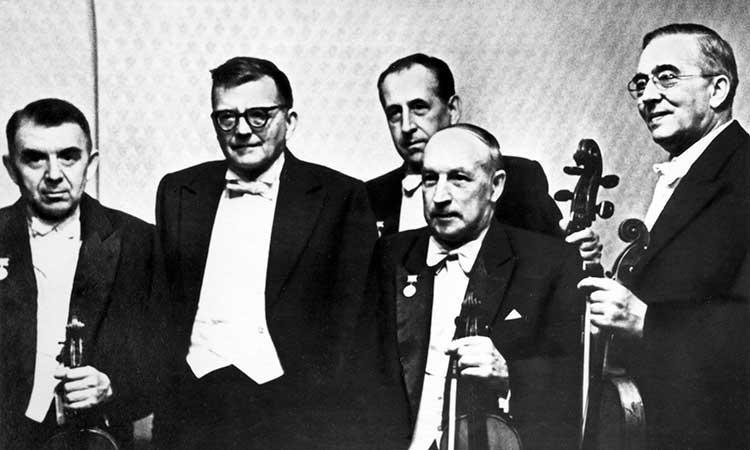
Shostakovich (seen above with the Beethoven Quartet) is renowned for the range of his symphonic work. He completed his first symphony in 1926 and his final symphony (there were also fifteen) was completed in 1971. He worked under the Soviet system and after early official recognition often fell out of favour with the Communist regime including denunciation during the Stalin era. The quartets were written over the period 1938-1974 and are often said to reveal a more personal side of Shostakovich in a way that his symphonies, which were subject to greater scrutiny by the Soviet authorities, don’t. One shouldn’t overstretch this, but there is certainly a deep sense of his own voice in the quartets.
There are a number of recordings of the complete cycle of quartets and amongst the most cited are those by the Emerson String Quartet, the Beethoven Quartetand the Borodin Quartet. All are worth your time – the Emersons (recorded before live audiences) being a good place to start:
Meanwhile the Beethovens are of significant interest because of the special relationship they had with the composer (they premiered most of the quartets):
I have a soft spot for the Borodins, who provided my introduction to the quartets (I still have the brilliantly designed box set of recordings from 1978-1983 reissued in 2006 by the Russian Мелодия label)
Wendy Lesser writes that Shostakovich always knew how his music should sound and her book contains a wonderful story from Valentin Berlinsky, cellist of the Borodin Quartet, concerning one of the quartets that illustrates this perfectly. Recalling preparing for a performance of the Third Quartet in the company of Shostakovich some years after its premiere, Berlinsky states:
“I said…’we’ve given it some thought…It seems to us that pizzicato [rather than arco] sounds better here.’
‘Yes, yes,’ he hastily interrupted, pizzicato is much better, but please play arco all the same.'”
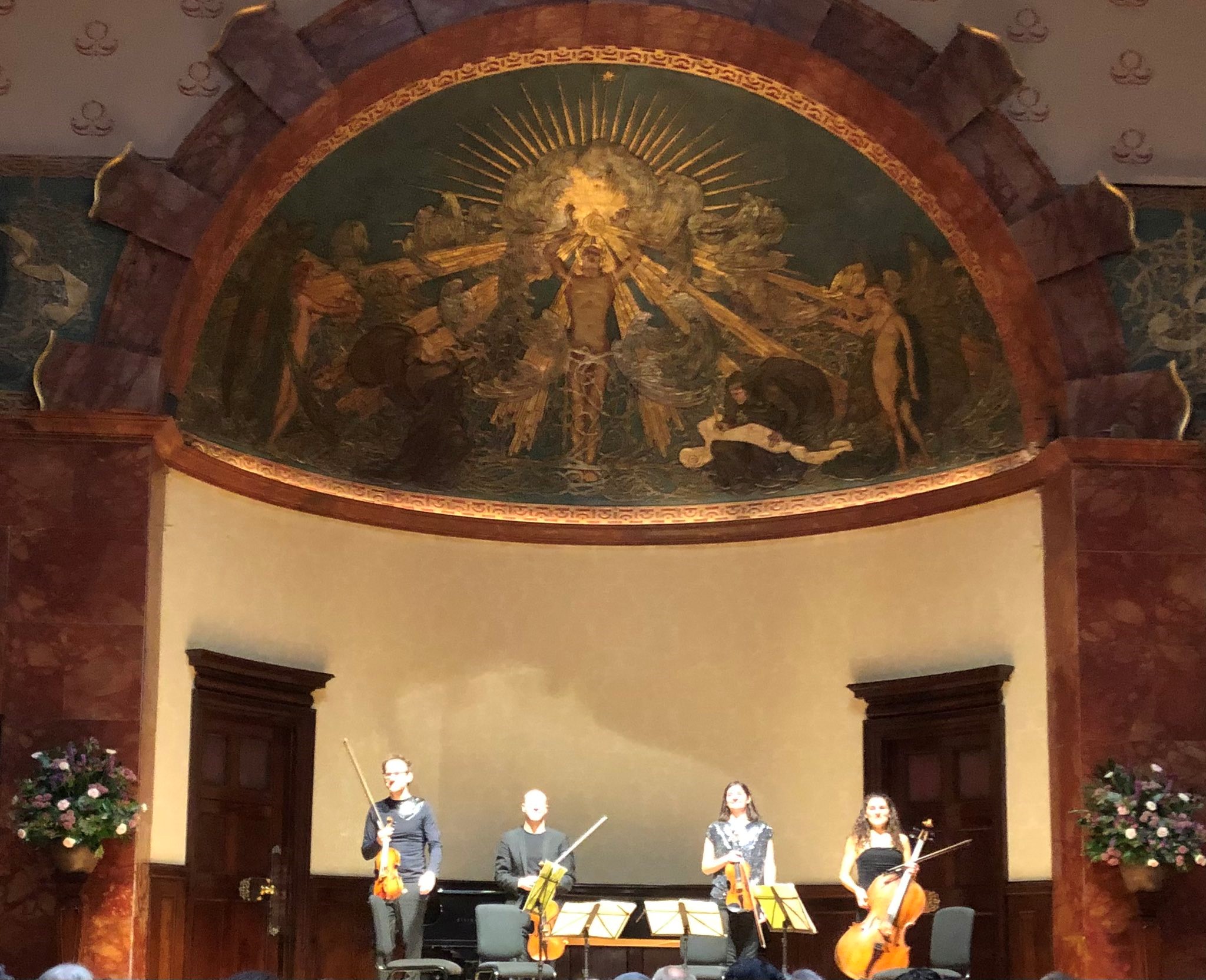
Of course, each of the quartets can be appreciated as an individual piece of music in its own right. But there is also something about hearing them played in one chronological series that gives something of a narrative thread. Lesser also writes of the “vital power” of Shostakovich’s quartets in live performance “that makes any interpretation seem incomplete until it is played before an audience”. Which brings me to the incredible feat that was the Carducci String Quartet – Matthew Denton (violin), Michelle Fleming (violin), Eoin Schmidt-Martin (viola) and Emma Denton (cello) – performing the full cycle of all fifteen quartets in chronological order in five magnificent concerts over two days on the weekend of 22-23 January 2022 at London’s Wigmore Hall.
Total admiration must go to the Carduccis for the dedication and application sustained over the two days and evident from the very first concert starting at 11:30 in the morning on the Saturday. Comprising of the first four quartets, it was for me probably the pick of the (pretty consistently impressive) bunch. The First Quartet was bright before the opening of the Second Quartet gripped with its bold first movement and a second movement featuring some absolutely yearning and sorrowful first violin. The stabbing ‘forces of war unleashed’ (to cite Shostakovich’s supposedly original subtitle) in the third movement of the Third Quartet was another arresting highlight.
More has been written about the Eighth Quartet than all the others combined and it has acquired a special status not least because, although dedicated ‘to the victims of fascism and war’, it is often considered to be Shostakovich’s memorial to himself, featuring as it does not only quotations from some of his other works, but his famous ‘DSCH’ musical monogram. It ended the second of the concerts with the Carduccis giving full musical and dramatic effect to the fevered second movement and forceful fourth movement.
Indeed, there were times when watching the Carduccis perform was just as gripping as listening to them play. This was the case in the ‘furioso’ second movement of the Tenth Quartet, which was near-exhausting to watch and featured in the third concert of the series which opened Sunday’s proceedings, as did the Eleventh Quartet with a deft dealing of its repetitions.
Picture (c) John Earls
The fourth concert gave particular effect to Shostakovich’s inventiveness showcasing the Twelfth Quartet with its mixing of Schoenberg’s twelve-tone serialism and more familiar harmony as well as the unsettling Thirteenth Quartet with the Carduccis opting to tap the fingerboards of their instruments with their fingers rather than bodies of the instruments with bows for the percussive elements. The Thirteenth Quartet also featured some enthrallingly eerie sliding on the viola as well as a wonderfully dramatic finale.
The final concert comprised of the last two quartets ending with the Fifteenth Quartet. The longest of the quartets it was completed in 1974 when Shostakovich was in hospital having been diagnosed with lung cancer. Its six desolate slow movements give a sense of mortality and the lack of a dedication has led to a notion that Shostakovich may have written it as an unofficial elegy for himself. It was played with appropriate respect and sensitivity, something that was recognised by the sustained silence from the audience following its – and the cycle’s – completion before generous and well-earned applause.
This remarkable series of concerts was a precious reminder of what an exceptional body of work Shostakovich’s string quartets are and how any one of them can stand on its own. But there is definitely something special about hearing them together and the Carducci String Quartet in this unforgettable weekend of concerts demonstrated how both hold true. However, it is the full cycle that I want and what I will be asking for on Desert Island Discs.
John Earls is Director of Research at Unite the Union and tweets at @john_earls
Poulenc Sonata for Clarinet and Bassoon, FP32 (1922); Trio for Oboe, Bassoon and Piano, FP43 (1924-6); Sextet for Wind Quintet and Piano, FP100 (1931-2, rev. 1939-40)
City of Birmingham Symphony Orchestra Members: Marie-Christine Zupancic (flute),Emmet Byrne (oboe), Oliver Janes (clarinet), Nikolaj Henriques (bassoon), Elspeth Dutch (horn), Robert Markham (piano)
CBSO Centre, Birmingham Friday 21 January 2022 2pm
Written by Richard Whitehouse
It made sense to devote a programme in the Centre Stage series – put on by musicians of the City of Birmingham Symphony Orchestra – to the chamber music of Poulenc, which is hardly less representative than those vocal and choral pieces that likewise run throughout his output.
Increasing in size and substance, the three works this afternoon were also a viable overview of the composer’s evolution during the interwar period. The Sonata for Clarinet and Bassoon finds Poulenc teasing out the expressive potential of Stravinsky’s often inscrutable chamber music from the previous decade; its Allegro and Final movements pursuing an agile dialogue whose harmonic astringency is offset by the wistful insouciance of its central ‘Romance’, in which the interplay between Oliver Janes and Nikolaj Henriques was at its most persuasive.
Stravinsky evidently had a direct output into the composition of the Trio for Oboe, Bassoon and Piano which, cut from similar stylistic cloth to the earlier piece, reveals greater emotional range. Not least in the opening movement’s pointed contrast between its wistful introduction and headlong Presto, or the Andante’s haunted charm – here emphasized by plaintive oboe playing from Emmet Byrne – whose ‘vulnerability behind the façade’ is duly swept away by a finale in which the breezy humour of the ballet Les biches comes unmistakably to the fore.
The Sextet cost Poulenc fair effort before reaching definitive form at the start of the Second World War but is arguably his most representative work at that stage. Not least in the way its animated opening Allegro makes a virtue of any imbalance between piano and wind quintet – Robert Markham keeping matters securely grounded – or sheer timbral and textural variety of the Divertissement with piquant contributions from flautist Marie-Christine Zupancic and horn player Elspeth Dutch. Nor was there any lack of verve in a Finale whose recollection of the work’s opening, now suffused with greater pathos, must surely be a comment on the times.
Eloquently realized, it brought to an end an admirable showcase for both music and musicians. Next week sees a no less engaging programme of Kodály and Korngold by the CBSO strings.
Further information on future CBSO Stage concerts can be found here




 Arcana.fm