In Praise of Shostakovich’s String Quartets: The Carducci String Quartet @ Wigmore Hall, London

By John Earls

The string quartets of Dmitri Shostakovich (1906-1977) hold a special place in my heart. At various times they have moved, inspired and consoled me.

Of course, it’s not just me. Wendy Lesser has written an outstanding book about the quartets, Music for Silenced Voices, in which she considers the great Russian composer’s life through the quartets whilst examining the music through a non-musician’s lens.

The quartets have featured amongst the Desert Island Discs selections of castaways as varied as Sheila Hancock, Tariq Ali and Marcus du Sautoy.

Stephen Joseph has written a powerful, honest and compelling essay on the composer, How Shostakovich Changed My Mind, and how his music helped with Joseph’s mental illness, which includes a section on the “exceptional phenomenon” that is the Eighth Quartet.
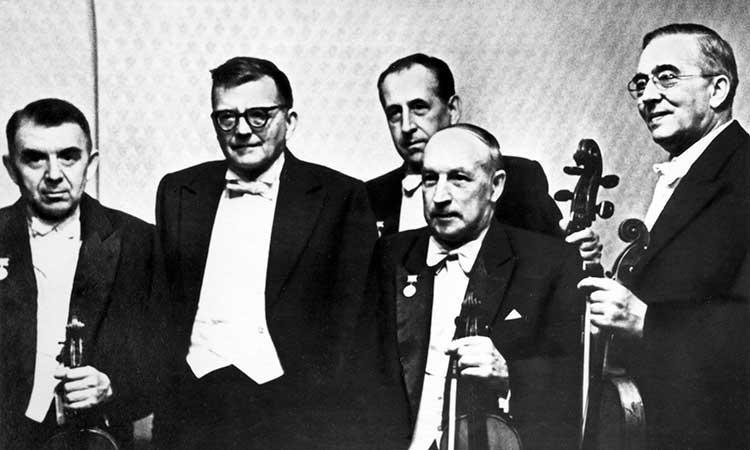
Shostakovich (seen above with the Beethoven Quartet) is renowned for the range of his symphonic work. He completed his first symphony in 1926 and his final symphony (there were also fifteen) was completed in 1971. He worked under the Soviet system and after early official recognition often fell out of favour with the Communist regime including denunciation during the Stalin era. The quartets were written over the period 1938-1974 and are often said to reveal a more personal side of Shostakovich in a way that his symphonies, which were subject to greater scrutiny by the Soviet authorities, don’t. One shouldn’t overstretch this, but there is certainly a deep sense of his own voice in the quartets.

There are a number of recordings of the complete cycle of quartets and amongst the most cited are those by the Emerson String Quartet, the Beethoven Quartet and the Borodin Quartet. All are worth your time – the Emersons (recorded before live audiences) being a good place to start:

Meanwhile the Beethovens are of significant interest because of the special relationship they had with the composer (they premiered most of the quartets):

I have a soft spot for the Borodins, who provided my introduction to the quartets (I still have the brilliantly designed box set of recordings from 1978-1983 reissued in 2006 by the Russian Мелодия label)

Wendy Lesser writes that Shostakovich always knew how his music should sound and her book contains a wonderful story from Valentin Berlinsky, cellist of the Borodin Quartet, concerning one of the  quartets that illustrates this perfectly. Recalling preparing for a performance of the Third Quartet in the company of Shostakovich some years after its premiere, Berlinsky states:

“I said…’we’ve given it some thought…It seems to us that pizzicato [rather than arco] sounds better here.’

‘Yes, yes,’ he hastily interrupted, pizzicato is much better, but please play arco all the same.'”

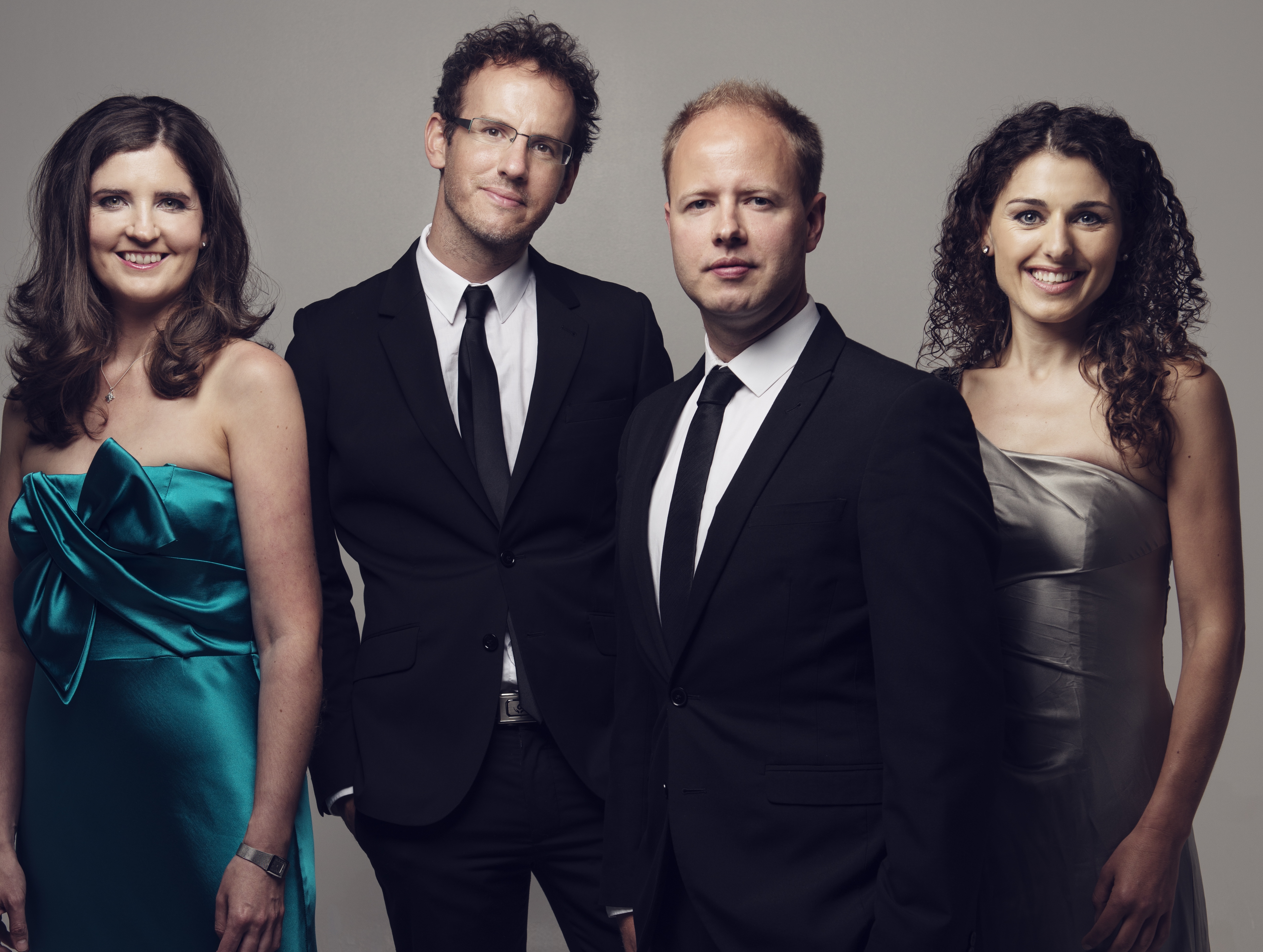
Of course, each of the quartets can be appreciated as an individual piece of music in its own right. But there is also something about hearing them played in one chronological series that gives something of a narrative thread. Lesser also writes of the “vital power” of Shostakovich’s quartets in live performance “that makes any interpretation seem incomplete until it is played before an audience”. Which brings me to the incredible feat that was the Carducci String QuartetMatthew Denton (violin), Michelle Fleming (violin), Eoin Schmidt-Martin (viola) and Emma Denton (cello) – performing the full cycle of all fifteen quartets in chronological order in five magnificent concerts over two days on the weekend of 22-23 January 2022 at London’s Wigmore Hall.

Total admiration must go to the Carduccis for the dedication and application sustained over the two days and evident from the very first concert starting at 11:30 in the morning on the Saturday. Comprising of the first four quartets, it was for me probably the pick of the (pretty consistently impressive) bunch. The First Quartet was bright before the opening of the Second Quartet gripped with its bold first movement and a second movement featuring some absolutely yearning and sorrowful first violin. The stabbing ‘forces of war unleashed’ (to cite Shostakovich’s supposedly original subtitle) in the third movement of the Third Quartet was another arresting highlight.

More has been written about the Eighth Quartet than all the others combined and it has acquired a special status not least because, although dedicated ‘to the victims of fascism and war’, it is often considered to be Shostakovich’s memorial to himself, featuring as it does not only quotations from some of his other works, but his famous ‘DSCH’ musical monogram. It ended the second of the concerts with the Carduccis giving full musical and dramatic effect to the fevered second movement and forceful fourth movement.

Indeed, there were times when watching the Carduccis perform was just as gripping as listening to them play. This was the case in the ‘furioso’ second movement of the Tenth Quartet, which was near-exhausting to watch and featured in the third concert of the series which opened Sunday’s proceedings, as did the Eleventh Quartet with a deft dealing of its repetitions.
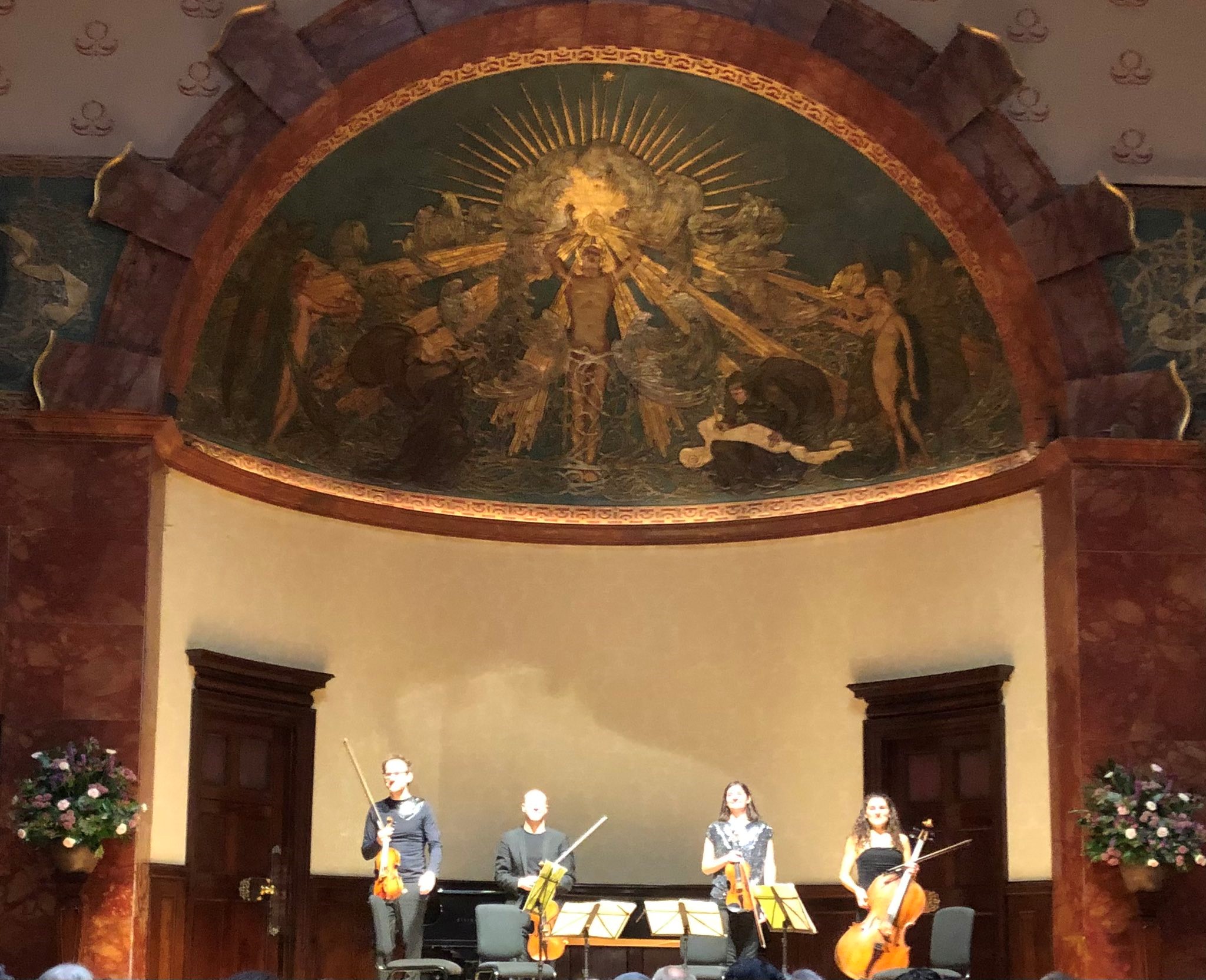
Picture (c) John Earls

The fourth concert gave particular effect to Shostakovich’s inventiveness showcasing the Twelfth Quartet with its mixing of Schoenberg’s twelve-tone serialism and more familiar harmony as well as the unsettling Thirteenth Quartet with the Carduccis opting to tap the fingerboards of their instruments with their fingers rather than bodies of the instruments with bows for the percussive elements. The Thirteenth Quartet also featured some enthrallingly eerie sliding on the viola as well as a wonderfully dramatic finale.

The final concert comprised of the last two quartets ending with the Fifteenth Quartet. The longest of the quartets it was completed in 1974 when Shostakovich was in hospital having been diagnosed with lung cancer. Its six desolate slow movements give a sense of mortality and the lack of a dedication has led to a notion that Shostakovich may have written it as an unofficial elegy for himself. It was played with appropriate respect and sensitivity, something that was recognised by the sustained silence from the audience following its – and the cycle’s – completion before generous and well-earned applause.

This remarkable series of concerts was a precious reminder of what an exceptional body of work Shostakovich’s string quartets are and how any one of them can stand on its own. But there is definitely something special about hearing them together and the Carducci String Quartet in this unforgettable weekend of concerts demonstrated how both hold true. However, it is the full cycle that I want and what I will be asking for on Desert Island Discs.

John Earls is Director of Research at Unite the Union and tweets at @john_earls

posted on 27 January 2022

In concert – CBSO Centre Stage: Poulenc Chamber music

cbso-centre-stage

Poulenc Sonata for Clarinet and Bassoon, FP32 (1922); Trio for Oboe, Bassoon and Piano, FP43 (1924-6); Sextet for Wind Quintet and Piano, FP100 (1931-2, rev. 1939-40)

City of Birmingham Symphony Orchestra Members: Marie-Christine Zupancic (flute),Emmet Byrne (oboe), Oliver Janes (clarinet), Nikolaj Henriques (bassoon), Elspeth Dutch (horn), Robert Markham (piano)

CBSO Centre, Birmingham
Friday 21 January 2022 2pm

Written by Richard Whitehouse

It made sense to devote a programme in the Centre Stage series – put on by musicians of the City of Birmingham Symphony Orchestra – to the chamber music of Poulenc, which is hardly less representative than those vocal and choral pieces that likewise run throughout his output.

Increasing in size and substance, the three works this afternoon were also a viable overview of the composer’s evolution during the interwar period. The Sonata for Clarinet and Bassoon finds Poulenc teasing out the expressive potential of Stravinsky’s often inscrutable chamber music from the previous decade; its Allegro and Final movements pursuing an agile dialogue whose harmonic astringency is offset by the wistful insouciance of its central ‘Romance’, in which the interplay between Oliver Janes and Nikolaj Henriques was at its most persuasive.

Stravinsky evidently had a direct output into the composition of the Trio for Oboe, Bassoon and Piano which, cut from similar stylistic cloth to the earlier piece, reveals greater emotional range. Not least in the opening movement’s pointed contrast between its wistful introduction and headlong Presto, or the Andante’s haunted charm – here emphasized by plaintive oboe playing from Emmet Byrne – whose ‘vulnerability behind the façade’ is duly swept away by a finale in which the breezy humour of the ballet Les biches comes unmistakably to the fore.

The Sextet cost Poulenc fair effort before reaching definitive form at the start of the Second World War but is arguably his most representative work at that stage. Not least in the way its animated opening Allegro makes a virtue of any imbalance between piano and wind quintet – Robert Markham keeping matters securely grounded – or sheer timbral and textural variety of the Divertissement with piquant contributions from flautist Marie-Christine Zupancic and horn player Elspeth Dutch. Nor was there any lack of verve in a Finale whose recollection of the work’s opening, now suffused with greater pathos, must surely be a comment on the times.

Eloquently realized, it brought to an end an admirable showcase for both music and musicians. Next week sees a no less engaging programme of Kodály and Korngold by the CBSO strings.

Further information on future CBSO Stage concerts can be found here

In concert – Echoes/BCMG NEXT @ Centrala

bcmg-next-centrala

Anderson Scherzo (with trains) (1993)
Salonen
Pentatonic Étude (2008)
Birtwistle
Duets for Storab (1983)
Donatoni
Soft (1989)
Finnis
Brother (2012/15)

Musicians from BCMG NEXT

Centrala, Digbeth, Birmingham
Thursday 16 November 2021

Written by Richard Whitehouse

It may not be the most easily locatable arts venue of those within Birmingham’s inner suburbs, but Centrala – launched almost a decade ago as a base for the dissemination and promotion of Central and Easter European cultures – was an appealing space for this latest recital featuring NEXT musicians from Birmingham Contemporary Music Group. The performance area itself might have been compact to a fault, but there no feeling of excessive restriction in the course of what was a varied yet balanced programme of works stretching across almost four decades.

It began in invigorating fashion with a timely revival of Scherzo (with trains) whose premiere at Wigmore Hall was an early success for Julian Anderson – being one of his most engaging works for ensemble and a major contribution to its genre. Drawing inspiration from Thoreau as well as rhythms of high-speed trains, two clarinets (Heather Ryall and George Blakesley), basset horn (Beth Nichol) and bass clarinet (Emily Wilson) unfold an unpredictable discourse; one whose requirements of technique and coordination were met in this assured performance.

A pity that the scheduled account of Anna Thorvaldsdottir’s Spectra was lost through Covid-related issues, but a further hearing for Esa-Pekka Salonen’s Pentatonic Étude was certainly no hardship. This testing paraphrase on a passage from Bartók’s unfinished Viola Concerto puts the soloist through its paces, restating the original in an understated apotheosis realized by Cameron Howe with evident sensitivity. Also reappearing from NEXT’s recent recital at Coventry Cathedral was Harrison Birtwistle’s Duets for Storab. Written when the composer lived on the Inner Hebridean island of Raasay, its inspiration lies in locations each having the name of a Viking prince whose shipwreck, pursuit and death are charted over six evocative pieces. Flautists Rebecca Speller and Leila Hooton were heard in (mainly) whimsical accord.

The music of Franco Donatoni enjoyed a brief vogue here in the decade before his death, but there have been few performances since – so making this revival of Soft the more welcome. Written for the late Harry Sparnaay, the bass clarinet’s doughtiest champion, this tensile and eventful piece feels typical of his late maturity in the way that seemingly detached, and even arbitrary gestures gradually build into a cohesive and cumulative continuity; one in which the expressive possibilities of the instrument are explored intensively though with no little irony.

Heather Ryall proved no mean exponent of this piece, as were Claudia Dehnke and Cameron Howe of Brother by Edmund Finnis. Written while he was composer-in-residence with the London Contemporary Orchestra, its four movements chart a gradually elaborating interplay between violin and viola, evolving from the meditative and incremental to the energetic and demonstrative – without the rapport between these instruments drawing apart in the process. Suffice to add the present performance lacked for nothing in terms of incisiveness or finesse.

It also brought to a close this final BCMG event for 2021. Dates of further performances are being announced in the new year, and it would be a shame if these not to feature a return to Centrala – well worth a visit by anyone who happens to be passing through Birmingham B5.

Further information on the BCMG can be found at their website. For more on NEXT Musicians click here, then on each of the composers names for the websites of Julian Anderson (with an alternative here), Esa-Pekka Salonen, Harrison Birtwistle, Franco Donatoni and Edmund Finnis. Finally for more information on the Centrala venue, click here

Online concert – Steven Isserlis & Connie Shih mark the centenary of Saint-Saëns @ Wigmore Hall

steven-isserlis

Saint-Saëns Cello Sonata no.1 in C minor Op.32 (1872)
Liszt Romance oubliée S132 (1880)
Fauré Romance Op.69 (1894)
Saint-Saëns Romance in F major Op.36 (1874)
Bizet arr. Hollman Carmen fantaisie (not known)
Willaume La noce bretonne Op.14 (pub. 1924)
Holmès arr. Isserlis Noël d’Irlande (1897)
Hahn 2 improvisations sur des airs irlandais (1894 rev. 1911)
Saint-Saëns Cello Sonata no.2 in F major Op.123 (1905)

Steven Isserlis (cello, above), Connie Shih (piano, below)

Wigmore Hall, London
Thursday 16 December 2021

Written by Ben Hogwood

This well-devised program to mark the centenary of the death of Saint-Saëns was put together by cellist Steven Isserlis and his regular partner, pianist Connie Shih. They presented the composer’s two cello sonatas, the first of which was recorded by Isserlis back in 1992, in an intriguing historical context.

There is no room for shrinking violets in the first movement of the Cello Sonata no.1 in C minor Op.32, a relatively early work, and both performers threw themselves headlong into the music. Saint-Saëns was a virtuoso pianist, and on occasion his writing for the instrument is as demanding if not more so than the instrument it is ‘accompanying’. Here however the two were on equal terms, with plenty of cut and thrust in a dramatic first movement. The C minor casting and stormy start draw parallels with Beethoven, and these were built upon in the players’ compelling dialogue. The improvisatory slow movement was ideally poised, with an air of mystery in its central section where the cello was in its lowest register, complemented by twinkling figures from the piano. The Allegro moderato third movement returned us to powerful, passionate music, Isserlis’ double stopping passages immaculately delivered and Shih finding the necessary definition and phrasing in a superbly played piano part.

A full 32 years elapsed between the first sonata and its sequel, the Cello Sonata no.2 in F major Op.123. By this time the 70 year-old composer’s style had developed considerably. It is a substantial piece, running over 35 minutes, and is perhaps less-performed on that basis, not to mention the demands made on the performers. Isserlis and Shih showed what a fine work it is, however, in a performance that was gripping from the off, full of passion but also finding the more elusive statements in the quieter music, where Saint-Saëns could be found writing subtle but far-reaching sleights of harmony.

A joyous opening paragraph surged forward with considerable energy, powering an impressive and flowing first movement, Shih harnessing the power of the piano but continuing to hold a sensitive balance. She led off a capricious scherzo, whose variations were brilliantly characterized, from a limpid third variation (marked Tranquille) to a rippling Molto allegro that followed.

The heart of the piece, however, lies in the substantial Romance, a dreamy slow movement with a beautiful melody and a profound middle section turning towards the minor key. Both played with poise and affection, finding the centre of music the audience could fully lose themselves in. The last movement, which the composer promised ‘will wake anyone who’s slept through the rest of the piece’, was terrific, working from its deceptively innocuous opening phrase to throw off the shackles and end in celebratory mood. Isserlis was typically generous with his expression, with Shih deserving credit for her technical command and shapely melodic phrasing. The octaves towards the end were especially well-handled.

While the two sonatas were the main works of the concert, the complementary pieces were no less involving, providing an ideal foil. Firstly we heard from Saint-Saëns’ close friend Liszt, one of his few works for cello and piano. The Romance oubliée began with a recitative, with beautiful tone in the held notes from the cello, setting the (intense) mood. Then another great friend (and pupil), Fauré – whose Romance uses the whole range of the cello, starting in the mysterious depths and ending in the rarefied upper register. Saint-Saens’ own warm-hearted Romance in F major Op.36 was affectionately recounted, before the showstopping Carmen fantasie from Saint-Saëns’ friend and regular recital partner, Joseph Hollman. This was a showstopper, with quickfire dances and a pizzicato Habanera, stylishly done by Isserlis.

Shorter pieces followed from Gabriel Willaume, Reynaldo Hahn and Augusta Holmès, each with fascinating connections to the composer. Willaume’s La noce bretonne (The Breton wedding) was rather moving, its distant drone growing in feeling and power before passing by and disappearing again. Hahn’s 2 improvisations were songlike and affecting in their simplicity, a soulful Willow Tree especially, before an arrangement by Isserlis of Holmès song Noël d’Irlande, its pentatonic language easy to absorb.

This was a very fine concert, with playing of an exceptionally high standard by both artists, but crucially with the involvement that told us how Saint-Saëns, in particular, could combine virtuosity with deep feeling, contrary to some opinion. It is hard to imagine how his centenary could have been better observed – and it ended with a perfectly weighted account of The Swan, one of his most famous shorter pieces – taken as it is from Carnival of the Animals. Isserlis needed only to introduce it with a wave of the hand.

You can watch this concert on the Wigmore Hall website for the next 28 days – and you can hear most of the music played by Isserlis and Shih on the Spotify playlist below, with some of the recordings drawn from their recent album Music from Proust’s Salons. That disc can be heard (and purchased) from the BIS website

On record – Peter Dickinson: Lockdown Blues (Somm Recordings)

lockdown-blues

Barber (arr. Dickinson) Canzonetta Op. 48 (1977-8)*
Berkeley
Andante Op.23/6 (1945)
Cage
In a Landscape (1948)
Dickinson
Blue Rose (1978); Freda’s Blues (2016); Lockdown Blues (2020)
Ellington (arr. Dickinson)
Twelve Melodies (1932-43)*
Gershwin
Three-Quarter Blues (c1925); Who Cares? (1931)
Goossens
Lament for a Departed Doll Op.18/10 (1917)
Lambert
Elegiac Blues (1927)
MacDowell
To a Wild Rose Op.51/1 (1896)
Poulenc
Pastourelle IFP69 (1927); Bal fantôme IFP64/4 (c1934)
Satie
Trois Gymnopédies IES26 (1888); Trois Gnossiennes IES24 Nos.1-3 (1889-90)

Peter Dickinson (piano)

SOMM Recordings SOMMCD0644 [68’24”]

Producer & Engineer Peter Newble

Recorded 16 and 17 April 2021 at Potton Hall, Westleton, Suffolk. * indicates first recordings

Written by Richard Whitehouse

What’s the story?

Peter Dickinson here turns the third phase of lockdown to his – and our – advantage with this collection of piano music touching on the blues and jazz which have long been a mainstay of his careers as performer and composer, and which also includes two notable first recordings.

What’s the music like?

The programme commences with the pensive sadness of Dickinson’s Freda’s Blues, written in memory of the widow of Lennox Berkeley, continuing with a poised and refreshingly non-mawkish take on MacDowell’s perennial To a Wild Rose – its blues and rag idioms made the basis of Dickinson’s Blue Rose. The empathetic feel of Lambert’s Elegiac Blues in memory of singer Florence Mills is affectingly caught, while Dickinson’s marrying of blues and Bach in Lockdown Blues recalls George Shearing’s pioneering such fusions. After the drollery of Poulenc’s Bal fantôme, Dickinson’s reworking of the Canzonetta which Barber intended for his unrealized Oboe Concerto proves a focal-point in its searching pathos. Such a quality is also to the fore in Berkeley’s limpid Andante, as is the alluring charm of Gershwin’s Three-Quarter Blues – and to which the whimsy of Poulenc’s Pastourelle provides a pertinent foil.

Whether as solo pianist or in recital with his sister Meriel, Dickinson has been unstinting in his advocacy of Satie and his reading of the original Gnossiennes (not those three published decades after the composer’s death) lacks for nothing in perception. Such is equally the case when, after the insinuating charm of Gershwin’s Who Cares? then the wistful eloquence of Goossens’s Lament for a Departed Doll, he renders Satie’s evergreen Gymnopédies with an objectivity that not unreasonably plays down the mystical aura often attributed to this music.

Perhaps the highlight here is Twelve Melodies that Dickinson has arranged from Ellington’s big-band numbers in what proved a veritable ‘golden age’ for such music and not previously recorded in this guise. Picking out a selection might hardly seem necessary, but the yearning of Solitude, eloquence of Lost in Meditation, questing emotions of Azure then the expressive warmth of Mood Indigo stand out in a sequence which concludes with the phlegmatic charm of Day-Dream then haunting atmosphere of Prelude to a Kiss. Moreover, Dickinson has one final trick up his sleeve with an elegant rendering of Cage’s In a Landscape – music in which this most recalcitrant of composers comes closest to his beloved Satie with its ineffable grace.

Does it all work?

Very much so, thanks not merely to the range of music covered but also through Dickinson’s insight. Into his 87th year when these recordings were made, his technique remains as fluent as his understanding and enjoyment are audible. Long able to accommodate the populist and the experimental within his own music, such inclusiveness extends to the idiomatic aspect of his interpretation and the deftness of his touch. Surely nothing can now prevent the Ellington set being taken up by pianists everywhere, with the numerous shorter pieces ideal as encores.

Is it recommended?

Indeed. The piano sound has a naturalness and clarity ideal for this music, while few writers other than Dickinson would be equally aware of technical details and chart standings. Here is looking forward to further releases by this always resourceful pianist in his ‘Indian summer’.

Listen & Buy

You can discover more about this release and listen to clips at the SOMM Recordings website, where you can also purchase the recording. For more information on Peter Dickinson, click here.