Wigmore Mondays – Hagen Quartet play Schubert’s last quartet

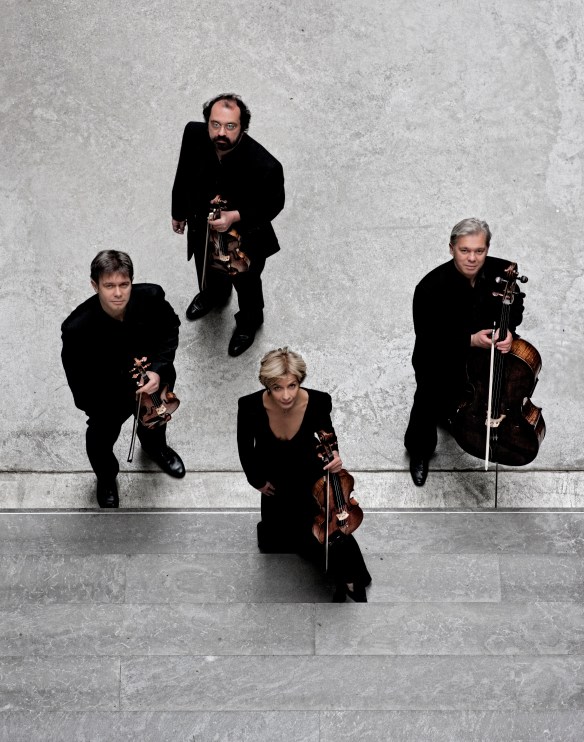
Lukas Hagen, Rainer Schmidt, Veronika Hagen, Clemens Hagen (f.l.t.r)

Lukas Hagen, Rainer Schmidt, Veronika Hagen, Clemens Hagen (f.l.t.r)

Hagen Quartet Photo (c) Harald Hoffmann

For this performance, Veronika Hagen had to miss out with a shoulder injury. The line-up was therefore Lukas Hagen and Rainer Schmidt (violins), Iris Hagen-Juda (viola) and Clemens Hagen (cello)

Wigmore Hall, London, 18 April 2016

written by Ben Hogwood

Audio (open in a new window)

http://www.bbc.co.uk/programmes/b0770ms1

Available until 17 May

What’s the music?

Schubert – String Quartet in G major, D887 (1826) (55 minutes)

Spotify

In case you cannot hear the broadcast, the Hagen Quartet’s recording of this work can be accessed through Spotify on the playlist below:

About the music

Schubert’s last quartet remains shrouded in secrecy. It is however another illustration of the ‘late’ Schubert’s ability to write at tremendous speed. ‘Late’ Schubert of course is the composer in his very late twenties, dogged by illness but still able to write a large string quartet such as this in a mere ten days.

He did not hear it in his lifetime, for the first performance did not take place until 1850 in Vienna – at which point the audience will no doubt have been surprised to note that the first movement, clocking in at well over 20 minutes, is the size of many Haydn quartets. It is classic late Schubert, finding its own sweet time but containing some extraordinary music of poignancy and depth.

It eclipses in size Schubert’s previous biggest quartets, known as the Rosamunde and Death and the Maiden respectively, but it goes further in exploring Schubert’s near-obsession with the conflict of major and minor mentality. The piece is listed as being in G major but often spends time in the minor, creating an exquisite tension resolved only in the final moments.

Performance verdict

Quite simply an outstanding performance from a quartet wholly inside the music. The Hagen Quartet kept extremely concentrated levels of performance throughout a gripping drama that took hold of the listener from the first moment and did not let them go.

The tension of the first movement never let up, its major-minor arguments sustained at an impressive level of intensity, but the second movement introduced more raw emotion in the form of Clemens Hagen’s yearning cello solo. The bubbling scherzo gave a little respite but in the finale the group restored Schubert’s tense arguments, never allowing one to dominate, holding the conflict firm.

They also reminded listeners of just how expansive Schubert’s quartet-writing had become, to the extent that some passages sound like a small string orchestra rather than four players. That the Hagens managed to do this without full-time viola player Veronika

What should I listen out for?

2:27 – the quartet begins and immediately sets out the idea that will give it extreme tension over the next 45 minutes. Here – and seemingly throughout – the music alternates between major (the very beginning) and minor (2:32), the listener torn between happy and sad and never quite sure which is which.

A certain amount of piece descends with the first theme proper from the violin at 3:09, given over hushed tremolos in the other three instruments.

At 6:36 the cello takes over with a beautiful theme, if somewhat hesitantly written in by Schubert. Then at 8:40 the quartet observe Schubert’s instruction to repeat the music from the beginning. From 14:58 the quartet slow the pace a little, giving the main tune a more graceful impression, but the tense movement in the other instruments takes over once again.

At 18:23 a serene home key is reached, and then the music heads into a more emphatic passage, closing out one of the longest single movements in the quartet repertoire (22 minutes)

26:17 – the second movement, marked Andante un poco moto, is a beautiful though rather sorrowful piece of music, introduced by a sparse chord and then passed over to the cello for a reflective, songful tune. This completely dominates the music, though there are two stormy interruptions (28:01 and (31:41), where Schubert feels more unhinged.

However at 34:11 the music shifts to the major, and for a brief moment all cares are forgotten as a shaft of sunlight comes through.

37:17 – the third movement is a Scherzo, and its scurrying main theme again sets the mood for the whole movement. It acts like the wind picking up stray leaves and whirling them around…before they are set down in the ‘trio’ section, beginning at 40:33, which features a charming melody from the cello which is almost suitable for the stage. This is taken up by the violins. The scherzo section returns in its entirety at 42:55.

45:25 – the last movement reinstates the conflict between major key and minor key, and holds it the whole way through til the end. It starts with the nervy tune, and the backwards and forwards continues in music of a distinctly wary energy. At 46:36 the violin introduces another prominent theme, this one more obviously happy in the major key. Then at 49:36 another melody asserts itself, this one more earthbound and like a hymn.

At 50:24 we hear the main idea of the last movement once again…through until at 55:16, when the hymn-like tune is more profound. The music then arrives at a final, massive two part cadence – completed at 57:20.

Further listening

How to follow one of the biggest works in string quartet literature? Well I’ve tried to go for a mixture of big and small in the additions to the playlist. For small-scale, you can enjoy another Schubert movement for string quartet, the brilliant, self-contained Quartettsatz, as it’s known. On a bigger scale, Schubert’s quartet is often compared and contrasted with his Symphony no.9, known as the Great – and that is noted below:

Wigmore Mondays – Britten and Auden from Robin Tritschler & Gary Matthewman

robin-tritschler

Robin Tritschler (tenor, above), Gary Matthewman (piano)

Wigmore Hall, London, 4 April 2016

written by Ben Hogwood

Audio (open in a new window)

http://www.bbc.co.uk/programmes/b074zd45

Available until 4 May

Britten To lie flat on the back; Fish in the unruffled lakes; Berkeley Night covers up the rigid land (1939); Underneath the abject willow (1941); Berkeley Lay your sleeping head, my love (1937), Britten: When you’re feeling like expressing your affection (17 minutes)

Trad, arr. Britten The Jolly Miller (1946), The Ash Grove (1941), The Salley Gardens (1940), The Bonny Earl O’ Moray (1940); The Foggy, Foggy Dew (1942) (12 minutes)

Tippett 3 Songs for Ariel (1961) (5 minutes)

Britten On This Island, Op.11 (1937) (14 minutes)

Spotify

If you cannot access the concert, the below Spotify playlist contains all the songs. Robin Tritschler has yet to record these, but they are given here in versions from Philip Langridge:

About the music

Both the personality and the poetry of W.H. Auden were a revelation to the young Benjamin Britten when he was living in New York…and not just Britten either, for Lennox Berkeley also fell briefly under the poet’s spell.

His unique and highly descriptive way with the English language was a perfect foil for song composers such as Britten and Berkeley in the late 1930s and early 1940s, and here are some choice settings that use the piano as well as the verse to paint vivid pictures.

A selection of Britten’s folksong settings follow, with familiar tunes in songs such as The Ash Grove and The Foggy, Foggy Dew given new clothes from Britten.

The Shakespeare 400th celebrations are marked with the music of Sir Michael Tippett, all too infrequently performed these days. His 3 Songs for Ariel are brief but concentrated miniatures.

Finally Britten’s first published collection of songs, On This Island, is a quintet of Auden settings, not as closely linked as subsequent song cycles such as the Serenade for tenor, horn and strings or Winter Words, but showing his increasing prowess as a song composer.

Performance verdict

Robin Tritschler is a natural in the music of Britten, and clearly enjoyed the nuances of Auden’s poetry as he sang these songs. With Gary Matthewman an excellent, attentive accompanist he caught the tension of this period in Britten’s life, where the young composer was trying to find his feet but also feeling the pressure of being a member of Auden’s ‘circle’.

Tritschler sings with great clarity – the words are always easy to hear – and Matthewman matches his ear for detail with some virtuosic piano playing that somehow sounds effortless.

What should I listen out for?

W.H. Auden selection

1:59 – Britten To lie flat on the back

4:27 – Britten Fish in the unruffled lakes – an incredibly vivid picture of the water issues forth from the piano, followed with an oblique melody that is somehow memorable, fitting Auden’s poetry perfectly. The twinkling right hand of the piano finishes the song.

6:59 – Berkeley Night covers up the rigid land

9:38 – Britten Underneath the abject willow – a poem of Auden’s that again has very pictorial references that Britten delights in referring to in his piano part. A bracing main part leads to a softer, shadowy central section, before the bracing theme returns (10:44)

11:33 – Berkeley Lay your sleeping head, my love – a soft lulling to sleep from the piano chords that toll softly, before a caring and rather romantic vocal is revealed. From around 14:40 a powerful climax is reached.

17:10 – Britten When you’re feeling like expressing your affection – a humorous advert for using the telephone that is also quite affecting personally.

Trad, arr Britten

19:49 The Jolly Miller (from Hullah’s song-book) Britten’s ability to paint a picture through his piano accompaniments is put to especially vivid use here, the waters swirling rather ominously around the miller. The constant clash of notes gives the setting a rather darker air, as the idea of the ‘jolly miller’ is given a twist by the final line, ‘I care for nobody, no not I, if nobody cares for me’.

22:04 The Ash Grove (Trad) A deceptively simple beauty. The graceful melody gets the ideal response from Britten here, as he uses one of his favourite musical forms – the canon – to keep the melody on the piano running at a distance of half a bar behind the voice. The graceful but slightly watery piano part sets up a mood of reflection, until later in the song when voice and piano part company, at which point the piano heads into a completely different key. Britten’s genius is fully at work here, and The Ash Grove becomes less folk song, more English ‘Lied’. It is a strangely unsettling song.

24:30 The Salley Gardens (W.B. Yeats) A simple, yearning song that makes the most of its beautiful melody. There is a deep sense of longing in the harmonies Britten chooses to go with the tune here, and he achieves this as early as possible in the piano introduction, despite the words remaining largely positive until the revelation at the end that ‘now I am full of tears’.

27:08 The Bonny Earl O’Moray (Trad) Britten’s setting is a regal funeral march, an invitation for the singer to completely let rip against a piano accompaniment that has grand pretensions too. He moves between the major and minor key rather like Schubert used to do, keeping the listener guessing until the downcast end in the minor.

29:12 The foggy, foggy dew (Trad) Britten’s piano is appropriately cheeky, offering a nod and a wink to the listener outside of its Schubert influence, and it’s a memorable tune that sticks in the head for a while after listening.

Tippett (words by Shakespeare)

33:11 Come unto those yellow sands Tippett uses a florid vocal line here, a direct influence from Purcell. The words are clear, the piano accompaniment fast moving – and at the end the tenor evokes a dog barking

35:08 Full fathom five A solemn song with Tippett’s imagery of the ‘ding dong bell’ striking both in the vocal and piano lines.

36:46 Where the bee sucks Quite a jumpy setting this, with Tippett’s jaunty, staccato piano introduction finding a match in the tenor’s line.

Britten – On This Island (W.H. Auden)

39:38 Let the florid music praise! A grand opening to the collection, the tenor’s declamation matched by a busy, regal piano line. The mood turns, however, into a more carefully considered and slightly sorrowful song.

43:07 Now the leaves are falling fast The detached piano figures reflect the tension in this song. interpreted by Humphrey Carpenter as laced with sexual frustration. Carpenter’s commentary on this period of Britten’s life is thoroughly engaging, bringing through the tensions of grief versus the true beginning of the composer’s adulthood.

45:12 Seascape A more agile song, this, but a restless one too – perhaps because of its evocation of the rising and falling tide in the piano part.

47:28 Nocturne The finest song of the five, where Britten’s simplicity wins through – as does Auden’s poetry, talking of ‘night’s caressing grip’. This is a very moving song, the slow tolling of the piano enhancing its impact – and reminding us that it is a lament for Britten’s recently departed friend, Peter Burra.

51:38 As it is, plenty A typically ‘smart’ Auden poem that gets a similar response from Britten. The piano part is like pointed footsteps, until gradually the celebratory mood of the first song in the collection asserts itself towards the end.

Encore

54:27 Fishing by Arthur Oldham, Britten’s only pupil on his return to England from America. Even in the incredibly brief 40 seconds of this song, taken from the Five Chinese Lyrics, you get a sense of the influence!

Further listening

English song is a maligned but very enjoyable musical area – and arguably the best people to take us through it are the tenor Ian Bostridge and pianist Julius Drake. Here is their album The English Songbook:

Wigmore Mondays – English Songs with Marcus Farnsworth & Joseph Middleton

farnsworth-middleton

Marcus Farnsworth (baritone), Joseph Middleton (piano)

Wigmore Hall, London, 28 March 2016

written by Ben Hogwood

Audio (open in a new window)

http://www.bbc.co.uk/programmes/b074zd45

Available until 27 April

What’s the music?

Purcell, arr. Britten – Music for a while; Fairest Isle (1945); Not all my torments (1943); Evening Hymn (1945) (13 minutes)

Ireland: Sea Fever; If there were dreams to sell; When I am dead my dearest; The bells of San Marie (9 minutes)

Finzi: Let us Garlands Bring (1929-1942) (15 minutes)

Trad, arr. Britten: The Salley Gardens (1940); Sally in our Alley (1959); The Plough Boy (1945) (9 minutes)

Spotify

Unfortunately not all the music performed is available on Spotify. There is however a playlist containing as many of the English songs performed as I could find:

About the music

A far-reaching program of English song, with old and new united through the thread of arrangements by Benjamin Britten – and in the middle some of the best early 20th century vocal writing from England.

Britten ‘realized’ a total of 42 vocal works by Purcell for voice and piano. That effectively means he gave them a new set of clothes, providing a new piano part for concert performance. This was done to give his recitals with Peter Pears more options, to remind their audience of Purcell’s standing, and for Britten to express his sheer admiration of the composer in musical form. These four examples illustrate how he was able to do this while keeping the essential mood of the Purcell originals.

Meanwhile in the 1930s Britten had already set out his position on folksongs. He was averse to Vaughan Williams’ treatment of them – in accordance with his teacher Frank Bridge – but aligned himself more readily with figures like Moeran, with whom he spent some time playing folksong arrangements, and Percy Grainger, who he and Peter Pears greatly admired. These three selections represent some of his best-loved arrangements.

The 400th anniversary of William Shakespeare’s death is marked by Gerald Finzi’s song cycle Let us Garlands Bring, a cycle of five songs the composer dedicated to Vaughan Williams. Finzi eventually arranged them for baritone and string orchestra, but this is the original version.

John Ireland, meanwhile, was a restless composer prominent in the early decades of the 20th century. His songs are an important part of his output, as well as chamber music, bittersweet orchestral music and a wonderful piano output containing some delectable miniatures. The vocal selection here includes arguably his best-loved song, Sea Fever.

Performance verdict

Marcus Farnsworth stepped in at the last minute to give this concert, and it seems to have been a winner. Arcana was not in the hall but his ability to stick with the original program was impressive, and the selection of English song is a clever and logical one.

Of this selection it is perhaps the Finzi that stands out as the most rewarding, a satisfying and extremely enjoyable cycle, but the Ireland songs – as always – leave a haunting impression.

Britten’s mining of his country’s musical archive for his own performing means is also very interesting to hear, and Farnsworth sings his arrangements with great clarity and poise. Joseph Middleton is a most able pianist alongside.

What should I listen out for?

Purcell, realized Britten

1:43 – Music for a While (words by John Dryden) It can take a little while to adjust to the idea of hearing Purcell’s music through Britten’s eyes. While his piano accompaniments are unobtrusive they are still recognisably his in the way the chords are spread. The piano often shadows the vocal line. There is then a real vocal emphasis on the way ‘the snakes drop from her head’ and ‘the whip from out her hands’

5:30 – Fairest Isle (Dryden) A grander setting, this, and the piano takes more of a back seat to the grand vocal line – though it does still offer complementary melodies.

7:45 – If all my torments (Anon) The piano and singer take a noticeably darker colour for this recitative, and the vocal line is almost completely free, the piano supplying just the basic outline of the harmonies. Farnsworth uses very little vibrato to enhance the despair of the song.

10:51 – Evening Hymn (Bishop William Fuller) After the despair of the previous song comes the consoling Evening Hymn, a period of repose at the end of the day. Again the piano is complementary rather than obtrusive, Britten making sure the voice projects very easily. The song ends with an expansive ‘Alleluia’

Ireland

16:44 Sea Fever (John Masefield) – one of Ireland’s most celebrated songs. It is ideal for the baritone, with a rich, resonant beginning and a vivid description of the ‘grey mist on the sea’s face’, at which point the piano goes quiet.

19:00 If there were dreams to sell (Thomas Lovell Beddoes) – Ireland’s music frequently explores the darker side, but this song is one of his most positive. The baritone has a yearning tone for much of the song, though reaches a fervent peak half way through.

20:59 When I am dead my dearest (Christina Rosetti) – despite its title the theme here is one of resignation rather than anything particularly morbid. The upper part of the baritone register is used.

22:54 The bells of San Marie (Masefield) – a slightly wistful but generally positive song, with a lilt to the piano part that gives it a folksy edge.

Finzi

26:37 – Come Away, Come Away, Death (from Twelfth Night) Finzi’s craft as a word setter is immediately evident in this song, which has a distinctive melody and is also laced with romance.

29:48 – Who is Silvia? (from The Two Gentlemen of Verona) – Who is Silvia, what is she? asks the baritone with a full voice. Finzi gives the piano a wandering counterpoint to the vocal melody. It is a celebratory song, especially when the words ‘to her let us garlands bring’ are sung.

31:20 – Fear No More The Heat o’ the Sun (from Cymbeline) – a flatter and lower beginning for the singer here, though this slower song grows gradually. There is a particularly heady piano interlude in the middle, where the harmonies are spicy and chromatic, before the final stanza, where the composer’s musings on death are fully revealed in power and emotion.

36:40 – O Mistress Mine (from Twelfth Night) – a much lighter outlook after Finzi’s contemplation of death, this is a perky song more preoccupied with youthful love.

38:33 – It Was a Lover and His Lass (from As You Like It) – another more energetic, ‘outdoor’ song, where Finzi celebrates the spring along with Shakespeare, in the company of his two lovers.

Trad, arr Britten

42:21 – The Salley Gardens (W.B. Yeats) – this is sung by Marcus Farnsworth at a lower pitch (D) than the one Britten arranged it in (F#) It is a plaintive and rather sad song.

45:01 – Sally in our Alley (Henry Carey) – one of Britten’s earliest folksong arrangements, this is a charming rendition of a romantic song. Farnsworth sings in A major rather than Britten’s arranged D.

49:13 – The Plough Boy (Anon) – the charming and rather quirky setting is an immediate winner thanks to the piano introduction, but the baritone’s clipped delivery is also a winner!

Encore

52:18 – the encore is Britten’s setting of I wonder as I wander (John Jacob Niles) which is an extremely moving experience when heard live. The piano does not play with the vocalist but is alongside, allowing the melody to be heard on its own.

Further listening

English song is a maligned but very enjoyable musical area – and arguably the best people to take us through it are the tenor Ian Bostridge and pianist Julius Drake. Here is their album The English Songbook:
Wigmore Mondays – Esther Yoo & Zhang Zuo play Mendelssohn & Sibelius

esther-yoo

Esther Yoo (violin), Zhang Zuo (piano)

Wigmore Hall, London, 21 March 2016

written by Ben Hogwood

Audio (open in a new window)

http://www.bbc.co.uk/programmes/b07457qx

Available until 20 April

What’s the music?

Bach – Chaconne from the Solo Violin Partita no.2 in D minor, BWV 1004 (c1720) (15 minutes)

Sibelius – Sonatina for violin and piano in E major, Op.80 (1915) (12 minutes)

Glazunov – Grand Adagio from Raymonda (Act 1) (1898) (4 minutes)

Mendelssohn – Violin Sonata in F major (1838) (21 minutes)

Spotify

In case you are not able to hear the radio broadcast, here is a link to a playlist of the music played. Esther Yoo has not recorded any of it in violin and piano form, so substitute versions have been used:

About the music

Sibelius wrote a great deal of music for the violin but other than the famous Violin Concerto, very little of it is heard regularly these days. It is therefore a refreshing change to see the E major Sonatina listed. A relatively short work, it helped Sibelius through a particularly testing time with his finances.

Mendelssohn has a number of parallels with Sibelius where the violin is concerned, writing a famous Violin Concerto that gets played at the expense of pretty much everything else. Once again in this case there are works for violin and piano, and the Violin Sonata chosen for this concert is the most substantial, completed in 1838. For some unexplained reason it was not published in Mendelssohn’s lifetime, and was resurrected by Yehudi Menuhin in the 1950s.

Esther Yoo begins the concert alone, with Bach’s famous Chaconne – taken from his Solo Violin Partita no.2. It is a landmark in solo instrument writing, a tour de force of 64 different versions of the same sequence of chords that Bach develops with ever greater virtuosity.

She complements the Sibelius, meanwhile, with a short piece – an excerpt of a love scene from Glazunov’s ballet Raymonda.

Performance verdict

A refreshing program from Esther Yoo, who has just recorded a very well-received disc of Sibelius and Glazunov with Vladimir Ashkenazy.

It was particularly good to report a rare outing for the Sibelius Sonatina, a piece with energy and fresh invention that definitely sweeps away the cobwebs! Yoo and her musical partner Zhang Zuo (known as ‘Zee-Zee’) gave a performance full of enthusiasm and energy, giving Sibelius’ melodies a real shot in the arm. Prior to this Yoo had greatly impressed with her account of the Bach Chaconne, a deliberately slow and careful start gathering in pace and intensity, taking the fearsome technical challenges in her stride.

Glazunov’s Grand Adagio made a fitting complement to the Sibelius, invested with suitable passion, but the real discovery was the Mendelssohn, a piece of great craftsmanship and, in the slow movement, a depth of feeling unusual even for him. The two performers had great chemistry here and clearly enjoyed their interactions through the faster music, taking time in the slow movement to let the hymn-like passage sing.

An excellent concert concluded with a Korean folksong arranged for violin and piano, played with delicacy and then great gusto!

What should I listen out for?

Bach

1:28 – the violin begins with a grand statement of a chord sequence which it then proceeds to spin out over 64 variations, reaching great intensity in the string crossing around 7:30. The variations are set mostly in the minor key but move to the major at 9:15. Bach gives an enormous variety of colour, speed, attack, repose and musicality, starting relatively slowly but moving to passages of increasing difficulty and intensity, notably the string-crossing passage mentioned above, but this is also one of his most profound pieces of music when interpreted well. The music turns back to the minor key with impressive dramatic effect.

Bach often asks for the violin to employ ‘multiple stopping’; that is, playing more than one note at a time – which means the music can sound as though it is in many parts, despite still being played on the one instrument.

Sibelius

18:49 – a bold start from Sibelius, with the colour from the piano recognisably his. The grand introduction cuts to a quicker theme at 19:30 which suggests the outdoors. The music trips along at quite a pace – as so often Sibelius suggesting quick movement in his music. It also ends with a typical lack of fuss.

22:25 – the thoughtful second movement starts to spread its wings with the emergence of a rather beautiful melody from the violin.

27:03 – a broad melody on the lower register of the violin restores a grand air to the piece, though soon the violin twists upwards. The music gets faster again, returning us to the spirit of the first movement, with energy and grace in equal measure. Up to the end it becomes increasingly breathless, Sibelius throwing in a surprisingly light finish.

Glazunov

31:05 – as you might expect from a declaration of love in a Russian ballet, this is deeply passionate music, with a melody tailor made for the violin. With long phrases and sweeping gestures the music swoons. The violin reaches for the heights around 34:35, before sinking gracefully into a soft coda.

Mendelssohn

36:47 – it is difficult to understand why Mendelssohn did not publish his Violin Sonata when it starts as brightly as it does in this performance. A distinctive theme leads to close interplay between violin and piano. This being Mendelssohn there is a typically busy piano part, but there is a particularly nice, spring-like passage around 40:00 where the music slows and the composer’s lyrical side comes out.

45:38 – the slow movement is an unexpected treat, one of Mendelssohn’s most searching emotionally. It begins with a solemn statement on the piano, joined by the violin in

52:40 – a typically brisk Mendelssohn finale, the violin scampering off with the piano in hot pursuit. Initially there is barely room for breath, right up until a contrasting slower section.

Further listening

Yoo’s new disc would seem the ideal place to go next, containing Glazunov’s Violin Concerto as well as the one by Sibelius. It has been very well received and can be heard here:

Meanwhile you can watch a preview of the disc here:

Wigmore Mondays – Maxim Rysanov & Ashley Wass: Schubert plus

rysanov-wass

Maxim Rysanov (viola), Ashley Wass (piano)

Wigmore Hall, London, 14 March 2016

written by Ben Hogwood

Audio (open in a new window)

http://www.bbc.co.uk/programmes/b0739t8r

Available until 13 April

What’s the music?

Schubert – Sonatina for violin and piano in G minor (arr. Rysanov) (1816) (20 minutes)

Leonid Desyatnikov Wie der Alte Leiermann (1997) (14 minutes)

Sergey Akhunov – Erlkönig (2015) (5 minutes)

Dobrinka Tabakova – Suite in Jazz Style (2008) (15 minutes)

Spotify

Unfortunately most of the music in this concert is not available to stream…but there is a violin version of the Schubert that you can hear on the below playlist – which also contains some recommended listening and the originals of the Schubert songs inspiring the pieces by Desyatnikov and Akhunov:

About the music

This is a concert rather cleverly themed on the music of Schubert. Maxim Rysanov, though still a relatively new performer, has already contributed much to the available repertoire for the viola – and some of these contributions are in the forms of original compositions by Brahms and Schubert.

Schubert wrote three attractive Sonatinas for violin and piano, but their titles are misleading as they were applied posthumously. They are actually quite in depth pieces deserving of a bigger audience, and as Rysanov shows the G minor work transcribes nicely for viola and piano.

Russian composer Leonid Desyatnikov works predominantly in film, but wrote Wie der Alte Leiermann, his take on a song from Schubert’s song cycle Winterreise, for viola and piano. Likewise fellow Russian Sergey Akhunov expanded on Erlkönig, one of the composer’s darkest songs, to create a minimalist spectacular.

Finally Bulgarian composer Donbrinka Tabakova, with whom Rysanov has worked closely on an arrangement of a Schubert sonata for viola and orchestra, contributes a freely formed Suite in Jazz Style, where she looks to combine classical and jazz in a way successfully achieved by the likes of Stravinsky, Milhaud and Duke Ellington to name just a few.

Performance verdict

Maxim Rysanov is without doubt one of the finest viola players around, and he cemented that reputation with a series of powerful and passionate performances at the Wigmore Hall.

He has also gained a reputation for imaginative programming, and that was also in evidence, taking the music of Schubert and projecting it into much newer music and influences. This was a more guarded success, for the piece by Desyatnikov felt too long, despite its dramatic profile, and was rather relentless in its cold and downbeat mood. This does imply it was a successful recasting of the Winterreise song, which is hardly sweetness and light itself, but a little more light amongst the shade would have been welcome.

Akhunov’s Erlkönig was more effective as it had more momentum and rhythmic interest, though this too was starting to test the ear and run thinner on inspiration by the time its five minutes came to a close.

Far more involving was Bulgarian composer Dobrinka Tabakova’s Jazz Suite, for it was more obviously fun, as well as being more immediately emotional. There were some clever syncopations and use of the viola to get some truly unusual sounds, and Rysanov clearly warmed to this, in the company of Ashley Wass’s clear but nicely swung rhythms.

The Schubert with which the two began was very well played and carried an urgent dialogue throughout, reminding us that the three pieces in this form are not trifles, as the Sonatina name implies they should be – they are actually really substantial and memorable works.

What should I listen out for?

Schubert

1:28 – a call to arms to begin (marked Allegro giusto by the composer, which becomes a bit more furtive as the piano takes the lead. This is repeated (2:51) and then developed from 4:14 – before a reprise back in the ‘home’ key at 5:12. Mostly the two instruments are equal partners, though they both become obsessed with the three-note figure that dominates Schubert’s thinking. Rysanov’s arrangement for viola lies relatively comfortably under the fingers.

6:55 – a relaxed Andante forms the slow movement, with a nice and simple theme from the viola. Schubert gives it plenty of space, and the whole movement – though relatively short – has a nice airy profile.

12:57 – the influence of Mozart can be more clearly felt in this brisk Menuetto. You would have to look pretty lively if you were dancing three in a bar! The viola is effective when Rysanov drops down an octave to exploit the lower range (e.g.13:48). A trio section (from 13:59) is nicely poised, before the main theme comes back at 14:54.

15:42 – this sounds more like one of Schubert’s songs, with an offbeat piano accompaniment to the main viola tune. There is a lively secondary tune though, which comes through to dominate – especially when Schubert brings it back in the main key at 19:05, to close what had initially been an uncertain piece in emphatic fashion…or so we thought! He then swings back to the minor key, but ultimately this tune wins through.

Desyatnikov

The inspiration for Desyatnikov’s piece is Schubert’s Der Leiermann, which can be heard here:

23:02 – the harsh tones of the viola’s opening strings evoke the hurdy-gurdy in coarse style. In response the piano line feels very cold, and the two exchange their ideas. Then there is a slow statement from the viola using harmonics () before things get very fraught between the instruments. At 28:43 a new, faster section starts with urgent sounds and a swing to the melody that sounds almost American. In the long closing section, from 33:30, the music’s frosty tone becomes almost devoid of feeling, though some outbursts (34:08) draw vivid parallels with the music of Janáček.

Akhunov

Akhunov’s inspiration is Schubert’s Erlkönig, which can be heard here:

38:48 – a twisted introduction, with plenty of discords, gives way almost immediately to an intriguing development, a pulsating tonal base from the piano and a melodic cell that grows steadily from the viola.

Tabakov

45:35 – this first movement, marked ‘Confident’, starts out with a walking bass in the piano deliberately written to imitate the sound of a plucked bass instrument. Over the top is an airy, improvisatory piece of work from the piano. The pair spar playfully until the viola literally dies away.

49:54 – the second movement is marked ‘Nocturnal’, and treats the viola as though it were a solo jazz singer. After a sultry introduction from the piano the viola comes in with a bluesy tune, moving between the major and minor keys with ease. Tabakova uses some intriguing techniques to vary the sound of the instrument.

56:12 – the third movement has a simple marking – ‘Rhythmic’. It starts almost inaudibly, scratching on the viola, but then the two instruments start trading a syncopated figure. The music has a happy disposition, and both viola and piano dance around each other, the viola becoming ever more expansive in its language. The two are restless bodies right until the end.

Further listening

There is plenty of good music for viola and piano if you look hard enough. Maxim Rysanov has recorded a fair bit of it already – and in a link with the music of this concert, here is an album begun by the Arpeggione Sonata arranged by Dobrinka Tabakova for viola and string orchestra:

Meanwhile you can watch her Suite in Old Style – again with Rysanov – below: