On record – Vaughan Jones & Marcus Price: History of the Salon – Morceaux caractéristiques 1823-1913 (First Hand)

d’Ambrosio Sérénade in D major Op.4 (1897); Aria Op. 22 (1903)
Braga La Serenata (1867 arr. Pollitzer)
Drdla Serenade no.1 in A major (1901)
Godard Canzonetta Op.35/3 (1876, arr. composer)
Granados Oriental Op.37/2 (1890, arr. Jones)
Hollander Mazurek in E major Op.25 (1898)
Laub Canzonetta in B minor Op.12/1 (1884)
Moszkowski Mélodie in F major Op.18/1 (1879, arr. Hermann); Guitarre in G major Op.45/2 (1890, arr. Sarasate)
Paganini Cantabile e Valzer Op.19 (1823)
Raff Méditation in A major Op.75/5 (1859, arr. Hermann); Cavatina in D major Op.85/3 (1862)
F. A. Schubert Bagatelles Op.13 (1860) – nos. 3, 4, 5 (Le désir), no. 9 (L’abeille), no.12 (Barcarola)
Sgambati Serenata napoletana Op.24/2 (1891)
Spohr Barcarole in G major Op.135/1 (1848)
Vecsey Valse triste in C minor (1913)
Zarzycki Mazurkas – no.1 in G major Op.26 (1884); no.2 in E major Op.39 (1894)

Vaughan Jones (violin); Marcus Price (piano)

First Hand Records FHR95 [82’50”]

Producer & Engineer John Croft

Recorded 27, 28 & 30 December 2019, Plumcroft Primary School, London

Written by Richard Whitehouse

What’s the story?

Vaughan Jones continues a productive association with First Hand Records on this generous selection of encores from the golden age of the violin virtuoso, skillfully programmed so as to present composers often regarded as ‘one hit wonders’ in a more rounded and inclusive light.

What’s the music like?

One of the chief attractions is Jones’s bringing together the established with the unfamiliar – so the programme features not only Aleksander Zarzycki’s vibrantly assertive First Mazurka, but also its seldom revived and no less characterful successor. Earliest of those unashamedly public virtuosos, Niccoló Paganini is represented by music of an elegance and finesse by no means foreign to his persona; with the comparable expressive range of Alfredo d’Ambrosio as evident in his lilting Sérénade as in his sombrely musing Aria. Enjoying modest revival, Moritz Moszkowski contributes the languid Mélodie but also the indelible élan of his Guitarre.

Benjamin Godard remains one for whom quantity is not always synonymous with quality, but this arrangement from his Concerto romantique yields a winning insouciance. The inclusion of Joachim Raff’s emotive Cavatina was to be expected, but that of his aptly subtitled Après le coucher du Soleil is an unexpected and affecting pleasure. The name of František Drdla is securely kept alive by the appealing whimsy of his contribution, as is that of Gaetano Braga by the wistful eloquence and finely drawn contrast of his Angel’s Serenade. Whether or not his name is wholly responsible for his latter-day obscurity, Franz Anton (François) Schubert was evidently a skillful composer – hence these five out of 12 Bagatelles such as reference a subtle range of moods on route to the animated L’abeille then the ruminative Barcarola.

The stealthy virtuosity evinced by Giovanni Sgambati sounds anything but mindless, while the taciturn charm conjured by Ferdinand Laub makes plain why his musicianship was held in such high esteem by Tchaikovsky. The incisive wit and technical agility of Benoit (Benno) Hollander is everywhere apparent, as too is the winsome and (at least as rendered here) never unduly saccharine charm of Louis Spohr. Nor does the ‘heart on sleeve’ immediacy of Franz von Vecsey fall victim to false sentiment, whereas the second (and not necessarily the most immediately appealing) out of those dozen pieces that comprise Enrique Granados’s Danzas españolas brings the whole programme to a warmly and thoughtfully understated conclusion.

Does it all work?

Yes, and not only on account of Vaughan Jones’s astute sense of programming. Throughout this lengthy yet always engaging miscellany, his playing eschews mere showiness in favour of a discipline and focus which ensure that even the most obvious ‘war-horses’ emerge newly minted. It also helps when the pianism of Marcus Price is consistently attentive to the subtle variations of mood and expression as are contained herein, while the balance between violin and piano could hardly be improved upon in terms of its definition and overall perspective.

Is it recommended?

Indeed. Special praise for a booklet which features the violinist’s finely researched notes and is designed to resemble a programme as might have been encountered at a recital during this period. Clearly FHR’s production values are no less conscientious than Jones’s musicianship.

Listen

Buy

You can discover more about this release at the First Hand Records website, where you can also purchase the recording.
On record – Aurora Orchestra / Nicholas Collon: Music of the Spheres (DG)

Pekka Kuusisto (violin), Iestyn Davies (countertenor), Sam Swallow (vocalist), Aurora Orchestra / Nicholas Collon

Mozart Symphony no.41 in C major K551 ‘Jupiter’ (1788)
Richter Journey (CP1919) (2019)
Dowland arr. Muhly Time Stands Still (1603)
Adès Violin Concerto ‘Concentric Paths’ (2005)
Bowie arr. John Barber Life on Mars? (1971)

Deutsche Grammophon 4838228 [69′]

Recorded 9 June 2019, Maida Vale Studio 1, London

Written by Ben Hogwood

What’s the story?

Only the Aurora Orchestra could put together an album running from Mozart to David Bowie. Yet as we have seen from their previous themed releases such as Insomnia and Road Trip, there are no gimmicks involved in their musical choices and a clear theme runs through the programming.

Music of the Spheres is no exception, beginning with Mozart’s Jupiter symphony before music from Max Richter (Journey), Dowland via Muhly (Time Stands Still) and the Violin Concerto of Thomas Adès, subtitled Concentric Paths. The soloist here is Pekka Kuusisto, while the Aurora play the Jupiter symphony entirely from memory, as they did in the BBC Proms in 2016.

What’s the music like?

There is something for everyone here. Mozart’s Jupiter symphony is his 41st and final essay in the genre, setting a new bar for the form when it was completed. While the first three movements are particularly fine it is the finale that comes in for the greatest acclamation, for its well-nigh perfect fusion of melody and counterpoint.

Richter’s Journey CP1919, is inspired by and named after the discovery of the first Pulsar star. It fits perfectly onto the tail of the Mozart, running at a slow speed and operating in C minor rather than the earlier piece’s key of C major.

By contrast Adès’ Concentric Paths operates in a wider orbit, the violin soaring at great heights over the compelling orchestral writing, which has in its spiralling strong echoes of the music of Benjamin Britten. As soloist Pekka Kuusisto has described, ‘it’s hyper-emotional music for people in an accelerating world’.

Complementing these instrumental pieces are two songs of identical length but very different form – a serene early 17th century song from Dowland and one of the best-known pop songs of the 20th century. Having heard from Jupiter and CP1919, Sam Swallow asks, to effective arranged accompaniment, is there Life On Mars?

Does it all work?

Pretty much! The Jupiter gets an athletic performance from the Aurora Orchestra – no dallying here, or lingering on expressive notes. That does mean a darkening of the slow movement, and maybe some constricted phrases, but by contrast it means an exciting first movement, a mysterious Menuetto and a lithe finale, busy and brilliantly played.

The Richter is haunting and really effective, its simplicity leaving the orchestra plenty of room to create a remote atmosphere. The songs are great too – Iestyn Davies is the perfect choice for the Dowland, with Nico Muhly’s sensitive orchestration, while Sam Swallow puts his own stamp on Life on Mars? without losing the essence of the original, which is an impressive achievement.

Yet the performance I kept coming back to was Pekka Kuusisto’s white-hot rendering of the Adès. This is terrifically difficult music to play, but he makes it sound easy even at the highest points of the violin range, and the moods range from serenity to power and even anger as the music moves relentlessly forwards. On occasion I have to admit I find Thomas Adès music hard to relate to emotionally, but this is a clear exception and the music digs deep.

Is it recommended?

Yes. The Aurora’s albums are great at bringing music of very different origins together, exposing new elements and old qualities, and it does so again here. Freshly minted Mozart and brilliantly played contemporary works, plus a good deal of imagination. What’s not to love?

Listen

Buy

You can purchase this recording from various digital outlets via the Presto website

Switched On – Bing & Ruth: Species (4AD)

reviewed by Ben Hogwood

What’s the story?

Species is the fourth album from Bing & Ruth, the New York-based project where the ever-present is David Moore. Previous album No Home Of The Mind was largely powered by flowing piano textures, but this time around the outlook is very different. As the cover art implies, the album was made in a hotter, drier climate, and this is reflected in the instrumentation. Moore wrote the music on a Farfisa organ, hooking up with friends playing clarinet (Jeremy Viner) and acoustic bass (Jeff Ratner).

What’s the music like?

This incarnation of Bing & Ruth feels more static than the previous model in terms of its harmonic and melodic movement. Yet it is every bit as compelling, and tracking the development of each track is a little like listening to the earlier Philip Glass of the Dance Pieces.

The colours are immediately appealing as Body in a Room and Badwater Psalm reveal. Time seems suspended in space as compact figures and loops oscillate on the Farfisa, spreading out over long, held pedal notes that support the framework. Moore sets out this deceptively simple material in a way that works really well, bringing out different and intriguing phasing effects from the mellow tones of the organ that prove very pleasing to the ear.

I Had No Dream emits a brighter light as Moore moves to the instrument’s upper register, but in response the short Blood Harmony gives out mellow, sonorous strokes. This prepares the listener for two tracks comprising half the album’s length. Live Forever develops a warm, reassuring loop of consonant harmony, blissfully layered and with beautiful mottled textures. The Pressure of this Water leads straight on with greater movement, its figures dancing in the mind’s eye.

Finally Nearer holds still, its relative lack of moment revealing a heart of greater substance, Moore’s simple bow strokes soft but emotionally penetrating.

Does it all work?

Yes. The longer pieces are the most effective, showing that Moore has really mastered the art of pacing a track that lasts almost a quarter of an hour while keeping it compelling to the listener. It is fascinating tracking the development of the material…but it is equally rewarding to zone out completely and allow the developments to take place in the background and set the mood.

Is it recommended?

Yes. David Moore has opened a fascinating new chapter of Bing & Ruth’s sound by switching to a different keyboard, one that wholly complements the previous piano-based work. Species is both intimate and expansive, so it will prove fascinating to witness it in a live environment – which, COVID-19 permitting, we should be able to do in the UK in December.

Stream

Buy

You can read an interview with David on Arcana in the next few days…and in the meantime enjoy the playlist he put together for us

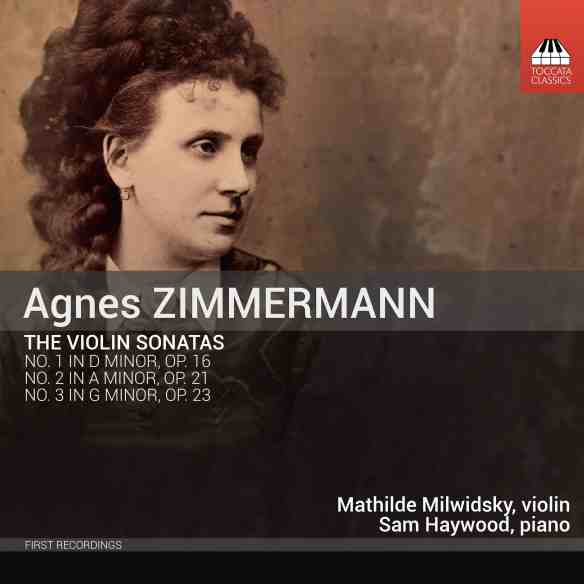
On record – Agnes Zimmermann: The Violin Sonatas (Toccata Classics)

Agnes Zimmermann
Violin Sonata no.1 in D minor Op.16 (1868)
Violin Sonata no.2 in A minor Op.21 (1875)
Violin Sonata no.3 in G minor Op.23 (1879)

Mathilde Milwidsky, violin; Sam Haywood, piano

Toccata Classics TOCC0541 [84’36”]

Producer Michael Ponder
Engineer Adaq Khan

Recorded 6-7 April 2019, 10 November 2019 at Middlesex University, London

Written by Richard Whitehouse

What’s the story?

Toccata Classics continues its not inconsiderable coverage of women composers with this disc of the violin sonatas by Agnes Zimmermann (1947-1925), little recognized as a composer but whose achievements as pianist, teacher and editor were readily acknowledged by her peers.

What’s the music like?

Born in Cologne but largely resident in London, Zimmermann long enjoyed a reputation for her pianism throughout Europe. Her own output is not extensive and mainly from her earlier years, with these three sonatas a notable addition to British music of the mid-Victorian era.

Lasting around 28 minutes, the format of these sonatas is consistent without being predictable. Each begins with a finely proportioned Allegro, the First Sonata being most straightforward in its purposefully contrasted main themes. That of the Second Sonata is more understated, its main themes merging into a seamless continuity whose ominous import is briefly disrupted in the central development. As to the Third Sonata, this commences with greater expansiveness then maintains such deliberation through its intensive development and on to a fatalistic coda.

Each sonata has a Scherzo, placed second in the initial two sonatas. That of the First Sonata brings appealing animation and rhythmic subtlety, not least as regards its warmly ruminative trio. By contrast, that of the Second Sonata has a lively insouciance which is accentuated by some deft syncopation and a notably winsome trio. That of the Third Sonata is placed third (not entirely justifiably) and is itself closer to an intermezzo on account of its halting main theme, to which the trio offers only minimal contrast in its mixture of elegance and pathos.

The slow movements are all designated Andante. That of the First Sonata is an ostensible ‘song without words’ and evinces a distinctly Mendelssohnian poise. Whereas that of the Second Sonata centres on a hymn-like melody that proves capable of no mean fervour as it evolves over the course of music whose direct eloquence never risks becoming cloying. By contrast, that of the Third Sonata (placed third) feels more akin to an intermezzo in its lightness of texture and wistful main theme, not least as it heads towards a subdued close.

As to the Finales, these all tend toward the trenchant and unequivocal. Most notably that of the First Sonata, albeit with a wistful second subject to offset the prevailing impetus. That of the Second Sonata unfolds more stealthily in keeping, with the trajectory of this work taken overall, though the decisiveness of its ending is hardly in doubt. That the Third Sonata needs a finale to balance the weight of its first movement is undoubted and this does not disappoint in its eliding ardency and affection, before an elaborate though not over-wrought apotheosis.

Does it all work?

Yes, in that Zimmermann was essentially a consolidator of the chamber tradition stretching from Beethoven, through Schumann, to Brahms. Her violin sonatas are at least equal to those by such British contemporaries as Parry and Stanford in their conviction and craftsmanship.

Is it recommended?

Indeed. Mathilde Milwidsky is an unfailingly persuasive exponent and astutely partnered by Sam Haywood. Sound is unexceptionally fine, and Peter Fribbins pens a detailed analytical overview. Why the sonatas are featured on CD in reverse order is, however, anyone’s guess.

Listen

Buy

You can discover more about this release at the Toccata Classics website, where you can also purchase the recording.
On record – Nash Ensemble – John Pickard: The Gardener of Aleppo (BIS)

John Pickard
The Gardner of Aleppo (2016)
Daughters of Zion (2016)*
Snowbound (2010)
Serenata Concertata (1984)**
Three Chicken Studies (2008)
The Phagotus of Afranio (1992)
Ghost-Train (2016)

*Susan Bickley (mezzo); **Philippa Davies (flute); Nash Ensemble / Martyn Brabbins

BIS BIS 2461 SACD [79’22”]

Producer / Engineer Simon Fox-Gál

Recorded September 2018 at All Saints’ Church, East Finchley, London

Written by Richard Whitehouse

What’s the story?

BIS continues its coverage of music by John Pickard (b. 1963) with an extensive overview of chamber works surveying more than three decades of creativity, in performances by the Nash Ensemble that do ample justice to this composer’s combative while always accessible music.

What’s the music like?

Earliest is Serenata Concertata, written when Pickard was still an undergraduate and his first paid commission. Essentially a concerto for flute and five instruments, it unfolds continuously from a haunting Cadenza I then a pensive Aria I to the Scherzo-Notturno whose accrued energy carries over into the climactic Cadenza II, before Aria II brings an emotional poise that gradually dies away towards the close. Whatever its passing influences, Pickardian traits are everywhere apparent and the composer was surely right to keep this work in his catalogue.

Philippa Davies makes a fine showing, as does Ursula Leveaux in The Phagotus of Afranio – the title that of a fanciful forerunner of the bassoon, whose Hoffnung-like presence evinces humour and no little pathos in this entertaining ‘capriccio’. Hardly less diverting, the Three Chicken Studies evoke its subjects respectively laying, feeding then fighting in miniatures, as rendered by Gareth Hulse, both winsome and insouciant (and fully deserving of inclusion in Pickard’s catalogue). Alone among these pieces, Snowbound has been previously recorded (Toccata Classics) – the new account being more spacious and more graphic in its depiction of a familiar landscape as rendered unrecognizable through music that cannily emphasizes those darker sonorities of bass clarinet, cello and piano on route to a ‘glacial’ denouement.

The remaining three works followed in the wake of the imposing Fifth Symphony and testify to the variety of Pickard’s approach irrespective of genre or instrumentation. Setting a text by Gavin D’Costa, Daughters of Zion relates the fateful decision of Mary and its consequences in music by turns ominous and plangent – superbly sung by Susan Bickley. No less resonant in emotional impact, The Gardner of Aleppo was inspired by an incident in the Syrian civil war, where a flower-seller continued to ply his wares in the face of heavy bombardment up until his untimely death. Here, too, flute, viola and harp make for a (surprisingly?) tensile combination across its trajectory of evocation, animation and recollection. By comparison, Ghost-Train might appear humorous in its (often graphic) portrayal of the once obligatory fairground ride; as represented by a perpetuum mobile whose stealthy refrain finds contrast with sundry episodes of a more or less grotesque nature, duly culminating in an apotheosis whose sombre equivocation suggests this to be a journey from which there can be no return.

Does it all work?

Yes, given the alacrity with which these musicians respond to music that, for all its textural and harmonic intricacy, conveys that expressive immediacy manifest throughout Pickard’s output. By so doing, moreover, the stylistic consistency of his idiom is no less in evidence.

Is it recommended?

Indeed. Sound is well up to BIS’s customary standards as to clarity and perspective, with the composer’s booklet note typical in its keen observation and wry humour. Further releases of Pickard’s music, not least his first three symphonies, will hopefully follow from this source.

Listen

Buy

You can discover more about this release at the BIS website, where you can also purchase the recording.