On Record – Matteo Generani: Martucci: Piano Works (Naxos)

Martucci
Romanza facile (1889)
Capriccio e Serenata Op.57 (1886)
Sei Pezzi Op.38 (1878)*
Notturno Op.25 ‘Souvenir de Milan’ (1875)*
Minuetto e Tempo di Gavotta Op.55 (1880/88)*
Sonata facile, Op.41 (1878)*
Scherzo in E major Op.53/2 (1880)
Nocturne in G flat major Op.70/1 (1891)
Tarantella Op. 44/5 (1880)
Prima barcarola, Op. 20 (1874)*

Matteo Generani (piano)

Naxos 8.574628 [71’51”] * World premiere recordings
Producer & Engineer Joseph Tesoro

Recorded 25-27 April 2023 at White Recital Hall, James C. Olsen Performing Center, Kansas City, USA

Reviewed by Richard Whitehouse

What’s the story?

Naxos continues its coverage of Giuseppe Martucci (1856-1909) with this selection of piano music, a medium for which the Italian composer wrote extensively but that has tended to be overshadowed by the upsurge of interest in his symphonies, concertos and chamber works.

What’s the music like?

As indicated by Tommaso Manera in his informative booklet notes, Martucci was established as a pianist when barely out of his teens and could have enjoyed an international career had it not been for his attraction to conducting and, most importantly, his determination to promote Austro-German symphonism when it was hardly established in the Italian-speaking territories. Even the piano pieces that enjoyed popularity in his lifetime often did so in transcriptions for orchestra, making the present anthology a viable overview of his achievement in this domain.

What is immediately noticeable about Martucci’s piano music is the relatively short time in which it was written – the 50 or so opus numbers over which it extends equating to 17 years of composing. Certainly, the Prima barcarola yields a melting limpidity redolent of Chopin, while the Notturno affords an evocation of Milan that wears any Lisztian antecedents lightly. More distinctive is the Sonata facile, a study in deftness and understatement which is by no means ‘easy’ and has an appealing humour. More substantial, however, the Six Pieces are not only contrasted within themselves but amount to a cohesive overall sequence (were they ever performed as such?). Highlights are its fourth and fifth pieces, an ebullient La Chasse then a beguiling Sérénade, but the whole sequence is demonstrably more than the sum of its parts.

Martucci’s piano output tended to fall away as the 1880s progressed, but what he did write is worth attention. Hence the capering Minuetto which was partnered almost a decade on by an even more engaging Tempo di Gavotta, or the Scherzo in E which is playful and resourceful by turns. A further set of six pieces is represented only by its final item, but this Tarantella is the most substantial piece here and testament to the increasing sophistication of its composer. Nor is Capriccio e Serenata other than a brace of genre-pieces unified in overall conception. Emerging either side of 1890, the Romanza facile is a compact study in unforced sentiment, whereas the Nocturne in G flat could hardly be further removed from that eponymous piece written some 16 years previously in terms of its harmonic subtlety and textural translucency.

Does it all work?

It does. As a composer for piano, Martucci may not have had the distinctive profile of Busoni (even at a comparable stage in their respective developments) or Sgambati, though the best of what he did write has no lack of character or personality. It is also music that cries out for the level of commitment evident throughout this selection, Matteo Generani audibly enjoying its technical challenges while always aware of that aspiring towards something more ambitious that was to find its outlet in the multi-movement works which crowned Martucci’s maturity.

Is it recommended?

It is. Although this does not survey the extent of Martucci’s piano music, Generani’s selection is an enticing one that will certainly appeal to those with any taste for the byways of musical Romanticism, along with those who have acquired earlier releases of this composer on Naxos.

Listen & Buy

Click on the artist names to read more on pianist Matteo Generani and composer Giuseppe Martucci

Published post no.2,513 – Wednesday 23 April 2025

On Record – Crispin Lewis & Raymond Lewis: Herbert Murrill: The Rediscovered Songs (First Hand Records)

Herbert Murrill
Four Elizabethan Songs (1927-30)
Three Carols (1929)
Self-Portrait (1929)
Trois Poèmes (1930)
Four Pastorals (1936)
The Months of the Year (c1936)
Two Herrick Songs (1938)
In Youth is Pleasure (1942)
Sonatina for Piano (1952) – Andantino

Crispin Lewis (baritone); Raymond Lewis (piano) with Rachel Broadbent (oboe, carols)

First Hand Records FHR161 [55’48’’] All world premiere recordings
English/French texts and English translations included
Producer Emily Baines Engineer John Croft

Recorded 19 & 20 April 2024 at Rosslyn Hill Chapel, Hampstead, London

Reviewed by Richard Whitehouse

What’s the story?

First Hand Records issues this first release devoted to the songs of Herbert Murrill (1909-52), now a largely forgotten though once influential figure on music circles in London and further afield; his pedagogical and administrative skills held in high esteem by a younger generation.

What’s the music like?

Murrill’s death at only 43 brought to its premature end a career which, in addition to a sizable output, involved working at the BBC – latterly as its Head of Music – and, in the earlier war years, intelligence work at Bletchley Park. An unassuming figure who operated within if at a conscious remove from the music establishment of his day, Murrill was widely respected for his professionalism – as is borne out by his own music with its lightness of touch and its deft handling of traits stemming from Stravinsky, Poulenc and neo-Classicism between the wars.

It made sense to open this recital with My Youth is Pleasure, its airy setting of Robert Wever highlighting that acute yet unforced nostalgia such as pervades so many of these songs. The lengthy The Months of the Year sustains itself ably, then a wittily engaging quartet of songs to Elizabethan texts almost inevitably recalls the influence of Peter Warlock. Four Pastorals find Murrill indulging his more lyrical tendencies to appealing effect, notably in a setting of the anonymous text Phillada Flouts Me that unerringly catches its deadpan anguish. Nor is he unwilling to tackle more contemporary writers, witness his Satie-esque response to verse by Jacques Prévert and Robert Desnos; though whether those changes to the former’s poems were considered improvements or just unintentional anomalies is now impossible to decide.

A trio of carols with oboe accompaniment (including a Medieval Scottish translation of verse by Martin Luther) would be a welcome addition to a medium which features little other than Vaughan Williams’s masterly Blake settings. After which, the wryly elegant Arioso from a Piano Sonatina makes one wish the surrounding movements could have been included (there was certainly room in terms of playing time). The brace of songs to texts by Robert Herrick summons a more sustained and eloquent response, as to suggest that Murrill’s music might have explored deeper emotions had he lived. This anthology concludes with Self-Portrait – four settings of his contemporary Geoffrey Dunn which anticipate Betjeman in their dry wit and self-deprecating humour – a very English take, indeed, on matters of existential import.

Does it all work?

Yes, albeit for the most part within its narrowly while precisely defined limits. As a composer, Murrill was clearly not out to change the world but rather to offer a discreet commentary from the margins, which he does with admirable skill and not a little affectingly. He has a devoted advocate in Crispin Lewis, for whom this project was doubtless a labour of love, and who is sensitively accompanied by Raymond Lewis or, in the Three Carols, Rachel Broadbent. He also contributes informative and well-researched notes about the life of this singular figure.

Is it recommended?

It is, and there is enough of interest musically to make one curious to hear such as Murrill’s jazz-opera Man in Cage, written to a libretto by Dunn and that enjoyed an eight-week run in London in 1930 before vanishing without trace. For now, this collection ably fulfils its remit.

Listen & Buy

Click on the artist names to read more on Crispin Lewis, Richard Lewis and Rachel Broadbent

Published post no.2,509 – Saturday 19 April 2025

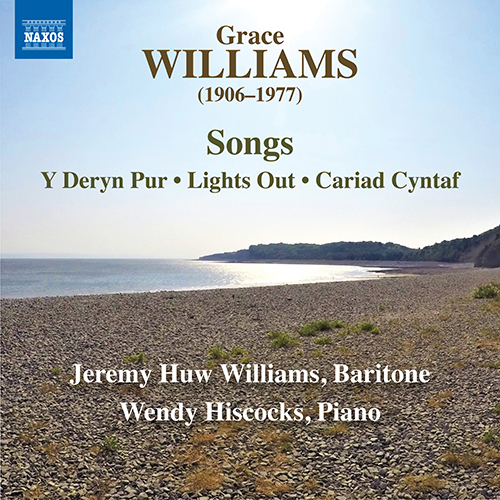
On Record – Jeremy Huw Williams & Wendy Hiscocks: Grace Williams: Songs (Naxos)

Grace Williams
Slow, slow, fresh fount (c1925); I had a little nut tree (c1930); Green Rain (1933); Stand forth, Seithenin (1935, rev; 1951); Ffarwel i langyfelach (?1920s); Llangynwyd (?1920s); The Song of Mary (1939, rev; 1945); Shepherds watched their flocks by night (1948); Fairground (1949); Flight (1949, rev; 1954); À Lauterbach (c1950); Le Chevalier du guet (1949); Four Folk Songs (1950-51); When thou dost dance (1951); Three Yugoslav Folk Songs (1952); Y Deryn Pur (1958); Y Fwyalchen (1958); Cariad Cyntaf (c1960); Ow, Ow, Tlysau (1964); Dwfn yw’r Môr (c1940); Lights Out (1965); Fear no more the heat o’ the sun (1967)

Jeremy Huw Williams (baritone), Wendy Hiscocks (piano)

Naxos 8.571384 [77’47”]
Producer Wendy Hiscocks Engineer Alastair Goolden

Recorded 28-30 September 2022 at Cooper Hall, Selwood Manner, Frome

Reviewed by Richard Whitehouse

What’s the story?

Naxos continues its long-running series of releases sponsored by the British Music Society with an album of songs by Grace Williams (1906-77), all of which are recorded here for the first time and, between them, extend chronologically over the greater part of her composing.

What’s the music like?

Even more than others of her generation, Williams has benefitted from the upsurge of interest in women composers this past decade with recordings of major works on Lyrita and Resonus. Songs may not have the primary place in her output, but they afford a viable overview of her stylistic evolution with individual instances among her most characteristic statements. Most are in English or Welsh though there also settings of French texts, while her own translations of several from the former Yugoslavia further underline the breadth of her literary concerns.

Early settings of Ben Johnson along with traditional English and Welsh poems find Williams, barely out of her teens, tackling verse with audible appreciation of this genre’s lineage within the Victorian and Edwardian eras. That of Mary Webb’s Green Rain is audibly more personal for its wistful ambivalence, while The Song of Mary brings due sensitivity to bear upon some familiar lines from St Luke. The most extended item, Fairground is a setting of Sam Harrison that captures the sights and sounds of said environment with an immediacy never descending into kitsch, while that of Flight matches the sentiments in Laurence Whistler’s poem and has a piano part testing in its intricacy. Her setting of the Jacobean-era When thou dost dance is, by comparison, slighter though no less attuned to the limpid elegance of its anonymous text.

Arrangements of traditional verse had early featured in this composer’s output, and this is not the customary text for her attractive treatment of a traditional Czech carol Shepherds watched their flocks by night. The period around 1950 saw a number of such arrangements and mainly of French texts, but with her take on the Northumbrian Bonny at Morn appreciably different from the more familiar one by Tippett. The end of that decade brought forth a trio of eloquent Welsh settings, while that of the Medieval text Oh, Oh, Treasures may be pastiche yet it has a fervency which feels not a little unsettling. The final two songs see a return to more familiar verse: that of Edward Thomas’s Lights Out evinces a subdued and even fatalistic acceptance, while that of Shakespeare’s Fear no more the heat o’ the sun captures its aura of resignation.

Does it all work?

Yes, allowing for inevitable unevenness in what is a conspectus over four decades. At least a half-dozen of these songs ranks with the best of those by British composers from this period and well warrant investigation by more inquiring singers. Jeremy Huw Williams clearly has no doubts as to their quality and, though his tone as recorded here is not always flattering, it captures his intensity of response. Nor could he have had a more committed or a perceptive accompanist than Wendy Hiscocks, who teases out myriad subtleties from the piano writing.

Is it recommended?

Indeed, and there ought to be enough remaining vocal items for a follow-up release at some stage. Graeme Cotterill pens informative notes, and while it is a pity that several texts could not be printed for copyright reasons, the clarity of Williams’s diction seems fair recompense.

Listen & Buy

Click on the artist names to read more on Jeremy Huw Williams, Wendy Hiscocks, composer Grace Williams and the British Music Society

Published post no.2,506 – Wednesday 16 April 2025

On Record – Splonge! An Introduction To Tubby Hayes (Decca / Fontana Jazz)

Reviewed by John Earls

A vinyl-only release, with the following tracklisting:

Side A
Tubbsville
You For Me
Lady ‘E’ – Tubby Hayes & The All Stars
Angel Eyes – Tubby Hayes Quintet
Johnny One Note – Tubby Hayes Quintet

Side B
Pedro’s Walk – Tubby Hayes Orchestra
Bluesology – The Tubby Hayes Quartet
Blues In Orbit – The Tubby Hayes Quartet
For Members Only (Take 1) – The Tubby Hayes Quartet
Hey Jude – Tubby Hayes Orchestra

What’s the story?

Tubby Hayes, born in London in 1935, was “one of the most influential and dominating personalities on the British Jazz scene” according to his one-time band mate and fellow British jazz legend Ronnie Scott. He died in 1973 at the age of 38 following a turbulent personal life that included alcohol and drug issues.

In an attempt to answer the question “Where do I start?” this album (a vinyl only release) brings together ten tracks originally recorded for the Fontana label between 1961 and 1969 and compiled by filmmaker, author and avid Tubby Hayes fan Mark Baxter, who has also written some excellent sleeve notes: “I once heard someone say that if John Coltrane had been born in Raynes Park he would have sounded like Tubby Hayes”. Interest in Tubby Hayes and his music was in no small part renewed by musician, writer and Tubby Hayes expert Simon Spillett’s magnificent 2015 biography The Long Shadow of The Little Giant: The Life, Work and Legacy of Tubby Hayes, and the 2016 documentary film Tubby Hayes: A Man In A Hurry, written and produced by Baxter.

What’s the music like?

This is a broad and thoroughly enjoyable selection of tunes capturing the virtuosity and range of a fine jazz musician in an eight year spell of his all too short career. It encompasses glorious big band music as well as some notable smaller jazz ensemble performances.

Hayes’s own composition Tubbsville (from the 1961 album Tubbs) is a great big band opener with a compelling groove and Hayes’s astounding tenor saxophone style to the fore.

The big band format is also represented on the album by three Tubby Hayes Orchestra performances including Pedro’s Walk (from 1964’s Tubb’s Tours) with its bossa nova inflections and a take on Hey Jude (recorded in 1969 but released on 1970’s The Orchestra) of which Baxter states that whilst its commercial sound may not be to some jazz lovers taste “it still has moments when you are reminded of what a jazz great Hayes was”. He’s right. It also features a terrific Spike Wells drum intro to boot.

The other Orchestra selection is Milt Jackson’s Bluesology from the album 100% Proof (1967) which sees multi-instrumentalist Hayes getting straight into vibraphone mode (he is also credited with tenor saxophone and flute) in a mellow bluesy number that features some other greats of British jazz, not least the aforementioned former Jazz Courier Ronnie Scott (also on tenor saxophone) and Kenny Wheeler on trumpet.  

The first we hear of Hayes’s vibraphone playing on the album is on Lady ‘E’ (from 1963’s ‘Return Visit!’), a Roland Kirk composition whose playing of the nose flute (amongst other things) is also a stand out feature. It’s a smooth swing produced by Quincy Jones. Hayes’s finesse on the vibraphone is again on display on the slow and more subdued ballad Angel Eyes which also features Jimmy Deuchar on muted trumpet.

Things are a bit more edgy with the Tubby Hayes Quintet’s interpretation of the Rodgers and Hart show tune Johnny One Note (from 1962’s Down In The Village), with Jimmy Deuchar’s “opening tear-arsed arrangement”, to quote Simon Spillett’s apt and graphic description, going into a fast and furious ride with Hayes concentrating on tenor saxophone duties but ably complemented by the rest of the quintet including Deuchar himself on trumpet. Hayes’s saxophone virtuosity is again on display on You For Me (from 1962’s Tubbs in New York), not least in the remarkable unaccompanied introduction.

The remaining tracks are For Members Only (Take 1) taken from Grits, Beans & Greens: The Lost Fontana Studio Sessions 1969 (released in 2019) with Hayes on tenor saxophone and flute, and Blues In Orbit from Mexican Green (1968) featuring some more flying Hayes sax solos and some ripping drums from Tony Levin who, Spillett reports in his book, says that Hayes apparently never played the tune again.

Does it all work?

Absolutely. If you are new to Tubby Hayes this does indeed answer the question “Where do I start?”. If you are more familiar with his music it is a superb reminder of the talent and virtuosity of this major figure in British jazz that will send you back to the original albums.

Is it recommended?

For sure. It’s a super compilation and with the sleeve notes and artwork (the cover image is Ed Gray’s wonderful ‘Soho Soul Tubby Hayes ‘A Man In A Hurry’’) it amounts to a great package put together with love and care and released just after what would have been Hayes’s 90th birthday. We owe Mark Baxter and Decca a debt of gratitude.

Oh, and if you’re wondering where the title Splonge! comes from, Baxter’s sleeve notes point you to the count-in on the recording of Hayes’s track Voodoo (not on the album).

Listen & Buy

To purchase Splonge! An Introduction To Tubby Hayes (available on vinyl only), visit the Decca website.

Published post no.2,501 – Sunday 13 April 2025

On Record – Naresh Sohal: Complete Piano Music (Konstantinos Destounis) (Toccata Classics)

Naresh Sohal
A Mirage (1974)
Chakra (1979)
Prayer (2006)
Tsunami (2007)
Piano Trio (1988)

Konstantinos Destounis (piano); Cristina Anghelescu (violin), Adrian Mantu (cello), Mark Troop (piano) (Piano Trio)

Toccata Classics TOCC0689 [56’30”]
Producers and Engineers Konstantinos Destounis and Bobby Blazoudakis, Peter Waygood (Piano Trio)

Recorded 18 January 2022 at Dmitris Mitropoulos Hall, Athens; 1-3 June 2001 at Gateway Studio, Kingston-upon-Thames

Reviewed by Richard Whitehouse

What’s the story?

Toccata Classics issues the first of a likely series devoted to chamber and instrumental music by Naresh Sohal, featuring all those acknowledged pieces for solo piano along with his Piano Trio, on a release that also continues the posthumous rehabilitation of this significant figure.

What’s the music like?

Although he composed sparingly for the medium, the piano pieces Sohal did write afford an overview of how his music evolved across three decades. Primarily this involved an active as well as frequently confrontational exploration of more radical tendencies in post-war music, resulting in a distinctive while personal synthesis which the composer duly refined and made more pliable with what came after. Those later pieces are not necessarily simpler technically or expressively, yet they convey their essential concerns with greater clarity and immediacy.

At the time of A Mirage, Sohal was still preoccupied with aspects of a European avant-garde he encountered on arrival in the UK some 12 years earlier. Hence the influence of Xenakis in its tendency toward registral extremes and stratified figuration which coalesce more through gestural force than motivic logic. This is already changing in Chakra, which likewise unfolds as an arch but now with a tangible sense of resolution at its apex – though little prepares one for the sudden upsurge at its close after a definite subsiding of tension across the latter stages.

Moving on almost 30 years and Prayer demonstrates a more methodical amalgam of formal means towards expressive ends, though there is nothing at all reactionary about the outcome – whether in the unforced eloquence of its initial Adagio or the fluid interplay of its ensuing Allegretto as it pursues an increasingly intricate and eventful course. A piece titled Tsunami might lead one to expect a headlong discourse, but Sohal’s study is far more controlled and understated by evoking this natural phenomenon in all its awesome and destructive majesty.

Although it comes nearer chronologically to the former group of pieces, the Piano Trio might well be the latest work here as regards overall elaboration. Thus, its three continuous if well-defined sections outline an active process of thesis, antithesis then synthesis which is audible at every stage, though here the evolution is one of a constantly increasing velocity towards a violent or even tragic denouement. Immersed in Indian philosophy as he was, Sohal was only too aware of those darker and negatory forces which are to be found at all levels of existence.

Does it all work?

Yes, in that Sohal’s is a powerful and flexible musical idiom that predicates communication of emotion over theoretical consistency. A quality always to the fore in these accounts of the piano pieces – Konstantinos Destounis searching out their imaginative reserves without ever falling short of their frequently considerable technical demands. Neither is there any lack of insight or commitment in that of the Piano Trio which, in terms of compactness and overall immediacy, is an ideal way into this composer’s language at its most characteristic or potent.

Is it recommended?

Indeed. The sound accorded Destounis is almost ideal in its clarity and definition, though the Piano Trio is rendered at a slightly oblique perspective. Informative notes on life and music, and good news that a follow-up release of Sohal’s string quartets should soon be available..

Listen & Buy

For purchase options, you can visit the Toccata Classics website. Click on the names to read more about pianist Konstantinos Destounis and composer Naresh Sohal.

Published post no.2,500 – Thursday 10 April 2025