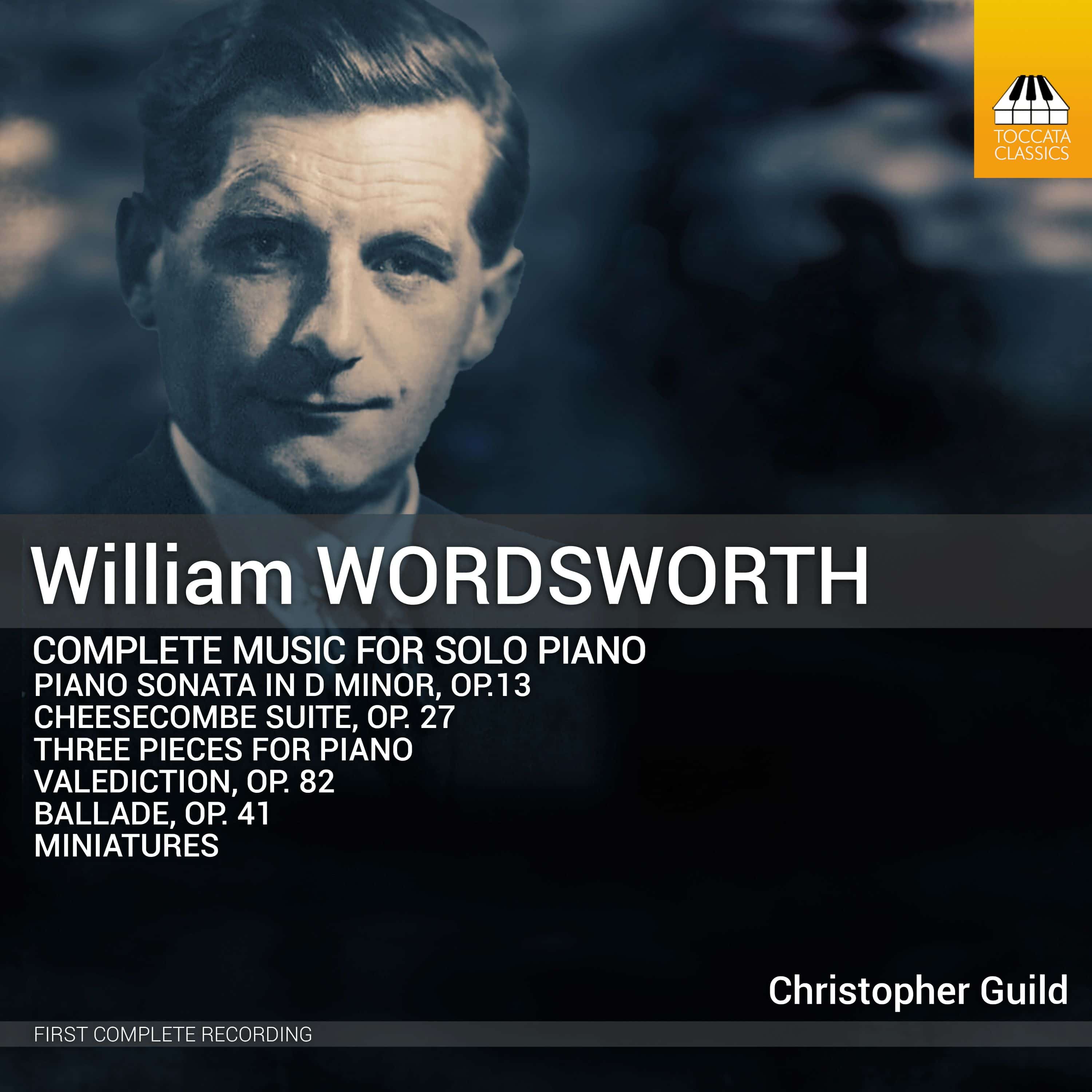
On Record – William Wordsworth: Complete Piano Music (Christopher Guild) (Toccata Classics)

William Wordsworth
Piano Sonata in D minor Op.13 (1938-9)
Three Pieces (1932-4)
Cheesecombe Suite Op.27 (1945)
Ballade Op.41 (1949)
Eight Pieces (all publ. 1952)
Valediction Op.82 (1967)

Christopher Guild (piano)

Toccata Classics TOCC0697 [81’08”]
Producer and Engineer Adaq Khan

Recorded 13 April, 29 May 2022 at Old Granary Studios, Beccles, 2 April 2023, Wyastone Hall, Monmouthshire (Three Pieces)

Reviewed by Richard Whitehouse

What’s the story?

Toccata Classics intersperses its continuing survey of William Wordsworth’s orchestral music with a release devoted to that for solo piano, including several works not otherwise recorded and all ably performed by Christopher Guild, who already features prominently on this label.

What’s the music like?

Although not a large part of his catalogue, piano music features prominently in Wordsworth’s earlier output – notably a Piano Sonata that ranks among the finest of the inter-war period. Its first movement is introduced by a Maestoso whose baleful tone informs the impetuous while expressively volatile Allegro. The central Largamente probes more equivocal and ambivalent emotion before leading into the final Allegro, its declamatory and martial character offset by the plangent recall of earlier material prior to a denouement of surging and inexorable power.

His status as conscientious objector found Wordsworth engaged in farm-work in wartime, the experience duly being commemorated in his Cheesecombe Suite whose pensive Prelude and dextrous Fughetta frame a quizzical Scherzo then a Nocturne of affecting pathos. Written for Clifford Curzon, Ballade is a methodical study in contrasts which makes an ideal encore; as, too, might Valediction – though here the emotions run deeper and more obliquely, as befits this inward memorial to a lifelong friend from comparatively late in its composer’s creativity.

This release rounds out our knowledge of Wordsworth’s piano music with two collections not previously recorded. Among his earliest surviving works, the Three Pieces comprise a taciturn Prelude, fleeting Scherzo then soulful Rhapsody which between them find the composer trying out whole-tone figuration with resourcefulness but also a self-consciousness that might have decided him against publishing. Published by Alfred Lengnick as part of its five-volume educational series Five by Ten, the eight miniatures wear their didactic intention lightly; only one of these exceeding two minutes, yet all evince a technical skill that is never facile along with a pertinent sense of evocation that should commend them to amateurs and professionals alike. Here, as often elsewhere, Wordsworth proves a ‘less is more’ composer of distinction.

Does it all work?

Very much so and Christopher Guild, with admirable surveys of Ronald Stevenson (Toccata) and Bernard Van Dieren (Piano Classics) to his credit, is a natural interpreter of often elusive yet always rewarding music. His charged and often impetuous take on the Sonata has more in common with the pioneering account by Margaret Kitchin (Lyrita) than the overtly rhetorical one by Richard Deering (Heritage). Similarly, his approach to the Cheesecombe Suite and the Ballade draws out their depths if occasionally at the expense of their expressive immediacy. Interestingly, Valediction is played from a copy by Stevenson that alters aspects of keyboard layout or pedalling if not the notes themselves; resulting in a greater emotional ambivalence and textural intricacy which Wordsworth, had he heard it, would most likely have endorsed.

Is it recommended?

Indeed, not least when the sound of both Steinway D’s are so faithfully conveyed and Guild’s annotations are so perceptive. Those who have the Deering release should consider acquiring this one also, while those new to this music need not hesitate in making this their first choice.

Listen & Buy

For purchase options, you can visit the Toccata Classics website. Click on the names to read more about pianist Christopher Guild and composer William Wordsworth.

Published post no.2,500 – Thursday 10 April 2025

On Record – Arnold Cooke: Complete String Quartets, Volume One (The Bridge Quartet) (Toccata Classics)

Arnold Cooke
String Quartet no.1 (1933)
String Quartet no.3 (1967)
String Quartet no.5 (1978)

Bridge Quartet [Colin Twigg, Catherine Schofield (violins), Michael Schofield (viola), Lucy Wilding (cello)]

Toccata Classics TOCC0696 [56’05”]
Producer and Engineer Michael Ponder

Recorded 21-22 November 2022, 5-6 March 2023, All Saints’ Church, Thornham

Reviewed by Richard Whitehouse

What’s the story?

Toccata Classics continues its coverage of Arnold Cooke (his organ music is on TOCC0659) with this first volume of his string quartets, performed by The Bridge Quartet and confirming him as a skilful practitioner of a genre such as found favour with many composers of his era.

What’s the music like?

Premiered by the Griller Quartet in March 1935, the First Quartet gained the praise of no less than Havergal Brian and helped to establish Cooke’s wider reputation. Completed a year after his return from study in Berlin, this undeniably shows the influence of Hindemith but offsets it with a lyrical poise as to suggest lessons well learned from an earlier generation of British composers. Although cast in four movements, the opening Lento is a fugue whose emotional austerity never seems unduly severe – with the ensuing Vivace and Allegretto a scherzo then intermezzo of respective impetus and suavity. The final Presto rounds off proceedings with a keen yet never wanton energy that sets the seal on a substantial and approachable work; one which should not have had to wait 84 years until its revival by the present ensemble in 2022.

First given by the English Quartet in May 1968, the Third Quartet is contemporaneous with Cooke’s Third Symphony – whose coupling on Lyrita with a suite from his ballet Jabez and the Devil doubtless introduced many to this composer. Here one senses the presence, rather than influence as such, of Bartók – specifically his Sixth Quartet, the underlying rhythm of whose Marcia informs the initial Allegro of this work, and whose recurrent Mesto theme proves hardly less pervasive in an Andante which none the less emerges as one of Cooke’s most thoughtful and revealing statements. The brief scherzo exudes a driving impetus that carries over into a final Allegro that, in its ongoing vivacity and affirmative close, confirms this as the most likely of these quartets to find its place in the repertoire of the 20th century.

By the time his Fifth Quartet received its premiere in March 1979, Cooke had evidently been eclipsed by a younger generation though there is nothing overtly reactionary about this piece. Unfolding as a single movement, it has three clearly defined sections (as on this recording) -thus, a tense if ambivalent Moderato leads into an Allegro which adeptly elides scherzo and slow movement with no loss of ongoing momentum, then a Presto whose sheer brevity does not preclude allusions to earlier ideas as it steers this compact work to a decisive conclusion.

Does it all work?

Pretty much. Cooke might never have had an overtly distinctive or even personal idiom, but his music has a technical rigour and a feel for communication as makes listening rarely less than pleasurable. It helps when, in the Bridge Quartet, it has exponents so well versed in the lineage of British quartet writing – not least the composer who provided this ensemble’s name – and as attentive to the wealth of contrapuntal invention as to the greater design with each of these pieces. Hopefully other such groups will be encouraged to include them in their recitals.

Is it recommended?

Indeed so. The recording has a focus and perspective which is ideal for such music, and there are succinctly informative annotations by Peter Marchbank. Hopefully the follow-up volume, featuring the Second and Fourth Quartets, will be appearing from this source before too long.

Listen & Buy

For purchase options, you can visit the Toccata Classics website. Click on the names to read more about The Bridge Quartet and composer Arnold Cooke.

Published post no.2,497 – Monday 7 April 2025

On Record – Myaskovsky: Vocal Works Vol. 2 (Ilya Kuzmin, Dzambolat Dulaev & Olga Solovieva) (Toccata Classics)

Myaskovsky
Six Poems of Alexander Blok Op. 20 (1920)
At the Decline of Day: Three Sketches to Words by Fyodor Tyutchev Op.21 (1922)
Three Sketches Op.45 (1938)
From the Lyric Poetry of Stepan Shchipachyov Op. 52 (1940) Songs of Many Years Op.87 (1901-1936, rev. 1950) – nos.1, 6, 7 & 10
Two Songs of Polar Explorers (1939)

Ilya Kuzmin (baritone, Op.20, Op.45), Dzambolat Dulaev (baritone, all other songs), Olga Solovieva (piano)

Toccata Classics TOCC0667 [62’44”] Russian (Cyrillic) texts and English translations included
Producer and Engineer Ilya Dontsov

Recorded 2018-2022

Reviewed by Richard Whitehouse

What’s the story?

Toccata Classics continues its estimable coverage of the songs by Nikolay Myaskovsky with a second volume devoted to those for baritone which, in term of its performances, sound and annotations, is no less successful as a demonstration of the composer’s prowess in this genre.

What’s the music like?

Myaskovsky composed some 120 songs, with roughly half written early in his career before the symphony was central to his thinking. The first two collections here emerged between his Fifth and Sixth Symphonies, a traumatic time personally and culturally with civil war having engulfed the Soviet Union. Hence that darkly fatalistic aura which pervades the Six Poems of Alexander Blok, its texts drawn from this poet’s early maturity at the tune of the 20th century and framed by two of Myaskovsky’s finest songs: the bittersweet A full moon has risen over the meadow and the speculative In the silent night. Written soon afterwards, At the Decline of Day features three ‘sketches’ after Fyodor Tyutchev whose brevity only accentuates their expressive acuity – notably the central setting ‘Your friendly voice prompts no living spark’.

Over a decade on and Three Sketches finds Myaskovsky tackling poetry with whose Socialist Realism he could have had little empathy, though his setting of Lev Kvitko’s A Conversation evinces a wistful poise hardly warranted by the text. This quality is more gainfully employed in From the Lyric Poetry of Stepan Shchipachyov, not least for the way the composer invests often wantonly propagandist texts with that sense of imaginative wonder that may have been their desired intention all along – as is evident from such as Mount Elbrus and the Aeroplane. Although published as Myaskovsky’s last opus, Songs of Many Years collates 15 songs which had been written often many years before. Of the four heard here, Thus yearns the soul finds the 20-year-old setting Aleksey Koľtsov’s text with due awareness of its aspirational ardency, while the baleful Sonnet of Michelangelo makes pertinent comparison with Shostakovich’s version 65 years on. The first two from Four Songs of Polar Explorers offer a distinctive take on the ‘mass song’, of which the rousing Song of the Polar Sailors audibly fulfils its remit.

Does it all work?

Yes, providing one accepts that Myaskovsky was not a composer of songs given to extremes of emotion or flights of fancy in those texts he chose to set. Such a tendency to introspection could easily have been over-emphasized through allotting this selection solely to the baritone register, and it is a tribute to Ilya Kuzmin and Dzambolat Dulaev that any risk of expressive uniformity is wholly avoided – the former as unforced in his eloquence as the latter renders his often more impersonal settings with a light and flexible touch. Both singers here benefit from Olga Solovieva’s perceptive accompaniment, confirming her once again as a pianist of no little finesse. The texts and translations for all of these 28 songs have been included, and though some may regret the absence of transliterations, they can mostly be accessed online.

Is it recommended?

Very much so, and not least as Patrick Zuk’s booklet note sets the scene so thoroughly yet evocatively. Warmly recommended and, with just over a third of Myaskovsky’s songs now recorded, this is hopefully a series that Toccata will be able to see through to its completion.

Listen & Buy

For purchase options, you can visit the Toccata Classics website. For information on the performers, click on the names to read more about Ilya Kuzmin, Dzambolat Dulaev and Olga Solovieva – and composer Nikolay Myaskovsky

Published post no.2,493 – Thursday 3 April 2025

On Record – Alessandro Marangoni, Orazio Sciortino, Orchestra Sinfonica di Milano / Giuseppe Grazioli: Rieti: Piano Concertos (Naxos)

Rieti
Piano Concerto no.1 (1926)
Piano Concerto no.2 (1937)
Piano Concerto no.3 (1955)
Concerto for Two Pianos (1951)

Alessandro Marangoni, Orazio Sciortino (pianos), Orchestra Sinfonica di Milano / Giuseppe Grazioli

Naxos 8.564505 [80’27”]
Producer Stefano Barzan Engineer Cinzia Guareschi

Dates: 21-22 August 2022, 17-20 August 2023 (Piano Concerto no.3, Concerto for Two Pianos) at Auditorium di Milano

Reviewed by Richard Whitehouse

What’s the story?

Naxos continues its enterprising 20th Century Italian Classics with the concertante works for piano by Vittorio Rieti (1898-1994), the Egyptian-born Italian composer whose years in Paris then New York and Chicago afforded contact with a range of illustrious musicians and artists.

What’s the music like?

Dedicated to Poulenc and likely inspired by the success of Prokofiev’s Third Concerto earlier that decade, Rieti’s First Piano Concerto brings a deft touch to its ostensible neo-Classicism – whether in the martially-inflected playfulness of its initial Allegro, laconic but also beguiling ambivalence of its central Andantino, or the theatrical high-jinx of a final Allegro whose nod towards jazz rhythm marks this out as a piece decidedly yet always unaffectedly of its time. Seemingly forgotten following its premiere (by the composer?), its revival is well deserved.

Just over a decade on, the Second Piano Concerto emerged from material originally intended for a harpsichord concerto. On a similar scale to its predecessor, the opening Allegro has an impetus that denotes the uncertainty spreading throughout Europe at this time, and which is intensified by the central Adagio with its plangent discourse between soloist and orchestra; a quality the final Allegro (which follows with barely a pause) does not so much overcome as dismiss through an energetic repartee which brings about the nominally affirmative ending.

By the time of his Third Piano Concerto, Rieti was well established in the United States such that the present work is audibly in the lineage of American works for this medium of the post -war era. Any undue portentousness in the introductory Largo is dismissed with the vivacious Allegro that follows, then the central Andantino confirms that, while Rieti’s idiom might not have altered substantially over his career, it gained in subtlety and depth. Any more ominous expression is avoided in the final Allegro as it wends a capricious course to its decisive close.

Written in the wake of his relocation to the USA, the Two-Piano Concerto helped to establish Rieti’s reputation in a very different cultural climate. There is little moderate about either the tempo or character of the impetuous opening Allegro, then the central Allegretto comprises a set of variations’ which takes its unassuming theme through a diverse range of moods without losing focus on route to the pensive close. The final Allegro turns away from any encroaching inwardness with its energetic fugal interplay such as makes for an ending of pointed defiance.

Does it all work?

It does, provided one accepts Rieti as a product of his age rather than trailblazer or innovator. Stravinsky, Prokofiev and even Jean Françaix are prominent in the stylistic mix, with a more tensile aspect derived from Copland in the works of his American years. Not that this should offset enjoyment of music that feels never less than communicative and often engagingly so, particularly as regards the latter two pieces. Both of these were recorded way back in the LP era, but to have all four works rendered in such sympathetic readings is hardly to be gainsaid.

Is it recommended?

It is, not least when Alessandro Marangoni (alongside Orazio Sciortino) is so attuned to this music, while Giuseppe Grazioli obtains a committed response from the Milan orchestra. The succinct booklet notes are highly informative and further enhance the appeal of this release.

Listen & Buy

For purchase options, you can visit the Naxos website. For information on the performers, click on the names to read more about Alessandro Marangoni, Orazio Sciortino, Giuseppe Grazioli and the Orchestra Sinfonica Milano. An interview between Vittorio Rieti and Bruce Duffie can be read here

Published post no.2,492 – Wednesday 2 April 2025

On Record – Claire Booth & Andrew Matthews-Owen: Paris 1913: L’offrande lyrique (Nimbus)

Caplet En regardant ces belles fleurs
Milhaud L’innocence Op. 10/3
Hahn À Chloris
Ravel arr. Stravinsky Trois poèmes de Stéphane Mallarmé M64
Auric Trois Interludes: Le pouf.
Ropartz La Route
Durey L’Offrande lyrique Op. 4
Saint-Saëns Petit main Op.146/9
Fauré Il m’est cher, Amour, le bandeau, Op. 106/7
Chaminade Je voudrais être une fleur
Debussy Trois poèmes de Stéphane Mallarmé L127
Satie ed. Dearden Trois Poèmes d’Amour
Lili Boulanger Clairières dans le Ciel: Vous m’avez regardé avec votre âme
Grovlez Guitares et mandolines

Claire Booth (soprano), Andrew Matthews-Owen (piano)

Nimbus RTF Classical NI6455 [66’23”] French texts included
Producer & Engineer Raphaël Mouterde

Recorded 11/12 March, 4-6 September 2023 at Wyastone Concert Hall, Monmouth

Reviewed by Richard Whitehouse

What’s the story?

Another enterprising song recital from Claire Booth and Andrew Matthews-Owen, this one focussing on songs that were either conceived, composed or premiered in Paris during 1913 and resulting in an absorbing collection best heard as a diverse while unpredictable totality.

What’s the music like?

Interleaving standalone songs and song-cycles, this recital opens with André Caplet’s take on Charles d’Orléans, its limpid modality highly appealing, then continues with an early song by Darius Milhaud as already demonstrates his distinctive and amusing approach to word-setting, while that by Reynaldo Hahn typifies the teasing charm familiar from his vocal music overall. Maurice Ravel’s triptych to texts by Mallarmé is performed in a version by Stravinsky with its accompanying nonet reduced to piano which, in preserving and maybe even accentuating the music’s questing introspection, represents no mean fete of transcription. Still relatively little known, this certainly deserves to be heard as at least an occasional alternative to the original.

Remembered best as a prolific writer of film scores, Georges Auric had shown a precocious talent for song as is evident in his sensuous setting of René Chalupt. A composer who often wrote on a symphonic scale, Guy Ropartz is heard in a setting of his own verse that amounts to a ‘scena’ in its wide expressive ambit. Interest understandably centres on the eponymous cycle by Louis Durey, a member of Les Six whose increasingly far-left conviction tended to marginalize his creativity yet, as these lucid and empathetic settings of Rabindranath Tagore (as translated by André Gide) confirm, had emerged as a protean talent by his mid-twenties. Hopefully these artists will be encouraged to investigate other of his songs from this period. By contrast, a late song by Camille Saint-Saëns exudes a touching poignancy, while that by Gabriel Fauré typifies the elusiveness of those in his last decade. As is evident here, Cécile Chaminade was a songwriter of style and elegance, then the Mallarmé triptych by Debussy (its first two texts identical to those of Ravel) finds this composer probing the inscrutability of these poems while drawing back from any more explicit intervention. The inscrutability conveyed by Erik Satie’s aphoristic settings (edited by Nathan James Dearden) of his own texts is altogether more playful – after which, the recital continues with a pensive offering by Lili Boulanger, with Gabriel Grovlez’s sultrily evocative setting of Saint-Saëns to finish.

Does it all work?

Yes, given the fascination of this collection taken as a whole and, moreover, the quality of these renditions. Booth is not a singer willing to take the easy option in her interpretations, and so it proves here with singing as fastidious as it is refined, while Matthews-Owen duly instils often deceptively spare accompaniments with understated insight. They contribute a succinctly informative note, but the booklet includes only the French texts with the English translations available at https://rtfn.eu/paris1913/: might it have best the other way round?

Is it recommended?

Very much so. There is much to fascinate even those who consider themselves afficionados of the ‘chanson’, and those who are unfamiliar with much of this repertoire could not have a better means of acquainting themselves with certain of its treasures – hidden or otherwise.

Listen & Buy

For purchase options, you can visit the Ulysees Arts website. For information on the performers, click on the names to read more about Claire Booth and Andrew Matthews-Owen

Published post no.2,466 – Friday 7 March 2025