On record: Peter Maxwell Davies – Music for Brass

maxwell-davies-brass

A new disc from The Wallace Collection on Nimbus Records, exploring Sir Peter Maxwell Davies’ rich and varied writing for brass instruments.

What’s the music like?

This collection brings with it some fascinating contrasts. On the one hand is the substantial Brass Quintet, a large-scale piece the composer wrote for the Empire Brass Quintet in 1981. It leaves a lasting impression, especially in the second of the three movements – an Adagio 16 minutes in length. It explores some desolate sound pictures, the composer achieving a strikingly dark and often subdued backdrop akin to the sky of the Lowry painting on the cover of the release.

Yet like that picture (Yachts, from 1959) there are pinpricks of light, too, as Maxwell Davies brings the instruments out in a solo capacity – especially the horn and two trumpets. It is a pointer towards the two complementary solo works on the disc. Litany for a Ruined Chapel between Sleep and Shore is for trumpet, and was written about the medieval ruins on the Orkney island of Sanday, where the composer moved in 1999. Sea Eagle, for solo horn, is a musical observation of a creature that captivated the composer from his first Orkney home in 1982.

Shorter works for brass complete the program, with a ceremonial fanfare written for the opening of The Lowry arts centre in Manchester, and arrangements of four short pieces by Tallis that reveal his influence on Maxwell Davies as a composer.

Does it all work?

Yes – but the music of Maxwell Davies, especially in the Brass Quintet, requires some work on the part of the listener to realise its full potential. It has taken me a long time to appreciate the composer’s music, as it can be difficult to connect with emotionally, and there are some complex harmonies. Yet familiarity brings great reward, and the bold writing for brass on such a large scale can be appreciated – especially when the music is quiet. The Wallace Collection are superb in the quintet, their feats of stamina and virtuosity complemented by genuine strength of feeling.

The works for solo instruments are more immediate in their impact, and helped by performances that could not be bettered. John Wallace plays as the composer would wish in the Litany, evoking an outdoor scene in the middle of the ruined Orkney church. Meanwhile Sea Eagle is still more effective, a vivid picture of the magnificent bird and the ultimate freedom it finds on the wing. With an especially reverberant recording in St Marylebone Church Paul Gardham delivers an outstanding performance.

The other pieces are well positioned on the disc and lighten the mood – the Four Voluntaries especially poignant in the simplicity of their arrangement.

Is it recommended?

Yes. This disc is a fine achievement documenting not just one of our greatest living composers but celebrating his habitat too.

Listen on Spotify

You can judge for yourself by hearing the album on Spotify here:

On record: John Cale – M:FANS / Music For A New Society (Domino)

MFANS

Richard Whitehouse considers in detail John Cale’s Music For A New Society, back from its original release in 1982 and now in digital guise.

That John Cale should have chosen to make his 16th studio album the rewriting of his eighth is hardly provocative in itself. Not least as Music For A New Society remains in any case the most provocative of all his releases, coming at a time when Cale – poised on his fifth decade – was not so much reassessing his creative priorities as searching, uncertainly if by no means tentatively, for the way forward. That the way forward only made explicit its fraught genesis explains why Cale should wish to readdress such anxieties and, in doing so, transcend them.

Originally released in September 1982, Music For A New Society came in the midst of what is perhaps Cale’s most challenging creative period. Seemingly caught on the back-foot with the advent of punk rock, this most recalcitrant of singer-songwriters duly stormed the citadel in the visceral guise of 1979’s Sabotage/Live (among a select handful of live albums to consist wholly of new songs), followed by its studio complement in 1981’s waspishly sardonic Honi Soit. Finding himself without a touring back the following year became the catalyst for Cale to pursue a more inward and uncompromising take on those issues personal and social in its successor – the result of live improvisations at New York’s Sky Line Studios – and how like Cale to focus his acute emotional angst through the discipline of a ‘time is money’ schedule.

Warmly while equivocally received on its release, Music For A New Society predictably died a death in commercial terms and soon went out of print. For a 1993 reissue, Cale subjected it to a degree of revision – notably with the inclusion of the track ‘In the Library of Force’ for a close of magisterial despair. Appreciative of if understandably guarded as to the qualities of an album long held in high esteem, he performed it live at the Aarhus Festival in 2013 then refashioned it from scratch into the very different if no less absorbing statement of M:FANS.

This release comprises a remastered Music For A New Society (largely adhering to the 1993 revision), such as renders its claustrophobic intensity with even more unsparing immediacy, along with M:FANS: their differences (not so) paradoxically highlighting their relatedness.

The precise nature of that relationship is clear at the outset – the barbed nostalgia of blurred keyboards and acoustic slide guitars of ‘Taking Your Life in Your Hands’ now an ominous processional of fazed ambience and interpolated voices, while the world weary vocal as set against mindless ostinato patterns of ‘Thoughtless Kind’ yields to an agile vocal line made more tactile by an unwavering rhythmic backdrop as makes possible the heady culmination. ‘Sanctus’ (heard now in a ‘Sanities mix’ as though to acknowledge its history of mistitles) duly swaps a fragmented vocal given context by fugitive percussion and glowering organ for a dehumanized rendition made even more menacing by its remorseless electronic backing.

By the same token, the eloquent vocal as enhanced by a fervent organ contribution of ‘If You Were Still Around’ is accorded greater sonic presence through melding of its keyboards and guitars with a motoric rhythmic undertow. Most lauded among the original tracks, ‘(I Keep A) Close Watch’ (the stripped down reworking of an opulent ballad from 1975 album Helen of Troy) has now acquired a deft lilt to its vocal thanks to the soulful backing voices – while, in ‘Broken Bird’, the formerly haunting combination of imploring vocal with subtly shifting keyboards has taken on heightened expression with piano and electronics sharply separated.

The intimate confession with acoustic guitars and intertwined strings of ‘Chinese Envoy’ gets a complete rhythmic overhaul with syncopated backing vocals over a funky electronic groove – while ‘Changes Made’, with its almost affirmative vocal and full-on rock backing, receives a more circumspect treatment via a whimsical central interlude and narrower sonic ambience. ‘(In the) Library of Force’, its initial incarnation no less fateful despite loss of that slammed piano lid, is more self-contained with its spoken voice foregrounded and an equivocal close.

M:FANS finds no place for ‘Damned Life’, its careworn vocal thrown into relief against the skewed instrumental paraphrase of Beethoven’s Ode to Joy, or the palpably uneasy amalgam of matter-of-fact recitation over an intrusive classical sample that is ‘Risé, Sam and Rimsky-Korsakov’. Music For A New Society is rounded off by out-takes of ‘Chinese Envoy’, heard in a ruminative acoustic version that is an almost perfectly realized demo, and ‘Thoughtless Kind’, which emerges as no less direct in its emphasizing one of Cale’s most revealing lyrics. M:FANS opens with ‘Prelude’, the fragmentary sample of a reticent phone-call between Cale and his mother as heard through a haze of processed ambience, and gains a second version of ‘If You Were Still Around’ whose discreet choral enhancement exudes even greater emotion. It closes with ‘Back to the End’ – a wistfully affecting number not so much abandoned as lost at the original sessions, and that makes for a restrained yet uplifting close wholly in keeping with the underlying affirmation of this ‘new’ album as well as (one presumes) of John Cale.

Make no mistake, such affirmation does not make M:FANS any ‘easier listening’ than was its parent album; rather the raw confessional of 33 years ago takes on a greater musical presence that conceivably serves to obscure or at least make the more oblique its singular perspective. As such, it fits securely into that sequence of albums which began with 2003’s HoboSapiens and then continued via 2005’s blackAcetate to 2012’s Shifty Adventures in Nookie Wood: a sequence in which personal observation has been rendered no less expressively acute for all that its creator has become not so much a primarily emotive force as a teasingly provocative presence. Where Cale goes from here remains to be seen: he evidently has an album of new songs ready for later this year; meanwhile, his realizing of The Velvet Underground & Nico to mark its 50th anniversary of release should be no less timely or relevant than is M:FANS.

Listen

On record: Renaud Capuçon plays the Bruch Violin Concerto no.1 and Lalo’s Symphonie espagnole

Featured recording: Lalo: Symphonie espagnole; Bruch: Violin Concerto no.1; Sarasate – Renaud Capuçon, Paavo Jarvi and the Orchestre de Paris (Erato)
lalo-capuconRenaud Capuçon, Paavo Jarvi and the Orchestre de Paris play arguably the best-loved work for violin and orchestra, Bruch‘s Violin Concerto no.1, and pair it with the sultry Symphonie Espagnole of Lalo. A virtuoso work by Pablo Sarasate makes up the trio.

What’s the music like?

These are two perennials of the repertoire for violin and orchestra, bursting with tunes. Bruch’s Violin Concerto no.1, the first of three he wrote, was dedicated to the Hungarian violinist Joseph Joachim, as was Brahms’ Violin Concerto. This is the work by which Bruch is best known.

It is small wonder really, for it is highly romantic, setting the ideal balance between violin and orchestra, who share some wonderful tunes. The soft hearted Adagio brings a tear to the eye, while the outer movements have an invigorating energy.

Meanwhile the Lalo Symphonie Espagnole, a five-movement piece that is essentially an extended concerto, brings some much-needed warmth. Lalo is a composer who has fallen out of fashion in the last few years, so it is good to have a new recording of this piece, as it has a few spiky and very catchy themes. If you like Bizet’s Carmen you will recognise his use of the Habanera, while the final Rondo has one of those tunes you won’t be able to stop whistling for the rest of the day!

Complementing the two bigger pieces is Sarasate’s Zigeunerweisen (Gypsy Airs). Lalo dedicated the Symphonie espagnole to Sarasate, who was a virtuoso violinist himself – and who also incorporates some memorable tunes in this shorter piece.

Does it all work?

Yes. Renaud Capuçon shares a birthday with Lalo (January 27) and will in fact be 40 this year. He is in great musical health, choosing a program that is definitely youthful in its tuneful profile.

His tone is especially beautiful in the Bruch, initially brooding but with an underlying sunny picture that comes through. The sun is hotter in the Symphonie espagnole, the more successful of the two bigger pieces here, and the one where Capuçon expresses himself with more fire.

The orchestral accompaniment from Paavo Jarvi and the Orchestre de Paris is ideal – clean and fresh, as you would want in a new recording of the often-heard Bruch. The Lalo is the best rendition here though, like a fresh sunny day.

Is it recommended?

Yes. A classical antidote to the January grind!

Listen on Spotify

You can judge for yourself by hearing the album on Spotify here:

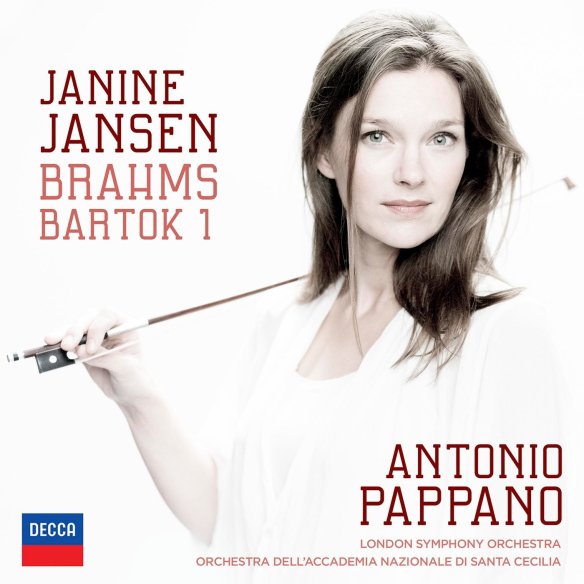
On record: Janine Jansen plays Brahms and Bartók Violin Concertos

Featured recording: Janine Jansen pairs the Brahms Violin Concerto with Bartók’s First
brahms-bartok-jansen

Leading violinist Janine Jansen explores violin concertos by Brahms and Bartók, bringing out the Hungarian connections between them. The accompaniment is from Antonio Pappano and orchestras from the Santa Cecilia Academy and London.

What’s the music like?

This is an unusual pairing that has not been tried on disc before, but it makes perfect sense. Brahms’ Violin Concerto has a finale that makes much of Hungarian gypsy music, so the leap from that to the thoughts of the young Bartók is not as big as you might think.

The Brahms is a big piece, heavily weighted towards its first movement, which at 21 minutes is more than half the length of the work. In this recording Janine Jansen uses cadenzas (the display parts for violin alone) written by Joseph Joachim, Brahms’s friend and the dedicatee of the concerto. Joachim was a long-fingered virtuoso, and because of that the violin part is technically very demanding.

Bartók’s Violin Concerto no.1 is the first of two such published works, and was completed when the composer was in his mid-20s. It also includes traditional Hungarian music but now the language is noticeably more modern, with crunchy harmonies, swaggering cross rhythms and a solo part that sounds more like a duel with the orchestra. In the Brahms the two forces are very much ‘on side’.

Does it all work?

This is an inspired pairing. Jansen plays with a beautiful tone in the Brahms but just as much credit should be levelled at conductor Antonio Pappano and the Santa Cecilia orchestra, for their singing accompaniment that makes the listener want to hum along with the tunes. The Brahms has been recorded a lot of late but in this recording there is a fresh approach, as though the melodies have just been written. The oboe solo in the slow movement is gorgeously played, while the rustic finale is joyous and uninhibited.

The Bartók is similarly fresh, and again the orchestra – this time the London Symphony – cut through all the different textures and crossrhythms to make sense of this occasionally complex music. The rhythmic profile is strong once again, while technically Jansen is right at the top of her game, graceful in the first movement and gritty in the second but without losing any poise.

Is it recommended?

Yes. The two works complement each other in a highly original and brilliantly played pairing.

Listen on Spotify

You can judge for yourself by hearing the album on Spotify here:

On record: Leif Segerstam conducts Sibelius – Works for the stage (Naxos)

leif_segerstam

Leif Segerstam, conductor of an intriguing series of Sibelius works for the stage on Naxos, where he directs the Turku Philharmonic Orchestra.

In recognition of 150 years since the birth of Finland’s greatest composer, Jean Sibelius, his countryman Leif Segerstam has been illuminating his music for the stage. In a year where the composer’s seven symphonies have been ubiquitous in orchestral concerts, it is really gratifying to have these new versions of relatively rare works made available – even more so since they are given here in complete rather than abridged versions.

What’s the music like?

Sibelius is a fascinating composer in this field, and is able to set a scene with little to no preparation. His economical treatment of melodies can come across as brusque, but he is never less than interesting and writes music that is occasionally puzzling but frequently moving.

segerstam-pelleas

Listeners will more than likely know the first number of Pelléas et Mélisande, At The Castle Gate, for the grand way it has provided the soundtrack to the BBC TV programme The Sky At Night.

Yet there is much else to discover in this music. Segerstam may not be as high powered as some conductors in his interpretation but the music is still deeply felt from the Turku Philharmonic strings, while there is a nice reedy woodwind sound.

The Adagio from Act 1 is notable for the sharp woodwind intervention and coarse strings, providing a chilling outlook, while there are some lovely colours in the opening to Act 3, where the influence of Tchaikovksy still evident.
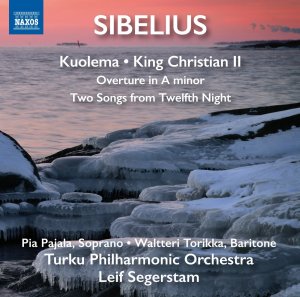
segerstam-kuolema

One of the numbers for Kuolema (Death) is one of the composer’s most popular encore pieces. Valse triste, as we know it, begins six scenes of music for a drama by Sibelius’ brother in law Arvid Järnefelt. Segerstam takes it slowly, but is poised and graceful throughout, as he is in the brooding Scene with Cranes, another Sibelius favourite.

Then he is joined by the fulsome baritone of Waltteri Torikka, who gives Paavali’s Song a convincing presence, while Pia Pajala is clear and crisp in Elsa’s Song. The last scene is strangely chilling, with the fateful tolling of bells.

The seven numbers Sibelius composed for the relatively early King Christian II, a Scandinavian historical play by his friend Adolf Paul, begin with a majestic Elegy, conclude with a tempestuous Ballade and include a substantial central Nocturne that proves surprisingly lively for the night time, building to a really impressive climax that reminds us how much sway Tchaikovsky holds over Sibelius’ early output. The whole score is beautifully performed, Segerstam clearly holding great affection for the romantic score.

segerstam-belshazzar

It was satisfying to see Sibelius’s music for Belshazzar’s Feast making a comeback at the BBC Proms this year, and in Segerstam’s hands we enjoy a colourful opening procession and a penetrating flute solo in the NocturnoPia Pajala deserves special credit for a fulsome soprano solo in The Song of the Jewish Girl.

The two discs where the corners of Sibelius’s output are really deeply explored are those devoted to music for Jedermann (Everyman) and Scaramouche.
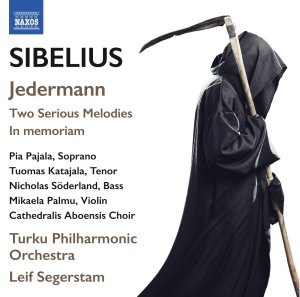
segerstam-jedermann

The former carries a chilling picture of a sabre-wielding Death on the cover and it is certainly very dark to start with, with some strikingly beautiful writing for strings that Segerstam is keen to bring out, especially when heard in a solo capacity in the Largo. There is more choral music in this score, sung with commendable spirit by the Cathedralis Aboensis Choir, and there is a memorable main tune that makes regular reappearances throughout. The sonorities become appreciably sweeter when the organ gets mixed in for the second part of the Adagio, but this is music that never really settles, and in the section marked ‘Con grande dolore’ there are some disarming sweeps from the strings.
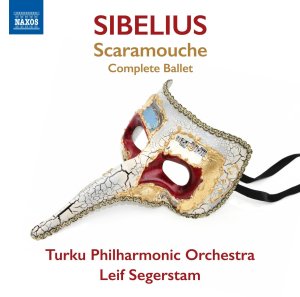
segerstam-scaramouche

Scaramouche caused Sibelius a lot of problems in its composition, causing him to break a telephone on one occasion, but it still has some striking qualities. The bolero in Act 1 is a very curious stop-start dance where what sounds like a bandoneon is used, while in Scene 6 of Act 2 (again untitled) there is extreme uncertainty, both here and in the start of the successive number in the harmonies and wind colouring. Scene 9 conjures up a favourite Sibelius tactic, the bouncing of bows on the strings. So while a bitty score, Scaramouche still generates a good amount of interest and mystery.

segerstam-swanwhite

 Swanwhite is quite an elusive piece but once again is revealed to have a mixture of charm and mystery. The former quality can be found in the third number of Act 2, where there is a poised and rather lovely dialogue between flute and strings, but by contrast the fifth number wears a stern expression, especially through its clarinet part. There are however some moments of pure serenity in Swanwhite, and while at times its music seems to have a short attention span it nonetheless leaves a lasting impression.

The Lizard, far from a makeweight, is a fascinating piece that shows all the composer’s hallmarks in their early stages – though when hearing the music it sounds a lot later than its publication number, Op.8, might suggest. The sweeping violas, the cold and often eerie unison string lines, and the shivers from tremolo strings around 17 minutes in – all are hallmarks of the mature composer and mark him out as an orchestral colourist of the highest quality.

One of the appealing qualities of Segerstam’s discs is the programming, as alongside the stage works he takes the opportunity to include rarely-heard items such as two songs from Twelfth Night, the Overture in A minor, and many more. These help put the Sibelius output in context, and while they might not be classed as masterpieces the works do still contain moments of inspiration and originality. While the Overture in E major may be an obvious early work, Scene de Ballet gets out the castanets to good effect, before finishing in typically abrupt manner. There is a glint in the eye of the waltz Musik zu einer Szene, and a graceful Valse lyrique. The Overture in A minor could only be by Sibelius, and offsets its stern brass with increasingly active strings before suddenly cutting to a brighter, energetic outlook. The Cortège is a piece of grand ceremony though still has its subtleties, while the Processional is a solemn piece. Meanwhile the short Menuetto has Sibelius’ own stamp on it, richly coloured and quite grounded, before once again stopping suddenly.

These are then extremely valuable additions to the Sibelius discography, and are highly recommended to those looking to progress beyond the ubiquitous symphonies. Though the symphonies make one of the twentieth century’s finest collections in the form, Sibelius was a much deeper composer than that – and in these recordings Segerstam proves that beyond doubt.

Does it all work?

Frequently. These are fascinating pieces, though listeners are advised to read the booklet notes either during or before hearing so that Sibelius’ acute scene setting can be fully appreciated.

Is it recommended?

Yes – especially to those who have gotten to know Sibelius through his symphonies. The stage works reveal the composer in a different light, and provide a substantial complement. They also show his remarkable powers of musical concentration and orchestral colouring.

Listen on Spotify

Pelleas https://open.spotify.com/album/2Hd0S5a6jiOzDziBVJ3uNR
Kuolema https://open.spotify.com/album/5NfQh1uva2xxerW8yNbqlr