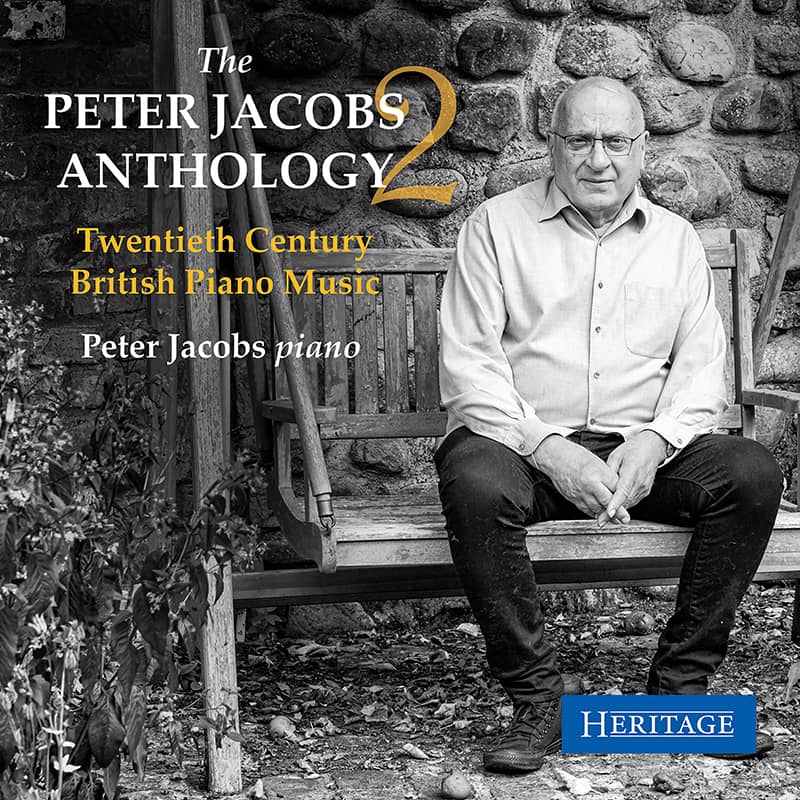
On Record – The Peter Jacobs Anthology Vol. 2 – Twentieth Century British Piano Music (Heritage)

Coleridge-Taylor Petite Suite de Concert Op.77 (1911)
Cooke High Marley Rest (1933)
Delius Mazurka and Waltz for a Little Girl RTIX/7, 1 & 2 (1922-3)
Headington Toccata (1963)
Rubbra Eight Preludes Op.131 (1967)
Scott Lotus Land Op.47/1 (1905)
Armstrong Gibbs Lakeland Pictures Op.98 (1940) – no.2, After Rain (Rydal Beck); no.8, Quiet Water (Tarn Howe)
Baumer Idyll (1935)
Mayer Calcutta-Nagar (1993)

Peter Jacobs (piano)

Heritage HTGCD131 [73’30″]
Producer & Engineer Paul Arden-Taylor

Recorded 14 & 16 September 2014 at Wyastone Concert Hall, Wyastone Leys, Monmouth

Reviewed by Richard Whitehouse

What’s the story?

Heritage extends an already extensive discography of British music with its follow-up to the Peter Jacobs Anthology, a further volume featuring collections of or standalone miniatures with a wide range of musical idioms given focus through the persuasiveness of the pianism.

What’s the music like?

Among the miscellaneous pieces included here are Greville Cooke’s ruminative ‘portrait’ of the home of pianist (and his former teacher) Tobias Matthay, Delius’s respectively pert and fey offerings, or Christopher Headington’s scintillating study for John Ogdon. Cyril Scott’s evergreen is treated to a subtly understated reading, while two out of a set of eight by Cecil Armstrong Gibbs provide enticing evocations of Rydal Beck then Tarn Howe – their innate Englishness sounding removed from the overtly Russian manner of that from Cecil Baumer.

Forming the backbone of this collection are three sets that in themselves attest to the variety of the music featured. Best known in its orchestral guise (a recording of which can be found on Heritage HTGCD249), Samuel Coleridge-Taylor’s Petite Suite de Concert is light music of a superior kind – witness its flighty initial Caprice, its ingratiating Sonnet or its lively closing Tarantelle, though its ostensible highlight is Demande et Réponse whose alluring sentiment helped with keeping the composer’s memory alive prior to his belated rediscovery.

Other than figuring among its composer’s later works, the Eight Preludes by Edmund Rubbra could hardly have been more different. As with his Eighth Symphony written soon afterward, these short while arresting pieces likewise focus on specific musical intervals rather than any overall key scheme, though their cohesiveness heard as an integral sequence could never be in doubt. Introspective without being inscrutable, this is wholly absorbing music and Jacobs accords ample justice to what is only the second complete recording this set has yet received.

As the most unlikely inclusion, John Mayer’s Calcutta-Nagar proves nothing less than a total delight. Known primarily for his syntheses of Indian and European elements, notably through the group Indo-Jazz Fusions, Mayer wrote extensively for Western media with this collection a notable instance. Only two of its 18 pieces last over a minute, yet their capturing of places recalled from the Calcutta of the composer’s youth is absolute. Jacobs notes his favourite as being the 13th (Kali Temple), but listeners will doubtless come up with their own favourites.

Does it all work?

Yes, whether as a judiciously planned collection or an anthology from which one can select individual items as preferred. The three collections are each among the most distinctive of its kind, while they and the various individual pieces provide ready-made encores in recital. Evidently this is music which Jacobs has long included in his repertoire, the performances exuding that combination of technical finesse allied to a probing insight as have long been hallmarks of his interpretations. Those who are unfamiliar with this music are in for a treat.

Is it recommended?

Indeed, not least as the sound has a combination of clarity and warmth ideal for piano music. The pianist pens informative notes, and one hopes that there will be further such anthologies. Meanwhile, Jacobs approaches his 80th birthday (this August) with his pianism undimmed.

Listen & Buy

For purchase options, you can visit the Heritage Records website

Published post no.2,448 – Monday 17 February 2025

On Record – Corelli Orchestra / Warwick Cole – William Hayes: Instrumental Music (Heritage Records)

William Hayes
Harpsichord Concerto in G major (c1740)
Harpsichord Concerto in D major (1755)
Concerto Grosso in D major (1758)
Concerto Grosso in G minor (1758)
Trio Sonata in E minor (1775)
The Fall of Jericho – Sinfonia (c1750)

Corelli Orchestra / Warwick Cole (harpsichord)

Heritage HTGCD134 [74’]
Producer Simon Heighes Engineer Paul Arden-Taylor

Recorded February 2010 at Prince Michael Hall, Dean Close School, Cheltenham; July 2018 at Church of St Philip and St James, Cheltenham

Reviewed by Richard Whitehouse

What’s the story?

The Heritage label adds yet another enterprising release to its expanding catalogue with this representative selection of instrumental music by William Hayes (1708-1777), idiomatically rendered by the Corelli Orchestra and its founder director, the harpsichordist Warwick Cole.

What’s the music like?

The most substantial works are two harpsichord concertos. That in G major is notable for the close-knit interplay between soloist and strings of its lively initial Allegro or the deft humour of its closing Minuetto, but it is the central Andante which leaves the strongest resonance – its intricate solo part (with two elaborate cadenzas) and its plangent expression both anticipating the ‘Sturm und Drang’ inclinations of a subsequent generation. That in D major (derived from an organ concerto) follows a not dissimilar trajectory, its buoyant and harmonically questing Allegro followed by a brief yet affecting Adagio for the soloist unaccompanied then a finale that takes in a wider expression than its Tempo di Menuetto marking might indicate. Equally effective are those transitions for soloist then strings as afford this work its overall continuity.

Taken overall, the six concerti grossi are Hayes’s most substantial legacy to the instrumental domain. That in D major duly alternates Andante movements of subdued pathos with Allegro movements in which this composer’s much-heralded contrapuntal facility is to the fore, while that in G minor owes its larger scale to the ruminative Larghetto which, preceded by a wistful Affetuoso and coursing Allegro then rounded off by a lilting Pastorale, is a sure pointer to the Classicism that lay ahead. It may be the shortest piece featured here, but the Trio Sonata in E minor (itself the final contribution to a set of six) is overall even more most forward-looking as it unfolds from a pathos-laden Adagio, via an incisive Allegro (which is pointedly marked ‘staccato’) followed by a gravely eloquent Largo, to the gracefully elegant closing Grattioso.

That just leaves the Sinfonia to the oratorio The Fall of Jericho which was likely the largest work Hayes completed. More than a mere curtain-raiser, this substantial piece begins with a purposeful Andante notable for trenchant oboe writing – as also the Largo into which it leads and whose plaintive melodic line makes it an aria in its own right. There follows an Allegro of deftly propelled impetus, then an Andante such as provides overall balance in terms of its undulating gait. A performance of the complete work can also be obtained at Fall of Jericho

Does it all work?

Yes, and not only viewed within its aesthetic remit. Acknowledged during his lifetime as one of the few English composers able to hold his own against Handel, Haynes (who dominated academic life at Oxford for three decades) left an output whose scope is evidently in advance of its size. Historically significant for being on the cusp between Baroque and Classical eras, his work is always appealing – not least given the poise and finesse of the Corelli Orchestra, an ensemble whose ‘authentic’ credentials never draw attention away from its music-making.

Is it recommended?

Indeed, and not least with annotations by Simon Heighes (no doubt recalled by some readers for his insightful reviews in International Record Review), whose book The Lives and Works of William and Philip Hayes (Garland Press: 1995) is the standard study about this composer.

Listen & Buy

For buying options, you can visit the Heritage Records website

Published post no.2,444 – Thursday 13 February 2025

On Record – Various Artists: Staying (Leaving Records)

by Ben Hogwood

What’s the story?

Emmett Shoemaker writes profoundly and eloquently in the documentation to this release, penned on 13 January – detailing the heartbreaking story behind Staying. Masterminded by Leaving Records head Matthewdavid, this is a massive compilation of 90 tracks released to benefit those whose lives have been wrecked by the “heretofore unimaginable destruction in the land we now call Los Angeles.”

Shoemaker wrote, “The wildfires that began on the morning of Tuesday, January 7th—and which are still raging—are, in scope and intensity, unlike any other disaster, natural or manmade, in the city’s living memory. Thousands of homes destroyed. Twenty-four lives lost at the time of writing (that number will almost certainly rise), and innumerable lives forever altered. The devastation arrived suddenly, and has persisted over the course of a punishing and surreal week.”

Later, he details the heartbreak suffered. “The individuals and communities affected in this moment are numerous and varied, but it is the case that Los Angeles’s musical community has been absolutely upended. The Palisades fire, with its reach into older parts of Malibu and Topanga Canyon, and the Eaton fire, in its virtual erasure of Altadena, have affected some of the only areas in Los Angeles where working musicians could live with a modicum of comfort—Though, as we are all too aware in this moment, precarity has always been part of the bargain here.” Later still, “Leaving Records in particular has deep roots in Altadena. Label founder MatthewDavid cut his teeth printing J cards at a home operation in the neighbourhood, and countless Leaving artists reside in the area. Many of these artists have either definitively lost their homes or are currently waiting to learn their fate. The path to rebuilding (how long it will take, what it will cost, whether it is even feasible) remains terribly unclear.”

Finally, “Seeking to supplement the numerous GoFundMes and the profound, often harrowing acts of mutual aid that are currently buoying recovery efforts, and in lieu of donating to a third party organization, all proceeds will be donated directly to impacted individuals. 50% will be meticulously,  manually allocated to Los Angeles artists and music colleagues in need, as equitably as possible. We will be referencing existing music community aid spreadsheets / documents already circulating, alongside a succinct internal list of those affected in our immediate community. The other 50% of funds will be allocated to displaced Black families and community impacted by the fires, again, as equitably as possible.

Personal and collective healing, ecological recuperation, spiritual transcendence, radical communality — these concerns are woven into Leaving’s roster and catalog. Never in the label’s history has it been so called upon to celebrate and implement these principles. Though we may not even know what “hope” constitutes yet, we know we’ve got it somewhere. We know it’s in solidarity, and we know it’s in the music.”

What’s the music like?

To say this is a generous offering from Matthewdavid would be a massive understatement. $15 buys you a digital album crammed to the brim with 98 tracks, including luminaries such as Laraaji, Julia Holter, Peaking Lights, Steve Roach, André 3000 and of course Matthewdavid himself. Vinyl and cassette options are also available.

The compilation may be sprawling but the standard remains incredibly high throughout – and it is a moving experience listening in the context of what these artists have had to deal with.

Highlights that Arcana has plucked illustrate the sheer musical variety of what is on offer here. They include the appealing oscillations of Xyla, the soothing ripples of the harp on Beyond Beyond from Earthtones with Shelley Burgon, or the melodic sweeps of Arushi Jain’s California, that feel like exclamations in the wake of the fires.

Charlene’s Mantra, from V.C.R., is a subtle call to arms, while by complete contrast MIZU offers an extended and immersive ambient track, The Course Of Empire. Baths and More Eaze are playful, Eddie Chacon’s Fate is an intimate confidential, while Sweatson Klank offers hope in the dreamy Find Our Way Back. Peaking Lights are typically mesmeric, Honeydrip exuberant, and Laraaji’s Joyous Dance ’82 full of bright and positive energy.

Ohma’s Live at LTMOITDUAT 10.14.23 has vibrant duetting saxophones, the instrument then fluttering gently on the thoughtful Matters Of Time from Anenon. There are good grooves, too, notably Automatic’s Mq9 and Jon Makes BeatsThe Mountain. Freeform tracks come from Matt Baldwin and Spencer Zahn, contrasting with the wall of sound offered up by Ryan York. The shimmering and rather magical Brijean track Strange Times takes the form of a live dubby workout, while lively percussion infuses Café Ale’s 60 W Palm. Aisha MarsSong For My Father. Toucan’s Stay is a carefree electro number, a polar opposite of Tate EC’s Wings, with its feathery outlines.

Does it all work?

It does. This is such a wide range of music, embracing fast and slow, colourful, stylish, ragged, improvised and processed. All for a meaningful cause!

Is it recommended?

Without question – it’s a no-brainer.

Listen / Buy

Published post no.2,443 – Wednesday 12 February 2025

On Record – Tunng: Love You All Over Again (Full Time Hobby)

by Ben Hogwood

What’s the story?

Tunng have enjoyed 20 years’ existence as a band, in which time their musical philosophy has remained constant. They might ask themselves ironically on Everything Else, “why do we do this?”, but their particular brand of music continues to spread its peculiar brand of warmth.

The band have always tended towards ‘switched-on’ folk music – that is, lyrics that find a common ground over glitchy, electronic loops and beats, with curious field noises and riffs that seem initially harmless but burrow into the listener’s brain.

Love You All Over Again celebrates all that and more, harnessing everything the band loved about their debut LP, This is Tunng… Mother’s Daughter and Other Songs, feeding in the experience gained in two decades and – typically – putting it through a slightly skewed blender.

What’s the music like?

Still very Tunng – which is, of course, a big compliment. The band have retained their singalong choruses, their quirky but meaningful lyrics, the bits of open air recording and processing that lead the ear this way and that, messing with perspective as they suddenly pan out from close intimacy to a stone’s throw away and then back again.

Unexpectedly tender moments cast a spell too, like the softly played guitar motif of Didn’t Know Why, which cuts to a wistful, singalong chorus – until suddenly you realise what the lyrics are, the familiar character of the murderous Jenny brought back amid lengthening shadows. Sixes is a satisfying blend of acoustic and electronic, but Snails shows how the group’s aptitude for new colours remains as keen as ever, its lovely clarinet and pizzicato strings an ideal match. Drifting Memory Station creaks and whirs, casting a sleepy spell as its mechanics grind lazily together.

The band’s vocals are still an ideal match, Becky Jacobs complementing Sam Genders and Mike Lindsay as the three main protagonists. They sing together rather movingly on the haunting Laundry, against a backdrop of chattering electronics and tender woodwind.

Does it all work?

It does. Tunng have an appealing mix of confidence, vulnerability and darkness that blend together in sounds that can move between rousing choruses and mildly horrific confessions.

Is it recommended?

Enthusiastically. In their own way, Tunng are national treasures, and have a corner of the interface between folk and electronic music all to themselves.

For fans of… King Creosote, Efterklang, Beta Band, Stereolab

Listen / Buy

Published post no.2,442 – Tuesday 11 February 2025

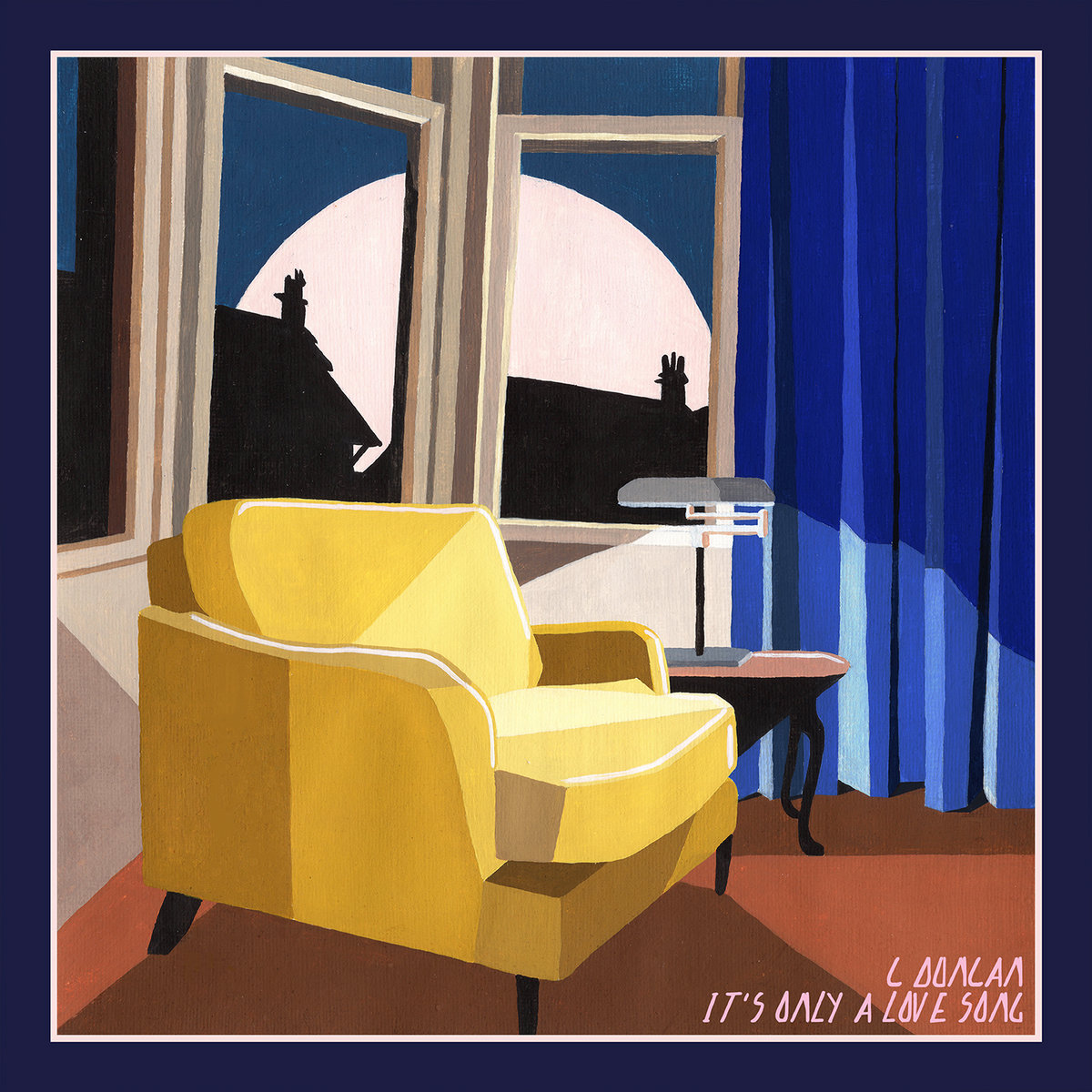
On Record – C Duncan: It’s Only A Love Song (Bella Union)

by Ben Hogwood

What’s the story?

Glasgow songsmith Chris Duncan moves seamlessly onto his fifth album, his second for Bella Union.

“I love the idea of something being so romantic that it almost hurts”, he says ahead of the modestly-titled opus, which is something of a family affair. Described as a ‘song suite’, it celebrates marriage with his long-term partner, but also reflects on times of stress and loss. The latter is expressed in symbolist terms on Triste Clair de Lune, where Duncan writes a “song about the moon losing a part of itself that floats down to earth, and this exquisite light being found by humans. And all the stars above lamenting the loss of this light.”

The family connection extends to his parents, both classically trained string players, who helped realise most of the lush orchestrations.

What’s the music like?

Once again, C Duncan delivers windswept pop music of the highest quality. Clearly borne of personal experience, his writing tugs at the heart strings with its powerful yearning, expressed through the beautiful soft timbres of his vocals.

This is immediately apparent in the title track, but also Lucky Today, a song of heartfelt sincerity. The sense of loss and hurt can be felt but ultimately these songs are uplifting and reach upwards in wonder, as on Sadness, where the lyric “dry those weary eyes” is set to positive melodic thoughts. Worry is an absolute beauty, softly delivered but far reaching, its harmonic shifts melting the hardest of exteriors and its multilayered vocals a true chorus of angels.

It is amazing how a song like Think About It is not a radio staple, for Duncan harnesses the best of 1980s soft rock while adding some extra twists and turns along the way, with unexpected harmonic sleights and lush orchestration. Delirium brings more urgency to the vocals, while Surface could even be a big Tim Burton show number, with its swirling chorus and textures. Duncan wraps up with iTime And Again, a twilight epilogue of serene beauty and swooning orchestral forces.

Does it all work?

It does – another volume of winsome songs, beautifully delivered.

Is it recommended?

It is, enthusiastically – but with the proviso that if you haven’t heard the music of C Duncan by now, you really should get to know it. Not just this album, but the four before it.

For fans of… The Blue Nile, Prefab Sprout, 10cc, Brian Eno

Listen / Buy

Published post no.2,441 – Monday 10 February 2025