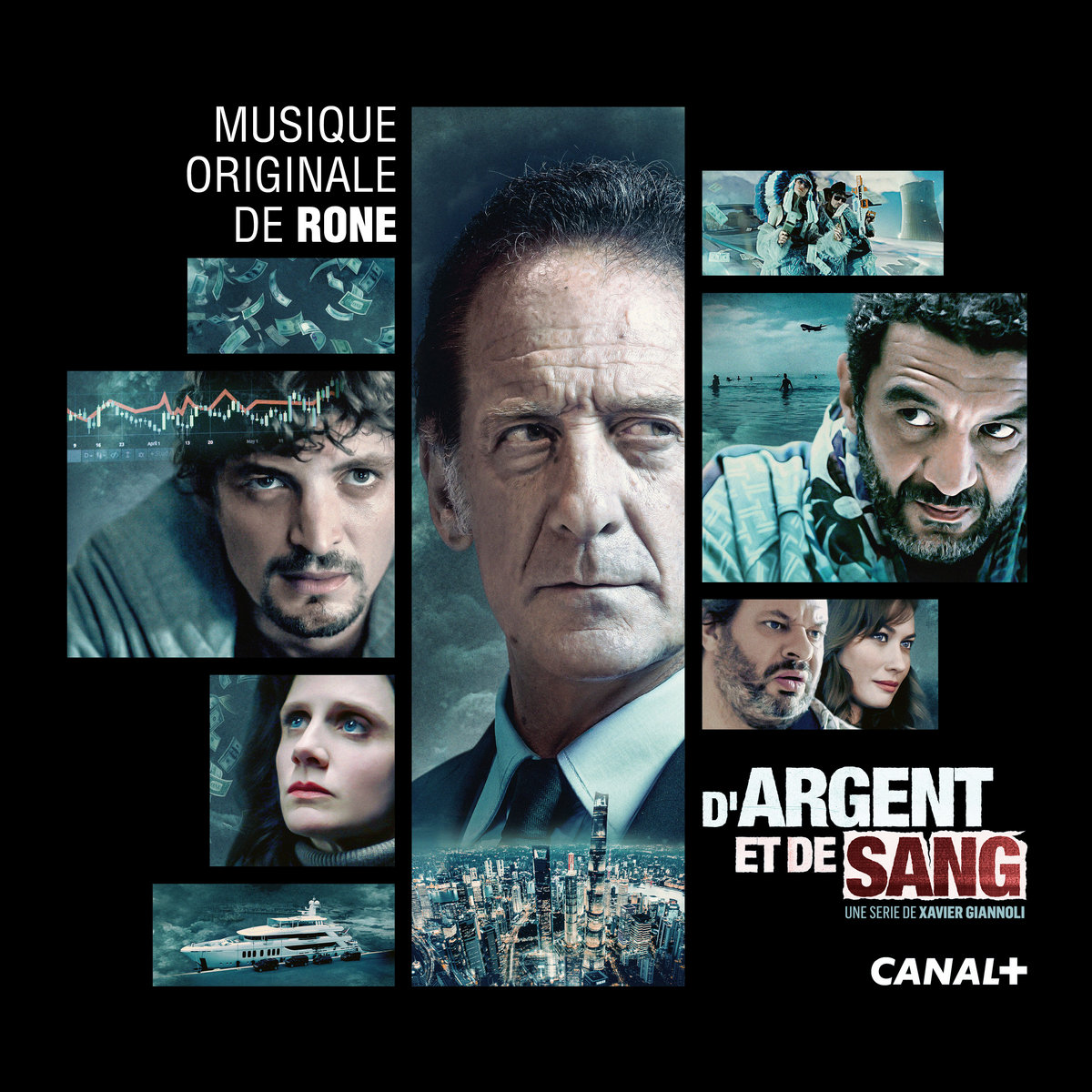
On Record – Rone: D’Argent et De Sang (Original Series Soundtrack (InFiné)

by Ben Hogwood

What’s the story?

The InFiné press release for this soundtrack does a fine job of setting the brief for the most recent soundtrack release from Rone. The French musician and composer has been tasked with writing a score for D’Argent & De Sang (originally titled Tikkoun), produced by Curiosa Films and directed by multi-César winning showrunner Xavier Giannoli.

Rone mixes orchestral textures with electronic elements to ‘symbolize the heterogeneity of the worlds that intersect on the story’. The story is that of the Carbon Tax scam, and Rone talks about how ‘we needed repetition and redundancy to highlight the theme of obsession, which is central to Xavier’s work – and to support the developments in the investigation and its characters’.

What’s the music like?

There is no doubt that Rone is a composer to watch, as his skill in blending orchestral and electronic music is becoming ever more accomplished and imaginative.

With D’Argent & De Sang he succeeds comfortably in following the brief, and the theme of obsession is hammered home. It helps for the listener to know the plot beforehand, as it explains Rone’s continued return to the main theme – but he is clever enough to set it in different context and give it different musical meaning.

The twinkling, shimmering opening pages of Tikkoun present the recurring theme, imaginatively scored. We here the sequence in various guises, from forthright string quintet to steely piano, expressively played by Vanessa Wagner. Rone’s pair of Electronic Variations are serene, in contrast to the grainy strings that darken the mood on Stress, with the use of creeping quarter tones. dRONE03 is ominous, while Jackpot is a powerful climax, combining the strings and electronics to good effect.

Does it all work?

It does – though there is the familiar issue with listeners to soundtracks that some ideas do not get developed as much as you would like, simply because Rone is following the brief. That said, his work is consistently rewarding, from the orchestra that bloom on headphones or widescreen, or the intimacy of the single piano.

Is it recommended?

It is – this is impressive stuff from the Frenchman, who is really carving a name for himself as a composer of some repute.

For fans of… Max Richter, Daft Punk (the TRON soundtrack), Jean-Michel Jarre and Vanessa Wagner

Listen

Buy

Published post no.2,061 – Friday 19 January 2024

On Record – Soloists, Transylvania State Philharmonic Choir & Orchestra / Lawrence Foster – Kodály: Te Deum & Psalmus Hungaricus; Bartók: Cantata Profana & Transylvanian Dances (Pentatone)

Kodály
Budavári Te Deum (1936)
Psalmus Hungaricus Op.13 (1923)
Bartók
Transylvanian Dances (Erdély táncok) Sz. 96 (1931)
Cantata Profana Sz. 94 (1930)

Luiza Fatyol (soprano, Te Deum), Roxana Constantinescu (mezzo-soprano, Te Deum), Marius Vlad (tenor, Te Deum and Psalmus Hungaricus), Ioan Hotea (tenor, Cantata Profana), Bogdan Baciu (baritone, Te Deum and Cantata Profana), Junior VIP, Children’s Choir (Psalmus Hungaricus), Transylvanian State Philharmonic Choir & Orchestra / Lawrence Foster

Pentatone PTC 5187071 [64’14”] Texts and English translations included

Executive & Recording Producer Job Maarse Balance Engineer & Editing Erdo Groot Engineer Lauran Jurrius
Recorded May 2022, Radio Studio of Radio Cluj, Romania

Written by Ben Hogwood

What’s the story?

Here is a chance to gain an insight into the choral music of two 20th century Hungarian composers known predominantly for their orchestral works. Bartók and Kodály were born just a year apart, and while their music is fiercely proud of their heritage their musical trajectories extend well beyond Hungary. Kodály stayed largely within Europe but brought back influences from Paris, while Bartók reluctantly emigrated to the US in late 1940.

Psalmus Hungaricus was Kodály’s first major post-war composition, in 1923. It is a landmark in his output, using for its text a Hungarian paraphrase of Psalm 55. Kodály uses a tenor soloist for the central dramatic role, the choir taking up their position as commentators. The Budavári Te Deum, completed 13 years later, marks the 250th anniversary of the liberation of Buda Castle from the Turks. While referencing Gregorian chant, Kodály incorporates references to Hungarian melodies and ornamentations in a dramatic setting.

In 1930 Bartók completed his first major work for chorus and orchestra. Cantata profana has Transylvanian roots, and Oana Andreica’s booklet note gives the context of its libretto, starting from two Romanian ‘colinde’ – ballads sung during the Christmas season but with a wide range of subjects well beyond the birth of Christ. Such is the case here, Bartók dramatising a myth of nine sons turned into stags. The cantata charts their fate and their father’s conflicting emotions, expressed by a baritone soloists. The Transylvanian Dances are a complementary addition, a short trio of works for small orchestra containing five traditional songs.

What’s the music like?

The Budavári Te Deum is a thrilling start to the album. This is red-blooded choral writing, Kodály diving in headlong to a high octane first section. He challenges choir’s higher sections, who respond admirably to the loud dynamic, retaining impressive clarity in the part writing. The work’s climactic points are notable for their power and passion.

This performance of the Psalmus Hungaricus has the authentic inflections to the melody, its bracing start turning to contemplation. Tenor soloist Marius Vlad inhabits the full tone and strong line demanded by Kodály, and sung so memorably by Ernst Haefliger in the legendary recording with Ferenc Fricsay. This makes for a fine digital alternative, with the choral response both full-bodied and unified. The meaningful counterpoint between Vlad and the Transylvanian woodwind in the middle section (Te azért lelkem) is especially memorable.

Bartók’s Cantata profana starts ominously, with an underlying menace that grows steadily as the hunt in the story progresses. Again the choral passages are well drilled, especially when in league with the percussion. The passionate tenor solo (Ioan Hotea) and fulsome bass (Bogdan Baciu) prove to be ideal foils, alighting on some spicy chords. There is little consolation at the end, in spite of the relative calm this performance leaves.

The Transylvanian Dances are over in a flash but leave a charming impression, with rustic themes. The recording is much closer, taking the action indoors to the tavern rather than outside in the wilds.

Does it all work?

Very much so. There is an adjustment to be made for the Transylvanian Dances, with the smaller ensemble and closer recording, but the performances justify the means. The choral works are a resounding success, brilliantly performed and with electric singing from the Transylvania State Philharmonic Choir, especially in the high passages. The orchestra match them under Lawrence Foster, who secures incisive rhythms and impressive clarity from such large forces.

Is it recommended?

It certainly is. This is an enterprising and very accessible coupling of three thrilling choral works, revealing fresh insights into the Hungarian composers.

Listen

Buy

For more information on this release and for purchase options, visit the Pentatone website

On Record: Bruce Brubaker – Eno Piano (InFiné)

by Ben Hogwood

What’s the story?

To read the full story behind Eno Piano, you can read Arcana’s recently published interview with Bruce Brubaker. In it he sets out his quest to recreate Brian Eno’s ambient masterpiece Music For Airports, made through tape loops and studio techniques, for a living and breathing musician to play on the piano.

To get the necessary sustain Brubaker has employed a number of intriguing techniques, not least the use of electro-magnetic bows over the piano, enabled by Florent Colautti.

While Music For Airports is the main act, Brubaker places it in the context of shorter works by Eno that have a more descriptive edge – The Chill Air, a collaboration with the late Harold Budd, By This River, co-written with Dieter Moebius and Hans-Joachim Rodelius, and Emerald and Stone, where his collaborators are Jon Hopkins and Leo Abrahams, with whom he still works a great deal.

What’s the music like?

Incredibly restful – which of course is a description you could level at the original Music For Airports. Job done, you would think, but the reproduction of this music in human hands does reveal a slight and unexpected intensity, the performer having to maintain a very high degree of concentration and control to get close to honouring Eno’s original music.

Brubaker certainly does that, and the electro-magnetic bows help the sustain very subtly at the start of Music For Airports 2/1. The whole thing is so carefully thought through that each note feels researched but also instinctive, especially in 2/2 where the angular lines create an extraordinary sense of space.

While Music For Airports is indoors, the other three pieces are very much outside, and have a refreshing clarity. The Chill Air and By This River are bracing, wintry piano music.

Does it all work?

It does. When Bang On A Can released their chamber ensemble version of Music For Airports in 1998 it gave a new dimension to Brian Eno’s thinking. This piano work will have a similar effect, and is even more intimate in its confines.

Is it recommended?

Yes. Any Eno fan will want to hear this, and Bruce Brubaker shows just how imaginatively and thoughtfully he can attend to the music of others. This is a quiet revelation.

Listen & Buy

Published post no.2,046 – Thursday 21 December 2023

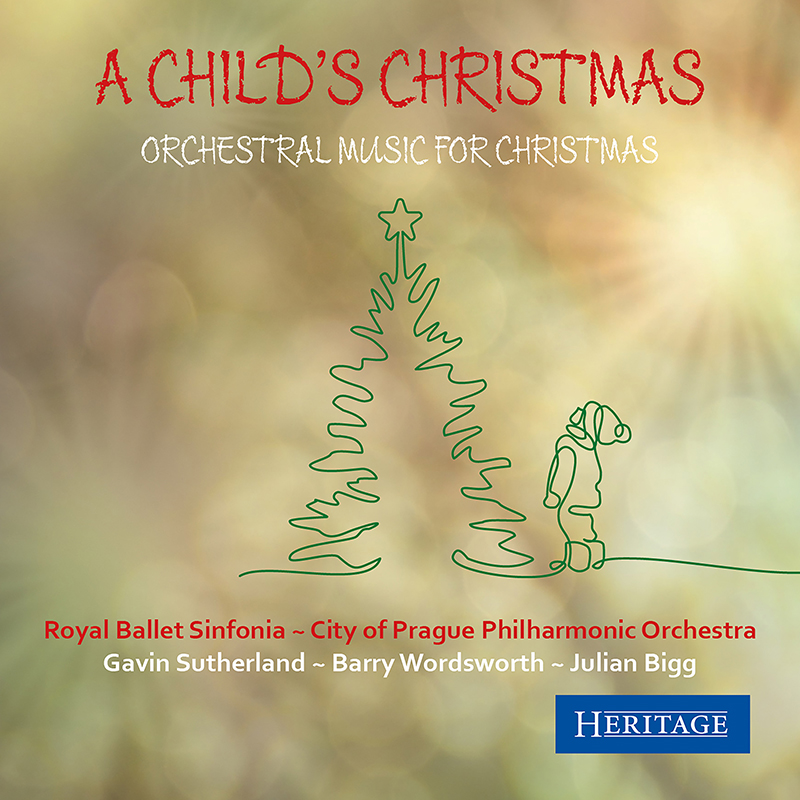
On Record: A Child’s Christmas – Orchestral Music For Christmas (Heritage)

Hely-Hutchinson Overture to a Pantomime (1946)
Hewitt Jones Christmas Party (2016)a; Overture: The Age of Optimism (2023)
Kelly Sing a Song of Sixpence (2020)
Lanchbery Tales of Beatrix Potter – excerpts (1971)
Lane/Nicholls Suite: The Adventures of Captain Pugwash (1999)b
Moore Santa’s Sleigh Ride (2019)
Saunders A Magical Kingdom (2003)a; Journey to Lapland (2020)
Thornett A Child’s Christmas (2016)a

Royal Ballet Sinfonia / Barry Wordsworth, aGavin Sutherland; bCity of Prague Philharmonic Orchestra / Julian Bigg

Heritage HTGCD139 [66’03’’]

written by Richard Whitehouse

What’s the story?

Heritage adds to the festive cheer with this latest anthology of music for, about or appropriate to Christmas as heard from a child’s perspective, expertly realized by this brace of orchestras and three conductors, in what should prove the ideal addition to anyone’s Yuletide listening.

What’s the music like?

The effervescence of Victor Hely-Hutchinson’s Overture to a Pantomime sets the ball rolling ideally, replete with Sullivan-like melodiousness whatever its lack of seasonal tunes, then into the title-track by Gordon Thornett – an appealing concocted medley with more than a hint of Tijuana to the brass (anyone recall the Torero Band’s 1968 masterpiece Tijuana Christmas?) and winsome writing for the woodwind. Adam Saunders displays his light-music credentials in the catchiness of A Magical Kingdom, then a deftly evocative touch in Journey to Lapland.

The youngest composer here, Thomas Hewitt Jones contributes two of the most substantial pieces in the cinematic Christmas Party, unashamedly old-style (not just musically) and with brother Simon the animated violinist, while The Age of Optimism makes for a stirring curtain -raiser. Roy Moore duly adds to what has become a notable Christmas sub-genre with Santa’s Sleigh Ride, while Bryan Kelly proves to be the present-day Roger Quilter with Six a Song of Sixpence – an extensive and resourceful fantasia on children’s songs both witty and amusing.

Prolific conductor and arranger for ballet, John Lanchbery (whose centenary fell this May) is well remembered for Tales of Beatrix Potter, drawing judiciously on a range of 19th-century light music – hence the graceful ‘Introduction’ and whimsical ‘Tale of Jemima Puddleduck’, before those lively goings-on of ‘The Picnic’ head straight into the jauntiness of the ‘Finale’. Launched with its indelible signature-tune, The Adventures of Captain Pugwash finds Philip Lane and Ian Nicholls in absolute accord for this saunter through the world of the sea-shanty.

Does it all work?

Yes, given that this is a miscellany only loosely unified by its Christmas theme – most of the pieces being ideal for listening at any other time of the year. The playing of the Royal Ballet Sinfonia is finely attuned under the direction of such ballet stalwarts as Barry Wordsworth or Gavin Sutherland, and the City of Prague Philharmonic Orchestra evidently enjoyed making acquaintance with Captain Pugwash (was the cartoon shown in the former Czechoslovakia?). Nor do these recording sessions suggest anything like a 24-year timespan in terms of sound.

Is it recommended?

Indeed, given this is a worthwhile addition to the Christmas music discography and features a succinctly informative note from Philip Lane. Those who get the seasonal bug should look no further then Heritage’s volume The Spirit of Christmas [HTGCD299] for a follow-up release.

Listen & Buy

You can explore purchase options at the Heritage Records website

Published post no.1,983 – Thursday 19 October 2023

On Record: Richard Deering – William Wordsworth: Piano Music; Wilson & McGuire (Heritage)

Wordsworth
Piano Sonata in D minor Op.13 (1939)
Cheesecombe Suite Op.27 (1945)
Ballade Op.41 (1949)
Valediction Op.82 (1967)
Wilson
Incanabula (1983)
McGuire
Prelude 7 (1983)
Six Small Pieces in C (1971)

Richard Deering (piano)

Heritage HTGCD142 [77’42’’]
Producer/Engineer Paul Arden-Taylor (Piano Sonata), Robert Matthew-Walker
Recorded 1985 at University of Wales, Cardiff, 2023 at Wyastone Concert Hall, Wyastone Leys, Monmouth

written by Richard Whitehouse

What’s the story?

Heritage here continues its extensive coverage of British music with a release of piano music primarily by William Wordsworth, complemented with short pieces by Thomas Wilson and Edward McGuire, all of them heard in idiomatic and insightful readings by Richard Deering.

What’s the music like?

Although his music is now relatively well covered in terms of recording (thanks to Lyrita and, more recently, Toccata Classics), Wordsworth remains a difficult composer to pin down – not least because this understated and often taciturn idiom does not lend itself to casual listening.

Piano music features prominently in his earlier output, notably a Piano Sonata that can rank with the finest such works from the inter-war period. Its initial movement is introduced by a Maestoso whose baleful tone informs the impetuous and expressively volatile Allegro that follows. The central Largamente probes more equivocal and ambivalent emotions before it leads directly into a final Allegro whose declamatory and often martial character is briefly offset by an aching recall of previous material, prior to a conclusion of inexorable power.

His status as conscientious objector saw Wordsworth engaged in farm-work during wartime, the experiences and friendships of this time being commemorated in the Cheesecombe Suite whose lilting Prelude and lively Fughetta frame a quizzical Scherzo then a Nocturne of affecting pathos. Written for Clifford Curzon, Ballade is a methodical study in contrasts that makes for an ideal encore; as, too, might Valediction, but here emotions run deeper and more elusively as befits this memorial to a lifelong friend written later in the composer’s maturity.

As with Wordsworth, Thomas Wilson was an incomer to Scotland (albeit from the United States rather than England), and Incanabula typifies the searching though accessible quality of his later music – the six sections unfolding as if variants on each other before concluding in a mood whose calmness does not preclude a degree of restiveness. Scottish by birth and among the most wide-ranging composers of his generation (not least through a half-century association with traditional group The Whistlebinkies), Edward McGuire has written widely for piano – notably a series of Preludes, of which the seventh integrates minimalist and folk elements into its fluid and cumulative overall design. Simpler as to form and expression, Six Small Pieces in C Major evoke Satie and Cage in their lucid textures and disarming naivete.

Does it all work?

It does, and not least when Deering is so evidently attuned to this music – having premiered the Wilson piece and MacGuire Prelude. Margaret Kitchin recorded those three earlier pieces by Wordsworth in the 1960s (Lyrita), and Christopher Guild recently set down all four items with various miniatures in his complete survey (Toccata), but those wanting the major works cannot go wrong with this anthology. Other than McGuire, booklet notes are by John Dodd – a tireless advocate of British music with whom this reviewer was fortunate to be acquainted.

Is it recommended?

Indeed. The sound has a clarity and focus such as belies the almost four decades between the two sessions, and this makes a worthwhile follow-up to Deering’s recent collection of piano music by Parry [HTGCD140-141]. Hopefully there will be further releases from this source.

Listen & Buy

You can explore purchase options at the Heritage Records website, and find out more about Richard Deering here. Meanwhile for more on the composers, click on the names William Wordsworth, Thomas Wilson and Edward McGuire.

Published post no.1,983 – Thursday 19 October 2023