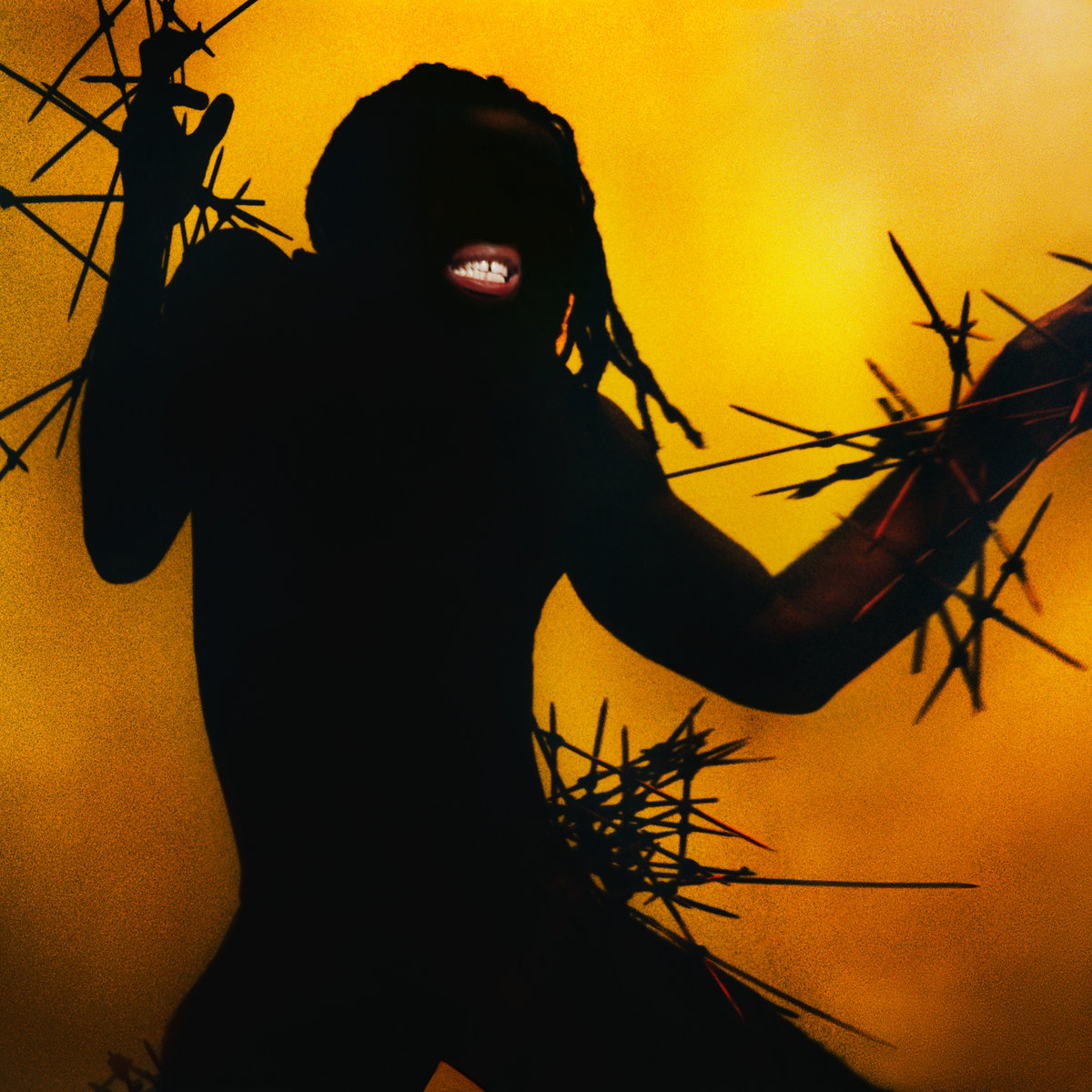
This is the fourth album from Edinburgh-based trio Young Fathers, and their first since 2018. It fulfils their pledge to go back to first principles, to make music in their basement studio with just equipment and microphones.
The back to basics approach extends to the music, with ten tracks despatched with very little fuss. As the band say, “The weigh that we’ve been carrying is now yours. Do what you want with it.”
What’s the music like?
There is something very elemental and primal about the Young Fathers these days. Part of that would seem to be down to the African percussion that comes to the fore in a lot of the tracks on this album, but the vocals also communicate with remarkable strength.
The 1-2 punch of opening duo Rice and I Saw make a striking impact, establishing the tone of an album that feels on one hand a celebration of the human spirit, and on the other a protest against the ways of the world.
Tracks such as Ululation strip everything back to basics, with extraordinary vocals that hit the heights against an undulating backing track. Here the music feels new, bringing together influences as diverse as Leftfield, Animal Collective, Mos Def and Afrobeat. The latter influence takes thrilling command of both this song and Sink Or Swim, the band operating with an urgency rarely heard in new music.
Does it all work?
Very much so. This is a lean album, its ten tracks lasting just over half an hour – and there is no sign at all of any padding. Its emotions feel wholly authentic, running from triumph to sorrow and back often in the space of just one song.
Is it recommended?
It is. Young Fathers’ first two albums were compelling, but this chapter contains their deepest revelations yet – along with the feeling there is much more to come with their development as a band.
This is an album with a deeply personal touch. Dedicated to Gerard Rochford, an Aberdeen poet and father of drummer Sebastian, it is described by him as ‘a short diary of loss’, offered as ‘a sonic memory, created with love, out of need for comfort.’
Around the time of his father’s death in 2019, Seb experienced a rush of musical thoughts coming to him, even though he wasn’t looking to write anything. This became part of the grieving process, and though he initially looked to resist the urge he found that giving space to the musical thoughts was helping him cope better elsewhere. Sat at the piano, he was able to vent his feelings through the simple vehicle of a home grand piano, and later the drum kit.
To help him he enlisted regular collaborator, pianist Kit Downes, and the pair recorded the music at the Rochford family home, capturing its ambience on record.
The final piece, Even Now I Think Of Her, is a composition by Gerard himself, sung into his phone and sent to Sebastian.
What’s the music like?
There is a beautiful and often heart stopping intimacy to this music. When experienced late in the day it is a companion for thought and reflection, turning inwards towards the centre of the mind on thoughtful pieces like Night Of Quiet, which at other times opens outwards and bringing the departed spirits and surrounding environment into the conversation.
This Tune Your Ears Will Never Here – a heartbreaking title – is a beautiful piece with which to start, setting out the hymn-like disposition of a lot of Rochford’s musical thinking. It begins with the piano intoning a solemn sequence in block chords, yet distracted by bigger thoughts at play.
The drums are very sensitively used, very much in the background – while on a piece like Love You Grampa complementing the piano’s free-thinking block chords. The first impression here is adding some well-judged percussion to a languid Debussy piece, but then the piece opens out into something more playful.
On Silver Light the music hints at folksong in the right hand of the piano, with modal melodies and light punctuation from the drums. Rochford’s compositions are capable of sustaining their concentrated thought for longer, too – and as Ten Of Us explores the lower ranges of the piano, the audience is effectively placed in the room next door, listening intently. It ends with a show of inner strength, Downes playing ever more expansively as the drum kit also intensifies.
Gerard’s composition fits hand in glove with the rest of the album, its right hand melody lightly insistent and dressed with brushed snare drum. It must have been almost unbearably poignant to record.
Does it all work?
It does. The instinctive nature of the music is wholly absorbing, and although Rochford’s father may have passed on, the strength of his character frequently comes across in writing that is thoughtful, reverent and lightly amusing.
Is it recommended?
It is. This is a concentrated, intimate set of musical studies and meditations, and clearly worked as part of the grieving process for Rochford. It is a beautiful, poignant album for musical reflection and reparation.
Listen
Buy
You can explore listening and purchasing options for A Short Diary at the ECM Records website
Born in Hiroshima but based in Montreal, Jonah Yano has been exploring his family history and making sense of his identity. This has been realised in musical form, through a solo album made with frequent collaborators BADBADNOTGOOD.
Yano used the songwriting process to make an intimate piece of work bringing his feelings on his Japanese-Canadian heritage to the fore, while examining family dynamics and personal relationships. Here he is aided by extended solo contributions from his bandmates, and some spoken word clips adding a domestic feel to proceedings..
What’s the music like?
Chilled in the first instance – but definitely rewarding the listener who wants to go deeper into the source material.
On the surface it is easy to admire the resultant sounds from this album. Chief among these is Yano’s velvety voice, a versatile instrument equally effective in soul or jazz. He is backed by thoroughly convincing instrumental parts, too – chief among them some superb drumming from Alexander Sowinski and fluent piano from Felix Fox-Pappas that determine the momentum generated in each track. Both combine in some of the strong solos, while Leland Whitty‘s guitar and saxophone contributions to Haven’t Haven’t stand out.
Always has a searching intimacy, especially when the lyrics make themselves clear. “The way you made me feel is the opposite of caring”, sings Yano in one verse, though by the time the piano takes over for an extended solo, things feel right with the world again.
Song About The Family House is deeply felt, an intimate aside to the listener, while a cover of Vashti Bunyan’s Glow Worms is suitably evocative. Guests Slauson Malone and Sea Oleena both acquit themselves well, with subtle contributions to In Sun, Out of Sun and Quietly, Entirely respectively. The latter has a beautiful introduction, with layers of murmured vocals like the wind in the trees.
Does it all work?
In the main, though occasionally Yano’s voice feels a bit understated in the mix – on headphones at least. The instrumental cameos are sensitively handled and complement the mood of each song.
Is it recommended?
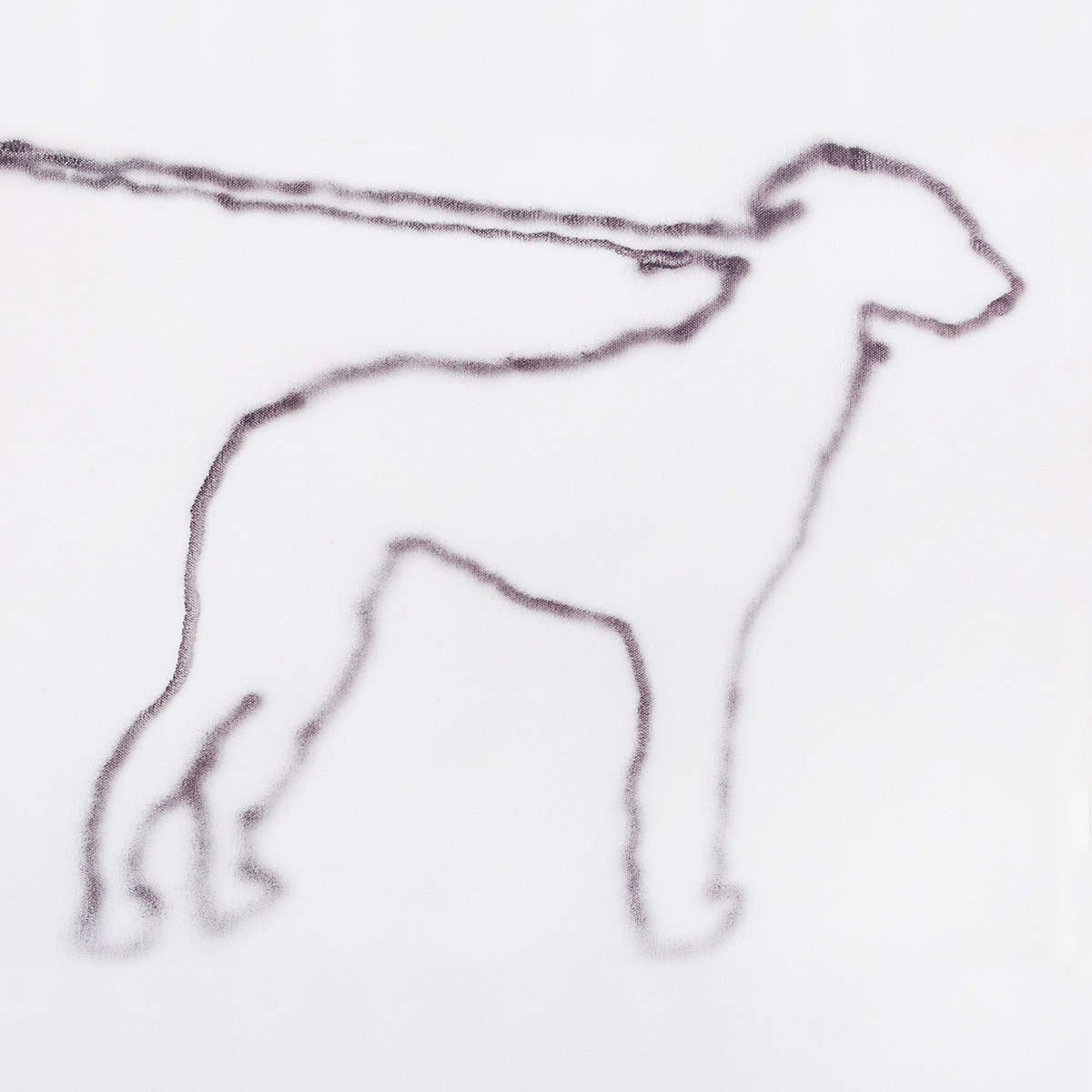
It is. Portrait Of A Dog proves to be an engaging and personal work, featuring some rather special instrumental contributions. Definitely worth a spin.
James Yorkston had no plans for a sequel to his 2021 album with The Second Hand Orchestra – but on writing new songs on his piano, and sharing them with the orchestra’s leader Karl-Jonas Winqvist, they realised the opportunity was ripe for a guest singer to enhance the music – and Winqvist suggested The Cardigans’ singer Nina Persson.
The pairing operated in relatively relaxed conditions, with no overriding concept other than the wish to sing a collection of folk-based songs. The orchestral parts are fresh, semi-improvised by the players on the day of recording.
What’s the music like?
This is a joyous collaboration, one that finds the singers and musicians finishing each other’s sentences as though they have been working together all their lives.
Both Yorkston and Persson are natural storytellers, and from Nina’s first verse on Sam and Jeanie McGreagor, the listener hangs on each tale and musical nuance. As the album progresses we get to know their vulnerable sides, but also some touches of light humour, the two singers bouncing off each other’s musical qualities. Try Mary and you will see how well their voices are matched.
There are singalong refrains in a lot of the songs, with the communal Peter Paulo Van Der Heyden a favourite, and in Keeping Up With The Grandchildren an extended guitar soliloquy to complement the vulnerable vocals. Most of the songs have the sort of childlike simplicity you might associate with folk music at its most raw, but the arrangements can propel these through unexpectedly complex forms, as they do in The Heavy Lyric Police.
As for The Second Hand Orchestra, their fresh contributions are beautifully delivered – notably the violin in An Upturned Crab, and Karl-Jonas Winqvist ensures total respect for the lyrical material throughout, moving from a single, plaintive instrument to the full force of an orchestra rich with woodwind colour.
“This is the time”, they sing on the winsome Hold Out For Love – the most wonderful, singalong moment, where everything is suddenly right with the world.
Does it all work?
Yes – mostly because the collaboration is so unforced, and the music making relaxed. That shouldn’t, however, be mistaken for complacency, for both singers deliver deeply felt songs, their voices ideally matched. The orchestrations are beautiful and consistently rewarding.
Is it recommended?
It is – an ideal match of musicians from the northern territories, doing what they do best – and clearly enjoying it immensely.
Arnold Commonwealth Christmas Overture Op.64 (1957) Clarinet Concerto no.1 Op.20 (1948) Divertimento no.2 Op.24 / Op.75 (1950) Larch Trees Op.3 (1943) Philharmonic Concerto Op.120 (1976) The Padstow Lifeboat Op.94a (arranged for orchestra by Philip Lane)
BBC Philharmonic Orchestra / Rumon Gamba
Chandos CHAN20152 [68’50″’] Producers Brian Pidgeon and Mike George Engineers Stephen Rinker, Richard Hannaford and John Cole Recorded 5 & 6 December 2019, 29 July at MediaCity UK, Salford
Reviewed by Ben Hogwood
What’s the story?
This collection of six pieces from Sir Malcolm Arnold’s composing career stretches from one of his first published pieces, Larch Trees, to one of his last, the Philharmonic Concerto. Both were written for the London Philharmonic Orchestra, for whom he played trumpet from 1941 until 1948, and with whom he maintained a close association as a composer.
In between these pieces Chandos have chosen a satisfying mix of styles to reveal Arnold as a multi-faceted composer, not just the humourous one of which we hear most. That side of his writing is happily celebrated through The Padstow Lifeboat and the Divertimento no.2 for orchestra reveals the happiness he found through writing for children and young people, being young at heart himself.
The Commonwealth Christmas Overture finds Arnold in commission mode, called upon to write the music for Royal Prologue: Crown and Commonwealth, a programme narrated by Sir Laurence Oliver to preface the 25th Christmas speech by a ruling monarch. Completing the collection is the first of many concertos from Arnold’s pen, and the first of two for clarinet.
What’s the music like?
Chandos have already presented us with a good deal of Sir Malcolm Arnold’s music, and this is further enhanced by a programme giving us first recordings and revealing each side of the composer’s personality.
The Commonwealth Christmas Overture gets proceedings off to a suitably ceremonial start, with plenty of bluster and high jinks, all buoyed by colourful percussion. The influence of William Walton is immediately evident, for the main theme has more than a little in common with his own ceremonial march Crown Imperial, but Arnold goes on to develop it in his own inimitable way.
The Clarinet Concerto is a compact piece, deft and slightly bluesy in the outer movements but pausing for meaningful reflection in the Andante, the emotional centre of the work.
The Second Divertimento, long thought lost, is a fun piece where a lot happens in nine minutes! Using a traditional-sounding structure, Arnold has a lot of fun with the bracing Fanfare, atmospheric Nocturne and grand Chaconne, harnessing the power of the large orchestra.
The two pieces for the London Philharmonic are next, and are vividly contrasting pieces of work. Larch Trees is an evocative musical sketch, reminiscent of Moeran in the way it pans out over the rugged terrain of northern England, while also confiding intimately in its listeners through the woodwind. The Philharmonic Concerto is more obviously noisy and confrontational, this late work utilising the dissonance which will be noted by those familiar with Arnold’s later symphonies. This is not comfortable music but it is brilliantly written, challenging the orchestra to throw off their shackles. The probing violin lines of the Aria offer a chance for deeper reflection.
Finally The Padstow Lifeboat, one of Arnold’s brass band treasures, with its persistent ‘wrong note’ which warns all shipping. It makes for the ideal sign-off.
Does it all work?
Yes, and wonderfully so. Rumon Gamba has enjoyed a long and fruitful association with Arnold’s music and comes up trumps here, leading the BBC Philharmonic Orchestra in some characterful and personal accounts. Arnold could hardly wish for better advocacy and understanding, the conductor charting his youthful prowess in Larch Trees, whose softer contours benefit from excellent recording by the Chandos engineers.
The Clarinet Concerto no.1 is brilliantly played by Michael Collins, negotiating the wide leaps of the solo part with aplomb, while responding with grace in the soulful slower sections. The strings of the BBC Philharmonic exploit the depths of the darker slow movement, its temperature appreciably colder by the end.
Is it recommended?
Enthusiastically. This is an anthology that will appeal to seasoned Arnold listeners, for its mix of the familiar and a curio or two, while it is also the ideal place for those new to the composer. If you are after some music to combat the onset of January, you have come to the right place!
Listen
Buy
For more information and purchasing options on this release, visit the Chandos website