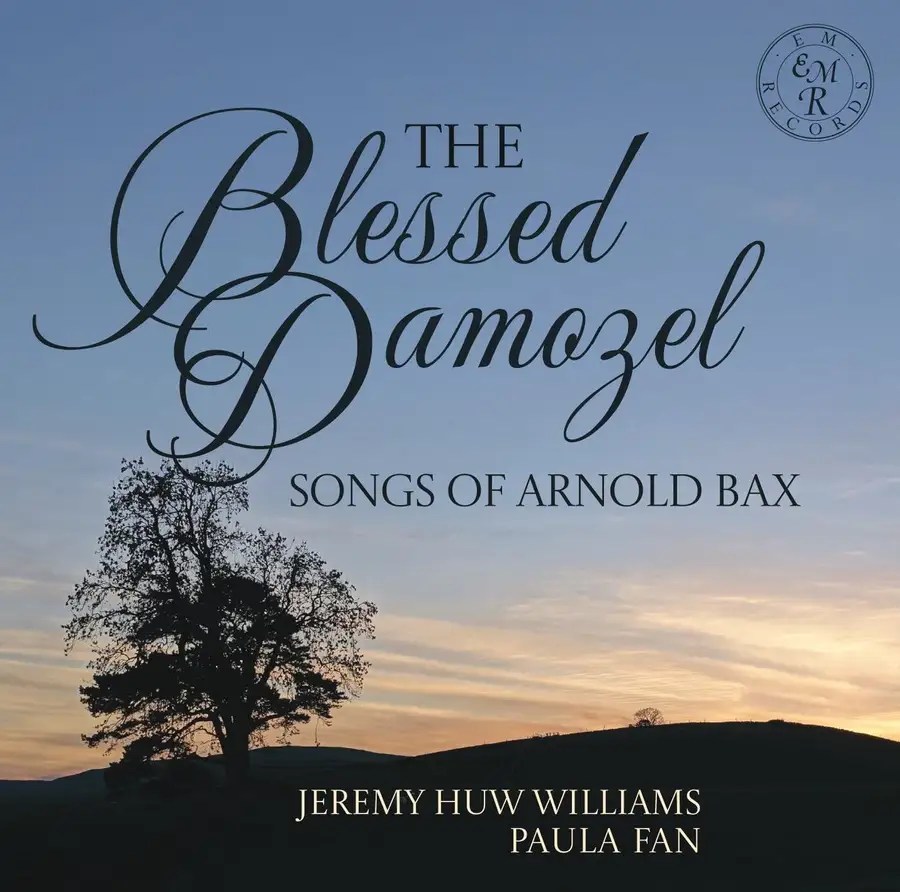
On Record – Jeremy Huw Williams & Paul Fan: The Blessed Damozel: Songs of Arnold Bax (EM Records)

Jeremy Huw Williams (baritone); Paula Fan (piano) with Theodore Buchholz (cello, Folk Tale)

Sir Arnold Bax
The Blessed Damozel (1906); A Milking Sian; The White Peace (both 1907); Shieling Song (1908); To Eire (1910); Roundel (1914); Parting (1916); Far in a Western Brookland; Folk-Tale; Jack and Jone; When I was One-and-Twenty (all 1918); The Market Girl; Rann of Exile; Rann of Wandering (all 1922); I Heard a Soldier (1924); In the Morning; On the Bridge (both 1926); Watching the Needleboats at San Sabba (1931)

EM Records EMRCD086 [84’55”] English texts included
Producer Jeremy Huw Williams Engineer Wiley Ross

Recorded 11-13 April, 6 May 2022 at Jeffrey Haskell Recording Studio, University of Arizona

Reviewed by Richard Whitehouse

What’s the story?

EM Records continues its coverage of songs by Sir Arnold Bax with a further volume (see also Arcana’s review of the previous volume, From The Hills of Dream by Jeremy Huw Williams and Paula Fan.

What’s the music like?

As is relatively well known, the writing of songs was a preoccupation of Bax earlier on in his composing which had all but ceased by the mid-1920s. Unlike their earlier release, Williams and Fan here focus on songs previously recorded (some of them several times) though it does include a major first recording along with Folk-Tale from the last year of the First World War. Theodore Buchholz does justice to the dramatic climax which emerges out of this latter piece’s sombre rumination, thus making the subtitle ‘Conte populaire’ more than a little tendentious.

That first recording is The Blessed Damozel – not a song or even a scena, but a melodrama or, as Bax described it, ‘‘musical illustration’’ for reciter and piano of the famous poem by Dante Gabriel Rossetti. Melodramas were a frequent occurrence during those early years of the 20th century, though this is its composer’s single example and even that was likely intended as the blueprint for a work with orchestra that failed to materialize. As it stands, the combination of measured yet rarely uneventful speech and piano writing as responds to the text as if ‘caught on the wing’ results in a curiosity well worth hearing. The present account holds the attention and, given the absence of any orchestration, there seems little need for any further recording. Those who are partial to Rossetti should find Debussy’s earlier cantata to be more substantial.

A glance at the listing above confirms the 16 items featured here range widely across the two decades when Bax’s song-writing was in fullest flow. It is not over-much of a generalization to suggest those written up to and including the ‘Great War’ are art-songs in a direct lineage from the composer’s French or German forbears, and those that came afterward are ‘popular’ songs or – as in with Jack and Jone – arrangements of traditional songs written at the behest of specific performers. The (surprisingly?) skittish setting of Thomas Hardy’s On the Bridge was followed with just two songs – Watching the Needleboats at San Sabba forming part of   a James Joyce anthology, masterminded by Arthur Bliss, which failed to benefit this author financially. Orchestral and chamber works were predominant in Bax’s catalogue henceforth.

Does it all work?

It should have done. Those having heard his previous Bax release will know of Jeremy Huw Williams as a devoted Baxian whose occasional misjudgement of expressive nuance is more than compensated for with thoughtfulness and insight. Unfortunately, the highly reverberant sound is inappropriate – to the extent those songs (tracks 5, 13 and 14) whose texts could not be reprinted for copyright reasons are frequently inaudible as recorded. Neither Paula Fan’s forthright pianism nor Theodore Buchholz’s burnished cello playing come through unscathed.

Is it recommended?

It should have been. The booklet is well up to EMR’s customary standards, with its detailed biographical overview by Graham Parlett and notes on each of the songs by Lewis Foreman. Paula Fan’s untimely death, in 2023, should have made this release a more fitting memorial.

Listen / Buy

You can listen to clips from the release at the EM Records website, and purchase options at the Presto Music site. Click on the names to read more about the artists Jeremy Huw Williams, Paula Fan and Theodore Buchholz, and the Sir Arnold Bax Society

Published post no.2,895 – Saturday 21 May 2026
For a new month – Bax: November Woods

by Ben Hogwood

To mark the 1st of November, here is the highly atmospheric tone poem that Sir Arnold Bax completed in 1917. November Woods is one of his most effective works, though in spite of its evocative title Bax said it “may be taken as an impression of the dank and stormy music of nature in the late autumn, but the whole piece and its origins are connected with certain rather troubled experiences I was going through myself at the time….”

You can enjoy it below in a performance with the Ulster Orchestra conducted by Bax specialist, the late Vernon Handley:

Published post no.2,705 – Saturday 1 November 2025

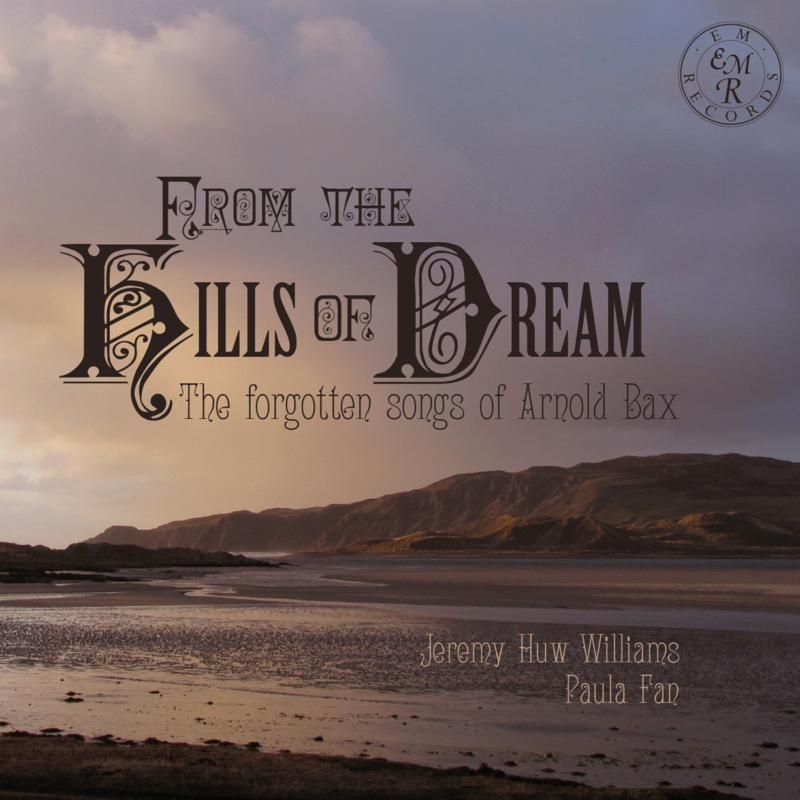
On record – Jeremy Huw Williams & Paula Fan – From The Hills of Dream: The Forgotten Songs of Arnold Bax (EM Records)

bax-songs

Jeremy Huw Williams (baritone), Paula Fan (piano)

Bax
The Grand Match (1903). To my Homeland (1904). Leaves, Shadows and Dreams. Viking-Battle-Song (1905). I fear thy kisses, gentle maiden. The Twa Corbies (both 1906). Longing. From the Hills of Dream (both 1907). Landskab (1908). Marguerite (1909). Das tote Kind (1911). Welcome, Somer. Of her Mercy (both 1914). A Leader (1916). The Splendour Falls (1917). Le Chant d’Isabeau. A Rabelaisian Catechism (both 1920). Carrey Clavel (1925) – all world premiere recordings

EM Records EMRCD073 [77’56”]

Producer Jeremy Huw Williams Engineer Wiley Ross

Recorded 13, 14, 16, 22 & 23 October 2020 at Jeff Haskell Recording Studio; 13 November 2020 at Jim Brady Recording Studios, University of Arizona, Tucson, USA

Written by Richard Whitehouse

What’s the story?

EM Records continues its coverage of lesser-known (or the lesser-known music of) English composers in an extensive survey of ‘forgotten’ songs by Arnold Bax, of which only a few were publicly performed in his lifetime with several of them first heard as recently as 2018.

What’s the music like?

Although he is best known for his symphonies and tone poems, songs with piano occupy a not unimportant place in Bax’s output – particularly over his formative years. This selection unfolds chronologically – opening with a lively setting of Moira O’ Neil’s The Grand Match, then continuing pensively with Stephen Gwynn’s To My Homeland in which Bax’s love of Irish culture was first manifest. Two settings of ‘Fiona Macleod’ (aka William Sharp) – the evocative Leaves, Shadows and Dreams, then the (would-be) heroics of Viking-Battle-Song – precede a ravishing take on Percy Shelley’s I fear thy kisses, gentle maiden, before The Twa Corbies finds Bax experimenting (not always successfully) with recitation in this traditional text. Two further settings of Macleod – the poised elegance of Longing, then the searching inwardness of From the Hills of Dream – lead on to this composer’s only treatment of a text in Danish, that of Landskab (Landscape) by Jens Peter Jacobsen, whose three manuscripts imply syntactical problems never adequately resolved despite the music’s gentle eloquence.

Bax set four texts by William Morris, among which the warmly expressive Marguerite went (surprisingly) unheard until now. The sombre symbolism of Conrad Ferdinand Meyer’s Das tote Kind is underplayed despite being in the original German, and two rondels by Geoffrey Chaucer – the wistful charm of Welcome, Somer then deft humour of Of her Mercy – exude sentiments to which he is more attuned. This is even more evident in A Leader, a setting of George Russell’s poem that underlines Bax’s emotional involvement with those issues and persons of Ireland’s ill-fated Easter Uprising that ranks among the composer’s finest songs. Few are likely to prefer his dogged setting of Alfred, Lord Tennyson’s The Splendour Falls to that by Britten (or the Delius part-song), whereas the traditional Le Chant d’Isabeau has appealing winsomeness. A Rabelaisian Catechism is a salacious take on another traditional text, with a little help from Vaughan Williams and Wagner, while Carrey Clavel matches Thomas Hardy’s wry observation of scorned love to a tee and makes for a delightful close.

Does it all work?

Most of the time. Almost from the outset, Bax was an inventive but also interventionist setter of texts, such that the poet’s sentiments are not necessarily those conveyed in his songs. This might explain why he increasingly eschewed the genre once he had found his true metier in orchestral and chamber media, so that there are very few songs from the mid-1920s onwards. That said, the literary range of what Bax did set as well as the expressive range of his settings ensures his contribution is a notable one and is enhanced by those songs featured on this disc.

Is it recommended?

Yes, not least through the advocacy of Jeremy Huw Williams whose unstinting advocacy is underpinned by Paula Fan’s perceptive accompaniment. The extensive booklet notes are by the Bax authority Graham Parlett, to whose memory this release is appropriately dedicated.

Listen and Buy

To listen to excerpts from this disc and view purchase options, visit the EM Records website. To read more about Arnold Bax, visit his dedicated composer website, and for more on the performers, click on the names of Jeremy Huw Williams and Paula Fan. Finally for more information on the English Music Festival, click here

In Appreciation – David Lloyd-Jones

by Ben Hogwood

This week we have learned the sad news of the death of conductor David Lloyd-Jones, at the age of 87. David was instrumental in founding Opera North in 1978, and there is a heartfelt tribute on their website in his honour.

While Lloyd-Jones was a highly respected opera conductor, I have chosen to focus on his many and pioneering recordings of English music by way of a tribute. These include extensive surveys of the orchestral music of Stanford (including a symphony cycle), Alwyn, Bliss, Rawsthorne and Arnold Bax, including another survey of his symphonies, and Holst – with an important disc of his orchestral music released in 1998. Here is just a hint of his discography for Naxos, with highlights from some very impressive recordings:

In concert – CBSO Centre Stage: Trios for flute, viola and harp (Marie-Christine Zupancic, David BaMaung & Katherine Thomas)

Instrument-detail-Neil-Pugh

Bax Elegiac Trio GP178 (1916)
Weinberg
Trio Op.127 (1979)
Debussy
Sonata for flute, viola and harp L137 (1915)

Members of the City of Birmingham Symphony Orchestra [Marie-Christine Zupancic (flute), David BaMaung (viola), Katherine Thomas (harp)]

CBSO Centre, Birmingham
Thursday 18 November 2021

Written by Richard Whitehouse

Although little more than a century old, the enticing combination of flute, viola and harp has since given rise to a host of stylistically varied pieces – three of which were featured in this Centre Stage lunchtime recital by members of the City of Birmingham Symphony Orchestra.

If not the most elaborate of his numerous works for mixed ensemble, Arnold Bax’s Elegiac Trio is surely among his most affecting as a (deliberately?) understated ‘in memoriam’ for those friends who had died as a result of the ill-fated Easter Uprising in Ireland. While the underlying mood rarely moves too far from that implied by the title, the close-knit motivic writing and subtly shifting emotions which are filtered through the textural ‘weave’ prove    as subtle as they are elusive – not least in a performance as focussed or as assured as this.

His extensive chamber output might be dominated by his 17 string quartets, but Mieczysław Weinberg wrote numerous pieces for sundry combinations – of which the present Trio could be considered typical of his spare and elusive later idiom. As in other works from this period, descriptions are replaced by metronome markings, endowing the music with an inscrutability as leaves the musicians to convey more tangible expression – whether in an initial movement that uncovers its formal trajectory as it brings these instruments into play, a central movement whose fragmentary textures never quite evolve into cohesive exchanges, then a finale whose vigorous rhythmic motion is tersely curtailed almost out of spite. An insightful account of an absorbing piece, especially when not given in its alternative version with piano replacing harp.

A recital such as this almost had to close with the Sonata by Debussy that will likely remain the template for this ensemble. Here, the opening Pastorale seemed a little too restive fully to convey this music’s ethereal emotion, but the Interlude found an ideal balance between incisiveness and elegance whose minuet-like gait belies its almost intuitive unfolding, while the Finale drew all three instruments into an inexorable motion through to the decisive close – the composer asserting his credentials as ‘musicien français’ with pointed understatement.

An appealing and not a little thought-provoking recital for which Marie-Christine Zupancic, David BaMaung and Katherine Thomas placed those present in their debt. The Centre Stage series continues on December 3rd, with a programme from the CBSO Percussion Ensemble.

Further information on future CBSO Stage concerts can be found here