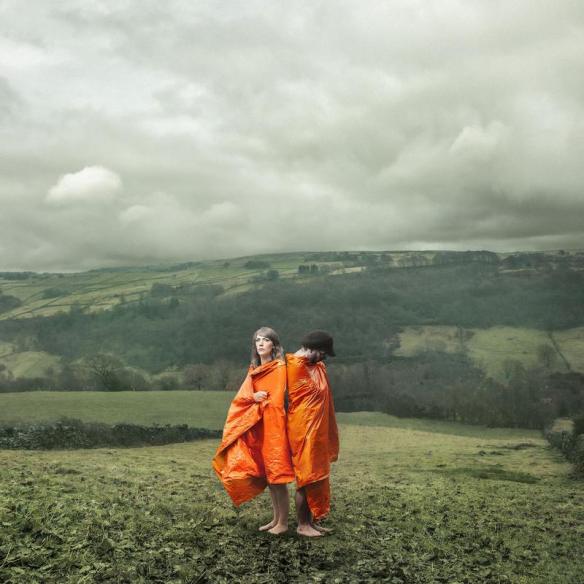
On Record – Cobalt Chapel: Orange Synthetic (Klove Recordings)

reviewed by Ben Hogwood

What’s the story?

Cobalt Chapel, the duo of Cecilia Gage and Jarrod Gosling, release a second album of pop roots in psychedelia and folk music, focusing in on their home county.

It is, as they say, ‘music grounded in the Yorkshire earth; its people, the surrounding nature, landscape and its mythology, from the distant past to modern life’.

What’s the music like?

Both protagonists of Cobalt Chapel have varied backgrounds – Gosling as a one-time member of I Monster and Gage through her work with Maps and Matt Berry. Orange Synthetic celebrates these diversities, and its music proves to be unpredictable and inventive if occasionally loose in structure.

The duo start out with what sounds like a leftfield pop album, but gradually more psychedelic, woozy layers are revealed, along with an underlying haunting quality. Our Angel Polygon is responsible for the latter feeling. A striking track with slightly sinister lyrics and a melody from folklore, it was inspired by RAF Fylingdales, the distinctive early warning centre on the East coast of Yorkshire. Its enormous domes, like oversized golf balls, are evoked here in a song of windswept mystery.

In Company, the first song of the album, is a dark fairy tale seen through the eyes of writer Angela Carter. It comes in an exquisitely scored chamber-pop setting, with Gage’s deadpan vocal both affecting and unsettling.

Meanwhile the rolling beat of It’s The End, The End carries a bleak, apocalyptic message, while the haunting folksong of E.B. is head as though in a weird apparition.

At times the album is downbeat in its message but the elements of fantasy and mystery are key, as are the elements of late 1960s psychedelia in the production. These give an essential colour to the music.

Does it all work?

Largely. The musical freedom Cobalt Chapel allow themselves is refreshing, and it allows them to construct unusual and evocative songs, which translate themselves into striking pictures for the mind’s eye. The bleakness of the Yorkshire moors is successfully evoked but so is the wonder of those open spaces.

Is it recommended?

It is, but with the caveat that Orange Synthetic is a dark album for a dark time of the year. It is beautifully made and executed, and offers some haunting visions. Fans of Broadcast and Stereolab will undoubtedly find something to enjoy here.

Stream

Buy

You can buy the album from the Norman Records website

On record: BBC Philharmonic Orchestra / Jac van Steen – David Matthews: A Vision of the Sea (Signum Classics)

BBC Philharmonic Orchestra / Jac van Steen

David Matthews
Toward Sunrise Op.117 (2012)
Symphony no.8 Op.131 (2014)
Sinfonietta Op.67 (1995)
A Vision of the Sea Op.125 (2015)

Signum Classics SIGCD647 [67’42”]
Producer Michael George
Engineer Stephen Rinker

Recorded 7 November & 6 December 2017, BBC Studios, Mediacity, Salford, UK

Reviewed by Ben Hogwood

What’s the story?

This album is billed as an approachable route in to the music of David Matthews, one of the most prominent living British symphonic composers. Matthews has nine symphonies under his belt already, and we hear the Eighth as part of this programme, but he has a wealth of orchestral music alongside, from which Jac van Steen and the BBC Philharmonic Orchestra draw three works.

What’s the music like?

Matthews’ Symphony no.8 forms the centrepiece of the program, a substantial three-movement work completed in 2014. Its taut musical arguments suggest the influence of Sibelius, the harmonic language appears to build on late Vaughan Williams, and there are references to Debussy and Stravinsky in the orchestral colours used by the composer.

Yet this is by no means a derivative work. Matthews writes in the booklet note that he no longer feels the need to defend writing tonal music, and this argument gets the strongest possible endorsement from the music itself. From the opening chord, rich in woodwind, the musical exchanges are compelling, the harmonies often bewitching, and the form instinctive, written as it is by a hand of symphonic experience.

Too many newer symphonies are let down by their faster music, but not in this case. The first movement unfolds with powerful statements from brass and strings, their energetic arguments punctuated by rolling timpani. The bracing energy is complemented by a reflective Adagio, whose soft chords achieve contemplation in the context of a surrounding, uneasy mood. The music builds, reaching an impressive apex with full-bodied string sound before returning to its original state.

Matthews finishes with an uplifting set of four dances, inspired in part by vapour trails on the Kent coast. The bright colours and persuasive triple time rhythms add a lightness of touch to the full orchestra passages, resembling the profile of the second movement Sibelius’ Fifth Symphony…in a good way! The lightness of touch Matthews achieves at the final resolution is both unexpected and charming.

After the Eighth Symphony we hear the Sinfonietta from nearly 20 years earlier. A tightly compressed piece, its leaner textures generate a good deal of tension, as does the jousting between instrumental sections of the orchestra. The piece is in effect a short concerto for orchestra, culminating with thunderous timpani and short but probing melodies. It is convincing in its outcome, but less accessible with its more oblique melodies.

The accompanying pieces show Matthews’ ability to paint pictures with an orchestra. His tone poem Toward Sunrise begins the album. It is a response to the sun’s ability to make its own music through magnetic loops coiling away from its outer atmosphere, captured in sound by students at Sheffield University. Matthews takes two notes heard in that recording and transfers the motif to the depths of the lower strings, conveying the passing shadows of the night from which the sun will emerge. As the sunrise itself begins the orchestra tingle with anticipation, a volley of timpani rings out and the first rays poke through as the piece ends. It is the ideal piece with which to start.

The hiss of waves on the beach is immediately audible in A Vision of the Sea, a four-part tone poem completed in 2013. British composers have long written effective pictures of the sea, notably Vaughan Williams, Britten and Bridge, and Matthews can be added to that list. His first-hand account of English Channel vistas, punctuated by herring gulls, gets into the minds’ eye of the listener, painted with the help of ghostly piano and an expert use of the percussion section. The vision ends with another sunrise, and the crash of the waves on the shore.

Does it all work?

It does. The program is ideally judged, each work succeeding on its own terms but working as part of the bigger whole. The clinching factor is these authoritative performances from the BBC Philharmonic Orchestra, who have a very strong relationship with Matthews’ music. They appreciate his credentials as a fine symphonist, and his ability to create pictures in an instant.

Is it recommended?

Yes, with great enthusiasm. So many works premiered in this century are not followed up with second performances or recordings, which can be frustrating for concert goers, so it is wholly satisfying to see Signum and the BBC Philharmonic investing so much in this release. Their efforts are handsomely rewarded.

For further information on this release, visit the Signum Classics website.

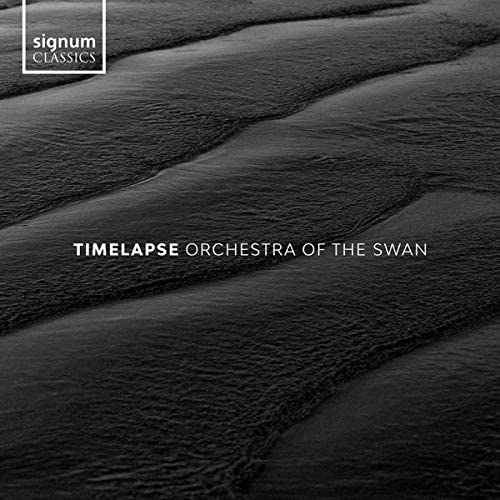
On Record – Orchestra of the Swan: Timelapse (Signum Classics)

reviewed by Ben Hogwood

What’s the story?

Timelapse is a concept album from the Orchestra of the Swan, conductor Bruce O’Neil and its artistic director David Le Page. Together they have created a sequence of works from as far back as the 17th century or as recently as last year, the concept illustrating how music can transcend time. In Le Page’s summary, Rameau and Vivaldi can be seen as fresh contemporaries of Thomas Adès or Radiohead, while the roots to songs from David Bowie and The Smiths are seen to lie in the music of Mahler and Vaughan Williams.

What’s the music like?

Timelapse hangs together as an hour of music perfectly suited to either end of the day. Its sequence is an imaginative one, and it hangs together in the way Le Page indicates thanks to the quality of his arrangements. There are no syrupy cover versions here; instead a song like Bowie’s Heroes is reduced to its bare elements. In the orchestra’s hands it becomes a contemplation on the original, a free improvisation from the flickering string ensemble complemented by icy droplets of melody from the harp.

The Smiths’ There Is A Light That Never Goes Out has similar qualities, though the substitution of an oboe for Morrissey’s voice, while beautifully played, is arguably less effective. Radiohead’s Pyramid Song fares better.

The ‘older’ music, as Le Page suggests, dovetails beautifully. François Couperin’s Les Barricades Mystérieuses and a sequence from Rameau’s Les Boreades work really well, while the addition of Trish Clowes’ saxophone to Vivaldi’s music for Sleep 1 is a nice touch, her recitative sensitively done.

The cold, spidery figurations of Schubert’s Sleep Softly – a meditation on his Serenade by Le Page – cut to a robust, bluesy solo, while the Couperin segues rather nicely to Steve Reich’s Duet and Thomas Adès O Albion, a chamber-music alternative to the Enigma Variations’ Nimrod, drawn from his Arcadia string quartet.

At the close of the set, Errollyn Wallen’s Chorale contains both soothing textures and an impassioned, wordless plea, while the last of Górecki’s Three Pieces in Old Style has a moving simplicity harking back over centuries, illustrating Le Page’s point rather nicely.

Does it all work?

Everything fits together nicely, the overall mood one of contemplation in the half light. I found the phrasing on Grieg’s Air a bit rushed at times, but that is personal taste of course – and when you’ve got round the idea of an oboe replacing Morrissey’s voice on There Is A Light That Never Goes Out you’ll agree that it works rather well.

Is it recommended?

Enthusiastically. There is a great need at the moment for music to soothe the fevered brow, and Timelapse is an effective playlist fulfilling that function every time you listen to it.

Stream

Buy

You can buy the album from the Signum Records website

Switched On – Bicep: Isles (Ninja Tune)

reviewed by Ben Hogwood

Isles is the second album from Bicep, the Belfast-born and London based duo of Matt McBriar and Andy Ferguson, who dazzled us with their self-titled album in 2017. On it they showed a love of early rave music and an ability to channel it into futuristic beats and soundscapes. This resulted in a number of high profile advert appearances (BMW especially) but also translates into a brilliant live show.

When live gigs do return, this ‘home listening version’ of their second album will find new impetus in front of an audience, with Bicep always keen to give their fans the biggest show possible.

What’s the music like?

In truth it would be impossible to recreate the primal thrill of Bicep’s debut, which was all about having the maximum possible impact on the dancefloor. Yet Isles runs its predecessor close, retaining the distinctive clipped beats and riffs that make the duo’s music instantly recognisable, and adding some imaginative samples and vocals drawn from international sources.

Second single Apricots is a prime example, powered by a double sample of traditional Malawian singers recorded in 1958 and a song from the Bulgarian State Radio and Television Choir. Along with Atlas it runs close to the sound of their first album, with enjoyable kinetic energy and early house highs. Meanwhile Sundial uses Asha Boshle and Bhupinder Singh’s Jab Andhera Hota Hai, a sublime piece of work catching the dazzling rays of our star.

The clipped beats find an ideal complement in the vocals of Clara La San on Saku, a singer who manages the balance of being quite subdued but capturing an underground garage sound. The two really feed off each other. Vocals of a very different kind inform the beatless Lido, based on a sample of a motet by Italian renaissance composer Carlo Gesualdo.

These examples show just how broad the reach of McBriar and Ferguson can be, a cosmopolitan approach that keeps a healthy edge to the music and gives the album a healthy variety.

Does it all work?

Pretty much everything does. Just on occasion it would be good to see Bicep develop their source material a bit more, as in a track like Rever, with Julia Kent, which has a really good sample but doesn’t push on as much as you might expect. Elsewhere though, when the beats ping around like images on a 1980s video game, Bicep are on great form.

Is it recommended?

Yes. While Isles may not have their immediate thrills and spills of the Bicep debut, it still has plenty going for it. A fine follow-up which shows them to be great beatsmiths on record – and let’s hope it’ not too long before we get to see them live as well.

Stream

Buy

Switched On – Apifera: Overstand (Stones Throw)

reviewed by Ben Hogwood

What’s the story?

How long should it take to record an album? From the stories we hear, a few months would seem to be appropriate; a few weeks if the components really click. Apifera, newly formed as a quartet, took just three days to finish theirs, which explains its instinctive music making.

The band are accomplished solo artists from Tel Aviv who have played together before on the Stones Throw label, fronted by Yuval Havkin under his Rejoicer moniker. Here they appear as equals, listing an intriguing set of influences that include Ravel, Debussy and Sun Ra. These are placed in the melting pot alongside folk influences from Israel, Ghana and Sudan.

What’s the music like?

Given the outline above, it is no surprise to report that Overstand is both instinctive and musically free. The music reflects the fresh approach with which it was recorded, creating vivid pictures while utilising a satisfying ebb and flow of energy. The mood is largely positive, the chemistry between the players clear as they create room for each to have their own say.

Drummer Amir Bresler provides the best example of this approach, with complicated rhythms on Lake VU given impressive clarity but also allowing other contributions to shine through. He is a versatile beat maker, pushing the music along with positive energy, over which the keyboards of Nitai Hershkovits and Yuval himself shimmer and shine. Underneath the bass of  Yonatan Albalak offers a sure foundation but embodies their flexible style.

Theirs is an expansive approach but a focussed one too – none of the improvised passages outstays their welcome, and on occasion they add even more colour with brass.

Does it all work?

It does – Overstand works as an overall creator of positive, laid back moods, but also up close as a set of interlocking lines and textures. Just occasionally the music hints it might lose direction, but these moments are fleeting. The blissful, watery finish of Pulse 420 suggests the band could easily make an accomplished ambient record too.

Is it recommended?

Yes. Gloomy Januarys need this sort of music to see them through – and Overstand is a welcome dose of positivity in that regard. It works very nicely as a blend of its influences, bringing some of the cleaner lines of 20th century classical music up against offbeat jazz rhythms.

Stream

https://tidal.com/browse/album/168901909

Buy