On Record – Orion Weiss: Arc 1: Granados, Janáček & Scriabin (First Hand Records)

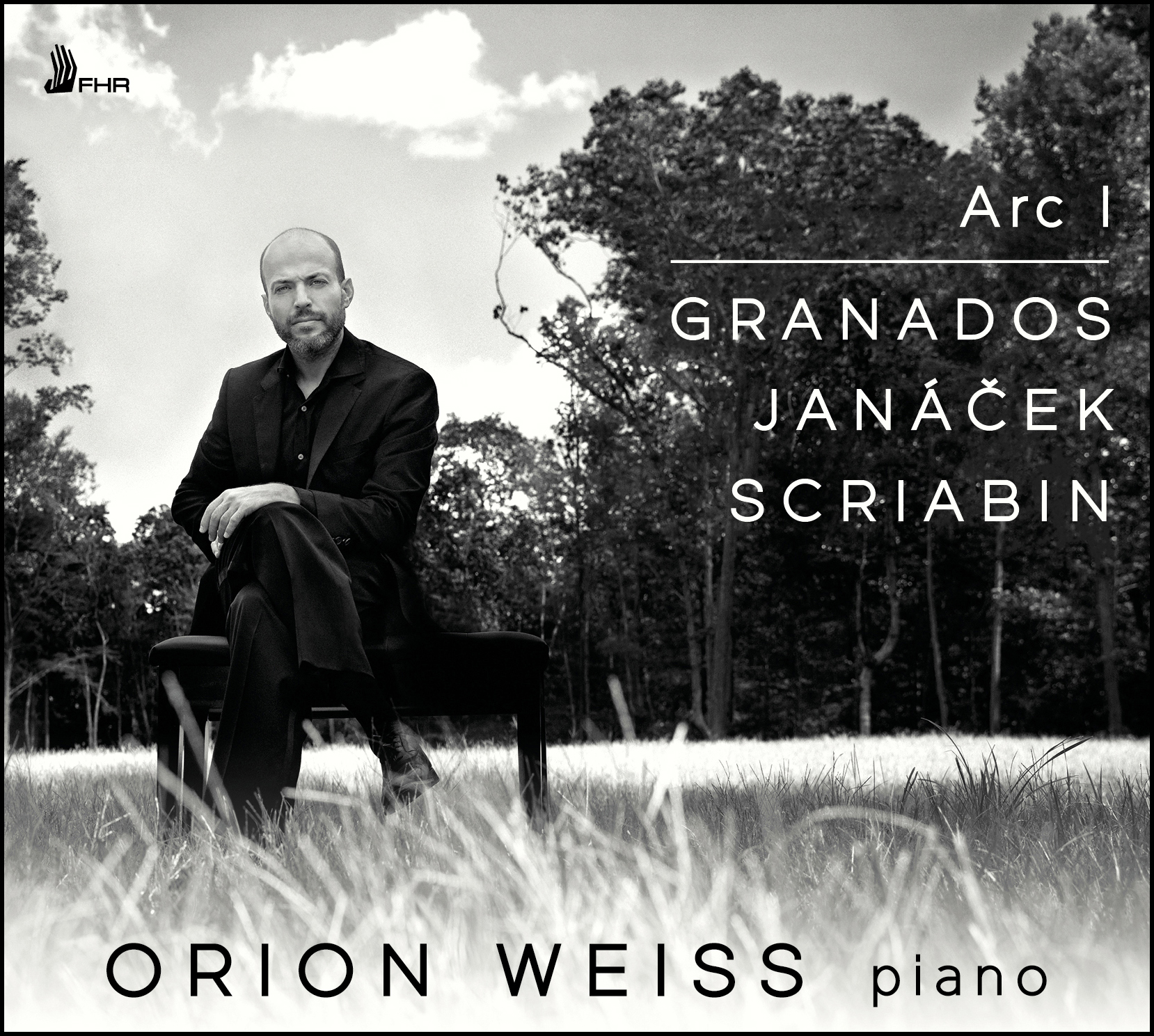
Granados Goyescas Op.11 (1911)
Janáček In the Mists (1912)
Scriabin Piano Sonata no.9 in F major Op.68, ‘Black Mass’ (1913)

Orion Weiss (piano)

First Hand Records FHR127 [74’51”]
Producer David Frost; Engineer Silas Brown
Recorded 22-24 May 2014 at SUNY Purchase Performing Arts Center, New York

Reviewed by Richard Whitehouse

What’s the story?

First Hand Records issues the first instalment of another planned trilogy (see also The Future is Female with Sarah Cahill), the Arc series being a traversal by Orion Weiss across a century of piano music with intermittent forays into conceptually related pieces by earlier composers.

What’s the music like?

Focussing on music from before the First World War, this first volume is dominated (at least in terms of length) by Goyescas – the cycle of piano evocations in which Granados both paid homage to the illustrious Spanish artist, while extending the potential for large-scale formal design associated primarily with Liszt. That the composer subsequently transformed this into a one-act opera says much for the original’s motivic interconnections, such as Weiss further emphasizes throughout an interpretation in which characterization and cohesion are as one.

The listener is guided from teasing melodic interplay in Flattery, via the (mostly) confiding intimacy of Conversation at the Window then encroaching fear of separation in Fandango by Candlelight and its pained experiencing in Laments, or The Maiden and the Nightingale. A tragic climax arrives in the ballade Love and Death; after which, Serenade of the Ghost offers an ironic epilogue. Weiss renders this methodical yet visceral sequence with no mean insight, drawing out that pathos seldom far beneath the surface of Granados’s mature music.

If the Spanish composer was realizing his vision despite – or even because of – his success as composer and performer, In the Mists finds Janáček combating those vicissitudes of personal and professional failure. Hence the tonally and expressively oblique nature of its initial three sections, such as Weiss articulates with notable emphasis on their volatile mood-swings and frequent welling-up of emotion. All of this is duly thrown into relief by the final Presto with its gradual yet, as here, inexorable tendency towards ultimate fragmentation and dissolution.

Much has been written over the past century about those occult and even satanic connotations of Scriabin’s Ninth Sonata, whose Black Mass subtitle was only added after the event and at the prompting of another. Once again, it is the harnessing of such fluid and increasingly violent expression to a formal follow-through as precise as it is fastidious which gives this music its uniqueness. Weiss ensures an audibly cumulative build-up that, in the closing stages, achieves a claustrophobic intensity which could be considered liberating or annihilating as one prefers.

Does it all work?

Yes. Although it is not hard to locate alternative recordings for each of these pieces of at least comparable value, their juxtaposition within this context makes for a programme absorbing in its overt contrasts yet satisfying in its overall cohesion. Whether or not Weiss has performed this in recital, the trajectory towards an even greater self-absorption and inward intensity feels as inescapable as the presentiments of world conflict which lie behind much of what is heard here. Future volumes will doubtless offer a changing perspective and maybe a ‘way forward’.

Is it recommended?

It is. The sound has a lucidity and detail ideal for piano music from this period, with Weiss’s annotations succinct but also pertinent to his interpretations. This series is a notable addition to his extensive discography, further information about which can be accessed at his website.

Listen

For further information on this release, head to the First Hand Records website, and for more information on Orion Weiss, head to his website

On Record – Sarah Cahill: The Future is Female, Vol.1: ‘In Nature’

Beglarian Fireside (2001)
Bon Keyboard Sonata in B minor, Op.2/5 (1757)
Carreño Un rêve en mer (1868)
Dillon Birds at Dawn, Op. 20 No. 2 (1917)
Gribbin Unseen (2017)
Jambor Piano Sonata ‘To the Victims of Auschwitz’ (1949)
Kaprálová Dubnová preludia, Op.13/1 & 3 (1937)
Kashperova Au sein de la nature – no.3: Le Murmure des blés (1910)
Mendelssohn-Hensel Lieder Op.8/1 & 3 (1846)
Watkins Summer Days (2020)

Sarah Cahill [piano, voice (‘Fireside’)]

First Hand Records FHR131 [71’32”]
Producer/Engineer Matt Carr
Recorded 15-28 August 2021 at St. Stephen’s Church, Belvedere, California

Reviewed by Richard Whitehouse

What’s the story?

First Hand Records has issued the first instalment in a planned trilogy devoted to piano works by female composers ranging across the past three centuries, played by Sarah Cahill who has made both the reviving and commissioning of this music a mainstay of her performing career.

What’s the music like?

As Cahill relates in an introductory video (below), The Future is Female is a project to record music by women composers from the Baroque era through to the present-day. Loosely based around the theme of nature, this first volume opens with music from the cusp of the Classical era: Anna Bon, Venetian-born and Prussian-educated, whose primary keyboard work is Six Sonatas published as her Op. 2 – the fifth comprising three relatively substantial movements which finds influences from C.P.E. Bach being put to productive use.

The music of Fanny Mendelssohn-Hensel has now started to come into its own, her extensive output for piano well represented by two from a set of Vier Lieder published as her Op. 8 and akin to the Songs without Words of her brother Felix in their respectively limpid and poetic moods. Exerting considerable influence as pianist and administrator, the Caracas-born Teresa Carreño wrote little in later life, making this teenage Étude-méditation the more striking for its suffused intensity. Equally highly regarded as a pianist, Leokadiya Kashperova brings an impressionist deftness to this movement from her piano suite In the Midst of Nature, whereas Fannie Charles Dillon yields an even lighter touch through an extract from Eight Descriptive Pieces with its pioneering though always subtle approach on the notation of various birdsong.

Long remembered through her association with Martinů, the short-lived Vitĕzslava Kaprálová was an able composer whose piano output includes April Preludes – elusive miniatures which pivot around without ever losing a sense of tonality. The sure highlight is the Piano Sonata by Agi Jambour, its recollection of Budapest during the Nazi occupation inspiring a piece whose three movements take in fraught passion, an Epitaph of sombre poise, then a finale of stark resolve. Of the three living composers, Eve Beglarian features the recitation of a poem by the teenage Ruth Crawford-Seeger within the context of an improvisatory piano backdrop. Deidre Gribbin pens a forceful study of London at a time of social and cultural upheaval, then Mary D. Watkins’s capricious evocation of children at play ends the recital on a more hopeful note.

Does it all work?

Yes. Although not all these pieces are of comparable value, the chronological approach such as Cahill favours makes sense in terms of a stylistic evolution in writing for piano; a parallel (rather than alternative) trajectory through 250 years of Western art music. There can be few reservations concerning either the sound, as good as it gets in terms of clarity and perspective, or the pianist’s detailed and informative annotations. At least half of this selection should be featured in the repertoire of pianists, male or female, which says much as to its overall worth.

Is it recommended?

Indeed. The second volume is imminent with the third in preparation, making for a series as inclusive as it is wide-ranging. Cahill has already amassed a significant discography – further information can be found at her website, which also gives details of her forthcoming recitals.

Listen

For further information on this release, head to the First Hand Records website, and for more information on Sarah Cahill, click here. For more information on the composers, click on the names of Leokadiya Kashperova, Vitĕzslava Kaprálová, Agi Jambor, Eve Beglarian, Deidre Gribbin and Mary D. Watkins

Leif Ove Andsnes records Dvořák’s Poetic Tone Pictures

Leif Ove Andsnes – picture (c) Gregor Hohenber

by Ben Hogwood

We all love a bit of Dvořák, don’t we?

That might be a bit of a sweeping statement – and don’t worry if you haven’t heard of him! – but the 19th-century Czech composer is much loved and admired for his winning way with a melody. His symphonies, concertos, chamber music and increasingly the vocal works are all part of the main body of classical repertoire.

Yet a part of Dvořák’s work is consistently overlooked, and that is his substantial body of piano music, that is hardly ever played. Leif Ove Andsnes, in a new album for Sony Classical, is looking to put that right. This is Dvořák’s Spring Song, taken from the 13-part cycle Poetic Tone Pictures, published in 1889:

The Poetic Tone Pictures are, as Leif explains briefly here, a ‘cycle of many stories’:

Happily we will be discovering much more of this music in the next month, from Leif himself. Stay tuned!

On Record: Steven Beck – George Walker: Five Piano Sonatas (Bridge)

george-walker

Steven Beck (piano)

George Walker
Piano Sonatas: no.1 (1953, rev. 1991); no.2 (1956); no.3 (1975, rev. 1996); no.4 (1984); no.5 (2003)

Bridge 9554 [53’13”]

Producer Steven Beck
Engineer Ryan Streber

Recorded 4 & 14 February 2021 at Oktaven Audio, Mount Vernon, NY

Reviewed by Richard Whitehouse

What’s the story?

Bridge continues its wide-ranging coverage of American music with this release featuring all five of the piano sonatas by George Walker (1922-2018), a composer who is now coming into his own on this side of the Atlantic and through, one trusts, the intrinsic quality of his music.

What’s the music like?

Although he achieved success in the USA, with commissions from several leading orchestras and a Pulitzer Prize in 1996 (making him its first black recipient), Walker was little known in the UK until recently – other than Natalie Hinderas’s account of his Piano Concerto in CBS’s ground-breaking Black Composers Series from the 1970s and occasional revival of his Lyric for strings (the most played such piece in America after Barber’s Adagio). That the current Proms season featured no less than three of his works is hopefully in itself a positive sign.

With its antecedents in Copland and Piston, the First Sonata appeared at a time of incipient change for American music – its three movements classically conceived but never adhering to formal archetypes; witness the flexible handling of sonata principles in the initial Allegro, followed by the contrasted sequence of six variations on a winsome folk tune, then dextrous contrapuntal texture and cumulative impetus of the rondo which comprises its final Allegro. Barely three years later, the Second Sonata sounds as if it might be responding to Sessions’s ‘transitional’ music of not long before – its initial movement’s theme the basis of 10 gnomic variations, followed by a Presto as brief as it is virtuosic, then an Adagio circumspect in its restiveness, and an Allegretto ensuring a degree of finality for all its harmonic ambivalence.

Almost two decades on and the Third Sonata postdates Walker’s most intensive involvement with serialism, but it does not eschew innovation – whether in the constantly metamorphosed shapes of the opening Phantoms, distanced yet ominous emotional resonance of the central Bell, or those myriad textural contrasts which build considerable momentum in the closing Choral and Fughetta. In the Fourth Sonata, number of movements may be further reduced but the emotional range is further extended – the forceful if never unyielding rhetoric of its Maestoso ideally complemented with the formal and expressive disjunction of its Tranquillo. Outwardly a concert study, the Fifth Sonata has as emotional impact out of all proportion to its brevity while leaving little doubt as to Walker’s creative prowess during his ninth decade.

Does it all work?

Almost always. As dates of composition suggest, these sonatas afford a viable (not inclusive) overview of Walker’s evolution – responding to the aesthetic changes in post-war American music methodically and resourcefully, without detriment to his creative integrity. It helps that Steven Beck is as audibly attuned to this music as to that by other US composers – rendering these pieces with precision and commitment, but the recording might have had a degree more warmth to complement its unfailing clarity. Succinctly informative notes from Ethan Iverson.

Is it recommended?

It is. All these sonatas have previous been recorded (notably as part of the extensive coverage on the Albany label), but this release is a clear first choice for anyone coming to them afresh. Hopefully Bridge will record further Walker – maybe an integral cycle of his five Sinfonias?

For further information on this release, visit the Bridge Records website, and for more on George Walker click here. You can read more about Steven Beck on his website

On Record – David Quigley – The Fair Hills of Éire: Irish Airs and Dances (Heritage Records)

david-quigley

David Quigley (piano)

Beach The Fair Hills of Éire Op.91 (1922)
Esposito Two Irish Melodies Op.39 (1883)
Field Go to the Devil and Shake Yourself (1798)
Hammond Miniatures and Modulations (2011) – No. 5, Old Truagh; No. 21, The Beardless Boy
Hennessy Variations sur un air Irlandais ancien Op.28 (1908)
Hough Londonderry Air (2014)
Martin Sionna – Spirit of the Shannon (2018)
Moeran Irish Love Song (1926); The White Mountain (1929)
Smith Paraphrase on ‘The Last Rose of Summer’ Op.173 (1883)
Stanford arr. Grainger Four Irish Dances Op.89 (1916) – no.1: Maguire’s Kick; no.4: A Reel

Heritage Records HTGCD152 [62’39”]
Producer / Engineer David Marshalsea

Recorded 9 & 11 April 2022 at Elgar Concert Hall, The Bramall, University of Birmingham

Reviewed by Richard Whitehouse

What’s the story?

The enterprising Heritage label continues its association with David Quigley in this recital   of Irish piano works as cover over two centuries, reminding listeners of the wealth of folk or traditional music from that island and its influence on successive generations of composers.

What’s the music like?

Published as Favorite (sic) Irish Dance Arranged as a Rondo for the Piano Forte, the first item is not unreasonably attributed to the teenage John Field and make for a breezy recital-opener – following which, pianist Stephen Hough demonstrated his prowess as an arranger with what is surely the most famous of all Irish melodies. Two pieces by the Italian émigré Michele Esposito – the trenchant Avenging and Bright, followed by the pensive Though the Last Glimpse of Erin – complement each other ideally, whereas the first from a set of dances by Charles Villers Stanford exudes bracing humour most likely accentuated in this idiomatic arrangement by no less than Percy Grainger. By some distance the longest piece here is from Swan Hennessy, an Irish/American later resident in France – his 12 variations on an (unidentified) theme in the lineage of various such works from the 19th century but diverting in its ingenuity. Best known as an inquiring pianist, Philip Martin the composer is represented by this evocative set of ‘rhapsodic variations’ written for the present artist.

Sidney Smith’s Paraphrase de concert on another Irish staple is the most virtuosic music and would make a dashing encore even today. Philip Hammond is the other contemporary composer featured – the present brace, part of a sequence of 21 drawn from the Edward Bunting collection and likewise written for Quigley, respectively searching and animated     in their emotional profile. From among her many mood-pieces, that by Amy Beach yields       a limpid poetry that more than deserves to provide the title for this collection overall. An English composer with direct Irish ancestry, Ernest Moeran’s predilection for all-things Celtic is made plain by the two pieces heard here, their recourse to traditional melodies enhanced by an idiomatic pianism which adds greatly to the winsomeness of their appeal. Back, finally, to those Stanford/Grainger dances with the fourth from this set a reminder that the former, whatever his formidable reputation as a pedagogue, was never averse to indulging his Irish roots in the writing of music as scintillating as it remains appealing.

Does it all work?

Admirably. Quigley is as committed to the music of his homeland as have been numerous of his predecessors, not only with performing these pieces in recital but also by finding ways of integrating them into a cohesive overall programme. Only one achieves (just) the 10-minute mark and another is almost eight minutes, making them ideal for combining into a judicious sequence – one which, at little more than an hour’s length, can be enjoyed at a single hearing. Quigley will hopefully have the chance to mine the ‘Irish piano-book’ further in due course.

Is it recommended?

Indeed. Quigley is a perceptive exponent of this repertoire, his Kawai Shigeru SK-EX heard to advantage in the spacious yet detailed acoustic of the Elgar Concert Hall. With succinctly informative notes from Andrew H. King, this recital warrants the warmest recommendation.

For further information on this release, and to purchase, visit the Heritage Records website, and for more on David Quigley click here