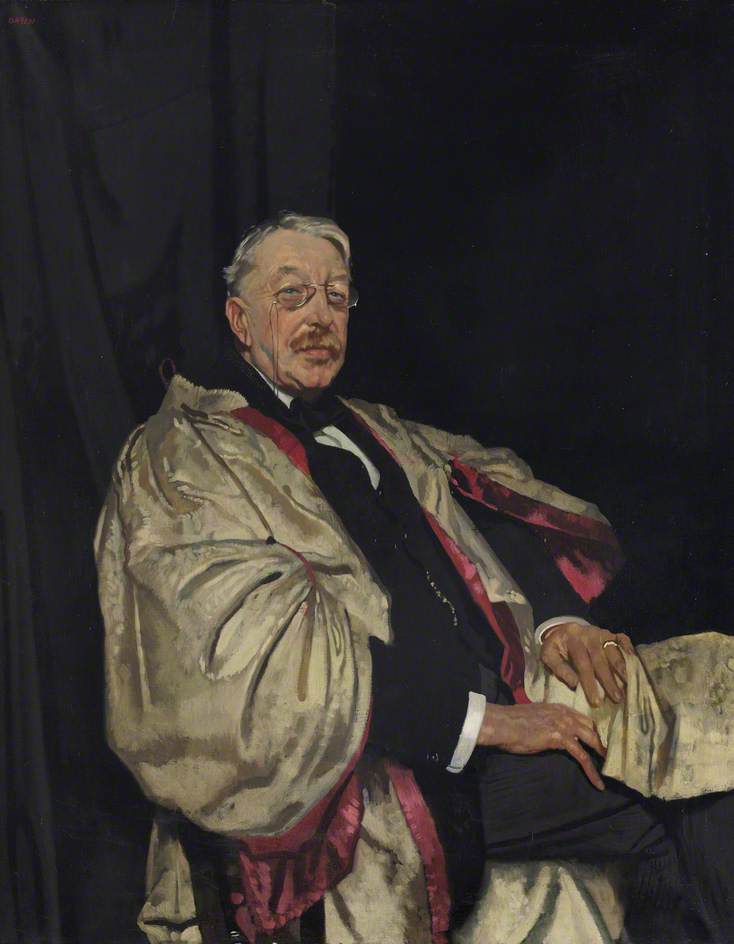
This is a playlist to mark the contribution to classical music of the Irish composer Charles Villiers Stanford, who died on 29 March 1924.
If you are a first-time listener to Stanford, the playlist gives a first indication of the strength of his output – though there is much more to enjoy should you wish to go further!
The Irish Rhapsodies have a lot of melodic charm…while the Piano Concerto no.2 is a fine work that is a late Romantic equivalent to Rachmaninov. Stanford was a fine choral and vocal composer, too – there are glimpses of that here – while for sheer positivity and generosity of melody, his Symphony no.6 takes some beating
You can enjoy all of those below! Arcana intends to return to Stanford’s music in more detail later in the year…
Throughout his career Pollini recorded for Deutsche Grammophon, leaving a succession of remarkable recordings ranging from a famous early collection of the Chopin Etudes through to pioneering modern collections, with a landmark LP of works by Schoenberg and a 20th century collection of Stravinsky, Webern, Boulez and Prokofiev. The playlist below is a personal selection of favourites and a memory from seeing Pollini play Schumann‘s Fantasie in C major at the Royal Festival Hall.
Last week one of the most esteemed British conductors celebrated his 90th birthday. Sir Roger Norrington has been a prominent force in the classical music recording industry over the last 30 years. His interpretations are largely informed by historical performance practice – which is to see he and his forces look to recreate the music of the day.
Norrington’s interpretations have tended to divide critics as to their effectiveness, and his approach has been more provocative with music from the turn of the 19th century. To some extent the ‘marmite’ reception has come about because he has conducted symphonic music from the likes of Bruckner and Mahler. This ‘marmite’ reception has sometimes overshadowed the sheer commitment and enthusiasm he has demonstrated for the British musical cause, whether with the London Classical Players or latterly with the Stuttgart Radio Symphony Orchestra.
His recording achievements with the former include a notable Beethoven symphony cycle for EMI, energetic and brilliantly played, and some standout recordings of symphonies by Mozart and Schubert, together with a thrilling collection of Rossini overtures. In Stuttgart, Norrington reprised some of this work as well as going deeper into the symphonic tradition. Meanwhile with the London Philharmonic Orchestra he recorded an intriguing set of Vaughan Williams symphonies. Some of the highlights of these discs can be heard below:
Today is Mothering Sunday in the UK – and here is a playlist celebrating mothers.
We begin with a touching suite for piano by Josef Suk. About Mother is dedicated not to his own mother but for his children about their mother, his wife Otilie Dvořák. Then we continue with a famous song from Suk’s father-in-law, Antonin Dvořák, Songs My Mother Taught Me.
Taking the theme a little loosely we move on to Ravel, and his delectable ballet Ma mère l’oye (Mother Goose) – evidence of the French composer’s beautiful writing for orchestra.
Finally something of an English rarity, Cecilia McDowall setting the Magnificat (the song of Mary, Mother of God) for chorus and orchestra. It is a striking piece with which to end.
I hope you enjoy!
This playlist is dedicated to the memory of my aunt, Angela – who passed away on Thursday. It is also posted in mind of her sister – my own mother Coralie (above), whose musical influence on my own life I celebrated on Arcana here.
This month we mark 200 years since the birth of Czech composer Bedřich Smetana in Litomyšl, east of Prague, on 2 March 1824.
Smetana is fondly regarded as the father of Czech music, his output spearheaded by the remarkable cycle of six symphonic poems Má vlast (My Country), containing vivid descriptions not just of the Czech countryside but also its architecture and history.
A new recording of the cycle has just been issued by the Czech Philharmonic Orchestra and their conductor Semyon Bychkov, on the Pentatone label, and it is included on the playlist below. However – as I hope you will find – there is a lot more to Smetana than this wonderful sequence alone.
The String Quartet no.1, subtitled From My Life, is a poignant tale of the composer’s life and subsequent deafness, unforgettably portrayed in the finale by the first violin. Also worth investigating in the composer’s chamber music output are the Second String Quartet and Piano Trio, while the inclusion of Richard III shows a depth of Smetana’s orchestral writing that is yet to be fully exploited in concert or on record. Make a note, too, of his contribution to Romantic piano music, in a series of attractive polkas.
Smetana’s contribution to opera is perhaps his principal legacy. Two works in particular stand out – The Bartered Bride, from 1866, and Dalibor, completed two years later. While very short excerpts from these are included in the playlist, I have included links to complete performances so that you can become acquainted with them.
Hopefully Smetana’s music will be celebrated in the concert hall as the year progresses, for it is generously melodic and passionate. The more you hear, the more rewarding it becomes!



 Arcana.fm