Let’s Dance – DJ Kicks mixed by Special Request (!K7)

special-request-dj-kicks

reviewed by Ben Hogwood

What’s the story?

The DJ Kicks story continues apace, and continues to choose imaginatively, with no sign of the quality dipping. Stepping up for this release is Paul Woolford, donning his Special Request moniker. As a listener he saw the DJ Kicks series ‘as a benchmark of quality and a time-stamped gateway into an artist’s state of mind’, going on to say that ‘for this volume, I wanted to focus on lush melodics. I kept that as a constant thread throughout, choosing only records I cherish…it’s not a ‘current snapshot’ by any means, more a chronicle of some of my all-time favourites.’

What’s the music like?

Given Woolford’s history and pedigree, the idea of sharing in his favourite music is too good to resist – and so it proves. It is no surprise to report a varied set of house and break beat, moving from classic disco-house to full blooded drum and bass, by way of variations in between. The mix is pleasingly rough around the edges in its blending of music, giving it a more authentic feel.

Woolford takes us straight to the heart of the dancefloor with Alicia MyersRight Here Right Now, remixed by John Morales, a very cool cut of swooning vocal house, and he backs this up with instrumentals from Harvey and Morgan Geist, complete with trumpet solo. Being such a prolific writer and producer, Woolford can’t resist adding some varied examples of his own canon, so we get KissFM NY87 Mastermix and Vellichor trading riffs and busy percussion while pushing the mix forwards.

Woolford then gives us sun-soaked techno from As One, Virgo (the brilliant synth-heavy R U Hot Enough?) and Ace Mo, complementing them with diverse beats from Krystal Klear, Speedy J, LS1 Housing Authority and μ-Ziq. Bleeps and blips, warm keyboard pads, dynamic percussive runs – all are found in a thrilling sequence of dance music, the direct style of Woolford’s own productions embodied in the music he chooses.

Two of his own remixes form highlights of the later section of the mix, FC Kahuna’s cool Hayling and μ-Ziq’s Twangle Frent, underpinned by a massive, sonorous bass sound. Now the pace is frenetic, with flurries of drums from Galaxian and Four Horsemen Of The Apocalypse cutting to a widescreen breakdown powering the Tim Reaper mix of another Special Request production, Pull Up. The two collaborate on another stormer, Elysian Fields, before a final Woolford collaboration wraps up the mix, the shimmering 96 Back co-write Petrichor.

Does it all work?

Very much so. Woolford is well-versed in pleasing his crowd, so the notion of a CD-length DJ Kicks mix comes easily to him. The only difficulty, you sense, was choosing what to leave out of the mix! In 25 tracks we get an excellent history lesson with no preaching, a view behind Woolford’s own creative process.

Is it recommended?

Highly. Special Request is an inspired, stellar addition to the DJ Kicks series, which just keeps on getting better. As a celebration of dance music’s primal power to move, you couldn’t ask for more.

Stream

Buy


Switched On – Thomas Fehlmann – Böser Herbst (Kompakt)

KOM432_Sleeve_3mmSpine_MPO_p.indd

reviewed by Ben Hogwood

What’s the story?

In which Thomas Fehlmann goes back in time once more, drawing on late 1920s Berlin for inspiration – specifically a documentary made by Matthias Luthardt, Herbst 1929, Schatten Über Babylon. This work, as Fehlmann’s press release describes, offers historical insight to the third season of the television series Babylon Berlin.

What it also does is give Fehlmann ample opportunity to prove his versatility as an electronic music artist, and he flexes his creative muscles by using archive sounds from the late 1920s. These fit snugly with his own loops, moods and structures.

What’s the music like?

Intensely calming. On headphones the full perspective of Fehlmann’s working is revealed, while even on a primitive sound system his exquisite harmonic shading goes a long way. Often the ideas are very simple, using the briefest of melodic loops or becoming preoccupied with a single chord or micro-progression.

These are spun into a substantial whole, so that on tracks such as VulkanKarnickel or Umarmt the listener is immersed in a warm bath of ambience. This is both soothing and stimulating, for while Böser Herbst could be used as a relaxation aid it is also a source of positive energy, the elements swirling into a meaningful whole.

Occasionally Fehlmann flexes his muscles a little more, hinting at the psychedelia of The Orb when the workings become mechanised. This happens on Abgestellt and Auf Die Spitze, but serves to heighten the ambient cloak elsewhere.

Does it all work?

Yes, providing you have the right listening environment. A quiet room or a headphone session at either end of the day will set the mood perfectly so that Fehlmann’s workings can be fully appreciated.

Time will often appear to stand still, especially when the likes of Mit Ausblick or .
Überschneidungen are casting spells with their consonant harmonies and thick, woolly ambience, but this has always been part of Fehlmann’s charm, and is precisely why he remains a master of ambient electronic music.

Is it recommended?

It is, for all the reasons outlined above – and because in these stressful times, Böser Herbst offers an all-too rare opportunity for escapism. Put simply, it’s good for the head!

Stream

Buy

Switched On – Dntel – The Seas Trees See (Morr Music)

dntel

reviewed by Ben Hogwood

What’s the story?

Dntel returns with his first new music in three years, with not one but two albums to offer for release on Morr Music in 2021. Dntel – the modus operandi of Los Angeles producer Jimmy Tamborello – has made intriguing music for 20 years now, enjoying leftfield pop on his early works for Plug Research, and mixing in ambience with subtle doses of hip hop and funk. He is an artist who has never stayed still musically, and this latest burst of creativity sees him taking on the challenge of working with less equipment.

What’s the music like?

As appealing as ever from this source. Tamborello springs a surprise or two, as well, with first track The Lilac And The Apple an interpretation of a folk song recorded by Kate Wolf in 1977. It is an oddly moving experience, especially with the minimal Dntel treatment, which feeds it through a vocoder but still gives it plenty of room.

With the scene set, The Sea Trees See – its title an indication of the subtle Dntel humour and a reluctance to take things too seriously – proceeds at an easy pace with some attractive music. Easy, attractive loops with foreground detail lift the likes of Back Home and Yoga App well above repetitive poolside fodder to music that handsomely repays closer listening. Around the edge of the textures sit woozy sound effects, gentle white noise and snatches of musical phrases that drift in and out of focus, lending a muffled heat haze to tracks like Whimsy. There is some nice storytelling, too, lifting The Man On The Mountain.

Does it all work?

Largely. The lack of rules and encouragement of explorations in sound, alongside the poppier moments, are a good combination. Sitting behind everything is a broad brush of ambience, ensuring the album works particularly well on headphones.

Is it recommended?

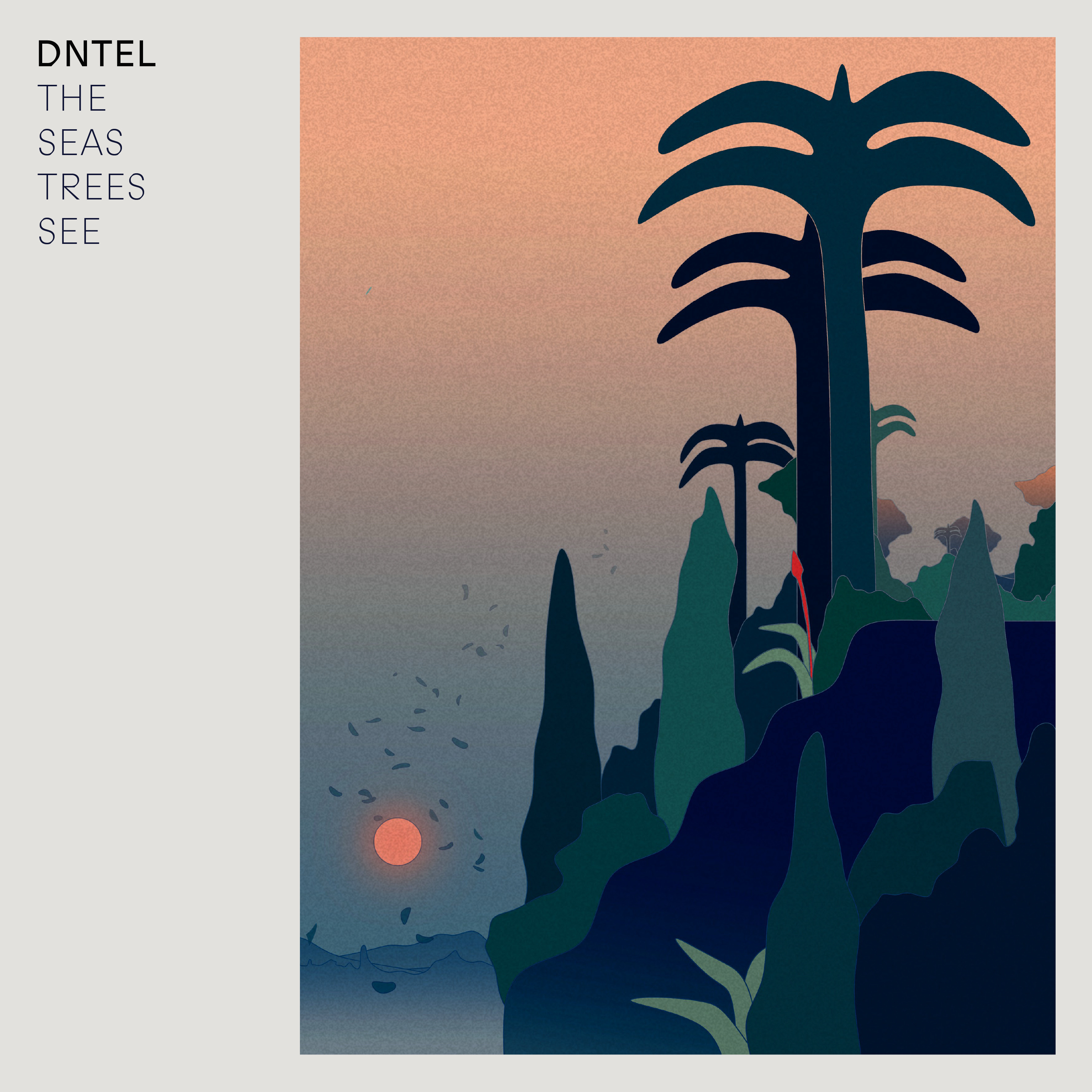
It is. Dntel delivers again with the winning mixture of comforting sounds and original exploration, meaning the ease of the familiar rubs up against newer thoughts and tendencies. This is an outdoor album, with an attractive and lasting warmth – as the cover art implies. Dntel’s second opus of this year is destined to be more pop-based, which bodes well for a complementary pair.

Stream

Buy

Switched On – Franck Vigroux: Matériaux (Erototox Decodings)

franck-vigroux

reviewed by Ben Hogwood

What’s the story?

This extended EP was released digitally towards the end of 2020 by Franck Vigroux, and will soon be available on vinyl. It reveals a more experimental and less beat-driven side of the French multimedia artist, last heard of by many on his solo 2017 album Barricades, or his 2015 collaboration with Matthew Bourne. There, the two paid an amended musical homage to Kraftwerk’s Radio-Activity album on the occasion of its 40th anniversary.

What’s the music like?

Minimal…but very descriptive. Vigroux proves himself to be a sonic architect, capable of telling a story with the barest material in a form of ‘musique concrète’. Much of the music here could soundtrack a film or an installation, for the images created are powerful and lasting.

The tracklisting is very simple – the ten tracks named Matériaux I through to Matériaux X – and the music follows suit, but with markedly different moods. Matériaux II explores blasts of sound, as does Matériaux VI, which portrays a massive space but with an increasing sense of dread, as a progression you might hear in a horror movie starts to build. Here Vigroux’s sounds are like a church organ, played at the highest range – while at the other end of the scale, Matériaux IV has a lovely rich sound with hints of quarter tones, like a group of monks recorded from the other end of a monastery. Matériaux VII stays lower in the spectrum but is still uneasy.

The two outer pieces are the most substantial, and Matériaux X is effectively a story in several parts. Early on there are individual sounds like tendrils twisting inwards to form a cluster, in the sort of style Greek composer Xenakis would have revelled, but then the sound dampens considerably, becoming easier on the ear but ensuring the listener remains wary.

Does it all work?

It does, once the listener buys into the sonic and musical language used on the album. There are no melodies as such here, no rhythm either – but the sounds and harmonies are everything, setting the colour and the mood.

Is it recommended?

Yes. Matériaux reveals Franck Vigoroux making music that is by turns caustic and comforting, and never less than dramatic.

Stream

Buy

Switched On – Mapstation: My Frequencies, When We (Bureau B)

mapstation

reviewed by Ben Hogwood

What’s the story?

Düsseldorf’s Stefan Schneider is the man behind Mapstation, a pseudonym he has used on eight albums since 2000. This is his eighth album, recorded in isolation between March and August 2020 – and because of that his usual penchant for including guest musicians had to be rescinded. He also scaled back the equipment used, paring down to an analog tape loop device, a Roland 808 drum machine, a Novation Peak synthesizer and a guitar – not to mention his own voice, which appears occasionally.

What’s the music like?

Schneider tends to operate towards the lower end of the frequency scale, which ties in with the influences he holds dear. Dub music and Krautrock are perhaps the two most prominent, while perhaps inevitably for a Düsseldorf-based musician the slower side of Kraftwerk and Hans-Joachim Roedelius make themselves known on occasion. So, too, does the music of Cabaret Voltaire.

Mapstation’s music is never over-reliant on a single strain, however, moving with fluid ease between moods and speeds and often maintaining considerable tension. My Mother Sailor has a sonorous lower range, while the Cabaret Voltaire influence comes to the fore on the short but sharp Train Of GerdaTo A Single Listener is an intriguing track, like a musician noodling on the pedals of an organ in a snowstorm. The bleeps and tones Mapstation uses can be intimate or expansive.

Does it all work?

Yes – though you need the right listening environment for My Frequencies to make a proper impact. Listening to it at home or in a studio would be the best environments, for the lower end frequencies to have maximum impact.

Is it recommended?

It is – followers of Schneider’s music will be pleased to note his quality threshold is still high…while followers of the Bureau B label will be satisfied.

Stream

Buy