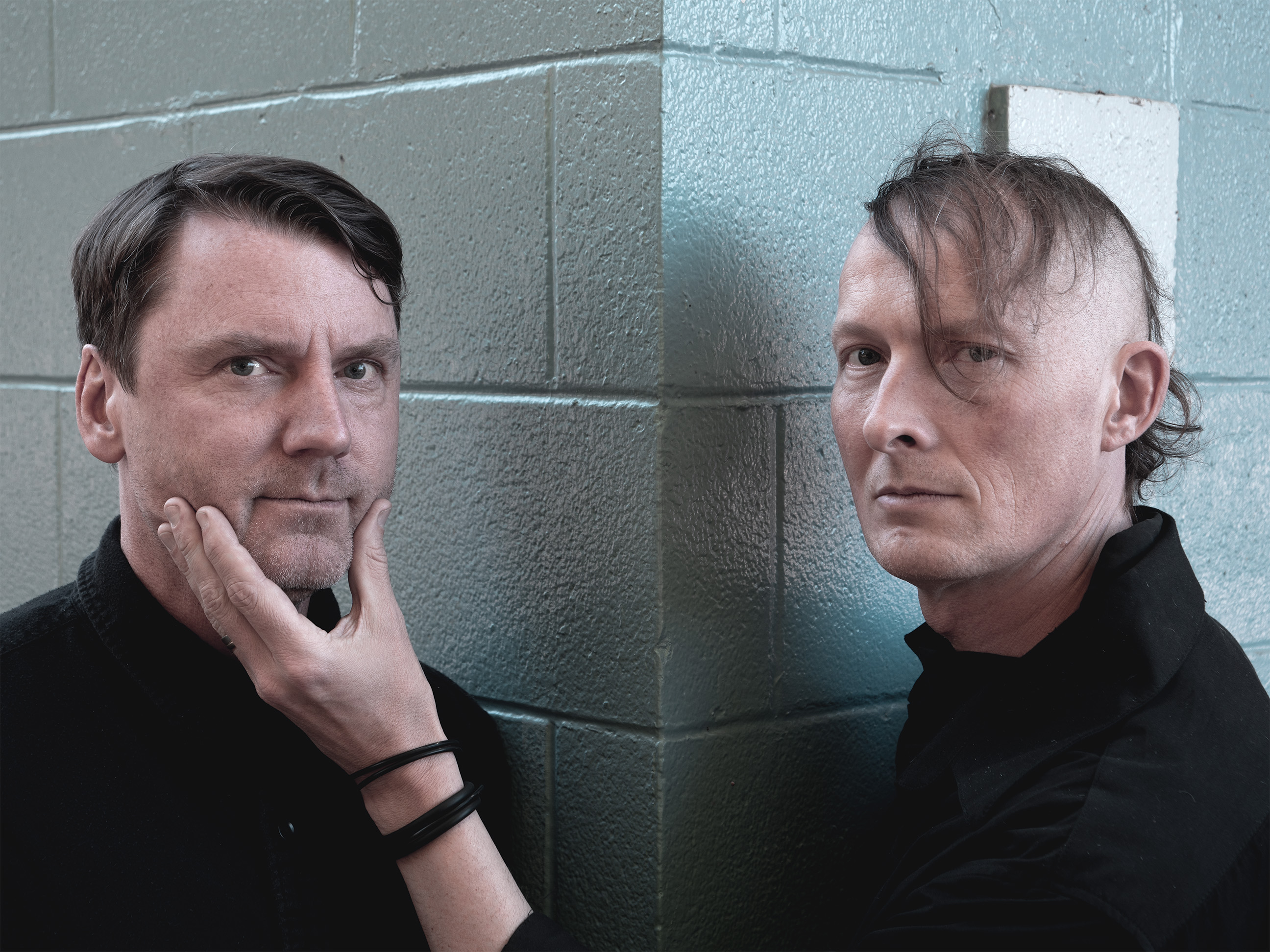
теплота is the London-based duo of Grundik Kasyansky & Tom Wheatley. In their biography they are described as ‘half techno, half free jazz’ – and goes into a bit more detail on how they use ‘feedback synthesizer and computer-acoustic bass’, and ‘fuse a spontaneous interplay orthogonally over cyclical structures, with techno as perpetual fulcrum’.
What’s the music like?
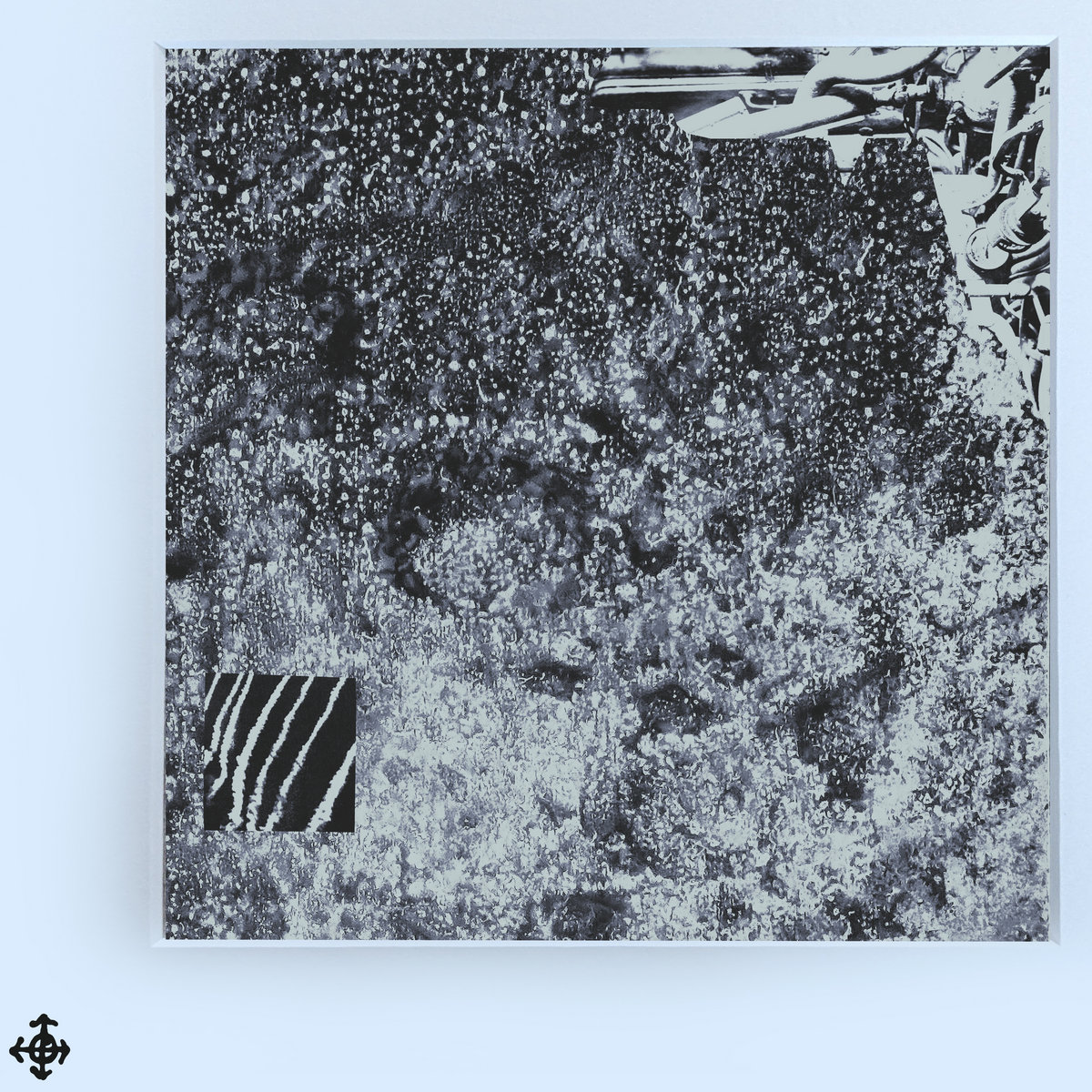
A coiled spring – Skynned has a good deal of energy, but often keeps it confined in tight musical spaces. Often it feels like the musical equivalent of a lithograph drawing in musical form, darkly shaded and executed.
First track Isolator is fidgety, beset by repetitive and glitchy noises, while Motus Haru has a more regular profile. The track Cycle appears in two versions – the first nervy, and a bit unsettled, showing its mechanical workings, while the second carries more dramatic weight. Sling strains at the edges, a treble line trying to break free but ultimately constricted, while there are brief snatches of woozy fairground rides that drift into view in the intriguing and distracted visions of Yagi. Apical, a substantial track, sends transmission codes through bass drum and monotone treble.
Does it all work?
It does – though the moody soundscapes and glitchy musical figures make for claustrophobic listening at times.
Is it recommended?
It is. There are some imaginative and detailed sound pictures here, often presented in the form of fever dreams. Occasionally unsettling, but always intriguing.
This is a proper labour of love from Cocoon Recordings, in honour of the rich musical heritage of their leader and founder Sven Väth. It is, in effect, a 36-track autobiography telling not just the story of his early DJing career through the 1980s, but a compendium of important electronic music released in that time.
Väth started the mammoth project during lockdown, a response to being unable to attend any parties or club nights of his own. Inevitably he started looking back at past successes and good times, and the idea of a full bodied compilation was born.
For vinyl afficionados, the collection is released on a set containing a dozen individually coloured 12” records, with full size portraits of Sven and each embossed with silver hot foil. There is also a triple CD release.
What’s the music like?
To say there are some classics in here would be an understatement, for the tracklisting is packed with electronic musical royalty. Kraftwerk’s Computerwelt, New Order’s Blue Monday, Frankie Knuckles and Jamie Principle in Your Love and the Andy Weatherall mix of Primal Scream’s Loaded are just four of the heavyweights here.
Most listeners will surely own these and not need them again, so the real interest comes when you dig deeper into the collection. Here you find uplifting anthems such as Hugh Masekela’s Don’t Go Lose It Baby, the self-titled Balearic classic from Sueño Latino, the early landmark Break 4 Love from Raze and Model 500’s No UFOs.
A Split create a real buzz with Second – Flesh, while Anne Clark’s Our Darkness is a thrill. Bobby Konders’ Nervous Acid works wonders with squiggly synthesizer lines, while one of the Afrobeat highlights is Le Serpent, from Guem Et Zaka Percussion. Logic System’s Unit starts the compilation, while Väth’s own collaborative effort 16 Bit gets a very welcome runout with Where Are You?
Does it all work?
It does – a thrilling documentary of some era-defining music. Whether or not the package itself is desirable will depend on the depth of peoples’ wallets, for the 12” box will set you back a cool €200.
Is it recommended?
Yes, enthusiastically – few history lessons are as enjoyable as this! Musically it is a no-brainer, but financial constraints may dictate otherwise.
It is helpful to reproduce in full the accompanying notes Gaspar Claus has written for this release on Bandcamp:
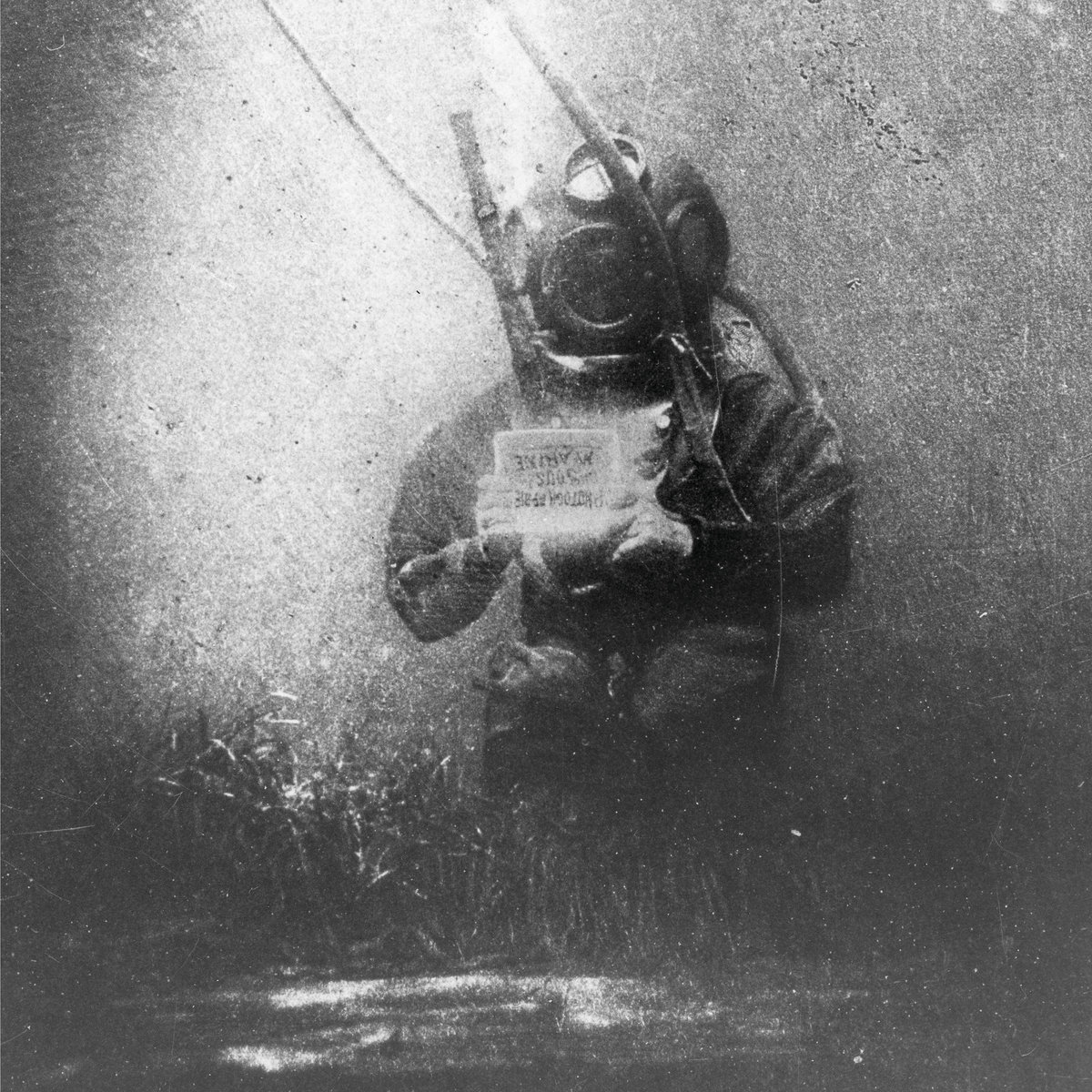
“Scaphandre is the story of an image found in a lost time on the internet a few years ago. It inspired two sound pieces conceived so that one can dive into it as into the sea.
Once their composition was finished, I looked for the origin of this image. It is one of the very first submarine pictures in history, taken by Louis Boutan in 1893 in the bay of Banyuls-sur-Mer… my home town. The original photo as well as a fantastic series of archives documenting this event can be found at the Arago Laboratory, where I often went as a child, after school, amazed by what the researchers were showing me. They just had never told me this story. This is how this record found its scenery.”
Both pieces were written alongside the composition of the album, and are broader in scope, each lasting more than 10 minutes.
What’s the music like?
Compelling, and often deeply mysterious.
Inside starts right from the depths, the instrument detuned by a distance of more than two tones. The scratchy, almost pitchless sounds gradually form a rich chord as layers of sound build up, until a rich, wooden wall of sound is secured, constantly evolving and yet acting as an immovable block. As this progresses the treble pitches start to gather and swirl, slowly orbiting the centre. There is a forbidding intensity about the progression of this piece.
Beyond has more consonant harmonies in its beginnings and occupies a safer space, suspended in a rich drone of mostly G major – but with another massive wall of sound to back it up. Gradually the music lifts, and the foundation drops away to leave mere threads, the elements of pitch dissolving into white noise.
Does it all work?
It does – but it is important to listen to these tracks in the right environment, as they are only fully impactful when a static half hour is set aside.
Is it recommended?
Yes, as a complement to the Tancade album – but if you haven’t heard that yet then it is the best place to start. Either way, Scaphandre is further proof of Gaspar Claus’s powers of invention, knowledge and deep love of the cello. He pushes its sonic boundaries further here, for sure!
This collaboration between Canada and Australia, between composers Loscil and Lawrence English, was born from a long-running conversation on electronic music. It gives both musical minds a chance to explore together the sounds of a pipe organ from the Old Museum in Brisbane. While Lawrence English’s work of the past decade has centred on the sounds of instruments such as this, Loscil’s has tended towards less analogue keyboard instruments.
Here the two combine their unique and deeply personal approach to music, taking the source recordings and manipulating the organ sounds into personal and uniquely colourful responses – hence a different shade for each of the eight tracks.
What’s the music like?
Perhaps inevitably, colourful. However there is something about the way Loscil and English bring colour into their music that sets it well above the ambient ‘standard’. These tracks really do live up to their names, and with eight different hues throughout the album it is certainly one for the mind’s eye.
The Brisbane instrument makes a major contribution, but not just through its resultant music. The mechanical actions are part of the recording process too, so on occasion the very instrument is inhaling and exhaling, providing a white-noise percussion along with the pitches.
Without ado, Cyan allows us to dive straight into these wonderful textures, a glittering array of musical shades that soon become punctuated with soft chimes. The music shimmers in a way that the organ music of Philip Glass does, but the motifs are blanketed, the shape shifting chords taking place like billowing clouds.
As the eight-part suite progresses, so we get to hear more of the nuances of the Brisbane instrument, with varying levels of attack and depth. The pitches stay relatively static, often in a drone-like stasis, but some allow for greater, mysterious movement – such as Aqua, with its ethereal sighing motif. Sharper tones are used for the brightness of Pink, a vivid contrast to the relatively withdrawn colours of Grey and Black that went before.
Black, the longest track of the eight, is a majestic piece of work, dark as space itself but panning out to the edge of perspective. Of a similar dimension is Magenta, whose slight pitch bends create a drawn out and very intense sonic drama.
Yellow is another standout moment, and it just so happened that I experienced this piece of music during a sunrise, which it most certainly evokes – one of those wonderful moments where sound and nature are as one.
Does it all work?
Yes. There are some fascinating processes at work here, and the feeling persists that the outcome is an equal musical agreement between the two parties. The listener still gets Loscil’s uniquely wide, weather-beaten panorama, but the pipe organ adds something special, Lawrence English securing his timeless response in a different and slightly more mechanical way.
Is it recommended?
Without hesitation. A mandatory purchase for fans of either – and for those in need of some musical balm to mark the end of January.
Matthewdavid has been busy, with new album Mycelium Music readied for the end of April – and the On Mushrooms EP is a taster ahead of that release.
What’s the music like?
The title gives a strong implication of where this EP sits, but as with other releases from Matthewdavid it works of its own accord, as music that enhances mental wellbeing.
The tracks are cleverly structured, divided by bursts of white noise that mean they can segue into one another comfortably. The music teems with life, in spite of its relative stasis, and on tracks like Under A Tree the green shoots are easy to discern. Matthewdavid works his electrical material with all sorts of intriguing twists and turns.
A New Ambient swirls across the stereo picture, gone all too briefly, but Too High To Play Bear’s Campout is like a musical whirlpool. One4G starts in a calmer place before twisting upwards and away.
Does it all work?
It does, with very little weight – this is music for recharge and reparation.
Is it recommended?
It is – maybe not as a way in to Matthewdavid’s music, as earlier releases are more immediate and more obviously ambient. However On Mushrooms doesn’t need any extra curricular stimulant to work its magic.