
In concert – London Symphony Orchestra & Sir Simon Rattle: Dutilleux centenary

sibelius-5Leonidas Kavakos (violin), Julia Bullock (soprano), London Symphony Orchestra / Sir Simon Rattle, live from The Barbican Hall, Wednesday 13 January 2016
Written by Ben Hogwood

What’s the music?

Ravel – Le Tombeau de Couperin (1914-17) (18 minutes)

Dutilleux – Violin Concerto, L’arbre des songes (The tree of dreams) (1983-85) (25 minutes)

Delage – Quatre poèmes hindous (1912) (11 minutes)

Dutilleux – Métaboles (1965)

Ravel – Daphnis et Chloé, Suite no.2 (1912) (17 minutes)

Broadcast link (open in a new window):

http://www.bbc.co.uk/programmes/b06v2663

About the music

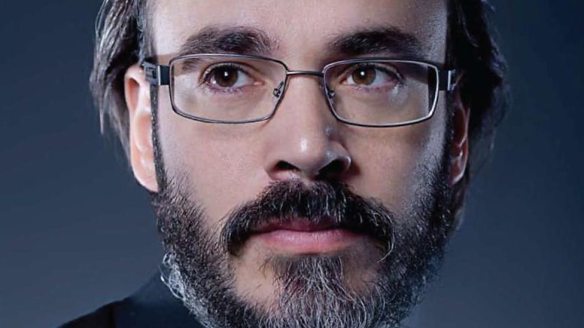
henri-dutilleux

If you are in any way intimated by newer classical music, Henri Dutilleux (above) is an excellent place to start. ‘One of the most aurally sensual programmes you could ever go through’ is how Sir Simon Rattle describes this concert of orchestral works. Doubtless that statement was made with Ravel’s Daphnis et Chloé in mind, and also the music of Henri Dutilleux, the centenary of whose birth falls on 22 January 2016.

Dutilleux continues in a line of French orchestral masters whose music is every bit about the overall sound as it is about the melodies and harmonies within. His mastery of orchestral colour owes a lot to Ravel’s influence, and that of Debussy too – as you will hear in the Violin Concerto L’arbre des songes (The tree of dreams) and the virtuoso piece for orchestra Métaboles.

The ‘sensual’ description does not apply so readily to Le tombeau de Couperin. The opening Ravel piece is an elegiac suite paying tribute both to his friends who died in World War I and the past generation of French ‘Baroque’ composers, who – Couperin among them – lived and excelled in the 18th century.

Also included are the Quatre poems hindous of Maurice Delage, written just a year after the French composer travelled to India. Delage writes for a much reduced ensemble of just ten instruments to accompany a soprano in four brief but exquisitely realised text responses.

What should I listen out for?

Ravel Le Tombeau de Couperin

3:23 – an attractive and slightly reflective Prélude where not a note is wasted. Ravel’s writing for the wind instruments is particularly beautiful, the oboe taking much of the lilting tune.

6:54 – the Forlane­, a dance where Ravel sounds like he’s written the wrong notes – but in fact has written tunes spiced with harmonies that are surprisingly catchy. Again the orchestration is exquisite, whether in the held string chords behind the woodwind tune or the little points of percussion and harp that provide punctuation. There are four more sections that include equally likeable tunes, with the main tune coming back between each one – structured carefully as a French Baroque composer would.

13:01 – the softly scored Menuet, a dance that has its bright colourings but is sorrowful at its heart. It turns darker in its quiet, minor key Trio (14:57), where a shiver of cold where the spectre of the War can clearly be felt. This builds to an anguished climax before the Menuet, now a brighter and more relaxed presence, returns.

18:14 – there is a sense of purpose about the Rigaudon, a brisk dance where Ravel is getting on with things again, in the face of the Menuet’s sorrow. It is a fun quickstep, pausing briefly for a slower middle section with oboe (19:31) before the main material returns, broken off quickly and emphatically at the end.

Dutilleux – Violin Concerto, L’arbre des songes (The tree of dreams)

28:28 – the violin begins this work on its lowest note, and after a thoughtful beginning becomes animated. The orchestral backdrop is beautifully crafted and carefully shaded. The colours are strongly suggestive of a forest, as is the humid atmosphere.

At 30:59 we hear the cimbalom for the first time as part of the orchestral texture. From 33:00 the tempo is faster, and then from 34:44 there is an upward surge to two bell strokes, which bring in the first interlude – and some agitated thoughts from the violin around 36:30. Now the music is energetic, the violin trading musical thoughts with the woodwind, and often using multiple stopping (playing more than one string at once).

Then, with the mute on, the violin disappears into the distance after 39:00. The cimbalom can be heard again – the second interlude – and then the music becomes nocturnal, and it feels as though we are at the heart of both the forest and the work.

From 41:21 we hear the oboe d’amore, part of an important duet, the two instruments close together while the strings and percussion observe from a distance. The colours here, particularly when strings join around 44:00, are especially beautiful. After a bigger passage with full orchestra, the high strings dazzle at 46:05.

Then at 46:37 the violin can be heard tuning – but this is part of the third interlude, Dutilleux not wanting to relax the intensity of the piece. Sure enough the transition to the final section is seamless, the bells prominent again – and an energetic last movement gets into full swing. Then, as the violins hold a high note, a solemn section of chords is heard, bringing in a coda.

At 52:14 a scratchy sound from the violin and cimbalom, then a big, percussive statement from the orchestra brings the piece to an emphatic end.

Delage – Quatre poems Hindous

Texts https://fr.wikipedia.org/wiki/Quatre_po%C3%A8mes_hindous

1:21:33 – Madras – a sultry flute sets the forest scene before the soprano comes in half a minute later. The music has sensual twists and turns, aided by the flute and cor anglais.

1:24:08 – Lahore – the keen ear of the composer for new sounds can be clearly felt here, the cello pizzicato and accompaniment seemingly from another world as they depict the ‘lone tree in the north’. This song – the most substantial of the four – ends with an exotic vocalise from the singer (music but no words).

1:29:03 – Bénarès – the cor anglais is prominent in the accompaniment here, and light percussive effects from the harp and strings vividly set the scene. The coming of Buddha on earth is announced by the excited singer.

1:30:39 – Jeypur – the flute is prominent in setting the scene, before the questioning vocal takes over. The instrumentation is relatively rich but again the flute has the final say.

DutilleuxMétaboles

Rattle describes this as the most perfect ‘bonzai’ concerto for orchestra. There are four movements, and each shows the different parts of the orchestra one by one, bringing them together at the end.

1:40:08 – sometimes with a contemporary composer you can tell just from the first chord what they are about. Métaboles is one such example, with a chord of extraordinary colours starting the first section, a fluid tour de force for the wind players. At around 1:43:30 the strings are much more in evidence, a velvety texture used. A high cello solo emerges from the mist.

1:46:38 – a lower clarinet starts off a new section where the music is quicker and lighter, aided by string plucking and carefully placed percussion.

Then with the full orchestra Dutilleux builds up a huge wall of sound to the finish. The audience reaction suggests this piece is well on the way to becoming one of the most popular in recent times.

RavelDaphnis et Chloé, Suite no.2

This is a shorter suite from the ballet, which lasts around an hour.

1:59:28 – surely one of the most wonderful evocations of dawn in all music. Ravel’s wonderfully mysterious tableau starts by murmuring in the lower reaches of the sky until, with calls from flute and oboe, the sun reveals its glorious light at 2:00:26. The rest of the movement continues with a sense of wonder at the new day until a massive climax at 2:04:06, the metallic glint at the very top of the sound courtesy of the triangle.

What’s coming up on Arcana in 2016?

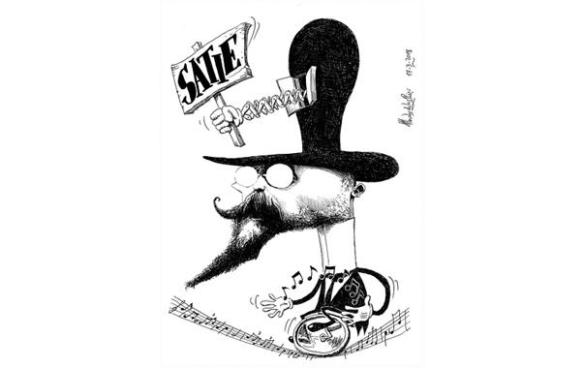
satie

Caricature du Maître d’Arcueil, Erik Satie

A question. What do Janet Jackson, Steve Hackett, Gary Numan and Cesar dog food have in common?

I’ll let you ponder the answer while setting out what Arcana has planned for some of 2016! We’ve already wished you a happy new year but having survived the first week back this is a great chance to let you know what we have planned for the year ahead.

We plan to make much more of the links between classical and pop music this year – so you can expect further episodes of The Borrowers (which already includes Manfred Mann, Plan B, Village People and Greg Lake), interviews with artists who like to work in both areas of music, and reviews of albums that appeal to both sides.

These will include the forthcoming James Holden and Luke Abbott album, a homage to Terry Riley – and we might even delve into the daunting prospect of Rick Wakeman and Alice Cooper celebrating the 40th anniversary of Pink Floyd’s Wish You Were Here, with large orchestra in tow! There is so much variety and depth in this area to explore. We also hope to hear from the artists themselves, whether electronic, prog, jazz or ‘other’.

shining

Arcana will also be training the spotlight on two composers who have been a big influence on pop music, albeit in very different ways. 2016 is the 150th anniversary of the birth of Erik Satie, and we will explore his influence on pop music from several directions. A good contrast to Satie’s music can be found in the work of Hungarian composer Béla Bartók – famously used by Stanley Kubrick in part of The Shining (above). Arcana aims to show the breadth of his writing, as well as illustrating how rock music can be said to trace back through his work. Kicking off, Richard Whitehouse will be covering James Ehnes and Andrew Armstrong playing Bartók in a concert from the Wigmore Hall tonight.

All that and the usual concert and new recording reviews…showing there is an awful lot to enjoy musically this year. Please do stick around for the ride! And the answer to the question? They’ve all used the music of Erik Satie! We’ll tell you how in due course…but for now we will leave you with his most popular piece:

Vilde Frang, Royal Scottish National Orchestra and Peter Oundjian – Viennese classics in Dundee

rsno
Ben Hogwood visits Dundee’s magnificent Caird Hall for an trio of Viennese works given by violinist Vilde Frang, the Royal Scottish National Orchestra and principal conductor Peter Oundjian
Caird Hall, Dundee, Thursday 12 November

Webern Langsamer Satz (1905), arr for string orchestra by Gerard Schwarz

Brahms Violin Concerto (1878)

Mozart Symphony no.41 in C, ‘Jupiter’ (1788)

What a magnificent setting for a concert. Dundee’s Caird Hall will be well known as an attraction by the locals but it bears repeating that the venue is an excellent acoustic for classical music, as the Royal Scottish National Orchestra conductor Peter Oundjian observed in his brief talk to the audience before the concert.

The high ceiling was perfect for the burnished ardour of Webern’s Langsamer Satz, written while the composer was still in a tonal way of thinking and in thrall to his hero Mahler. Although normally heard through the intimate medium of the string quartet, this arrangement, made by the conductor Gerard Schwarz for string orchestra, worked extremely well, and the RSNO strings made a beautiful and clean sound that left us in no doubt as to the composer’s feelings towards his cousin – who was later to become his wife.

The Norwegian violinist Vilde Frang then joined the enhanced orchestra for another Viennese piece, Brahms’s Violin Concerto­ – and in the process she built on a relationship already established with the erte concerto last year. Frang is not a player prone to exaggerated gestures or one-upmanship on the orchestra and this was the ideal approach for the Brahms, where the two forces work together and where the orchestra often have the better tunes. Oboist Adrian Wilson, acknowledged by Frang at the end, was superb in his slow movement solo, and while this was perhaps a more ‘classical’ reading looking back towards Schubert, Frang took the difficult and extended solo passages, particularly the cadenzas, by the scruff of the neck and refused to let them go.

Completing the Viennese trio was Mozart’s Jupiter symphony, his last – with Oundjian sensibly reducing the forces in the name of clarity. This was an extremely fine performance where the rapport between the RSNO and their conductor was abundantly clear, and where he ensured that Mozart’s deceptively simple themes were beautifully communicated and developed. A graceful minuet was notable for the floated violin delivery, though in the trio the minor key harmonies sowed the seeds of disquiet.

These were emphatically blown away by the finale, one of Mozart’s greatest achievements as a composer in his successful dovetailing of all five themes in a brilliantly worked fugue. Oundjian took this at a daringly fast tempo but we never lost sight of the tunes, the orchestra working incredibly hard to keep their lines clear and crisp. The enjoyment of all – players and audience – was clear, for this was music to banish even the squalliest of November nights.

Edinburgh String Quartet – Intimate Voices

Edinburgh-Quartet

Ben Hogwood visits the Edinburgh String Quartet on their home turf for an inventive program studying the intimacy of the string quartet
Queen’s Hall, Edinburgh, Wednesday 11 November

Schubert String Quartet in E flat major, D87 (1813)

Shostakovich String Quartet no.7 (1960)

Sibelius String Quartet in D minor, Op.56, Voces Intimae (1909)

Intimate Voices was the subtitle of this triptych from the Edinburgh String Quartet, an intriguing look at how the combination of two violins, viola and cello has become one of the main expressive forms in classical music.

To show how composers have approached the medium in different ways they presented a quartet by the teenage Schubert, a mature and compact example by Shostakovich and the only fully published example by Sibelius.

Of the three pieces it was perhaps this one – subtitled Intimate Voices – that carried the most penetrating emotional impact, played with passion and purpose by the quartet, whose dynamic control was especially impressive. The quiet moments, helped by an attentive Queen’s Hall audience, were a real window into Sibelius’ mind, and his string writing, which as the perceptive booklet note pointed out was boosted by his knowledge of stringed instruments through playing the violin, was interpreted with real style.

This piece was equalled in emotional impact by the Shostakovich, arguably the most effective of his fifteen quartets at making its mark in a very short space of time. Just twelve minutes pass in the String Quartet no.7 but in it we get deep into the thoughts of the composer. Shostakovich vividly illustrates his humour in the face of adversity but also the adversity itself, and the Edinburgh Quartet could be found warily treading forward as though worried what might be around the corner. Here again they paid exquisite attention to the quiet writing, so that when the third movement exploded out of the box it did so angrily and with maximum impact.

By complete contrast the first item in the program served notice that the sixteen year old Schubert was capable of going places. While taking obvious leads from Haydn (the second movement) and Mozart (the third) the String Quartet in E flat, published as D87 in the composer’s catalogue, is a beautifully crafted work that is by no means a copy. Schubert writes with confidence and melodic interest, the roots of his work in song already sown and making their most poignant effect in the first and third (slow) movements. The second movement was a blink-and-you-miss-it affair, with first violinist Tristan Gurney and cellist Mark Bailey helping to bring out the humour. Overall the intimacy between the players was as Gurney said in an insightful chat with the audience, essentially being a conversation between friends.

Gurney’s introduction was a key part of the enjoyment of this concert, showing that the theme Intimate Voices need not be restricted to the four players, but that the audience were included as well.

The Edinburgh String Quartet website can be accessed here

James McVinnie with Bedroom Community – Royal Festival Hall, 24 September

james-mcvinnie

Arcana has just completed an extremely interesting interview with the organist James McVinnie, who is due to give a concert on the Royal Festival Hall organ along with several of his Bedroom Community colleagues on 24 September.

Bedroom Community is the family-sized Icelandic label that specialises in music where classical and pop intersect, founded as it was by Valgeir Sigurðsson, Nico Muhly and Ben Frost in 2006.

Music by all three artists can be heard in McVinnie’s concert at the RFH tomorrow night, which will be given with singers and instrumentalists from the label. It will include the premiere of Median Organs, a new piece by The National’s Bryce Dessner, written for McVinnie himself…but not the organ.

“The great thing about how Bryce and Nico write,” says McVinnie, “is that they have written pieces without indication. That means you can sit down at the organ with the notes and you are in a sense the orchestrator, which is an interesting and artistically fulfilling piece of work. Bryce has not specified the registrations he wants, but knowing his music I can relate my choices to all of that.”

You can hear and download James McVinnie playing Nico Muhly’s The Revd Mustard his Installation Prelude, which he will also play in the Festival Hall concert, below:


The full interview with McVinnie, in which he talks about Bedroom Community, removing organ music from its religious stigma and the overriding influence of Bach, can be read on Arcana soon.