
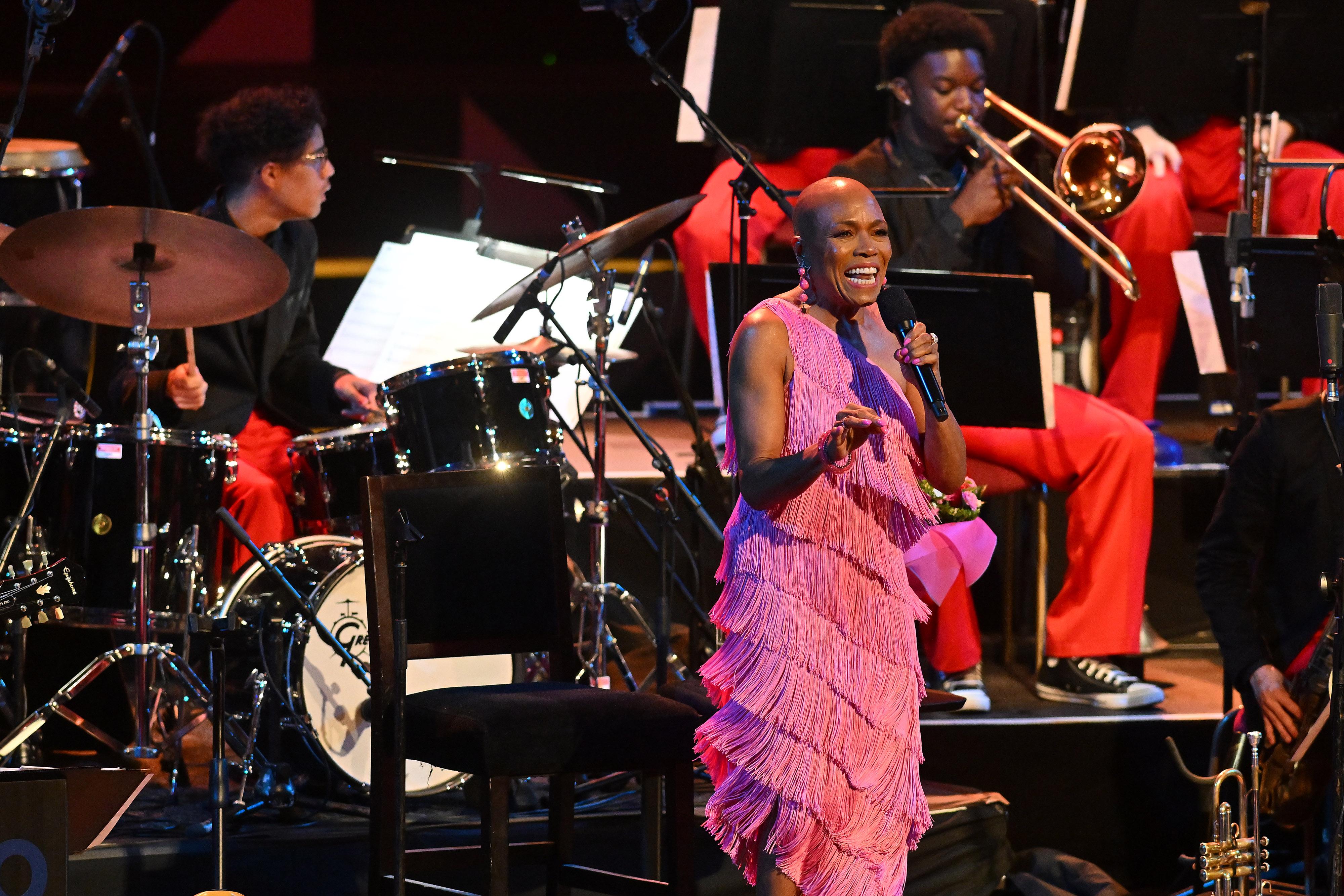
Prom 23 – NYO Jazz (USA) with Dee Dee Bridgewater
Dee Dee Bridgewater (vocals), NYO Jazz / Sean Jones (trumpet)
Duke Ellington trans. David Berger Braggin’ In Brass
Sean Jones The 29ers
Roy Hargrove arr. David Gibson Strasbourg/St. Denis
Duke Ellington arr. Slide Hampton Cottontail
Spencer Williams arr. John Clayton Basin Street Blues
Mongo Santamaría arr. Clayton Afro Blue
Newley / Bricusse Feeling Good
James Brown I Got You (I Feel Good)
Billie Holiday arr. Cecil Bridgewater Fine and Mellow
Leonard Lee arr. Frank Foster Let the Good Times Roll
Wycliffe Gordon We’re Still Here
Royal Albert Hall, London
Tuesday 1 August 2023, 10.15pm
by Richard Whitehouse photos by Chris Christodoulou / BBC
Jazz bands, battling or otherwise, have become something of a fixture for late-night Proms and this latest instance saw a debut at these concerts for NYO Jazz – together with a singer who has kept the role of jazz vocalist, long synonymous with big-bands, well and truly alive.
The latest incarnation of the jazz youth orchestras having emerged from Carnegie Hall over this past decade, NYO Jazz may have been relatively modest in numbers but lacked nothing in impact. That virtually all its members fell into the 18-25 category was duly belied by the sheer technical facility but also the versatility – whether individually or collectively – with which they ranged across the spectrum of styles as encompassed by the big-band medium, much of it suitably demonstrated by the 10 numbers that comprised this evening’s set-list.
The programme was launched in fine fashion with a sassy take on Duke Ellington’s Braggin’ in Brass, giving each of the orchestra sections its time in the spotlight. An energized presence as trumpeter and director, Sean Evans contributed a distinctive number in The 29ers, a tribute to jazzers born on the 29th of the month (not least Ellington); the prominence accorded brass and reeds complemented by limpid cameos for guitar and piano. Next was a smouldering take on Roy Hargrove’s Strasbourg / St Denis and notable for its intensive work-out on double bass.

Dee Dee Bridgewater – singer, actor, magnetic stage-presence and one of a (surprisingly?) select handful of vocalists who have moved between the very different domains of jazz and pop – then took the stage for an animated take on Ellington’s Cottontail, her distinctive scat to the fore alongside the NYOJ’s reeds. This was followed by the sultry strains of Afro Blue by Mongo Santamaría, its Cuban antecedents evident through driving percussion and lyrics whose ‘shades of delight’ sentiment was everywhere apparent. It might have had a complex genesis but the Anthony Newley / Leslie Bricusse number Feeling Good, later immortalized by Nina Simone, segued effortlessly into the James Brown classic I Got You (I Feel Good) – this latter’s swaggering impetus abetted by a visceral solo contribution from baritone sax.
The tempo relaxed incrementally for a soulful take on Billie Holiday’s Fine and Mellow, its all-round looseness enhanced by contributions on double bass, drum-kit and piano. Spencer Williams’ Basin Street Blues is a breezy number whose homages to Ella Fitzgerald and Louis Armstrong were uncannily emulated by Bridgewater’s vocal. She rounded off her sequence with a roistering take on the Shirley Goodman / Leonard Lee number Let the Good Times Roll, made famous by B.B. King and whose roster of brass here featured a stentorian trumpet solo.
Throughout this set (evidently designed with the requirements of a late-night Prom in mind, and one where only a few punters were seen leaving before the close), the NYOJ musicians gave their all. Sean Jones took lead on vocal and trumpet for the fervent groove of Wycliffe Gordon’s We’re Still Here, notable for its contributions from piano and electric keyboard – which instruments partnered Jones in his calmly affectionate allusion to the Londonderry Air, just before the final moments let rip to the undoubted delight of those on and off stage.
For more on the 2023 BBC Proms, visit the festival’s website at the BBC. Click on the names for more information on NYO Jazz, Sean Jones and Dee Dee Bridgewater.


