…from the pen of Antonin Dvořák, who wrote two irresistibly charming works in the form – one for strings, and this Serenade for Wind Instruments in D minor, published as Op.44. It has quite a serious tone to begin with – but the wonderful sonorities come through, as in this performance from the Royal Philharmonic Orchestra, filmed in Cadogan Hall in 2021:
BUNKR‘s third album is centred around Antenne, a 24-hour pirate station transmitting instrumental music only, “devoid of any human voice to provide us with clues. No big ups for the SW9 crew, no ads for the turbo-sound rave with safe security. The 97.9 FM frequency was vibrant with all manner of cosmic, unending playlists of widescreen techno, breakbeats, ambient washes and occasional forays into obscure German synth music.”
The commentary goes on. “Who or what was behind Antenne we may never know; without doubt the unknown makes it all the more alluring. But this album serves to keep the memory of Antenne alive along with the countless other faceless pirate stations from the golden era of electronic music. Just maybe those radio waves continue to hurtle through space like gradually decaying echoes from a once brave new world, readying to connect with our brothers and sisters on the back side of the sun.
Antenne transmitted and informed, we listened and absorbed.”
What’s the music like?
The concept is an ideal one for BUNKR’s music – which could indeed have been teleported from 1996 – but has certainly come via a contemporary mind that knows how to make things fit in the modern world. Antenne flows beautifully, like one of those DJ sets, with BUNKR – aka James Dean – securing music of great fluidity and no little energy.
The beats have more breaks this time round, and his music feels faster, the likes of I Feel Eye See, Controller 29 and Nectar Rushes tearing up ground with very different beats, as they cleverly and energetically intertwine their loops. There is still room for the slower atmospheric grooves we know he can produce, Ceres Outpost and Waiting In Tofino the pair of beauties appearing on here. Meanwhile Oriam Speedway works intricate bleeps and percussion into formation.
Does it all work?
It does. BUNKR’s music is as expressive as ever, the moody soundscapes painting many a picture – and working so well in instrumental form. The greater variety of beats is the icing on the cake.
Is it recommended?
Enthusiastically. James Dean is a prolific writer – this is his third long player in five years – but each one adds a thrilling chapter to what is turning into a compelling story. If atmospheric electronic grooves are your thing, then you need look no further.
With two decades of cutting edge pop music behind them, Eva Padberg and Niklas Worgt return with a slick set of tunes and grooves, described as “their most multifaceted and layered long player yet”.
What’s the music like?
Punchy, poppy and very enjoyable. The pair know how to write a good pop song, and the ten nuggets here are very well formed and extremely well executed.
Hooks, lithe bass lines and supple rhythms are in plentiful supply, and the strap lines are brilliantly delivered. In Between captures all of these qualities, its leading line – “that’s where you’ll find me” – doing the trick. Meanwhile songs like It’s All Yours have a great match of riffing and rhythm.
Does it all work?
It does – the only complaint being that it’s all over a bit too soon.
Is it recommended?
It is. This is an upfront score of electro pop tunes, winningly delivered.
George Lloyd Piano Concerto no.1 ‘Scapegoat’ (1962-3) Piano Concerto no.2 (1963-4, orch. 1968) Piano Concerto no.3 (1967-8) Martin Roscoe (piano), BBC Philharmonic Orchestra / George Lloyd Piano Concerto no.4 (1970, orch. 1983) Kathryn Stott (piano), London Symphony Orchestra / George Lloyd
Lyrita SRCD.2421 [two discs, 73’49” and 70’17”] Producers Ben Turner (1&2), Chris Webster (3), Howard Devon (4) Engineers Harold Barnes (1&2), Tony Faulkner
Recorded 9 & 10 February 1984 at Henry Wood Hall, London (Piano Concerto no.4), 25 & 26 September 1988 (Piano Concerto no.3) and 20 & 21 October 1990 at Studio 7, New Broadcasting House, Manchester (Piano Concertos 1 & 2)
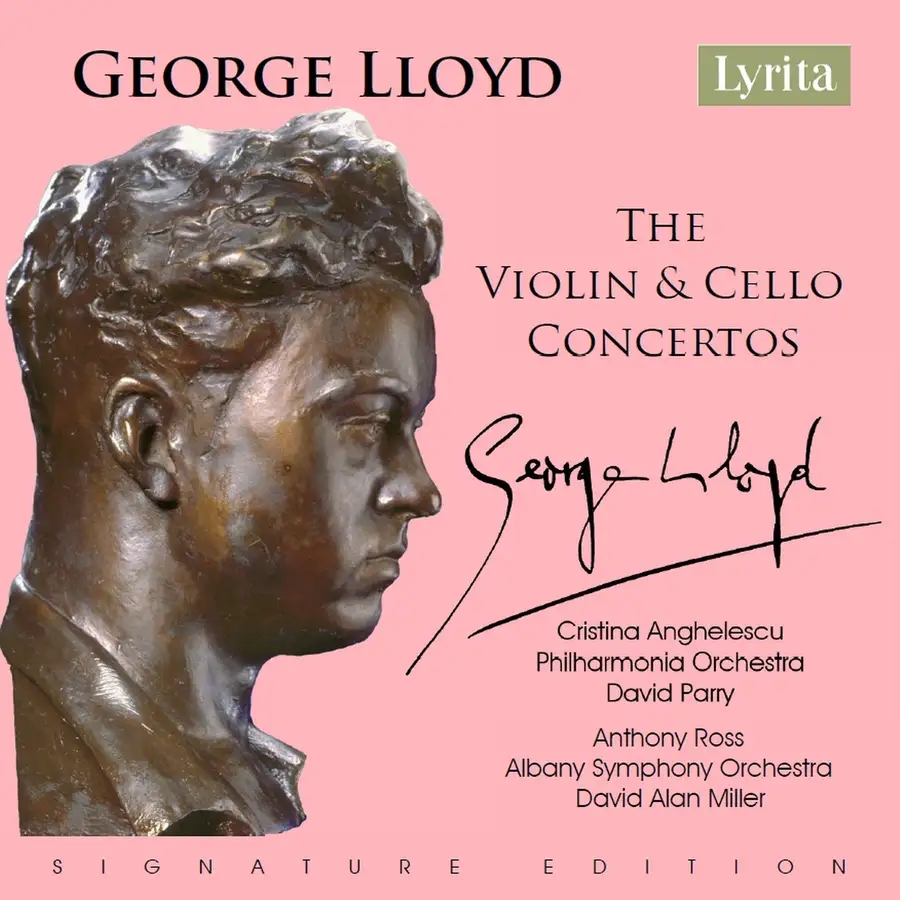
George Lloyd Violin Concertos no.1 (1970) Violin Concerto no.2 (1977) Cristina Anghelescu (violin), Philharmonia Orchestra / David Parry Cello Concerto (1997) Anthony Ross (cello), Albany Symphony Orchestra / David Alan Miller
Lyrita SRCD.2422 [two discs, 64’37” and 29’40”] Producers Ben Turner (Violin Concertos), Gregory Squires (Cello Concerto) Engineers Phil Hobbs (Violin Concertos), Gregory Squires (Cello Concerto) 29 June to 3 July 1998 at Henry Wood Hall, London (Violin Concertos), 22 April 2001 at Troy Savings Bank Music Hall, Troy, NY (Cello Concerto)
Reviewed by Richard Whitehouse
What’s the story?
Lyrita continues its ‘Signature Edition’ of George Lloyd recordings (originally for the Albany label) with two volumes respectively devoted to his concertos for piano and string instruments – all of them being played by soloists either conducted by or who worked with this composer.
What’s the music like?
His previous output having been dominated by the genres of opera, or symphony, Lloyd came belatedly to the concerto. An able violinist in his youth (and taught for several years by Albert Sammons), he had resisted his wife’s predilection for the piano until the early 1960s when he wrote four such works in barely eight years, followed at lengthier intervals by two for violin then one for cello. No less characteristic of their composer, these constitute a significant part of his development from a time when his music was still largely unknown to the wider public.
Hearing the young John Ogdon galvanized Lloyd into writing for the piano, with Scapegoat his striking first attempt at a concerto and his most performed work since before the Second World War – its 1964 premiere in Liverpool, Charles Groves conducting, soon followed with hearings in Bournemouth, Glasgow, Berlin then a BBC broadcast in 1969. A pity that Ogdon never recorded a piece ideally suited to his temperament – its single movement duly taking in elements of the soulful and sardonic in a close-knit structure with Lloyd’s motivic thinking at its most resourceful. Ominous, aggressive, ultimately fatalistic, this is one of the composer’s most cohesive works and urgently warrants revival. Lloyd had enough ideas for its successor but, for reasons unstated, Ogdon never played the Second Piano Concerto that went unheard until 1984. Its single movement yields a distinct progression from trenchant ‘first movement’ via lively ‘scherzo’ then, after an elaborate cadenza, threnodic ‘slow movement’ and resolute ‘finale’ as brings the whole structure into focus while not precluding a tangible equivocation.
Not to be deterred, Lloyd pressed on with his Third Piano Concerto. Brahmsian in scale, its three movements eschew both symphonic density and virtuosic flamboyance – whether in an opening Furioso whose relative brevity belies its wealth of incident, a Lento which sustains its expansive length through imaginative interplay between soloist and orchestra and with a keen sense of atmosphere, then final Vivace that pointedly fights shy of any grand peroration as it heads to a decisive if hardly affirmative close. The piece remained unheard until 1988, whereas the Fourth Piano Concerto had made it to the Royal Festival Hall four years earlier as part of the artistically lauded while commercially disastrous Great British Music Festival. The three movements find Lloyd attempting to banish painful memories in favour of a more relaxed but still restive discourse – hence the poignancy behind the geniality of the opening Allegro, suffused pathos of a central Larghetto that is its undoubted highlight, then animated final Vivace whose spirited ending is offset by the soulful Lento interlude which precedes it.
Hardly had Lloyd finished this last of his piano concertos when he wrote the first of his violin concertos. As the booklet note suggests, its scoring for woodwind and brass has the urbanity of a divertimento or serenade – which holds good for the sanguine opening movement and its plaintive successor, whose cor anglais melody is one of Lloyd’s most potent ideas, but less so for a rather prolix eliding of scherzo and finale. More convincing overall is the Second Violin Concerto, its resonant scoring for strings and obliquely spiritual programme demonstrably to the fore in the initial Lento with its plangent chorale. After an impulsive scherzo and eloquent slow movement, the final Vivace reaches a close whose joyfulness is never contrived. A fine piece, but the Cello Concerto is one of Lloyd’s finest. His penultimate work feels valedictory in tone, its seven continuous sections outlining a four-movement sequence whose clarity of expression is abetted by its scoring for modest forces, and whose subtle range of mood makes the final evanescence more affecting. A professional performance in the UK is well overdue.
Does it all work?
Pretty much. Those aspects of the piano concertos which do not quite succeed are due more to recordings which, scrupulously prepared and lucidly rendered, lack a degree of intensity in their execution. That 1969 broadcast of Scapegoat confirms what is lacking here, but Martin Roscoe is never less than attentive in the first three concertos and Kathryn Stott brings a deft touch to the fourth. Cristina Anghelescu plays with dexterity and no mean insight in the violin concertos, while Anthony Ross is fully attuned to the fatalistic restraint of the Cello Concerto.
Is it recommended?
Yes, but listeners unfamiliar with Lloyd’s symphonies and choral works should hear these in the first instance. Lyrita’s presentation, with objectively enthusiastic notes by Paul Conway, is up to its customary standards and those who are acquiring this series should be well satisfied.
Marshall Jefferson needs no introduction as a house music master, for he is one of the genre’s cornerstone names, a founder member of house in its Chicago form.
If he had only made a single record – Move Your Body – Jefferson would already be of great importance to house music. Yet he used that as a springboard to decades of a consistently good output, where he crossed over easily to pop circles – or kept in with the deeper stuff.
With this House Masters compilation Defected have managed to assemble a set of 40 tracks from 1987 to 2022, no doubt overcoming a number of licensing issues on the way.
What’s the music like?
Consistently good – and often goose bump-inducing. Naturally the compilation starts with the piano-led Move Your Body, a bona fine classic – but it is the first of many, including a couple of the best cuts from Ten City, the quartet with whom Jefferson made house and disco-infused pop. The joyous, spring-loaded That’s The Way Love Is only gets better with age, likewise Devotion and Love Is Just A Game.
The deeper side makes itself known with the spaced-out Mushrooms shows how well he does the deeper side of things. The creeping chord sequence of The Cow (Is Already Waiting) works well, as do the volleys of percussion in Raindance.
Remixes and co-productions also feature, and Mission is slower – if a bit smoother. Vicky Martin’s Not Gonna Do It, meanwhile, is a classic extended mix. Other highlights are On The House’s Pleasure Control, a funky treat with busy piano, and Virgo’s R U Hot Enough, an excellent brass and piano workout. Ragtyme’s I Can’t Stay Away is a big room vocal winner, another linkup with Stingily, while Richard Rogers’ Can’t Stop Loving You features a particularly smoky trumpet.
Does it all work?
It does – a generously filled and well linked collection, partying its way through two hours.
Is it recommended?
Wholeheartedly – and more than that, it is an essential part of house music’s history lesson.




 Arcana.fm