On Record – English Symphony Orchestra, English String Orchestra, Kenneth Woods – Robert Saxton: Scenes from the Epic of Gilgamesh & The Resurrection of the Soldiers (Nimbus)

English Symphony Orchestra, English String Orchestra (The Resurrection) / Kenneth Woods

Robert Saxton
Scenes from the Epic of Gilgamesh (2023)
The Resurrection of the Soldiers (2016)

Nimbus Alliance NI6447 [47’17’’]
Co-Producers Phil Rowlands and Tim Burton
Recorded 7 April 2021 (The Resurrection) and 7 March 2023 (Scenes) at Wyastone Concert Hall, Monmouth

Reviewed by Richard Whitehouse

What’s the story?

The English Symphony Orchestra and Kenneth Woods continue their 21st Symphony Project with this major work from Robert Saxton, here coupled with one of his earlier pieces in what is a welcome and valuable addition to the discographies of composer, conductor and orchestra.

What’s the music like?

His output now as extensive as it is diverse, Saxton had written little purely orchestral music for several decades and few works that might be called ‘symphonic’, but listeners with longer memories may recall the Dante-inspired ‘chamber symphony’ The Circles of Light (1986) or taut incisiveness of the sinfonietta-like Elijah’s Violin (1988). Speaking only recently, Saxton stated a reluctance to call Scenes from the Epic of Gilgamesh a symphony and yet the piece, a result of many years’ thought about the musical treatment right for one of the oldest surviving written texts, has a formal cohesion and expressive unity which are demonstrably symphonic. Scored for pairs of woodwind, horns and trumpets with timpani and strings, its textural clarity imbues any illustrative aspect with an abstract focus amply sustained over its five movements.

Amounting to a continuous narrative, these head from the fluid motion of ‘Prologue’ to ‘The Journey to the Forest of Cedar’, whose passacaglia-like unfolding finds this composer at his most harmonically alluring, then on to ‘From dawn to dusk’ in a scherzo as animated as it is evocative. ‘Lament’ distils a tangible emotional impact from its gradual if inexorable build-up, moving into ‘Apotheosis’ which expands upon the melodic potential of earlier ideas and sees a powerful culmination with the ‘hero’ forced to seek immortality through other means.

Saxton’s approaching the issue of religious belief indirectly, or even obliquely, is as central to this piece as to the earlier The Resurrection of the Soldiers. Inspired by Stanley Spencer’s series of paintings which depict soldiers emerging from their graves on Judgement Day, this might be described as ‘prelude, fugue and threnody’ – the sombre introduction soon reaching an expressive apex, from where the intricate yet cumulative middle phase builds inexorably to a plangent climax; the ensuing slow section gradually ascends linearly or texturally to an ending whose affirmation feels pervaded by anguish. Both these works have the concept of redemption as their focal-point – albeit one which cannot be gained without effort and, even then, should never be taken as read. Tonality, indeed, as the corollary to travelling in hope.

Does it all work?

It does. Four decades on from those flamboyant pieces which established his name, Saxton here evinces an orchestral mastery which will hopefully find an outlet in further such pieces – whether, or not, ‘symphonic’. More overtly tonal it might have become, his music still poses considerable challenges whether technical or interpretative. Suffice to add these are met with finesse and conviction by Woods and the ESO, who are fully conversant with its elusive but always accessible idiom. The composer could hardly have wished for a more tangible QED.

Is it recommended?

It is, not least as enhanced by the composer’s succinct introductory notes and the conductor’s pertinent thoughts on ‘Conducting Saxton’. It reinforces, moreover, that the 21SP is not about retrenchment – rather, the enrichment of this most archetypal of genres is what really matters.

Listen & Buy

This album is released on Friday 5 July, but you can listen to samples and explore purchase options on the Presto website. Click on the names for more on conductor Kenneth Woods, the English Symphony Orchestra and composer Robert Saxton

Published post no.2,220 – Tuesday 25 June 2024

On Record – James Turnbull, Poppy Beddoe, Mira Marton, BBC NoW / Matthew Taylor: Matthew Taylor: Orchestral Music Vol.2 (Toccata Classics)

James Turnbull (oboe), Poppy Beddoe (clarinet), Mira Marton (violin), BBC National Orchestra of Wales / Matthew Taylor

Matthew Taylor
Symphony no.6 Op.62 (2021)
Oboe Concerto Op.60 (2020-21)
Clarinet Concertino Op.63 (2021)
Violin Concertino Op.52 (2016)

Toccata Classics TOCC0708 [69’32’’]
Producer Andrew Keener Engineer Andrew Smillie
Recorded 17 & 18 December 2022 in Hoddinott Hall, Millennium Centre, Cardiff

Reviewed by Richard Whitehouse

What’s the story?

Toccata Classics continues its now extensive coverage of Matthew Taylor (b.1964) with this coupling of his most recent symphony alongside three of his concertante pieces, two of them here played by the soloists for whom they were written and all with the composer conducting.

What’s the music like?

Those familiar with Taylor’s symphonic output will recall that the Fifth ended with an adagio of powerfully inward emotion, and the Sixth Symphony picks up on this directly. Dedicated to the memory of Malcolm Arnold in the year of his centenary, it is his contemporary Robert Simpson (a pervasive influence on Taylor’s formative years) who comes most to mind in an opening movement whose alternation between relative darkness and lightness is informed by a gradually cumulative momentum the more striking given this music’s textural transparency.

The second of three continuous movements centres on a fugal theme of affecting poise, one whose transformation is made more so by orchestration where piano and harp confirm their substantive rather than merely colouristic roles. Only with the finale does Arnold’s presence assert itself – the jazzy cast of its clarinet theme facilitating allusions to, if not quotations of, several of this composer’s salient works prior to a culmination that, launched by a crescendo of mounting anticipation, rounds off the whole work with a decidedly no-nonsense terseness.

Of the other pieces, the Oboe Concerto is most substantial. Imaginatively scored for Haydn-esque forces, with cors anglais instead of oboes, it inverts the expected order of movements with the first of these featuring a central section whose intermezzo-like deftness offsets the sombreness either side. There follows a Scherzo which further develops the primary motifs with dextrous virtuosity, before an Adagio affords not just closure but a sense of fulfilment   through the emotional raptness such as pervades this most eloquent among Taylor’s finales.

Taylor having earlier written concertos for clarinet and violin, the present works are lighter in their overall mood but not slighter in actual content. Thus, the Violin Concertino intersperses respectively trenchant and lively outer sections with an ‘aria’ of wistful elegance, whereas the Clarinet Concertino frames its pert amalgam of slow movement and scherzo with an Andante of autumnal repose then a finale of artless naivety. Brahms is mentioned in the latter instance, though the late woodwind sonatas of Saint-Saëns and Poulenc might be felt equally apposite.

Does it all work?

It does, and not only because of Taylor’s sill in writing from a soloistic or orchestral vantage. Each of the concertante pieces confirms his feeling for the instrument in question, while the symphony reaffirms his status among the leading exponents of this genre from the past half-century. The three soloists are audibly attuned to his music, and the BBC National Orchestra of Wales continues the favourable impression it made with his Fourth Symphony (recorded by Kenneth Woods on Nimbus NI6406) by similarly responding to the composer’s direction.

Is it recommended?

It is, and not least when the booklet features informative notes by Taylor himself. This release is dedicated to the memory of Tom Hammond (1974-2021), trombonist and conductor whose untimely death deprived the musical world of a gifted musician and exemplary human being.

Listen & Buy

You can listen to samples and explore purchase options on the Toccata Classics website Click on the names for more on artists James Turnbull, Poppy Beddoe and Mira Marton, the BBC National Orchestra of Wales and composer / conductor Matthew Taylor

Published post no.2,219 – Monday 24 June 2024

On Record – BBC Symphony Orchestra / Martyn Brabbins, Sir Andrew Davis – Payne: Visions and Journeys (NMC)

BBC Symphony Orchestra / Martyn Brabbins, Sir Andrew Davis (Visions and Journeys)

Anthony Payne
Orchestral Variations: The Seeds Long Hidden (1992-4)
Half-Heard in the Stillness (1987)
Visions and Journeys (2002)

NMC D281 [62’15’’]
Producers Philip Tagney, Ann McKay (Visions and Journeys) Engineers Simon Hancock, Philip Burwell (Visions and Journeys)
Broadcast performances on 22 September 2006, Maida Vale Studios, London; live performance 9 August 2002 Royal Albert Hall, London (Visions and Journeys)

Reviewed by Richard Whitehouse

What’s the story?

NMC issues a tribute to Anthony Payne (1936-2021) featuring three of the most representative among his mature orchestral works and so makes for a viable overview, featuring an orchestra and conductors who between them gave numerous performances of his music in his lifetime.

What’s the music like?

Earliest here is Half-Heard in the Stillness, a short yet evocative tone poem making use of the Memorial Chimes which Elgar wrote for the Loughborough carillon in 1923. By this stage in his career, Payne had evolved an idiom that effortlessly but meaningfully elides between post -war Modernism and a late Romanticism (not necessarily British in derivation) such as gives his later output its tonal and expressive lustre. The outcome is ‘landscape’ music that intimates far more than it states, to an extent which the senior composer would surely have appreciated.

Most extensive of these pieces, The Seeds Long Hidden is a sequence of orchestral variations which outlines an autobiographical trajectory. Other than the opening gesture from Brahms’s First Symphony (a hearing of which in 1947 determined the course of Payne’s life thereafter), the works alluded to over the course of its 10 variations are not quoted directly but rather flit across the music and so inform the context from which the ‘theme’ variously emerges. While there is a constant and productive eddying between relative stasis and dynamism, moreover, the overall cumulative thrust seems one of clarification towards an emotional climax of self-realization which quickly recedes into the calm equivocation of the closing bars. If this is, as the composer states, a ‘musical autobiography’, it is an overtly self-effacing and oblique one.

As the first major work that Payne wrote in the aftermath of his realization of Elgar’s ‘Third Symphony’, Visions and Journeys is inevitably bound up with the re-establishing of his own idiom: a statement of intent to be pursued over what became the final phase of his creativity. Nominally inspired by frequent journeys he and his wife – the soprano Jane Manning – made to the Isles of Scilly, this is in no sense pictorial or illustrative in intent. That said, its overall follow-through from unforced anticipation, via understated fulfilment, to underlying regret could not otherwise have been made explicit; the degree to which this is transcended being both the music’s purpose and its primary fascination. A blueprint, indeed, for the select few works that were to come and which reinforced Payne’s standing as a composer of substance.

Does it all work?

Yes, as long as one approaches these works not as compromise between competing aesthetic tendencies but as their synthesis in music which is often eloquent and always appealing. The playing from the BBC Symphony Orchestra could hardly be bettered, with Martyn Brabbins and the late Sir Andrew Davis always committed in their advocacy. Occupying that amorphous middle-ground between the rarified and accessible, Payne’s music neither rejects nor courts popularity but the rewards are considerable for those willing to spend time in its company.

Is it recommended?

Indeed, in the hope a follow-up release which features Spirit’s Harvest (initially intended for inclusion here) and Payne’s culminative statement Of Land, Sea and Sky may yet be possible. The composer’s introductory notes explain everything while giving absolutely nothing away.

Listen & Buy

You can listen to sample tracks and purchase on the NMC website. For further information, click on the names for more on Martyn Brabbins, the BBC Symphony Orchestra and composer Anthony Payne

Published post no.2,218 – Sunday 23 June 2024

In appreciation: Darius Milhaud

Darius Milhaud died 50 years ago today. One of the most prolific composers of the 20th century, Milhaud’s list of works extends to several hundred published pieces for all manner of instrumental and vocal combinations, with works for the stage, concert hall, chamber music and piano all filling the list to bursting point.

More recently his music has been difficult to find, whether on concert programs or recordings – and we hope to redress the balance a little over the next month, exploring some of his works – including all 12 symphonies and five piano concertos. For now, here is a performance of one of Milhaud’s best-loved works, the jazz-inspired La Création du Monde:

Published post no.2,217 – Saturday 22 June 2024

In concert – Martin Fröst, Janine Jansen, LSO / Gianandrea Noseda: Lost and Found @ Barbican Hall

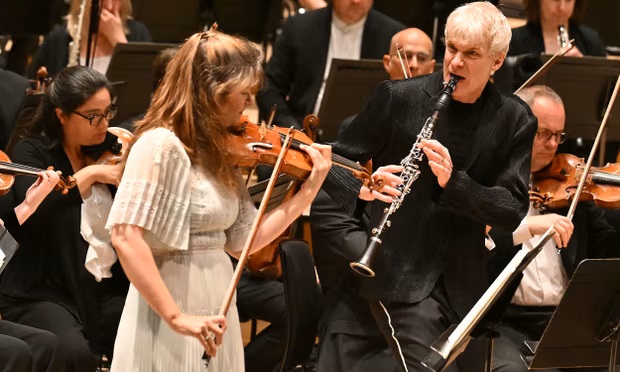
Martin Fröst (clarinet), Janine Jansen (violin), London Symphony Orchestra / Gianandrea Noseda

Beethoven Leonore Overture no.3 Op.72b (1806)
Beamish Distans: Concerto for violin and clarinet (UK premiere) (2023)
Prokofiev Symphony no.7 in C# minor Op.131 (1952)

Barbican Hall, London
Thursday 20 June 2024

Reviewed by Ben Hogwood Pictures (c) Mark Allan

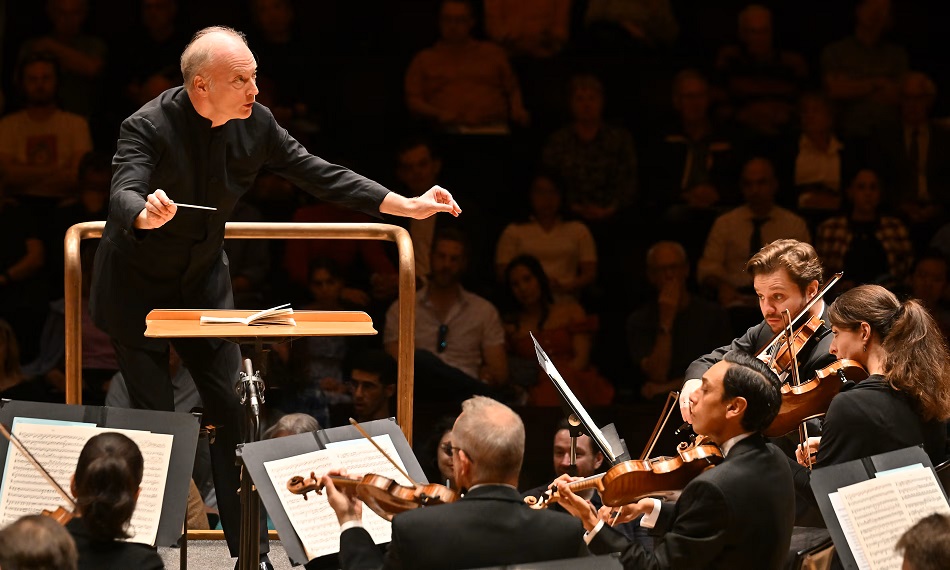
The London Symphony Orchestra and their principal guest conductor Gianandrea Noseda continued their Prokofiev symphony cycle with the elusive Seventh, prefaced by one of Beethoven’s four operatic overtures and a finally realised UK premiere.

This was Distans, a co-commission between four orchestras for Sally Beamish to write a concerto for the unusual combination of clarinet and violin. Its first performance was delayed due to the pandemic, which became the inspiration for the content of the work. Themes of separation run through the three movements, drawing on the composer’s Swedish and Scottish connections. Separated from her children during lockdown, Beamish also used the forceful musical personalities of soloists Martin Fröst and Janine Jansen (both above) for inspiration.

The two began offstage, however, beckoning to each other across the Barbican Hall as Calling, the first movement, took shape. This was named in the concert notes as ‘kulning’, “the high-pitched singing of women calling the calls on remote pastures”. Beamish’s wide-angle musical lens produced an effective and touching first paragraph, the soloists eventually united on stage in music of the dance, evoking a Swedish fiddle with the full weight and energy of the orchestra in support.

Echoing, the slow second movement, explored more intense feelings of isolation through beautiful scoring, earthy cellos and metallic percussion casting a rarefied light suggesting a Swedish winter. The third movement, Journeying, was powered by an ancient march, the soloists together in spirit and melody, out in the elements with the orchestra. Although the music of beckoning reappeared, the mood was one of reunification, the soloists now at peace and content to remain on stage.

Distans made a strong impact in the hall, and Beamish’s writing for clarinet in her first major piece for the instrument made the most of Martin Fröst’s extraordinary breath control and agility. Jansen also fully inhabited the spirit of the piece, though her part often felt within that of the clarinet, and rarely used the high register. This was definitely a work to hear again, for Beamish’s sound world is a very attractive one in concert.

After the interval, Prokofiev’s Seventh Symphony was given an affectionate performance, yet one that also found the darkness lurking within. One of Prokofiev’s final works, the Seventh was written for the Soviet Children’s Radio Division, and as a result adopts a youthful stance, with commendably little room for nostalgia. Instead the composer gets up to his characteristically witty tricks, with inventive scoring enjoyed by the orchestra as woodwind doubled in octaves, and the piano and harp supplemented lower strings.

The music danced, a reminder of Prokofiev’s balletic qualities. The second movement Allegretto had poise in its first tune but a heavier swagger in the second, suggesting the unpredictable movements of older age – though an impressively powerful and assured close was reached. The following Andante enjoyed rich string colours, together with brilliant individual characterisations from oboe (Juliana Koch) and cor anglais (Clément Noël).

Yet the abiding memories came from two themes used in the outer movements. The first, a sweeping unison for orchestra, lovingly recreates the key and spirit of the composer’s first piano concerto, one of his greatest early successes – and was delivered with great charm here. The second, a cautionary motif from flute and glockenspiel resembling a ticking clock, returned like a regretful memory at the end – reminding this listener of an equivalent moment in Shostakovich’s last symphony, completed nearly 20 years later. It ended this performance on a thoughtful note, in spite of the exuberance that had gone before. The LSO were excellent throughout, presenting a convincing case for the Seventh as a bittersweet triumph, and reminding us in the process of Prokofiev’s abundance as a melodic composer.

Meanwhile Beethoven’s Leonore Overture no.3 began in a more desperate mood of resignation, the opera’s main character Florestan losing all hope in prison. Noseda – fresh from recording a symphony cycle with the National Symphony Orchestra in Washington – has very strong Beethovenian instincts, and paced this just right, with an appropriate hush falling over the hall. As the drama heightened, and an evocative offstage trumpet beckoned, the release from prison led to an outpouring of joy, sweeping us up in its forward momentum. The players were off the leash, enjoying every second.

You can find more information on further 2023/24 concerts at the London Symphony Orchestra website

Published post no.2,216 – Friday 21 June 2024