Manu Delago is closing in on the release of his new album Snow From Yesterday, due on 2 February. Here is another substantial taster from it, a piece written by Manu in tribute to his late step-father.
As his label’s press release described last year, “the Austrian composer, innovator, Grammy nominee and acclaimed percussionist has teamed up with vocal ensemble Mad About Lemon to craft a profound and distinct new concept piece. Manu has become a leading name in his field, touring with the likes of Björk, most recently on her celebrated Cornucopia tour. His trademark handpan virtuosity is the rhythmic lifeforce of Snow From Yesterday, creating majestic, emotive sounds, often with a tender delicacy, for Mad About Lemon’s folksy harmonies to pour over.
Those words capture the mood of the new single – and bode well for the new album, which Arcana will of course review.
Published post no.2,053 – Thursday 11 January 2024
Four Tet has an album ‘coming soon’, as announced on his Instagram page today (10 January) The first track released from it is Loved, presenting his first new original material in eight months. As regular followers will know this is a relatively long period of inactivity for the producer – real name Kieran Hebden – but suggests the start of a busy year.
What’s the music like?
Languid – and enjoyably so. This is a contented side to Four Tet that picks up where previous track Three Drums left off, though this time there is a leaner texture and even more dreaminess. Both pieces of music suggest he is in a better place where music is concerned, a year and a half after his legal wranglings with former label Domino were resolved.
A slow beat, borne of hip hop and not far from the likes of early DJ Shadow, sets a relaxed backing over which cool and airy keys spin their magic. It is a blissful listen.
Does it all work…and is it recommended?
Yes indeed. Hebden is known for his consistency while always forging ahead or taking interesting paths – and this is no exception. Loved bodes well for the new album.
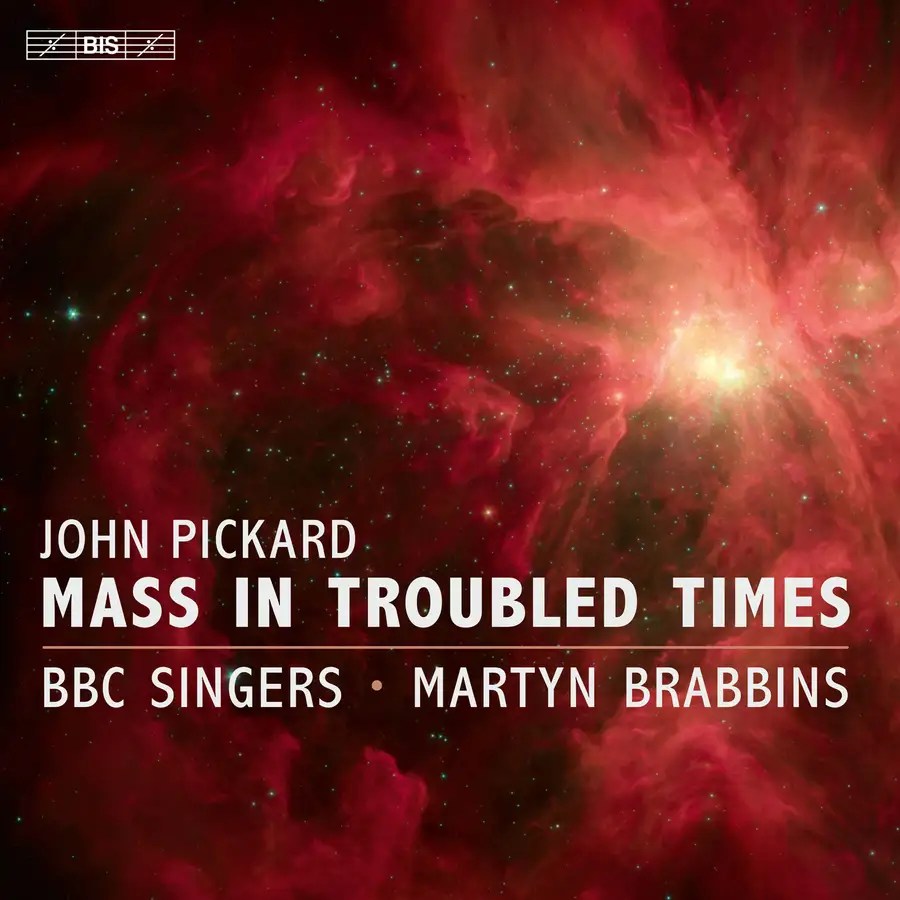
John Pickard Three Latin Motets (1983-7) O magnum mysterium (2015) Orion (2004) Ave Maris Stella (1992) Ozymandias (1983) Tesserae (2009) Mass in Troubled Times (2018)
BBC Singers / Martyn Brabbins with Chloë Abbott (trumpet/flugelhorn, Orion); David Goode (organ, Orion and Tesserae)
BIS 2651 [74’30’’] Texts and English translations included
Producer Adrian Peacock Engineer Pete Smith Recorded 13 & 14 October, St Jude-on-the-Hill, Hampstead, London
Written by Richard Whitehouse
What’s the story?
Although known primarily for his substantial orchestral and chamber output, John Pickard has written several notable choral pieces. This latest release from BIS to be devoted to his music brings most of them together, and in the company of two major instrumental works.
What’s the music like?
Ranging across 35 years of his music, the collection features Pickard’s earliest acknowledged work – a teenage setting of Shelley’s Ozymandias that elicits a response both imaginative and impassioned. Already assured, his choral writing was further honed and refined in Three Latin Motets where limpid renderings of O nata lux and Ubi caritas et amor frame a melting Te lucis ante terminum for female voices. A rapturous Ave Maris stella and touchingly restrained O magnum mysterium duly reinforce Pickard’s confident handling of the a-cappella medium.
The two non-choral items indicate their composer’s abiding fascination with astronomy and antiquity. Scored for trumpet and organ, Orion strikingly evokes said constellation from the vantage of increasing energy in Nebula, an alternating lyricism (courtesy of the flugelhorn) and impetus in Alnitak, then incisive rhythmic interplay of Betelgeuse with its distanced close. Its title indicating those ‘tiles’ used in a mosaic, Tesserae builds cohesion via a steadily accumulating momentum such as tellingly underlies this showpiece with substance for organ.
For 18 unaccompanied voices (in six groups), Mass in Troubled Times is not a setting of the Mass, but a text assembled by the author Gavin D’Costa – lines from T. S. Eliot, Edith Sitwell and Matthew Arnold heard alongside extracts from the Syriac Orthodox Liturgy, the Shahada and the Qur’an. The key is a Turkish Twitter-hashtag from 2015, “Humanity washed ashore”, relating the flight from Aleppo then the drowning of Ayesha – her tragedy an emotional focus over six sections whose expressive intensity seems the greater for their formal concentration.
An Introitus precedes the customary sections of the Mass – reaching a dramatic apex at the climax of the Gloria while carrying the accrued intensity through those that follow; ending with the juxtaposition of lines from William Blake and thrice-repeated Agnus Dei that, next to an evocation of the child’s body off Palermo, has a poignancy shorn of sentiment thanks to Pickard’s acute eloquence. With its wide range of vocal techniques and demanding tessitura,Mass in Troubled Times is a rewarding challenge which all enterprising choirs should tackle.
Does it all work?
It does, not only through the quality of this music but also of these performances – the BBC Singers conveying the immediacy or pathos of Pickard’s response with unstinting clarity and precision. If a demonstration of this choir’s continued existence were needed, this surely is it – Martyn Brabbins (late of English National Opera) directing with his customary conviction. Nor are Chloë Abbott and David Goode to be found wanting in their pieces, rounding out a collection enhanced with vividly analytical recording and the composer’s informative notes.
Is it recommended?
It is, and not merely to those who have been following this invaluable series, which is set to continue with a coupling of Pickard’s Second and Sixth Symphonies. Certainly, the Mass in Troubled Times must feature in any representative selection of works from the 21st century.
Mahler’s Liederabend: A Recreation of Mahler’s Concert in Vienna on 29th January 1905
Mahler Des Knaben Wunderhorn – selection (1892-1901) Kindertotenlieder (1901-4) Vier Rückert-Lieder (1901)
April Fredrick (soprano), Stacey Rishoi (mezzo-soprano), Brennen Guillory (tenor), Gustav Andreasson (bass), Colorado MahlerFest Orchestra / Kenneth Woods
Macky Auditorium, 1595 Pleasant Street, Boulder CO (Links to concert sections embedded below) Saturday 20th May 2023
by Richard Whitehouse
In an event as inclusive as Colorado’s MahlerFest, it was happily inevitable the Liederaband Mahler gave in Vienna on 29th January 1905 be recreated and, while the decision to distribute these songs between four singers was not strictly ‘authentic’, it yet emphasized their variety of thought and expression more readily than had one vocalist been present throughout. What remained consistent was the creative zeal of Mahler at a crucial juncture in his composing, as he left behind the fantastic realm of his earlier music for greater realism and even abstraction.
The first half was of seven songs from Des Knaben Wunderhorn, which collection dominated Mahler’s thinking the previous quarter-century. Two of them are ostensibly dialogues, but the absence of a second singer mattered little when April Fredrick rendered that interaction of the yearning woman with her condemned lover in Lied des Verfolgten im Turm so graphically; as too the more wistful imaginings of separated lovers in Der Schildwache Nachtlied. She also underlined the glancing irony of Des Antonius von Padua Fischpredigt and the playful whimsy of Rheinlegendchen with understated assurance. Brennen Guillory pointed up the deadpan humour of Trost im Unglück and if Der Tamboursg’sell felt a little too earnest, the stridency that increasingly borders on aggression of Revelge was bracingly delivered.
Here, as elsewhere, adherence to Mahler’s scoring, with its emphasis on woodwind and brass, brought out its evocative quality which outweighed any passing thinness of tone in the strings. This was even less of an issue during the sparser textures of Kindertotenlieder, whose songs find universal truths in Friedrich Rückert’s intimate ruminations. Gustav Andreasson seemed a little raw of timbre in Nun will die Sonn’ so hell aufgeh’n, though the yearning fatalism of Nun seh’ ich wohl, warun so dunkel Flammen was tangibly conveyed, as too was the aching poignancy of Wenn dein Mütterlein. The bittersweet elegance of Oft denk’ ich, sie sind nur ausgegangen felt slightly undersold, but not those contrasts of In diesem Wetter as this final heads from fraught anguish toward a repose from which all dread has been wholly eradicated.
Kenneth Woods directed the Colorado MahlerFest Orchestra with that unforced rightness evident from his earlier Mahler performances. Never more so than the four Rückert-Lieder which ended this programme – albeit in a discreet but effective reordering from that of 118 years before. Thus, the capricious whimsy of Blicke mir nicht in die Lieder! preceded the deft enchantment of Ich atmet einen Linden duft; Stacey Rishoi proving as responsive to these as to Um Mitternacht, with its crepuscular winds and majestic climax with swirling arpeggios on harp and piano. Fittingly, the sequence closed with Ich bin der Welt abhanden gekommen – the finest of Mahler’s orchestral songs in its rapt serenity, Rishoi’s conveying of Rückert’s otherworldly sentiments more than abetted by Lisa Read’s eloquent cor anglais. If recreating the Liederabend meant no place for Liebst du um Schönheit (now available in a far more idiomatic orchestration by David Matthews), which might have made a pertinent encore), its absence did not lessen the attractions of this enterprising and successful concert.
Today marks 150 years since the birth of Czech composer Josef Suk in Křečovice, south of Prague, on 4 January 1874.
Over the last 25 years or so, Suk, has enjoyed a mini-musical renaissance, thanks in part to the advocacy of conductors such as Libor Pešek and Sir Simon Rattle. Yet he remains a composer whose music still doesn’t get out that much.
Closer inspection reveals an innovative musical mind, proud of his Czech ancestry but taking in influences from the likes of Brahms as well as Dvořák, who, as well as being Suk’s teacher, became his father-in-law when he married daughter Otilie.
Suk wrote evocatively about nature and the seasons, but a good deal of his music was inspired by family connections, such as the piano suite About Mother, or Czech / Bohemian heritage and history, as in the large orchestral work Praga.
Hopefully 2024 will see more performances of Suk’s music, so that attached Tidal playlist will help set the scene. It introduces the orchestral works for which he is best known, but also some fine chamber and piano compositions. Get a flavour for the music for Suk below:





 Arcana.fm