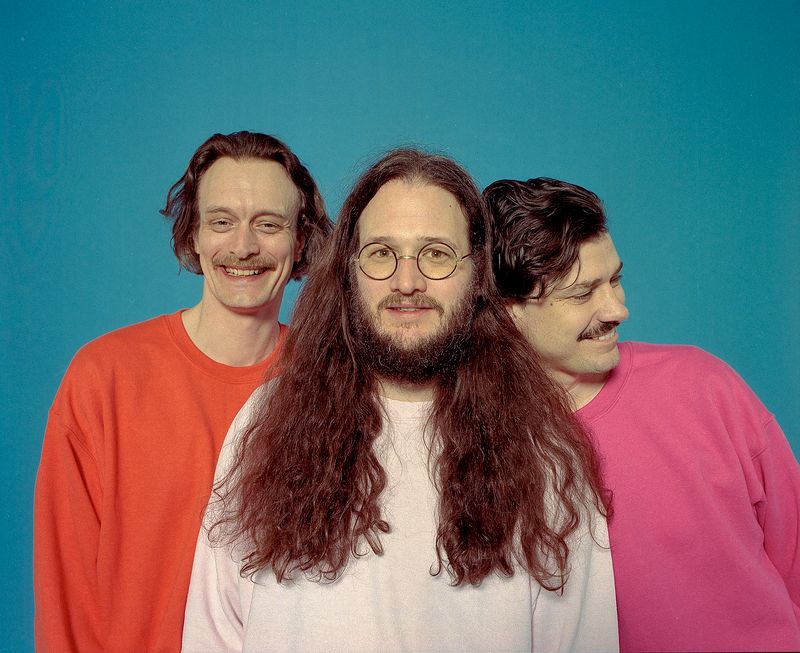
Today brings soothing new music from Danish group Efterklang, in the form of a collaboration with Sønderjysk Pigekor (South Denmark Girls’ Choir), who the band have collaborated with frequently over the last twelve years.
Speaking on the track, Efterklang vocalist Casper Clausen comments: “This piece originated in my little studio in Lisbon. In the early stages of the process, I shared numerous sketches with the others, and this one stood out. As we began to develop it further, we often played it together with the girls’ choir, Sønderjysk Pigekor, from our hometown. Their addition brought a whole gospel vibe to the track, which I found incredibly appealing. I was struck by how their voices seemed to lift the composition into another realm, creating a sense of expansiveness that no instrument or single voice could achieve. I’m singing about being alone, clinging to the stone, kissing oneself to the bone, deep in the heart of the soul.”
The accompanying video was directed by Søren Lynggaard and the band’s Rasmus Stolberg, portraying the members of the choir. Stolberg says: “The video is an homage to the choir who are featured on ‘Animated Heart’ and have given us so many unforgettable musical memories. Inspired by the scenes of ticket lines in Jem Cohen’s Fugazi documentary, we met with the choir to film the video on May 29, 2024. We are honoured to have the choir featured in the song and video, and we are inspired by the hope they bring for the future.”
This is the third single from the band’s forthcoming album Things We Have In Common, which is set for release on September 27, 2024 on City Slang. The band will tour extensively in support of the album throughout the Autumn and Winter, including a show at London’s Barbican on October 5th.
Sometimes, a press release for an album tells you the story in exactly the form you want it to. This is the case with Copper Sounds, whose story runs as follows from the Sequenced Ceramics Bandcamp page:
A unique take on deconstructed club / ambient music, the intimate and immersive sounds on Sequenced Ceramics were made using seven purpose-built ceramic vessels, played using a custom-made sequencer and mechanical beaters. The album is released as a limited edition of 50 ceramic vessels, each one unique, and glazed with a download code. This ceramic is also an instrument, its shape based on one of the seven ceramics used on the album.
“While developing Sequenced Ceramics, we were initially inspired by traditional and highly sculptural clay instruments such as the Udu and the Ghatam. We then experimented with different clays, forms and scales; allowing us to understand the specific acoustic and resonant properties of ceramics. Through this process we began to think about sound, like clay, as a malleable material which you can manipulate through various sculpting and making processes. The final sculptures showcase a range of traditional ceramic making techniques, forms and are made with both visual and sonic aesthetics in mind.”
These sculptures were initially presented together as an installation and have recently been shown at the British Ceramics Biennial 2023 and Indian Ceramics Treinnale 2024. The album features seven sequences composed on this array by the duo, including a collaboration with Tara Clerkin and Sunny Joe Paradisos, and reinterpretations by DJ 2 Button, Memotone, Dan Thorman, Deep Nalström, Wojciech Rusin and Dwhyte Olivers.
What’s the music like?
The music ends up as a fascinating mix of positive energy and ambience. Above all, it feels old and primitive, in a good way – for the rhythmic profiles generated are easy on the ear but could be heard sitting around the fire.
The seven Sequences unfold very naturally, each with a different rhythmic profile that fits the sequences around it.
There is a striking centre point on the album, too – the vocals of Tara Clerkin and Sunny Joe Paradisos adding unexpected emotion to Sequence 4.
As a substantial bonus there is a range of mixes from carefully considered producers, many of whom take the ritual feel of the original further down the road. Dan Thorman’s Pseudo-Spiritual Drone is especially good, time stopping still as the harmonies slowly shift. By contrast Memotone’s Inebriated Cop Following Suspect stumbles across the path with unpredictable movements, and Wojciech Rusin’s Dzban mix projects hyperactive movement.
Does it all work?
It does – and is best heard on headphones, where the wide range of frequencies can be properly appreciated.
Is it recommended?
It is. This is a thought-provoking piece of work that takes its music back to basics, and the mixes are the ideal complement. A sonic investigation well worth making.
For fans of… Kathy Hinde, Cabaret Voltaire, Daphne Oram
…this time in the form of one of the most charming works by Johannes Brahms, his Serenade no.1 in D major. An early work – published as Op.11 – it is full of good tunes and has a sunny disposition. Here it is in a performance on period instruments, with the Philharmonia Baroque Orchestra conducted by Nicholas McGegan:
Fahrland is the pseudonym by which Alexander Geiger makes his music, switching to the name when he released a first Mixtape for the Kompakt label.
In theory, The World Is Crazy finds him in introspective mood – but that is not the case. As he takes up the commentary, “There has been a paradigm shift since the 2000s. From golden to grey. The World Is Crazy (TWIC) is a musical diary, in which Fahrland tries to manifest these changes through musical quotes.
It reflects the global madness that has been developing at an unstoppable pace worldwide ever since the beginning of the financial crisis, the pandemic till now in which wars worldwide and social unrest dominate the news. Despite the apparent hopelessness many songs are thought as an antidote to the crisis the world finds itself in. Always with a romantic wink. And always a bit seductive.”
What’s the music like?
This is indeed an antidote to the world crisis – just what house music should be. In the course of this consistently good album, Fahrland offers up some very danceable beats, plenty of hooks and sunshine grooves – all taking their lead from the deeper side of house, but keeping a great deal of originality while they do.
We begin with some nice, easy going deep house, on the smoky side – but the subtly inventive Geiger drops plenty of good ideas throughout, with well chosen vocal snippets and hook lines. He is not afraid to drive a bit more on cuts like Deeptroit, with its rolling beats, or the chunky set-up of I Am Keeping Up, featuring tOMBo. If You is especially good, while Feel So Fine 2 and Love Me both hit strong grooves, flickering in the half light
Does it all work?
It does – a consistently strong piece of work, nicely woven together.
Is it recommended?
It is. Fahrland’s deeper side of house is a great place to be, and The World Is Crazy offers up a release to the strife – taking house music back to first principles in the best possible way, but with an individual flair.
Tier3 Trio [Joseph Wolfe (violin), Jonathan Ayling (cello), Daniel Grimwood (piano)]
Liszt arr. Saint-Saëns Orpheus Tchaikovsky arr. Grimwood Andante non troppo (second movement of Piano Concerto no.2 in G major Op.44) (1880) Arensky Piano Trio no.1 in D minor Op.32 (1894)
St Giles Cripplegate, London Thursday 13 June 2024, 1pm
Reviewed by Ben Hogwood
‘Love’s Labours’ is the title of this year’s Summer Music in City Churches festival, based opposite the Barbican Hall in St Giles Cripplegate. The ten day-long enterprise is proving ample consolation for the much-missed City of London Festival, which once captivated audiences in the Square Mile for three weeks and offers music of equal range and imagination.
For the second year in succession the Tier3 Trio visited for a lunchtime recital, following up last year’s tempestuous Tchaikovsky Piano Trio with an attractive programme subtitled From Russia with Love. They began with a curiosity, playing Saint-Saëns’ little-known arrangement of Liszt’s symphonic poem Orpheus for piano trio. A highly effective transcription, it retained its dramatic thread in this fine performance, notable for its attention to detail and well-balanced lines when reproducing Liszt’s slow-burning music. Pianist Daniel Grimwood successfully evoked Orpheus’ lyre, while Jonathan Ayling’s burnished cello sound probed in counterpoint to Joseph Wolfe’s violin.
Tier3 was formed during lockdown, and in the same period when he was performing Tchaikovsky’s Piano Concerto no.2 in Germany, Grimwood realised the suitability of the work’s slow movement for trio. He rightly complemented ‘the extent to which Tchaikovsky was an experimenter in form’, a trait found in many works but at its inventive peak in the second concerto, whose slow movement is in effect a piano trio with orchestra. Here the arrangement was just right – balanced, elegant and fiercely dramatic towards the end. Clarity of line was secured through sensitive pedalling from Grimwood, the trio using the resonant acoustic to their advantage, while the individual cadenzas were brilliantly played.
These two notable curiosities linked beautifully into one of the best-known works of Anton Arensky, his Piano Trio no.1 in D minor. Arensky is not a well-known composer, fulfilling in part an unkind prophecy from his teacher, Rimsky-Korsakov. However that does not mean his music is without merit – far from it, as in his brief life of 45 years he wrote two symphonies, four orchestral suites, a substantial output of piano and high quality chamber music, of which the first piano trio is the pick.
Dedicated to the cellist Karl Davidov, it is equal parts elegy, drama and ballet – with a powerful first movement setting the tone. The balletic second movement Scherzo demands much of the piano, but Grimwood was its equal, sparkling passagework from the right hand dressed with twinkling figures for cello and piano. The emotional centre of the trio was in the slow movement, with a heartfelt tribute to Davidov in Ayling’s first solo, while the finale rounded everything up in a highly satisfying payoff, a return to the first movement’s profound theme capped with an emphatic closing section.
These were very fine performances from a trio at the top of their game, navigating the resonant acoustic of St Giles with power and precision. On this evidence, Rimsky-Korsakov would have had to eat his words!
You can read more about Summer Music in City Churches at the festival website – and you can listen to a Spotify playlist below, containing the music heard in this concert – with the original version of the Tchaikovsky: