On Record – BBC Symphony Orchestra / Martyn Brabbins, Sir Andrew Davis – Payne: Visions and Journeys (NMC)

BBC Symphony Orchestra / Martyn Brabbins, Sir Andrew Davis (Visions and Journeys)

Anthony Payne
Orchestral Variations: The Seeds Long Hidden (1992-4)
Half-Heard in the Stillness (1987)
Visions and Journeys (2002)

NMC D281 [62’15’’]
Producers Philip Tagney, Ann McKay (Visions and Journeys) Engineers Simon Hancock, Philip Burwell (Visions and Journeys)
Broadcast performances on 22 September 2006, Maida Vale Studios, London; live performance 9 August 2002 Royal Albert Hall, London (Visions and Journeys)

Reviewed by Richard Whitehouse

What’s the story?

NMC issues a tribute to Anthony Payne (1936-2021) featuring three of the most representative among his mature orchestral works and so makes for a viable overview, featuring an orchestra and conductors who between them gave numerous performances of his music in his lifetime.

What’s the music like?

Earliest here is Half-Heard in the Stillness, a short yet evocative tone poem making use of the Memorial Chimes which Elgar wrote for the Loughborough carillon in 1923. By this stage in his career, Payne had evolved an idiom that effortlessly but meaningfully elides between post -war Modernism and a late Romanticism (not necessarily British in derivation) such as gives his later output its tonal and expressive lustre. The outcome is ‘landscape’ music that intimates far more than it states, to an extent which the senior composer would surely have appreciated.

Most extensive of these pieces, The Seeds Long Hidden is a sequence of orchestral variations which outlines an autobiographical trajectory. Other than the opening gesture from Brahms’s First Symphony (a hearing of which in 1947 determined the course of Payne’s life thereafter), the works alluded to over the course of its 10 variations are not quoted directly but rather flit across the music and so inform the context from which the ‘theme’ variously emerges. While there is a constant and productive eddying between relative stasis and dynamism, moreover, the overall cumulative thrust seems one of clarification towards an emotional climax of self-realization which quickly recedes into the calm equivocation of the closing bars. If this is, as the composer states, a ‘musical autobiography’, it is an overtly self-effacing and oblique one.

As the first major work that Payne wrote in the aftermath of his realization of Elgar’s ‘Third Symphony’, Visions and Journeys is inevitably bound up with the re-establishing of his own idiom: a statement of intent to be pursued over what became the final phase of his creativity. Nominally inspired by frequent journeys he and his wife – the soprano Jane Manning – made to the Isles of Scilly, this is in no sense pictorial or illustrative in intent. That said, its overall follow-through from unforced anticipation, via understated fulfilment, to underlying regret could not otherwise have been made explicit; the degree to which this is transcended being both the music’s purpose and its primary fascination. A blueprint, indeed, for the select few works that were to come and which reinforced Payne’s standing as a composer of substance.

Does it all work?

Yes, as long as one approaches these works not as compromise between competing aesthetic tendencies but as their synthesis in music which is often eloquent and always appealing. The playing from the BBC Symphony Orchestra could hardly be bettered, with Martyn Brabbins and the late Sir Andrew Davis always committed in their advocacy. Occupying that amorphous middle-ground between the rarified and accessible, Payne’s music neither rejects nor courts popularity but the rewards are considerable for those willing to spend time in its company.

Is it recommended?

Indeed, in the hope a follow-up release which features Spirit’s Harvest (initially intended for inclusion here) and Payne’s culminative statement Of Land, Sea and Sky may yet be possible. The composer’s introductory notes explain everything while giving absolutely nothing away.

Listen & Buy

You can listen to sample tracks and purchase on the NMC website. For further information, click on the names for more on Martyn Brabbins, the BBC Symphony Orchestra and composer Anthony Payne

Published post no.2,218 – Sunday 23 June 2024

In appreciation: Darius Milhaud

Darius Milhaud died 50 years ago today. One of the most prolific composers of the 20th century, Milhaud’s list of works extends to several hundred published pieces for all manner of instrumental and vocal combinations, with works for the stage, concert hall, chamber music and piano all filling the list to bursting point.

More recently his music has been difficult to find, whether on concert programs or recordings – and we hope to redress the balance a little over the next month, exploring some of his works – including all 12 symphonies and five piano concertos. For now, here is a performance of one of Milhaud’s best-loved works, the jazz-inspired La Création du Monde:

Published post no.2,217 – Saturday 22 June 2024

In concert – Martin Fröst, Janine Jansen, LSO / Gianandrea Noseda: Lost and Found @ Barbican Hall

Martin Fröst (clarinet), Janine Jansen (violin), London Symphony Orchestra / Gianandrea Noseda

Beethoven Leonore Overture no.3 Op.72b (1806)
Beamish Distans: Concerto for violin and clarinet (UK premiere) (2023)
Prokofiev Symphony no.7 in C# minor Op.131 (1952)

Barbican Hall, London
Thursday 20 June 2024

Reviewed by Ben Hogwood Pictures (c) Mark Allan

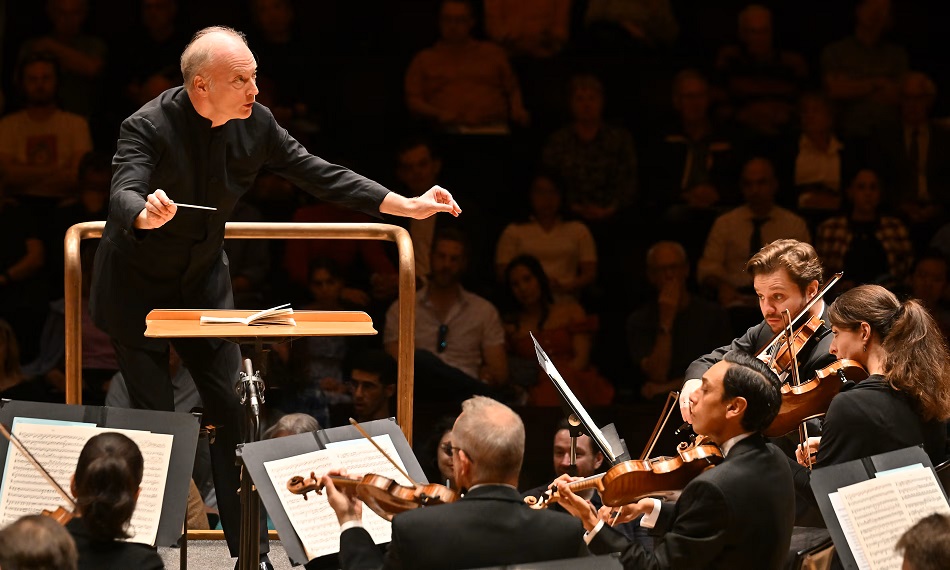
The London Symphony Orchestra and their principal guest conductor Gianandrea Noseda continued their Prokofiev symphony cycle with the elusive Seventh, prefaced by one of Beethoven’s four operatic overtures and a finally realised UK premiere.

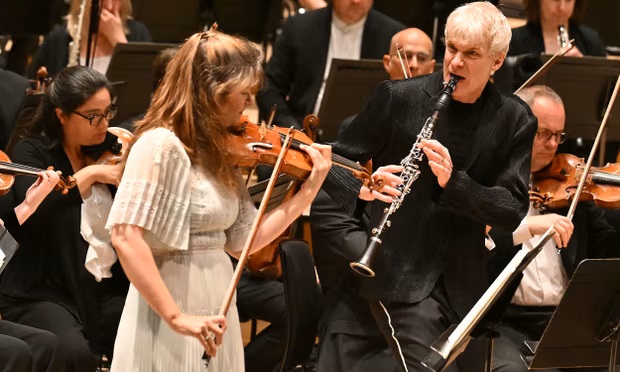
This was Distans, a co-commission between four orchestras for Sally Beamish to write a concerto for the unusual combination of clarinet and violin. Its first performance was delayed due to the pandemic, which became the inspiration for the content of the work. Themes of separation run through the three movements, drawing on the composer’s Swedish and Scottish connections. Separated from her children during lockdown, Beamish also used the forceful musical personalities of soloists Martin Fröst and Janine Jansen (both above) for inspiration.

The two began offstage, however, beckoning to each other across the Barbican Hall as Calling, the first movement, took shape. This was named in the concert notes as ‘kulning’, “the high-pitched singing of women calling the calls on remote pastures”. Beamish’s wide-angle musical lens produced an effective and touching first paragraph, the soloists eventually united on stage in music of the dance, evoking a Swedish fiddle with the full weight and energy of the orchestra in support.

Echoing, the slow second movement, explored more intense feelings of isolation through beautiful scoring, earthy cellos and metallic percussion casting a rarefied light suggesting a Swedish winter. The third movement, Journeying, was powered by an ancient march, the soloists together in spirit and melody, out in the elements with the orchestra. Although the music of beckoning reappeared, the mood was one of reunification, the soloists now at peace and content to remain on stage.

Distans made a strong impact in the hall, and Beamish’s writing for clarinet in her first major piece for the instrument made the most of Martin Fröst’s extraordinary breath control and agility. Jansen also fully inhabited the spirit of the piece, though her part often felt within that of the clarinet, and rarely used the high register. This was definitely a work to hear again, for Beamish’s sound world is a very attractive one in concert.

After the interval, Prokofiev’s Seventh Symphony was given an affectionate performance, yet one that also found the darkness lurking within. One of Prokofiev’s final works, the Seventh was written for the Soviet Children’s Radio Division, and as a result adopts a youthful stance, with commendably little room for nostalgia. Instead the composer gets up to his characteristically witty tricks, with inventive scoring enjoyed by the orchestra as woodwind doubled in octaves, and the piano and harp supplemented lower strings.

The music danced, a reminder of Prokofiev’s balletic qualities. The second movement Allegretto had poise in its first tune but a heavier swagger in the second, suggesting the unpredictable movements of older age – though an impressively powerful and assured close was reached. The following Andante enjoyed rich string colours, together with brilliant individual characterisations from oboe (Juliana Koch) and cor anglais (Clément Noël).

Yet the abiding memories came from two themes used in the outer movements. The first, a sweeping unison for orchestra, lovingly recreates the key and spirit of the composer’s first piano concerto, one of his greatest early successes – and was delivered with great charm here. The second, a cautionary motif from flute and glockenspiel resembling a ticking clock, returned like a regretful memory at the end – reminding this listener of an equivalent moment in Shostakovich’s last symphony, completed nearly 20 years later. It ended this performance on a thoughtful note, in spite of the exuberance that had gone before. The LSO were excellent throughout, presenting a convincing case for the Seventh as a bittersweet triumph, and reminding us in the process of Prokofiev’s abundance as a melodic composer.

Meanwhile Beethoven’s Leonore Overture no.3 began in a more desperate mood of resignation, the opera’s main character Florestan losing all hope in prison. Noseda – fresh from recording a symphony cycle with the National Symphony Orchestra in Washington – has very strong Beethovenian instincts, and paced this just right, with an appropriate hush falling over the hall. As the drama heightened, and an evocative offstage trumpet beckoned, the release from prison led to an outpouring of joy, sweeping us up in its forward momentum. The players were off the leash, enjoying every second.

You can find more information on further 2023/24 concerts at the London Symphony Orchestra website

Published post no.2,216 – Friday 21 June 2024

New music – BUNKR: Ceres Outpost (VLSI)

by Ben Hogwood

BUNKR, an electronic musician whose first two albums have been greatly appreciated on these pages, is back with a third album.

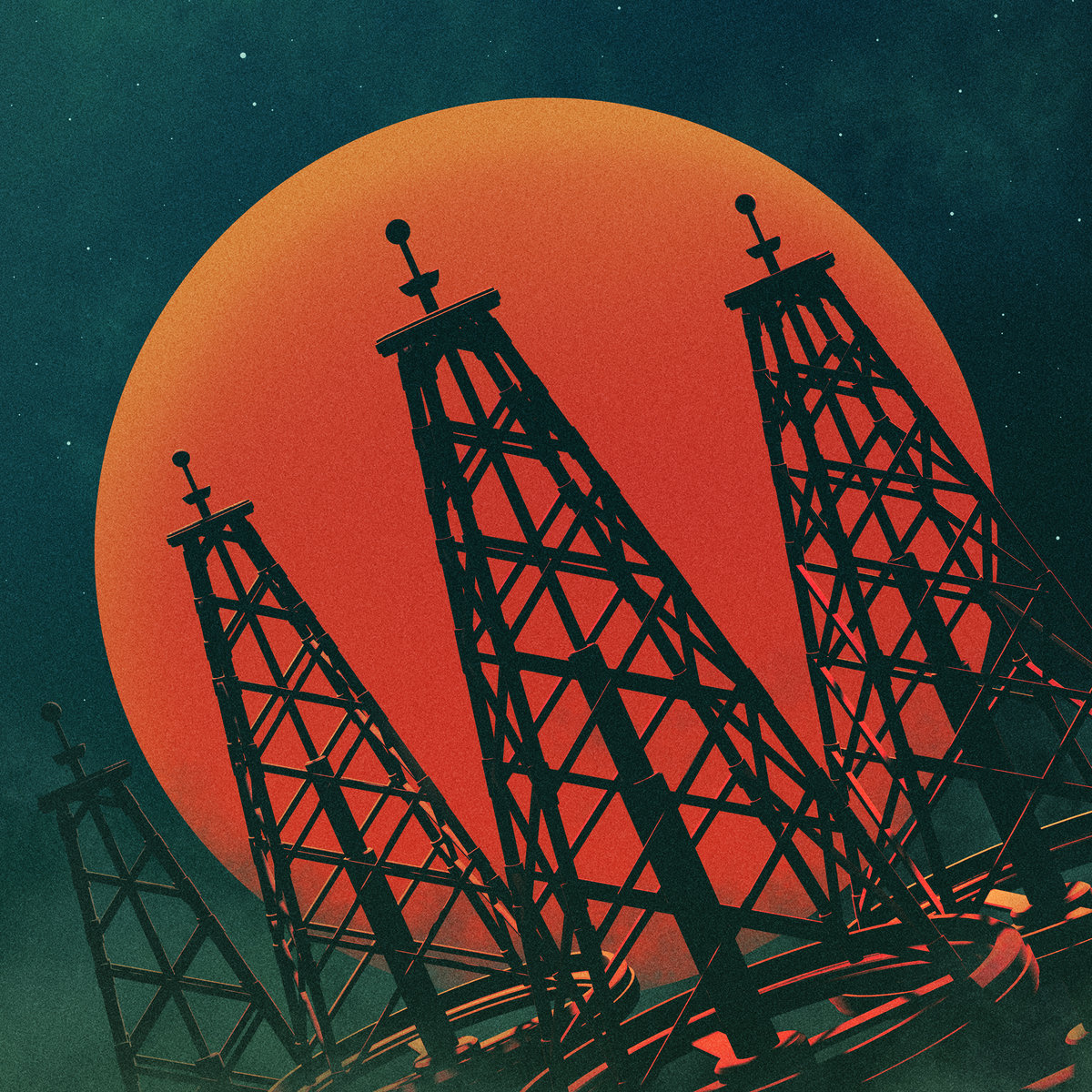
Antenne is due on Friday 28 June – and if you head on over to Bandcamp on the page below you can hear the first excerpt from it, Ceres Outpost. The signs are good for a quality third opus! Keep coming back here to find out more in the next 10 days…

Published post no.2,215 – Thursday 19 June 2024

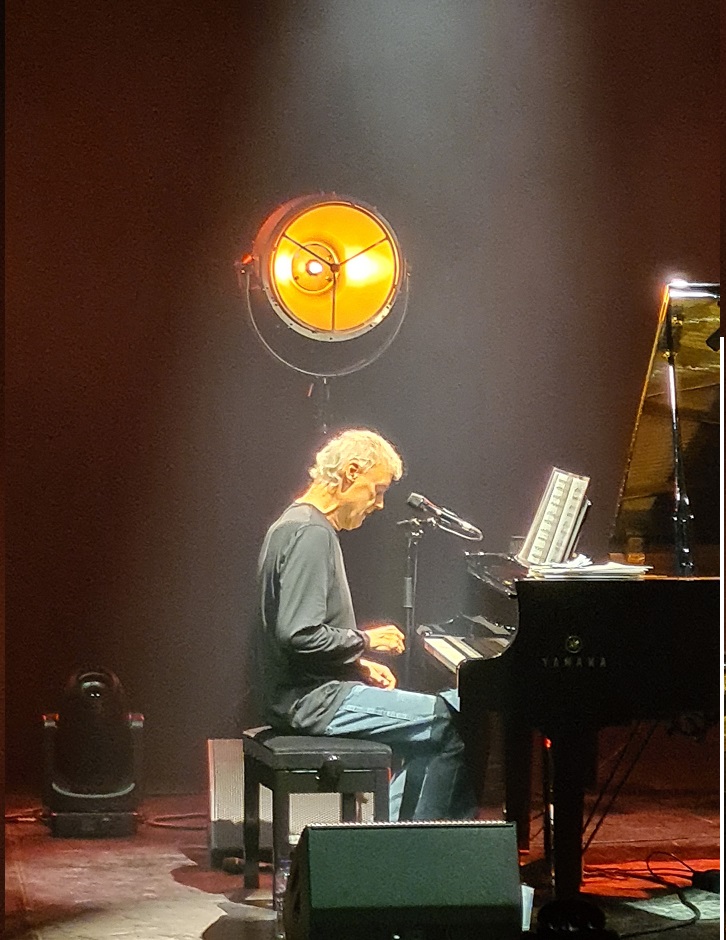
In concert – Chaka Khan’s Meltdown: Bruce Hornsby @ Royal Festival Hall

Bruce Hornsby (vocals, piano), Olivia Chaney (vocals, harmonium)]

Royal Festival Hall, London
Tuesday 18 June 2024

Reviewed by Ben Hogwood Photos (c) Ben Hogwood

Bruce Hornsby likes to challenge his audience. When I was fortunate enough to interview him for musicOMH, he went into some detail – with great feeling – about how the gig experience should not be a mere reproduction of his recorded output.

In reality, the opposite is the truth. While he presents his best-known material, he coats it in new clothes, pairing it in some cases with modern classical piano works. Ligeti, Webern, Elliott Carter and Schoenberg all make themselves known in the course of this solo piano set, their chromatic compositions a direct contrast to the pop songs with which they are juxtaposed.

Hornsby is a natural raconteur in between, his stories told with a glint in the eye but also with a good deal of meaning and emotion. The piano is his closest relative, for sure – and the feeling is that not a day goes by without Hornsby spending at least a few hours seated at the keyboard. Watching this gig is akin to eavesdropping on a practice session in the room next door. Sure, there are some rough edges, but they are all part of the charm – moments where the voice has to travel higher than it might normally go, or where there are too many notes to fit into the available meter at the end of a particularly fulsome improvisation.

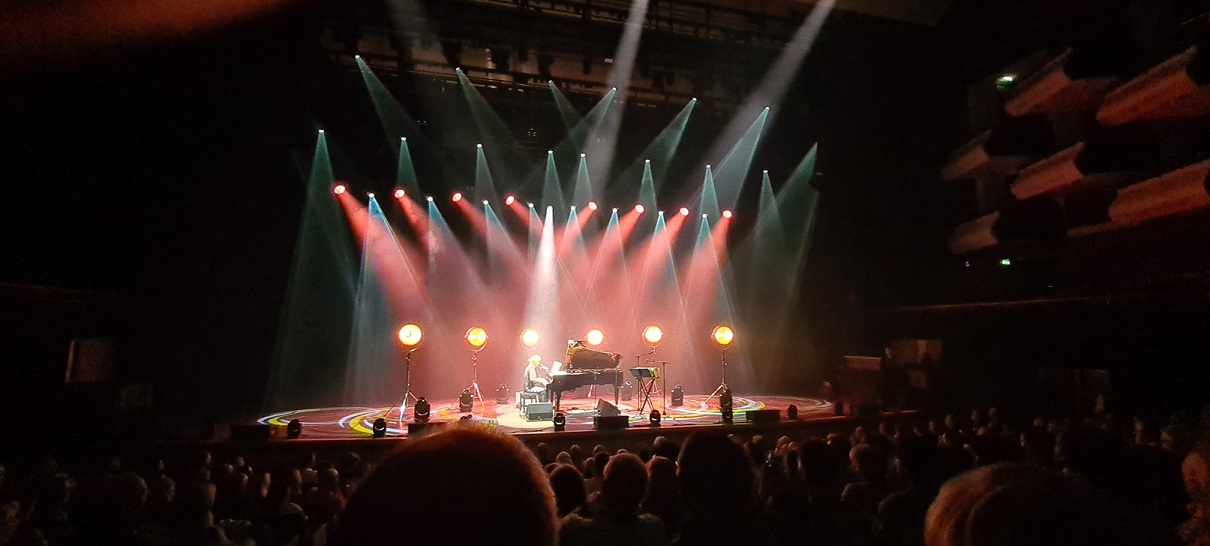
For these performances are very much in the moment, and for that the audience is grateful. The Royal Festival Hall stage is an oversized living room, the audience effectively sat around the fire as the host tells his musical stories. The narration is kept brief, as the generous host ‘only has 90 minutes’ in which to fit the music he wants to play.

Ten minutes in and we have already had our money’s worth, in the form of elegant versions of Days Ahead and Soon Enough. In these songs Hornsby uses the piano as a miniature orchestra, creating colours through the unusual density of the left-hand part but giving us memorable melodies and lyrics too. The voice is in good shape, the piano even more so.

Cast-Off is the first to showcase his more recent musical directions, the co-write with Bon Iver’s Justin Vernon a humourous tale of a man addicted to break-ups but one with a lingering sadness. The melodic profile is now angular, but the tunes still make sense, while the harmonies strain at the leash leaving their audience behind.

At times it seems Hornsby is determined to challenge and even rile the audience, with provocative one-liners and musical about-turns. The Way It Is now comes without its principal riff – but it still reaches deep into the soul, a moment for the audience to think and check themselves, assess their life direction even. It remains a special song, one of the ‘80s best, and the mark of a good song is that it can work in several guises. The same can be said for The End Of The Innocence, a Hornsby composition for Don Henley, which by its end inhabits the air of a Brahms intermezzo.

The co-writes are a source of constant surprise and wonder. There are songs written with Chaka Khan (the moving Love Me Still), performed with Sting, Eric Clapton and Bruce Springsteen (Halcyon Days), or with Elton John (Dreamland), where the piano line is recognisably the work of Hornsby.

He sings affectionately of his son’s dislike of school (Hooray For Tom) and ventures into ‘the curiously American genre of the murder ballad’ for the Pat Metheny collaboration Country Doctor, where wondrous things happen beneath the floorboards – aka the piano’s lowest register. This is the song with the most rhythmic drive.

At two points in his set Hornsby is joined by fellow singer-songwriter Olivia Chaney, who also plays harmonium. Their version of The Pogues’ Fairytale In New York is on the quaint side, and feels under rehearsed, but works thanks to the musicianship on show, even if the harmonium is low in the mix. Balance is restored for Mandolin Rain, one of the best songs on show, where Hornsby’s deadpan emotional guard almost slips.

He is a true entertainer, able to get the crowd eating out of his hand while they marvel at the skill and guile of a performer who has not yet been fully appreciated in his time. Fifteen albums into his career, Hornsby is more adventurous on his approach to 70 than he ever has been, set to challenge his audience even further with time. More power to his elbow, for a great pianist such as him deserves this stage on a much more regular basis. The crowd, discussing a memorable night, would surely agree.

Published post no.2,214 – Wednesday 19 June 2024