BBC Proms 2023 – Kirill Gerstein, Rundfunk-Sinfonieorchester Berlin / Vladimir Jurowski: Weill, Adès & Rachmaninoff

Prom 60 – Kirill Gerstein (piano), Berlin Radio Symphony Orchestra / Vladimir Jurowski

Weill Kleine Dreigroschenmusik (1928, arr. 1929)
Adès Piano Concerto (2018) [Proms premiere]
Rachmaninoff Symphony no.3 in A minor Op.44 (1935-6, rev. 1938)

Royal Albert Hall, London
Thursday 31 August 2023

by Richard Whitehouse photos by Andy Paradise / BBC

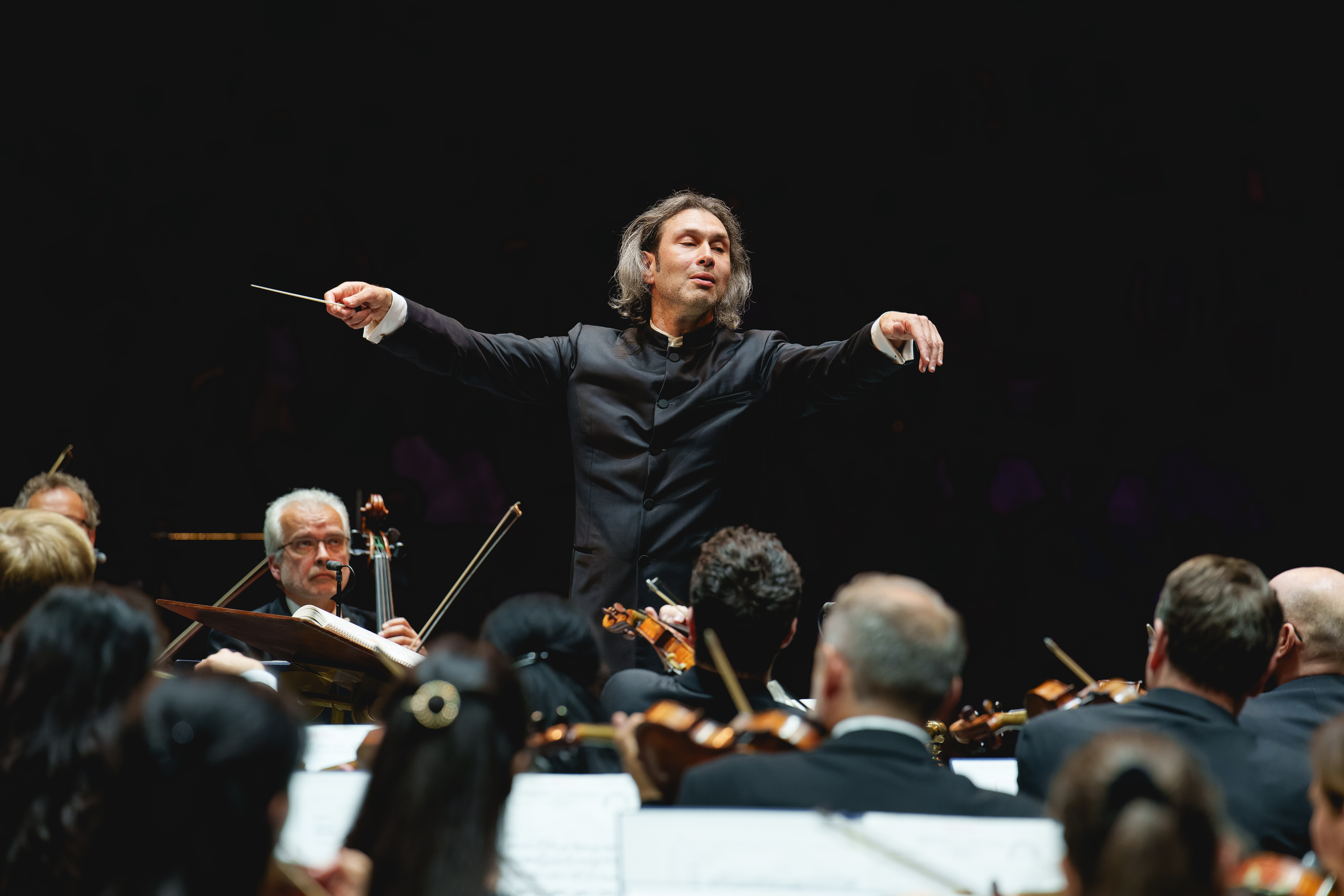
Marking its centenary this October, the Berlin Radio Symphony Orchestra may be less known abroad than other Berlin orchestras but this Proms debut under chief conductor Vladimir Jurowski confirmed an ensemble at home across the broad range of modern and contemporary music.

Not least in Little Threepenny Music, a ‘selection’ Kurt Weill arranged from his and Bertold Brecht’s reworking of The Beggar’s Opera which takes in several of that show’s best-known numbers while also affording a demonstrable overview of its satirical concerns. The BRSO responded with vigour and not a little pathos – above all, in the Threepenny Finale and its juxtaposing pensive ambivalence with a glowering decisiveness: that final chorale making plain its damning inditement of German cultural failings in the era of the Weimar Republic.

A spirited participant, Kirill Gerstein took centre-stage for the first hearing at these concerts of the Piano Concerto written for him by Thomas Adès. Now as before, Gerstein’s dexterity in negotiating this score’s pert amalgam of intricacy and bravura warranted respect: whether in what might be called the ‘Self-Portrait with Gershwin and Ligeti (though Prokofiev is also there)’ of the first movement, Stravinskian cortège of the central Andante, or the interplay of vivacity and uncertainty in the final Allegro. An attentive accompanist, Jurowski summoned playing as tensile and supple as the orchestral writing demands – though abetting the overall impression (his recent works in particular) that even as consummate a conceptualist as Adès needs to instil those ideas, often arresting in themselves, with comparable musical substance.

Gerstein’s transcription of Rachmaninoff’s In the Silence of the Secret Night (Op.4/3) duly prepared for the latter’s Third Symphony. First given at the Proms 85 years ago, it still attracts dislike from those who find it a self-conscious update of the composer’s inherently Romantic idiom as well as those who dislike such an idiom in any case. Not that Jurowski’s account brooked any compromise in marrying consistent technical precision to a powerfully shaped conception of music often appealing, frequently intriguing and not a little unsettling.

The stark rendering of its introduction – spectral ‘motto’ then surging tutti – set the course for an initial movement where contrast between expectancy and eloquence came to a head in the development with its anguished fusion between heart and brain. The Adagio unfolded with an almost Sibelian inevitability, not least in the seamlessness by which its outer sections flowed into then out of a central scherzo abounding in that sardonic humour as became a mainstay of Rachmaninoff’s later years. Nor was there anything blandly predictable about a finale whose opening exuberance was ably maintained through a consoling but never wantonly languorous secondary theme, eventually resolving into a coda whose unfolding as a crescendo of activity brought the whole work – and the present reading – animatedly and satisfyingly full circle.

Impressive music-making on all levels and Jurowski further cemented the Proms connection, specifically that between Rachmaninoff and Henry Wood, with the latter’s transcription of the former’s Prelude in C sharp minor Op.3/2) – as tempestuous as it proved exhilarating.

For more on the 2023 BBC Proms, visit the festival’s website at the BBC. Meanwhile click on the names for more information on artists Kirill Gerstein, the Berlin Radio SO and conductor Vladimir Jurowski – and finally composer Thomas Adès

Switched On: Aphex Twin – Blackbox Life Recorder 21f / in a room7 F760 (Warp Records)

by Ben Hogwood

What’s the story?

New music from Aphex Twin always feels like something of an event, and although this EP has been out in the public domain for over a month the music is still well worth stopping to experience and contemplate.

What’s the music like?

This is Aphex Twin somewhere towards his best, writing music packed with incident but somehow finding time for inward-facing ambience. He achieves this balance perfectly on Blackbox Life Recorder 21f, where a particularly busy rhythm track plays pinball around the stereo picture, but a sonorous bass and overarching keyboard line give time and space.

zin2 test5 is a deeply intimate experience, one man and his machine – its introverted chords leaving their mark long after the active rhythm track is stopped. in a room7 F760 uses cowbells alongside the thick, woolly chords, the experience like a plane flying from sunshine into dense cloud and back out again.

The Parallax mix of Blackbox Life Recorder 21f brings out the fatter low notes, introducing more of a sci-fi feel.

Does it all work?

It does – and all easy on the ear for an Aphex Twin release. Or should that be uneasy? For beyond the ambience lurks a little dread.

Is it recommended?

It is – typically thought provoking work from one of Britain’s finest electronic music makers.

Listen

Buy

Let’s Dance – Simon Field: Need No Music (Basement Records)

by Ben Hogwood

What’s the story?

Oslo-based producer Simon Field has shown a versatility in several dance music forms, based on house music – which, as he says, ‘is a feeling’.

To that end he delivers the packed album Need No Music, exploring deep, disco-infused house music that puts the beats first.

What’s the music like?

Field knows how to work his house music, using a tried and tested ‘less is more’ technique to get maximum dancefloor movement.

The vocals are well chosen too – the likes of Gack Gack (Get Down) are also refreshingly raw, bringing in the essence of early Chicago house to contemporary beats in a way Paul Johnson used to achieve, while Calling reaches for the roof with percussion in tow. The rolling undercarriage of A Thing works a treat, the bass of Diamond cuts deep while Es Vedra brings the heat, panning out to see the haze on the horizon.

There is also an excellent collaboration with Blichfeldt, 10 Minutes.

Does it all work?

It does. Field plays to his crowd, giving them the beats, riffs and good times they want – consistently hitting the spot.

Is it recommended?

It is – Simon Field’s album will keep party season going long into September and beyond.

Listen & Buy

You can explore options for Need No Music on Amazon music

BBC Proms 2023 – Jon Hopkins with the BBC Symphony Orchestra and Jules Buckley

Prom 58

Hopkins
ATHOS (arr. Jules Buckley) (BBC Commission, world premiere)
Feel First Life (arr. Peter Riley & Leo Abrahams)
The Wider Sun (arr. Sam Gale)
Singularity (arr. Simon Dobson)
Music for Psychedelic Therapy – excerpt (arr. Peter Riley)
Form by Firelight (arr. Peter Riley)
Luna Moth (arr. Sam Gale)
Collider (arr. Simon Dobson)
Abandon Window (arr. Tom Trapp)
Recovery

Jon Hopkins (piano, programming), Leo Abrahams (guitar), BBC Singers, BBC Symphony Chorus (chorus master David Young), BBC Symphony Orchestra / Jules Buckley

Royal Albert Hall, London
Tuesday 29 August 2023

by Ben Hogwood photos by Mark Allan / BBC

Electronic and orchestral music are more closely related than you might think, with Jon Hopkins a classic case in point. For 15 years, the pianist and producer has been carefully sculpting his music either as a contributor for other artists (King Creosote, Coldplay and Brian Eno to name just three) or making his own, weather-beaten albums. Starting with Opalescent and Insides, these have developed into immersive meditations (Singularity and the most recent long player Music for Psychedelic Therapy) by way of more full-bodied rave music (2013’s Immunity). How, then, does this music hold up in a packed and expectant Royal Albert Hall?

Extremely well as it turns out. In order to achieve what he described beforehand as ‘a meditation for 5,000 people’, Hopkins has to temporarily turn his back on beat-driven, post-rave landmarks such as Collider or Form By Firelight. When such material appears, its percussive impact is modified so that the main job is done by the timeless, meditative chorale echoing around the hall.

Hopkins’ music is repetitive, but as with the best exponents of minimalism – Steve Reich, Philip Glass and John Adams, for instance – the material under repetition rewards the investment made. The mind is eased, enjoying the upfront melodies but also taking up the option of picking out new threads beneath the surface, like examining a tartan pattern under a magnifying glass.

The tartan analogy is purposeful, for Hopkins’ earlier music has a distinctive Celtic edge furthered by his work with King Creosote. The Wider Sun, from 2009 album Insides, has an authentic left of centre tuning, is slow but packs emotional heft, beautifully arranged by Sam Gale and masterfully weighted by Jules Buckley and the BBC Symphony Orchestra strings.

Before that we hear a new piece, the 25-minute ATHOS demonstrating Hopkins’ control of larger structures. This is a natural direction for his music to be taking after Music for Psychedelic Therapy, for it is effectively an album ‘A’ side of several interwoven tracks. The profile and material of ATHOS sits closely to composers such as Arvo Pärt, and in particular his Credo, but Hopkins has up his sleeve a number of heart-shifting modulations. Accentuated by the Royal Albert Hall organ, these are once heard, never forgotten moments.

So, too, are the choral passages, thanks to pinpoint interpretations from the BBC Singers and BBC Symphony Chorus, whose lines float effortlessly above the orchestral forces. Their vocal control is masterful and effortless, ensuring the sustained notes keep their emotional impact without wavering. Lesser singers would have tailed off long before these ones even think of blinking!

The sequence of music, running for approximately 75 minutes, is well chosen. Only on occasion does the source material become oversimplified, and as it turns out these moments serve as natural pauses for breath in the musical tapestry.

Guitarist Leo Abrahams, appearing for the last two numbers, makes a critical contribution (above). A good friend and established collaborator with Hopkins and Eno, he brings a sharper timbre to the shredded distortion of Recovery, which is – as throughout – complemented by imaginative and sympathetic lighting.

This was a multisensory Prom, containing a different sort of symphony to which the Royal Albert Hall is normally accustomed. Hopkins has proved his credentials in mastering larger structures, and his development in this field will be worth watching for sure. For now, the afterglow remains.

For more on the 2023 BBC Proms, visit the festival’s website at the BBC. For more on the artists, click here to read about Jon Hopkins, Leo Abrahams, Jules Buckley and the BBC Symphony Orchestra

On Record – Laura Groves: Radio Red (Bella Union)

by Ben Hogwood

What’s the story?

This is the first album Laura Groves has released under her own name. Previously known as Blue Roses, the singer-songwriter marked her move to the Bella Union label with a fresh album of songs recorded with multi-instrumentalist Ben Reed.

The album’s name derives from the two radio transmitting towers near where Groves’s studio is based. The track titles and lyrical content take communication as their theme, providing helpful metaphors for relationship-fuelled feelings with those close by while also noting the interference threatening those connections.

What’s the music like?

There are some beautifully written songs here. The first thing to note is the vocal delivery, for Groves has a naturally appealing voice. To use an old cliché, she could sing the phone book and hold an audience – but when the lyrical content is laden with emotion, as it is here, then the songs are even more meaningful.

Sky At Night sets an airy scene, starlit but with a lingering darkness behind the upward looking melody, which explores the very top of Groves’ range. Good Intention is similarly descriptive, with bittersweet tales of love and vulnerability that extend through the album. This track and D 4 N feature the complementary tones of Sampha, whose rounded timbre is an ideal foil, the latter a lush duet.

At times Groves bursts with positivity, but there is an undercurrent of frustration too, with missed opportunities and misunderstandings. “Can we just get on with it, I’ve got a lot to give!” she sings on I’m Not Crying. There is a strong pull to the yearning Sarah, missing its subject with the line “I hope you’re doing fine”. Time, is irresistible, its winsome melody softly delivered, while in Silver Lining the album has a dreamy coda with underlying resolve.

Does it all work?

It does. The careful shading of the production on this record gives the vocals the ideal platform from which to make maximum expression – which brings parallels with the much-loved Scottish band The Blue Nile to mind. As with them, less is most definitely more.

Is it recommended?

Yes – provided you give it time, Radio Red will have you under its spell by the third listen.

Listen

Buy