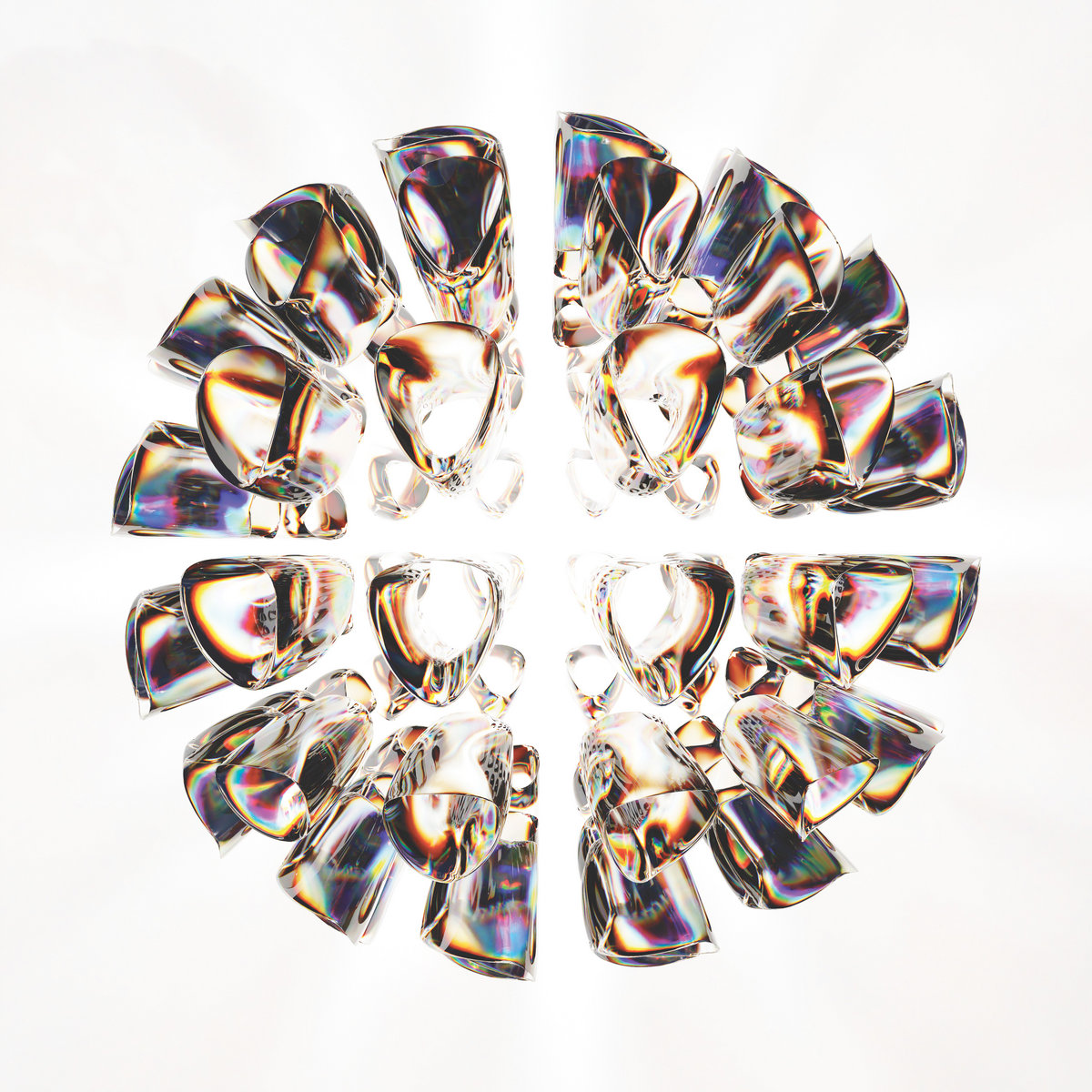
There is no sub plot to Crystal Vision, Nathan Fake’s sixth album.
The Norfolk-based producer describes his approach as “music for music’s sake – recorded without angles, agendas and themes”. This means a continuation of his energetic electronica, creating powerful minds-eye visions with its bold colours and busy rhythms.
What’s the music like?
Crystal Vision pulses with energy. The music here often feels like part of a bigger machine, especially in the cymbal-rich percussion, which on tracks like Boss Core feels like some sort of euphoric process, the repetitive motion of its beats leading to greater highs.
Vimana is a bracing and colourful track, using its synths to trace bright lights across the sky. Bibled grows inexorably over a thudding breakbeat, while the urgency of Hawk also whips up a storm, while uncannily describing its subject matter.
Wizard Apprentice gives an appropriately cool vocal to The Grass, while the closing Outsider is a busy and rewarding collaboration with Clark that takes a restless, probing single line and spins it out across an urgent beat and a wide sonic panorama, the music becoming ever more dense and thrilling as it progresses.
Does it all work?
Yes, it does – fulfilling Fake’s promise that the music is there for its own sake, creating positive energy and thoroughly rewarding experiences.
Is it recommended?
It is indeed, enthusiastically so – a strong addition to what is now a formidable discography.
Don Banks Horn Trio (1962) a Five North Country Folk Songs (1953) b Prologue, Night Piece and Blues (1968) c Three Studies (1954) d Piano Sonatina in C sharp minor (1948) e Violin Sonata (1953) f Tirade (1968) g
(bg) Jenny Duck-Chong (mezzo-soprano), (c) Francesco Celata (clarinet), (a) Robert Johnson (horn), (af) Ole Böhn (violin), (d) Geoffrey Gartner (cello), (g): Rowan Phemister (harp), David Kim-Boyle (siren), Alison Pratt, Daryl Pratt, Joshua Hill (percussion), Daniel Herscovitch (piano)
Toccata Classics TOCC0591 [81’34″]
Producer David Kim-Boyle Engineer David Kinney
Recorded (cdf) 21 September (ag) 24 September and (be) 5 November 2020 at Recital Hall West, Conservatorium of Music, Sydney
Reviewed by Richard Whitehouse
What’s the story?
Toccata Classics provides a strong case for the greater recognition of Don Banks (1923-80) with this release of a representative cross-section of vocal and chamber works, performed by Australian and Australia-based musicians who are never less than empathetic with his music.
What’s the music like?
Wholly neglected following his untimely death, Banks was a senior figure in the generation of Australian composers – featuring such as Malcolm Williamson, David Lumsdaine and Nigel Butterley – who posited a decisive if hardly uniform course for the country’s music during the post-war era. Based in London for two decades, he made a living through teaching (notably at Goldsmith’s College) or writing music for horror films (notably Hammer productions), while evolving an increasingly personal language which can be heard in those works included here.
Earliest is the Piano Sonatina whose three movements – an agile Allegro, pensive Largo that nimbly amalgamates elements of fugue and chorale, then an impulsive Risoluto – constitute no mean statement of intent. It was the Violin Sonata which Banks considered his Op. 1, its pithy if contrasted ideas drawn into intensive development that effortlessly sustains a single movement whose 15 minutes seem never less than eventful. More unexpected is his identity with traditional sources in Five North Country Folk Songs (written for Sophie Wyss no less), whose piano accompaniments enhance the sentiment of each text with deadpan humour and audible affection. Reflecting his time spent with Dallapiccola (and, by extension, Webern), Three Studies for cello and piano applies its serial thinking both deftly and resourcefully.
By the 1960s, Banks had fashioned an idiom that was demonstrably but never slavishly of its time. One of the finest instances is the Horn Trio that, for all its inherent abstraction, pursues a tangible emotional trajectory from its forceful opening Allegro, via an Adagio of no mean eloquence, to a final Moderato in which the work’s arresting slow introduction is transformed through hunt-like gestures. Conversely, Prologue, Night Piece and Blues for Two underlines his love for jazz and its deployment within a ‘third stream’ context; here, the music’s restraint affords a sultriness alluring and ominous. Tirade could hardly be more different – its setting of Peter Porter’s impassioned poem on the increasing commercialization of Australian culture notable for a virtuoso vocal part and its imaginative writing for a sizable array of percussion.
Does it all work?
Almost always. Banks took a compositional path that assuredly takes no prisoners, yet which is rarely less than engrossing and, on occasion, affecting. Almost all these pieces would stand up well in recital today, not least for the opportunities they provide to enterprising performers. Other than the concertos for horn and violin (Lyrita), few of his major works are available in modern accounts, and if Toccata could undertake or even licence recordings of his orchestral Divisions or such cross-genre conceptions as Nexus and Meeting Place, so much the better.
Is it recommended?
Very much so. These performances, rarely less than authoritative, are heard to advantage in a spacious but never diffuse ambience. Daniel Herscovitch contributes detailed and informative annotations, and this release hopefully marks a first stage in the rediscovery of a major figure.
Listen & Buy
For buying options, and to listen to clips from the album, visit the Toccata Classics website. For more information on Don Banks, click here
Enescu Romanian Rhapsody no.1 in A major Op.11/1 (1901, arr. 1957) Impressions roumaines (1925, arr, 2008) Sonata Torso in A minor (1911) Impromptu concertant in G flat major (1903) Regrets in G flat major (1898, compl. 2018) Adagio in B flat major Op.3/3 (1897, arr. 1929) Valse lente ‘L’Enjôleuse’ (1902) Caprice Roumain (1925-49, compl. 1994-6)
Sherban Lupu (violin) with Viorela Ciucur (piano); Sinfonia da Camera / Ian Hobson (Caprice Roumain), Ian Hobson (piano, Romanian Rhapsody)
Toccata Classics TOCC0647 [72’52″]
Producers / Engineers Florentina Herghelegiu, Christopher Ericson (Romanian Rhapsody), Jon Schoenoff (Caprice Roumain)
Recorded 7-8 April 2022 at George Enescu Auditorium, University of Music, Bucharest, 2 February 2001 at Krannert Center for Performing Arts, Urbana, Illinois (Caprice Roumain), 15 March 2004 at Krannert Art Museum, Champagne Illinois (Romanian Rhapsody)
Reviewed by Richard Whitehouse
What’s the story?
The expansion and enrichment of George Enescu’s catalogue has been in progress for several decades. Toccata Classics now issues a follow-up of works realized by others, posthumously published or performed in unfamiliar arrangements, all featuring the violinist Sherban Lupu.
What’s the music like?
Enescu’s early output charts a steady incline from precociousness to mastery, evidenced by the melodic poise of the Adagio from his First Piano Suite arranged by violinist Sandu Albu, or a fragmentary transcription of the bittersweet piano waltz Regrets as completed by Lupu. L’Enjouleuse might well have been a hit had its composer chosen not to publish it under the pseudonym ‘Camille Grozza’, its smouldering pathos in contrast to the objectified elegance of Impromptu concertant which was intended as a test-piece for the Paris Conservatoire.
Much the most significant among these earlier items, Sonata Torso belongs to a sequence of unfinished or unpublished pieces from between the First and Second Symphonies (1905-12) that find Enescu reassessing and extending his musical idiom. For all its prolixity, as would have made further movements unfeasible, this yields a wealth of tonal and harmonic incident within its rarefied ambit. Realized by Lupu from extensive sketches, Impressions roumaines makes for an invigorating entrée into the Third Violin Sonata for which this was preparation.
Lupu was also the catalyst behind Caprice Roumain on which Enescu intermittently worked for almost a quarter-century and the nearest he came to a violin concerto in his maturity. As completed by Cornel Țăranu, its compact design takes in a sombre and often ominous initial Moderato, a lightly sardonic scherzo modelled on the hora, a Lento of understated eloquence then a final Allegro whose synthesis of folk and art elements resembles Bartók in procedure if not aesthetic. Happily, this realization is increasingly being taken up by younger violinists.
Opening the collection with the First Romanian Rhapsody might seem unnecessary given its popularity over more than 120 years, yet this arrangement by composer and violinist Marcel Stern remains little known despite being published 65 years ago. The initial stages faithfully recreate the instrument interplay of Enescu’s original, and though the heady continuation can only hint at its scintillating orchestration, what results is a bravura concert-piece in its own right. Duo partnerships everywhere could do worse than try out this version in their recitals.
Does it all work?
Pretty much. This is a collection which, drawn from various sources and recorded at several locations, is given focus by the commanding presence and unstinting advocacy of Lupu. His playing may not be technically immaculate, though it does convey the essence of Enescu’s increasingly personal language; not least in Caprice Roumain, which he previously recorded with Cristian Mandeal (Electrecord) and to which this is a more than worthy successor. Ian Hobson’s credentials in Enescu hardly need restating, and neither do those of Viorela Ciucur.
Is it recommended?
Yes. Those who are primarily interested in the Caprice should investigate David Grimal’s superb account with Les Dissonances (La Dolce Vita) but this release, enhanced by detailed notes from Valentina Sandu-Dediu, makes a valuable addition to the Enescu discography.
Antisphere (BBC Philharmonic Orchestra / Vimbayi Kaziboni) Producer Matthew Bennett, Engineer Stephen Rinker Recorded 29 November 2022, Bridgewater Hall, Manchester
sphere (BBC National Orchestra of Wales / Mark Wigglesworth) Producer Dean Craven, Engineer Stephen Rinker Recorded at the Aldeburgh Festival, 23 June 2018, The Maltings, Snape
Compass (Julian Warburton (percussion), Birmingham Contemporary Music Group / Gabrielle Taychenné) Producer & Engineer David Lefeber Recorded 4 December 2022, Royal Northern College of Music, Manchester
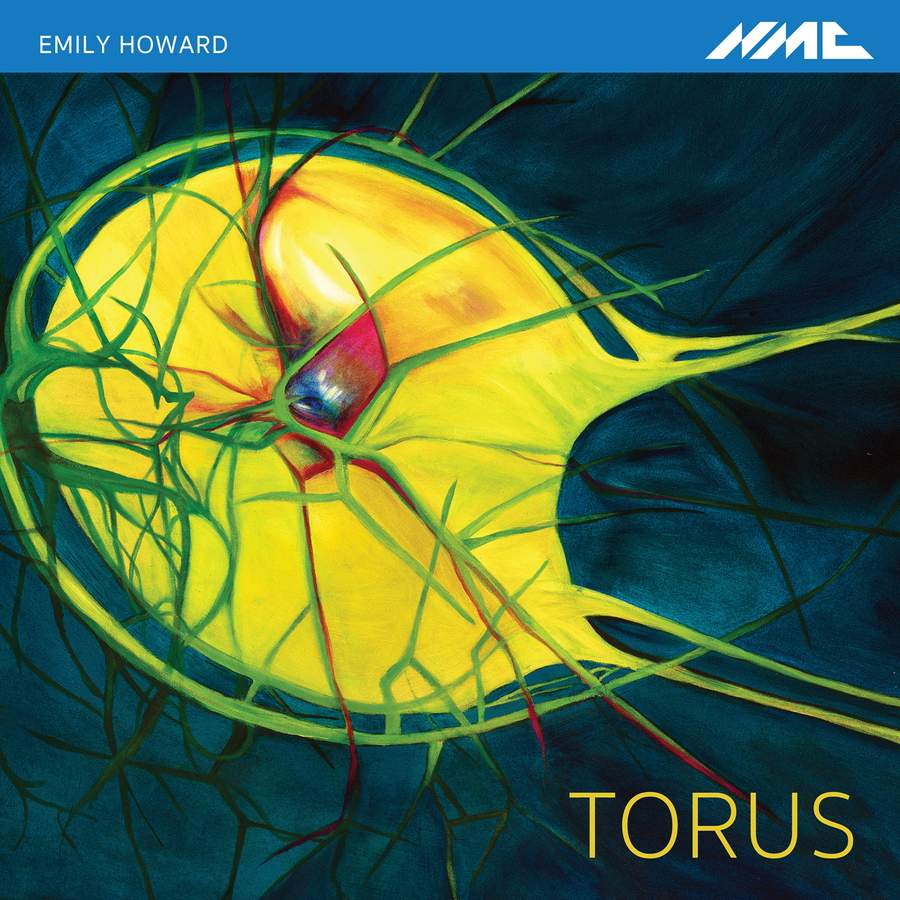
Torus (BBC Symphony Orchestra / Martyn Brabbins) Producer Ann McKay, Engineer Christopher Rouse Recorded 11 November 2019, Barbican Hall, London
NMC Recordings D274 [68’58″]
Reviewed by Richard Whitehouse
What’s the story?
NMC releases a second collection of music by Emily Howard – now in her early forties and established among the most distinctive while forward-looking composers of her generation, heard in scrupulous performances by a notable line-up of British orchestras and ensembles.
What’s the music like?
Few world premieres from recent years have left an impression comparable to that of Taurus at the Proms in 2016. Its appearance, moreover, marked a further stage in an evolution which had commenced just over a decade earlier and has continued apace, with major commissions from British and European organizations. This has been paralleled by Howard’s commitment into researching the intrinsic properties of sound, most recently via the Centre for Practice & Research in Science and Music (PRiSM) at Manchester’s Royal Northern College of Music.
As it now stands, Torus is the first part in an informal trilogy of pieces collectively entitled Orchestral Geometries. It evolves along the perceived trajectory of a doughnut-shaped ball whose central void is crucial to music evoking absence as much as presence. Not that a work subtitled Concerto for Orchestra could be found lacking in either immediacy of content or virtuosity of gesture, which qualities come demonstrably to the fore as it unfolds and make for a composition involving in its expressive profile and fascinating in its formal process.
By contrast, Sphere is a succinct yet eventful journey through and around the global shape in question and which, in this context, might reasonably be thought an extra-terrestrial interlude – its ideas pithy while exuding enough potential for their development in subsequent pieces.
This is what happens in Antisphere which forms its conceptual opposite though also its aural continuation, the piece gradually encompassing the ‘sound-space’ through an engrossing and imaginative demonstration of orchestral prowess. Evident too is an increased focus upon the visceral nature of the musical content, likely reflecting a form which can precisely be defined in mathematical terms but remains all but intangible as regards human perception. Fortunate, then, that Howard has been able to render this concept as an emotional and affective whole.
Hardly less absorbing is Compass, the most recent of these pieces. This takes the spatial and nautical connotations of its title as the basis for music which unfolds as a cohesive dialogue between string septet and percussion that complements it and offers contrasts at every turn.
Does it all work?
It does, not least for providing an arresting take on that interplay of ‘heart and brain’ that has been a mainstay of Western music. The cerebral basis of all these pieces may be undeniable, though equally so is the precision of their forms and, above all, the allure of their expression judged intrinsically as sound. Much the same could be said of the music of Iannis Xenakis, the centenary of whose birth was commemorated last year, and whose thinking is continued by Howard from a vantage that is inherently personal while being decisively of the present.
Is it recommended?
It is, not least for its excellent performances by three of the BBC orchestras and Birmingham Contemporary Music Group, with booklet notes by Paul Griffiths and mathematician Marcus du Sautoy. This impressive release reinforces Howard’s significance in no uncertain terms.
All of this was book-ended by two concerts of sacred music broadcast on BBC Radio 3 for Holy Week, both demonstrating what a unique and valuable choir they are.
On 17th March they gave their first concert following the BBC’s shameful axing announcement at St Giles’ Cripplegate in London. It was inevitably a special and emotional occasion. The programme of choral and cello music went under the bitterly ironic title of All Will Be Well (after Roxanna Panufnik’s piece of the same name which concluded the programme). “I’m still the producer of the BBC Singers” said Jonathan Manners in his introduction to much applause.
The concert was a fitting example of the range and depth of the choir’s repertoire in terms of time (it opened with Hildegard von Bingen’s O cruor sanguinis from the 12th Century) and style. It displayed impressively their ability to convey a sense of comfort and balm such as in Lesia Dychko’s short piece Blessed be the name (Emma Tring a beautiful solo soprano) as well something more unsettling like Fac me tecum pie flere by Sven-David Sandström.
But this was a programme of choral and cello music and cellist Benjamin Hughes was individually expressive as well as combining powerfully with the choir, both in evidence in Knut Nystedt’s Stabat Mater.
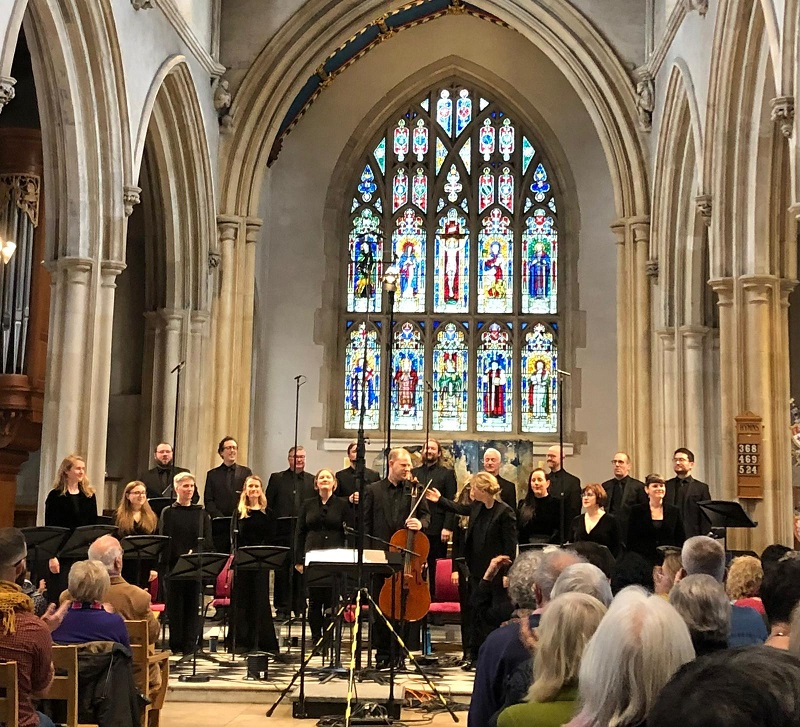
A magnificent encore of Maurice Duruflé’s motet Ubi Caritas was followed by a rapturous and moving ovation (below)
Today, we were joined by cellist @benhughescello and Chief Conductor @sjeannin in a programme for choir and solo cello 🎶
Thank you to all who joined us at a packed out @stgilesc 👏
The concert was recorded for future broadcast, stay tuned for more information 📻 pic.twitter.com/JJcJDh2dX6
Less than three weeks later, and following the BBC statement announcing a suspension of the closure, the group performed a Music for Maundy Thursday concert of sacred pieces on the theme of ‘contemplation, sorrow and reflection’ for live broadcast on BBC Radio 3 at St Paul’s Church, Knightsbridge, London (above).
Yet again the programme highlighted the sweep of their repertoire opening with a meditative motet from the 1590s, Vittoria Aleotti’s Miserere mei, Deus (from the first published book of sacred music by a woman) and also featuring sacred pieces from the 21st Century (Karin Rehnqvist’s I raise my hands and Judith Bingham’s Watch with Me), as well as William Byrd’s 14th Century The Lamentations of Jeremiah.
But there were two pieces where the group really shone to spectacular effect. Domenico Scarlatti’s Stabat Mater à 10, with Richard Pearce on chamber organ, was stunning and utterly compelling in its detailed delivery. Francis Poulenc’s Quatre motets pour un temps de penitence made a glorious finale.
One must also acknowledge the key role of Chief Conductor, Sofi Jeannin, always assured yet empathetic. To watch her conduct is a mesmerising experience in itself.
The extent to which the BBC Singers and Jeannin develop and promote a diverse repertoire (they have a 50:50 gender policy for composers whose music they perform), engage in learning and community work, regularly perform commissions and broadcast on Radio 3 (making their phenomenal output available to such a wide audience) is all part of what makes them so unique.
I have seen them many times over many years and they never fail to move me. These two concerts only served to prove just why they are irreplaceable.
John Earls is Director of Research at Unite the Union and tweets at @john_earls




 Arcana.fm